Isaacman’s Polaris Dawn mission to launch July 31, 2024

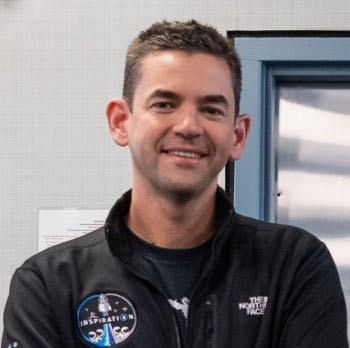
Jared Isaacman
Jared Isaacman

According to a short notice on the Polaris Dawn webpage, Jared Isaacman’s manned orbital mission where he will do the first spacewalk by a private citizen is now targeting a launch date of July 31, 2024.

The four-person mission is planned to spend five days in orbit in SpaceX’s Resilience Dragon capsule, during which it will fly to as high as 870 miles, the highest orbit flown since Gemini 11 in 1966, and the farthest any human has flown from Earth since the Apollo lunar missions. That orbit will make possible some new radiation research:

[T]his is high enough to penetrate the inner band of the radioactive Van Allen Belts that encircle the Earth. This isn’t good for the crew consisting of Mission Commander Jared Isaacman, Mission Pilot Scott Poteet, Mission Specialist Sarah Gillis, and Mission Specialist and Medical Officer Anna Menon, but their initial orbit will be highly elliptical with a lower altitude of 120 miles (190 km), so their exposure will be minimal.

The purpose of this radiological game of chicken is to conduct 38 science experiments to study the effects of spaceflight and space radiation on human health. When these are completed, the altitude for the remainder of the five days in orbit will be reduced to 430 miles (700 km).

Isaacman will then attempt his spacewalk, opening a hatch on Resilience that replaced its docking port. While Isaacman will be the only one to exit the capsule, all four crew members will be in comparable spacesuits, since the capsule has no airlock and thus its entire atmosphere will escape during these activities.

If this mission is successful, I expect Isaacman will renew his push at NASA for making the goal of his next Polaris mission to replace the gyros on the Hubble Space Telescope. At the moment agency officials have expressed skepticism and seem uninterested. That might change however.

7 comments

SpaceX gets NASA contract to launch gamma-ray space telescope

NASA yesterday announced that it has awarded SpaceX a contract to launch a new gamma-ray space telescope, dubbed the Compton Spectrometer and Imager (COSI), using its Falcon 9 rocket and targeting an August 2027 launch date.

The firm-fixed-price contract has a value of approximately $69 million, which includes launch services and other mission related costs. The COSI mission currently is targeted to launch August 2027 on a SpaceX Falcon 9 rocket from Cape Canaveral Space Force Station.

This wide-field gamma-ray telescope will study energetic phenomena in the Milky Way and beyond, including the creation and destruction of matter and antimatter and the final stages of the lives of stars. NASA’s COSI mission will probe the origins of the Milky Way’s galactic positrons, uncover the sites of nucleosynthesis in our galaxy, perform studies of gamma-ray polarization, and find counterparts to multi-messenger sources. The compact Compton telescope combines improved sensitivity, spectral resolution, angular resolution, and sky coverage to facilitate groundbreaking science.

The stated launch price gives us a sense of what SpaceX is charging these days for launches. The contract award also illustrates once again why the delays in developing ULA’s Vulcan and Blue Origin’s New Glenn rockets — caused by Blue Origin’s difficulties in manufacturing its BE-4 rocket engine — has ended up costing both companies a lot of money in sales. SpaceX keeps getting these launch contracts because Vulcan and New Glenn are not yet flying operationally. Vulcan has flown once, but it is probably isn’t capable of adding additional launches to is manifest. More important, the rocket is not yet reusable, and probably could not match SpaceX’s price.

As for New Glenn, it supposedly will make its first launch this fall, but we shall see. It remains four-plus years behind schedule, and though it is described as reusable, its first stage landing vertically like a Falcon 9, it is doubtful it will become doing this on its first launches. It needs to prove out its systems first.

5 comments

SpaceX launches 20 Starlink satellites

SpaceX early this morning launched another 20 Starlink satellites, its Falcon 9 rocket lifting off from Cape Canaveral.

The first stage completed its sixteenth flight, landing on a drone ship in the Atlantic.

The leaders in the 2024 launch race:

70 SpaceX
29 China
8 Russia
8 Rocket Lab

American private enterprise now leads the world combined in successful launches, 81 to 44, while SpaceX by itself still leads the entire world, including other American companies, 70 to 55.

To get a sense of how incredible SpaceX’s launch pace this year has been, those 70 launches, completed in only days more than first half of the 2024, matches the American record for launches in a entire year, that was set in 1966 and remained the record until 2022.

4 comments

SpaceX studying changes to de-orbit procedures for Dragon service module

Because it appears the trunk section of the service module of SpaceX’s Dragon capsules actually survives re-entry, the company is now studying changes to its de-orbit procedures so that it can guarantee that trunk will not crash on land, as has happened now three times in the past two years.

The solution [a NASA official] said NASA and SpaceX are looking at involves changing deorbiting procedures. Currently, the trunk is released before the capsule performs its orbit burn. That means the trunk can remain in orbit for months before making an uncontrolled reentry.

Instead, [that NASA official] said engineers are examining doing the deorbit burn and then releasing the trunk. That would provide more control of where the trunk reenters, ensuring that any debris that survives reentry lands in unpopulated regions.

To make this new procedure work they need to recalculate the fuel requirements for doing the de-orbit burn. It also requires them to figure out when to detach the trunk after the burn. I expect SpaceX to successfully implement these changes before the next Dragon launch, whether manned or unmanned.

5 comments

SpaceX and China complete launches

Both SpaceX and China completed launches in the past 12 hours. First, SpaceX last night launched a package of National Reconnaissance Office reconnaissance satellites, its Falcon 9 rocket lifting off from Vandenberg in California. The first stage completed its eighth flight, landing on a drone ship in the Pacific. The two fairings completed their seventh and thirteenth flights respectively.

Then, early today China launched a new communications satellite, its new Long March 7A rocket lifting off from its coastal Wenchang spaceport. Video of the liftoff can be seen here.

The leaders in the 2024 launch race:

69 SpaceX
29 China
8 Russia
8 Rocket Lab

American private enterprise still leads the world combined in successful launches, 80 to 43, while SpaceX by itself still leads the entire world, including other American companies, 69 to 54.

10 comments

New update on SpaceX’s preparations for future Starship/Superheavy test launches

Link here. Lots of progress described, all suggesting SpaceX continues to target late July for the next test orbital flight. Very much worth reading.

The article repeatedly suggests the work to prepare the launch tower at Boca Chica to catch a returning Superheavy means the next launch will attempt such a catch, but in truth there is no evidence such a thing is planned, other than a single tweet by Elon Musk. As the article finally admits in its next-to-last paragraph,

Starship can now fly missions that have very similar profiles to Flight 4 with the existing FAA license, but a license modification is needed for any catch attempt. If Flight 5 does indeed proceed with a catch attempt at the tower for Booster 12, additional paperwork will need to be filed for this license modification.

I continue to expect SpaceX to propose such a catch on a later flight. The tower work at Boca Chica could be the company doing the necessary work to prove to the FAA that a amended launch license process should be issued, but not for the next flight.

12 comments

Indonesia government offering proposed launch site to SpaceX and others

Indonesia proposed spaceport on Baik

As part of its effort to promote a long term space industry development plan, Indonesian officials have repeatedly been offering a proposed launch site to SpaceX and others on government land on the island of Biak off the coast of New Guinea.

The map to the right shows the location. First SpaceX and China were offered use of Baik. Neither has accepted. Then,

As recently as 2023, BRIN officials promoted their spaceport plans at the G20 Space Economy Leaders’ Meeting and Asia-Pacific Regional Space Agency Forum. China, Russia, Japan, South Korea and India were invited as potential partners, but none signed on.

Meanwhile, the article says Indonesia hopes to launch 19 satellites in 2025, using a variety of commercial launchers.

6 comments

European weather satellite company cancels launch contract with Ariane-6, switches to SpaceX

We now know the reason why an Arianespace official on June 26th demanded new legislation requiring all European payloads to launch on European rockets. Today it was revealed that the European weather satellite company Eumetsat has canceled a launch contract on an Ariane-6 rocket and instead switched to SpaceX’s Falcon 9.

Late yesterday, French news outlet Le Monde reported that the executive committee of Eumetsat, the European meteorological satellite agency, had asked the agency’s board of directors to cancel a contract it signed with Arianespace four years ago to launch its Meteosat MTG-S1 satellite. The mission would have been flown aboard the third Ariane 6 flight, which is expected to be launched in early 2025. The satellite will now be launched aboard a SpaceX Falcon 9 rocket.

Not surprisingly, another French official today — Philippe Baptiste, the head of France’s CNES space agency — once again demanded action to require European companies to use European rockets. In his whining however he revealed an amazing inability to understand why this decision was made.

“How far will we, Europeans, go in our naivety. … I am impatiently waiting to understand what reasons could have led Eumetsat to such a decision at a time [when] all major European space countries as well as the European Commission are calling for launching European satellites on European launchers.”

The reasons why are quite obvious, and if this guy can’t recognize them then there is little hope the European Ciommision will ever figure out how to compete. Not only is the cost for a Falcon 9 launch likely one third that of an Ariane-6, it is a proven launcher. Ariane-6, four years behind schedule, won’t make its first launch until July 9, 2024, assuming all goes as planned. Eumetsat officials probably decided they couldn’t afford the extra cost and risk.

3 comments

Supreme Court to SEC: Use of in-house administrative law judges unconstitutional

SEC: no longer above the law

The Supreme Court today ruled 6-3 that the SEC has violated the Constitution with its use of in-house administrative law judges to rule on its various securities fraud cases.

The agency, like other regulators, brings some enforcement actions in internal tribunals rather than in federal courts. The S.E.C.’s practice, Chief Justice John G. Roberts Jr. wrote for a six-justice majority in a decision divided along ideological lines, violated the right to a jury trial. “A defendant facing a fraud suit has the right to be tried by a jury of his peers before a neutral adjudicator,” the chief justice wrote.

This ruling against the use of administrative law judges has a direct bearing on SpaceX’s own lawsuit [pdf] against the National Labor Relations Board (NLRB). In January the NLRB filed a complaint against SpaceX, accusing it of firing eight employees illegally for writing a public letter criticizing the company in 2022. Rather than fight that complaint directly, SpaceX’s response was to file a lawsuit challenging the very legal structure of the NLRB itself, including its use of administrative law judges.
» Read more

13 comments

SpaceX now valued at $210 billion

As part of another sale of insider shares to raise more private investment capital, SpaceX has now been valued at $210 billion.

SpaceX will sell shares at $112 each in the tender offer, the Bloomberg report said, with the newer sales valuing the company much higher than a $180 billion valuation seen during a tender offer in December.

The report does not say how many shares SpaceX hopes to sell, or how much total new capital it hopes to obtain. Previous such sales have raised a total of $12 billion, money the company is using to develop both its Starlink constellation and its Starship/Superheavy rocket.

0 comments

NASA awards SpaceX $843 million contract to de-orbit ISS

NASA today announced that it has awarded SpaceX a $843 million contract to build a de-orbit spacecraft that can dock to ISS and fire its thrusters so that the station will be safely de-orbited when it is retired in 2030, burning up over the ocean.

While the company will develop the deorbit spacecraft, NASA will take ownership after development and operate it throughout its mission. Along with the space station, it is expected to destructively breakup as part of the re-entry process.

The announcement provided no other details. It is not clear whether the thrusters on a Dragon capsule would be sufficient for this task. Most likely not, which means SpaceX will have to develop something else to do the job. Maybe its bid proposed using a Starship for the task.

It is also not clear whether any modules on ISS will be salvaged for other uses before de-orbit. The modules that the commercial company Axiom plans to attach to ISS in the next year or so are supposed to undock to form its own independent space station sometime later this decade. Will Russia’s modules do the same? And will any other modules?

2 comments

SpaceX launches 23 Starlink satellites, using a first stage for the 22nd time

SpaceX early this morning launched another 23 Starlink satellites, its Falcon 9 rocket lifting off from Cape Canaveral and using a first stage on its record-setting 22nd flight.

That stage successfully landed on a drone ship in the Atlantic. The flight was so routinely boring for the launch crew that the flight director felt no need to even bother having anyone do a T-10 second countdown at launch.

The leaders in the 2024 launch race:

68 SpaceX
28 China
8 Russia
8 Rocket Lab

American private enterprise now leads the world combined in successful launches, 79 to 42, while SpaceX by itself still leads the entire world, including other American companies, 68 to 53.

0 comments

Blue Origin to FAA: Limit future SpaceX Starship launches at Cape Canaveral

Blue Origin has once again decided to use lawfare against SpaceX rather than actually build rockets that are competitive. As part of the process by the FAA to do a new Environmental Impact Statement on SpaceX’s plans for Starship/Superheavy launches at Cape Canaveral, Blue Origin last week submitted its own comment asking the FAA to cap the launches of its competitor, citing environment concerns.

The company recommends the following mitigation method for SpaceX’s Starship launches, prior to the company being issued a Vehicle Operator License:

“Capping the rate of Ss-SH launch, landing, and other operations, including but not limited to test firings, transport operations, and fueling, to a number that has a minimal impact on the local environment, locally operating personnel, and the local community, in consideration of all risks and impacts, including but not limited to anomaly risks, air toxin and hazardous materials dispersion, road closures, and heat and noise generation.”

Along with requesting a max number of Starship launches at the site, Blue Origin argues that the government increase launch infrastructure that opens other launchpads to nearby lessees when roads are forced to be closed for SpaceX launches. The filing also notes that SpaceX has already received environmental testing at its Starbase site in Boca Chica, Texas.

You can read Blue Origin’s full comment here [pdf]. Essentially, Blue Origin is attempting to use this new impact statement to have the federal government damage or destroy its competition.

Musk’s response was a two word tweet: “Sue Origin.”

It is very clear that Jeff Bezos’s company is poorly focused. In the last decade it has built almost nothing, while spending a lot of time filing lawsuits against its competition. This action is simply another example.

Worse, Blue Origin’s comment will provide ammunition for the continuing Biden administration lawfare against Musk and SpaceX, making it difficult for the FAA to approve the impact statement as requested by SpaceX. If so, the development and operational use of Starship/Superheavy will be seriously threatened.

19 comments

Collins reportedly in the process of canceling its NASA spacesuit contract

As if NASA didn’t have enough spacesuit problems, with a ISS spacewalk this week canceled because one of the NASA-built suits on the station began leaking water again, Collins Aerospace, one of the two companies that won contracts to build new spacesuits, is now in negotiations to end that contract.

But Collins’ role in the program has been bumpy and development has fallen behind schedule, and the company has been in talks with NASA officials on how to wind down its role in the program, the two people said. “After a thorough evaluation, Collins Aerospace and NASA mutually agreed to descope Exploration Extravehicular Activity Services (xEVAS) task orders,” a Collins spokeswoman said in a statement, referring to the spacesuit contract.

If this story is confirmed, it means at present only Axiom is building new spacesuits that can either be used on ISS or on future Artemis missions to the Moon and Gateway. Whether NASA will put out the Collins contract for bid again is unknown. In its original cargo capsule contracts early in the 2010s, one company failed to raise sufficient funds to build its capsule, so NASA cancelled it and awarded Orbital Sciences and its Antares rocket and Cygnus capsule the deal.

If the contract is put out for new bidding, SpaceX would be in a very strong position to win, as its own internally financed spacewalk spacesuits are about to get their first flight test on Jared Isaacman’s Polaris Dawn mission on the Resilience Dragon capsule later this summer.

The failure of Collins here is disturbing, and might be an indicator of an overall loss in American engineering capabilities. Once a challenge like this would have posed no problem for any American aerospace company. Now such tasks are increasingly difficult and unachievable.

5 comments

SpaceX’s Falcon Heavy launches NOAA weather satellite

SpaceX’s Falcon Heavy rocket today successfully launched a NOAA weather satellite, completing its first flight in 2024 and its tenth flight overall.

The two side boosters completed their first flight, with both landing back at Cape Canaveral. The core stage was allowed to fall into the ocean.

The leaders in the 2024 launch race:

67 SpaceX
28 China
8 Russia
8 Rocket Lab

American private enterprise now leads the world combined in successful launches, 78 to 42, while SpaceX by itself still leads the entire world, including other American companies, 67 to 53.

7 comments

SpaceX completes two launches today, from opposite coasts

The bunny marches on! SpaceX successfully completed two launches today.

First, its Falcon 9 rocket launched 22 Starlink satellites from Cape Canaveral in Florida. This was the launch that had been delayed several times by weather, and then by a tecnical launch abort at T-0. After several days of review, it lifted in the morning today with no problems, the first stage completing its eleventh flight, landing on a drone ship in the Atlantic.

Then, about ten hours later a Falcon 9 rocket lifted off in the evening Vandenberg in California, putting 20 Starlink satellites into orbit, 13 of which are said to be designed for direct cell-to-satellite capabilities. This first stage also completed its eleventh flight, landing on a drone ship in the Pacific.

This post is a bit late because we had a five hour power outage in my neighborhood tonight, caused apparently when someone drove into a utility pole and knocked it over.

The leaders in the 2024 launch race:

66 SpaceX
28 China
8 Russia
8 Rocket Lab

American private enterprise now leads the world combined in successful launches, 77 to 42, while SpaceX by itself still leads the entire world, including other American companies, 66 to 53.

5 comments

SpaceX announces a mini-version of Starlink designed for backpackers

SpaceX today unveiled what it calls Starlink Mini, a smaller version of the Starlink antenna that can fit inside a backpack.

Early Starlink customers were invited to purchase the Starlink Mini kit for $599, according to an invitation sent to customers and viewed by TechCrunch. That’s $100 more than the standard Starlink kit. They were also given the option to bundle Mini Roam service with their existing service plan for an additional $30 per month, though the data is capped at 50 gigabytes per month.

That would mean a Starlink residential customer on the standard service plan would spent $150 month. SpaceX aims to reduce the price of the kit, it said in the invitation. As of now, there is no stand-alone Mini Roam plan.

The unit weighs only 2.5 pounds, with the first deliveries arriving in July. It is designed specifically for travelers who want a reliable internet connection wherever they go.

4 comments

SpaceX launches commercial geosynchronous satellite for SES

SpaceX today successfully launched a commercial geosynchronous satellite for the Luxembourg company SES, its Falcon 9 lifting off from Cape Canaveral.

The first stage completed its ninth flight, landing successfully on a drone ship in the Atlantic.

The leaders in the 2024 launch race:

64 SpaceX
27 China
8 Russia
8 Rocket Lab

American private enterprise now leads the world combined in successful launches, 75 to 41, while SpaceX by itself still leads the entire world, including other American companies, 64 to 52.

0 comments

Update on SpaceX activities leading to the next Superheavy/Starship orbital test flight

Link here. Lots happening, including fueling and static fire tests of Starship prototype #26 (which will not fly) and major changes on Starship prototype #30, which is slated to make that fifth test flight:

Ship 30 continues to receive upgrades, preparing it for Flight Five. Now, with most of the older tiles removed [18,000 total], new similar-sized tiles are being attached to Ship 30. These tiles could potentially have a different formula, which would make them more resistant to heat while holding a similar size.

Also, an ablative pyron layer is being added to the hot spots where Ship 30 is most likely infiltrated by plasma during entry. Pyron is used in the Falcon 9’s engine bay and is a material that SpaceX knows and trusts.

SpaceX has said it is targeting July for the flight, and the FAA has said the company’s launch license will allow it to launch whenever it is ready, with no FAA red tape to stand in the way.

4 comments

SpaceX launches 20 Starlink satellites

After a ten day pause in launches, which included one launch abort at T-0, SpaceX yesterday successfully launched 20 Starlink satellites, its Falcon 9 rocket lifting off from Vandenberg in California.

The pause is noteworthy because it is possibly SpaceX’s longest pause in launches this year (I haven’t gone back and checked). Consider this fact: A ten day pause between launches would have once been considered a fast launch pace. Now it seems like something is wrong.

The rocket’s first stage completed its fifth flight, landing on a drone ship in the Pacific.

The leaders in the 2024 launch race:

63 SpaceX (with another launch scheduled for later today)
27 China
8 Russia
7 Rocket Lab

American private enterprise now leads the world combined in successful launches, 73 to 41, while SpaceX by itself leads the entire world, including other American companies, 63 to 51.

2 comments
1 31 32 33 34 35 142