
Lawrence of Arabia: Truth is sometimes stranger than fiction
One of the 20th century’s greatest movies is David Lean’s 1962 epic Lawrence of Arabia. The story it tells — of the clash of cultures, of war, and of colonization — combined with the personal story of T.E. Lawrence during World War I, is one of high drama that is unforgettable to anyone who has ever seen it.
Yet, the events it tells seem too dramatic to be believed. Did Lawrence actually rescue a man in the desert, by himself and against the advice of his Arab allies who knew better? Did he actually later execute that man coldly to prevent a tribal war that would have destroyed the Arab revolt against the Ottoman Empire? Did he actually lead those Arab tribes across a deadly desert to take the town of Aqaba from the rear?
And did he actually lead that Arab revolt so successfully that it took Damascus ahead of the British, only to lose it because that medieval tribal culture knew nothing about modern technology?
For years I wondered about these questions and tried to find out. I read T.E. Lawrence’s own memoir of his time there, The Seven Pillars of Wisdom, and found it to be unclear and obscure, answering none of my questions. Other histories about World War I merely touched upon these events, treating them as a minor side show. And histories about the Middle East during that time seemed uninterested in telling this part of the story.
So, the questions remained: Did these events really happen? They seemed too good to be true.
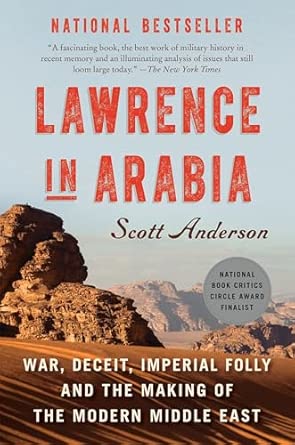
I have now discovered that these stories are not only largely true, the reality of T.E. Lawrence’s life and his time in Arabia was even stranger than I could suppose. I learned this from Scott Anderson’s fine biography of Lawrence, Lawrence in Arabia: War, Deceit, Imperial Folly, and the Making of the Modern Middle East. Anderson not only unveiled Lawrence in all his inexplicable glory in this book, he made clear the complex political background that shaped the Middle East, and made it as we know it today.
» Read more