
The insane terrain inside Mars’ Death Valley

Click for original image.
Cool image time! The picture to the right, cropped, reduced, and sharpened to post here, was taken on October 27, 2025 by the high resolution camera on Mars Reconnaissance Orbiter (MRO).
The science team labels this a “twisted surface,” to which I think we all can agree. What we are looking at is a geological feature found only on Mars in only one region that has been labeled “taffy terrain” by scientists. According to a 2014 paper, the scientists posit that this material must be some sort of “a viscous fluid,” naturally flowing downward into “localized depressions.” Because of its weird nature I have posted many cool images of it in the past (see here, here, here, here, here, and here).
In the case of the image to the right, the red dot marks the peak of a small knob, with the green dot on the upper left the low point about 900 feet below. As you can see, the taffy has migrated into the depressions, as some flowing material would.
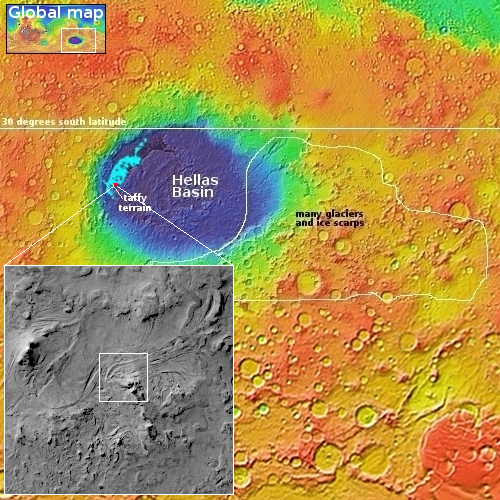
The red dot on the overview map to the right marks the location, inside Hellas Basin, the Death Valley of Mars because it has the lowest relative elevation of any place on the red planet. Note also that the taffy terrain is found mostly at the deepest parts of Hellas Basin, which is an arc parallel to its northwest perimeter.
The inset covers an area about ten miles across. If you look close, you will see that this taffy terrain fills all the low spots. It does not do so like most materials that were once a liquid, however, forming smooth ponds. Instead, in every place it has this banded, twisted pattern, as if the great candy-maker in the sky was stirring it up as it flowed into those depressions.
At present, no one knows what this material is made of. It could frozen lava. It could be hardened mud. Or it could be something else entirely, produced by the alien Martian geology.

On Christmas Eve 1968 three Americans became the first humans to visit another world. What they did to celebrate was unexpected and profound, and will be remembered throughout all human history. Genesis: the Story of Apollo 8, Robert Zimmerman's classic history of humanity's first journey to another world, tells that story, and it is now available as both an ebook and an audiobook, both with a foreword by Valerie Anders and a new introduction by Robert Zimmerman.
The print edition can be purchased at Amazon or from any other book seller. If you want an autographed copy the price is $60 for the hardback and $45 for the paperback, plus $8 shipping for each. Go here for purchasing details. The ebook is available everywhere for $5.99 (before discount) at amazon, or direct from my ebook publisher, ebookit. If you buy it from ebookit you don't support the big tech companies and the author gets a bigger cut much sooner.
The audiobook is also available at all these vendors, and is also free with a 30-day trial membership to Audible.
"Not simply about one mission, [Genesis] is also the history of America's quest for the moon... Zimmerman has done a masterful job of tying disparate events together into a solid account of one of America's greatest human triumphs."--San Antonio Express-News
it’s pretty crazy to think within a couple years we might have Optimus bots wading through the stuff and taking selfies
also optimistic that within 10 years Helion will be able to ship a 50MWe D-He3 fusion reactor on a Starship to power a colony
Helium three?
It was estimated that the moon has enough helium three to power the earth for 1000 years, Mercury has enough to power the earth for 10,000 years.
That is very optimistic considering we don’t have enough helium three samples on earth to perform testing of theories… The new moon race will change that and hopefully the optimism will come true.
Meanwhile, California quit buying power from Delta Utah to shut down it’s coal fired power plant. (when I last drove by, it had oil tankers feeding the power plant)
https://www.latimes.com/california/newsletter/2025-10-08/essential-california-california-dumps-coal-power
They will soon re-open the 1983 plant as a modern gas fired power plant producing 840 MW less but using 1/4 of the manpower.
They also brag that they will convert the local desert water supply into hydrogen to make clean energy… Which produces about half the energy / heat then natural gas does. (that’s more CO2 in the name of “clean” air) insanity.
(they are currently building the largest AI server farm in the world near this location… And now it has its own power plant… when the sale price drops considerably)