
Interstellar comet 3I/Atlas is unusually enriched with windshield wiper fluid
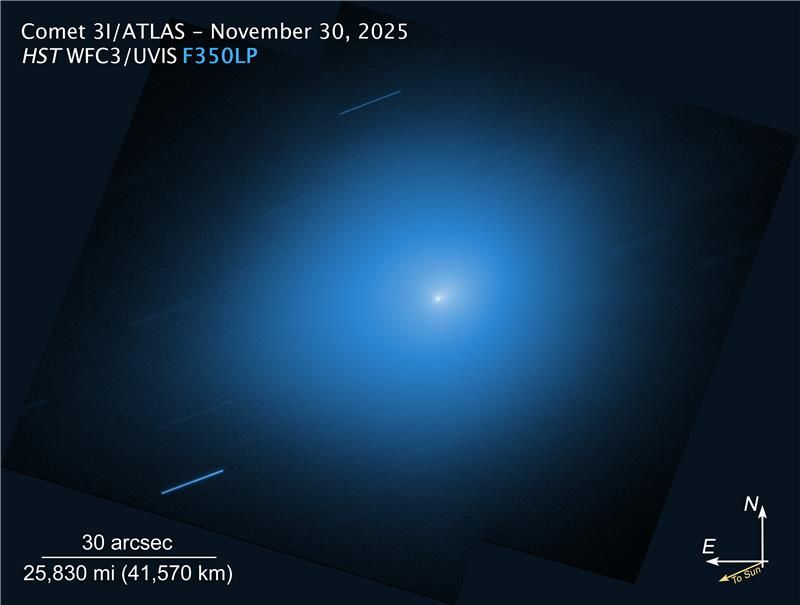
Comet 3I/Atlas as seen by Hubble
in November 2025. Click for original.
While interstellar comet 3I/Atlas is remarkably like most comets from our own solar system, scientists have now found new evidence that it spalled off unusual amounts of methanol (CH3OH) — material normally used as windshield washer fluid, carburetor fluid, and cooking fuel — when it made its close fly-by of the Sun in the fall of 2025.
You can read the paper here [pdf] . The research also detected large amounts of prussic acid (HCN). As the comet made its closest pass to the Sun, the numbers increased. From the paper’s abstract:
The CH3OH production rate increased sharply from August through October, including an uptick near the inner edge of the H2 O sublimation zone at r H = 2 au. Compared to comets measured to date at radio wavelengths, the derived CH3 OH/HCN ratios in 3I/ATLAS of 124+30 −34 and 79−14 +11 on September 12 and 15, respectively, are among the most enriched values measured in any comet, surpassed only by anomalous solar system comet C/2016 R2 (PanSTARRS).
Though the numbers are high, they aren’t outside the range of what has been found in comets from our own solar system. Instead, this data suggests — as has all data so far — that Comet 3I/Atlas is a normal comet, but unique in its own way, as are all comets and in fact every object in space.

On Christmas Eve 1968 three Americans became the first humans to visit another world. What they did to celebrate was unexpected and profound, and will be remembered throughout all human history. Genesis: the Story of Apollo 8, Robert Zimmerman's classic history of humanity's first journey to another world, tells that story, and it is now available as both an ebook and an audiobook, both with a foreword by Valerie Anders and a new introduction by Robert Zimmerman.
The print edition can be purchased at Amazon or from any other book seller. If you want an autographed copy the price is $60 for the hardback and $45 for the paperback, plus $8 shipping for each. Go here for purchasing details. The ebook is available everywhere for $5.99 (before discount) at amazon, or direct from my ebook publisher, ebookit. If you buy it from ebookit you don't support the big tech companies and the author gets a bigger cut much sooner.
The audiobook is also available at all these vendors, and is also free with a 30-day trial membership to Audible.
"Not simply about one mission, [Genesis] is also the history of America's quest for the moon... Zimmerman has done a masterful job of tying disparate events together into a solid account of one of America's greatest human triumphs."--San Antonio Express-News
Robert: you mean ethylene glycol, not methanol:
“Methanol is commonly found in windshield washer fluid, carburetor fluid, and cooking fuel. Ethylene glycol is the main component in engine antifreeze and coolant.”
Correction: the comet substance _is_ methanol, so it’s the title and text that needs to be changed, i.e., not antifreeze, but windshield wiper fluid, carburetor fluid and cooking fuel.
Rex W Ridenoure: Thank you for the correction. This is what I get when I depend on Wikipedia.
It’s alright…homeless Arrakoth used the wrong stuff when it jumped in front of the comet looking for handouts
“Wipe your windshield mistah?”