
November 27, 2018 Zimmerman/Batchelor podcast
Embedded below the fold in two parts.
» Read more
Embedded below the fold in two parts.
» Read more
The new colonial movement: India’s PSLV rocket successfully placed 31 satellites into orbit, including an Indian Landsat-type satellite plus 30 commercial smallsats.
This ties India with Japan at six launches for the year. With one more launch scheduled for this year, they should end up ahead of Japan.
The leaders in the 2018 launch race remain unchanged.
33 China
18 SpaceX
11 Russia
9 Europe (Arianespace)
8 ULA
At 95 total successful launches so far this year, 2018 now matches the total from 1993, the last time the global aerospace industry accomplished that many. That year, China and Japan had one launch each, Europe seven, with the rest by Russia and the U.S. Now the wealth is much more widely spread, and has a strong potential to grow significantly in the next few years.
An evening pause: I think this video, taken at the equator in Ecuador, nicely proves the Coriolis Effect. In fact, it is remarkable how short a distance you need to travel on Earth to flip the effect.

Cool image time! In the November image release from the high resolution camera on Mars Reconnaissance Orbiter (MRO) I found the image on the right (cropped to post here), dubbed “Possible Rock Falls on Steep Slopes in Cerberus Fossae.” You can see the full image by clicking on the photo on the right.
The cropped section focuses on the steep cliffs of this deep canyon, formed when lava flowed down from the giant volcano Elysium Mons almost like water, following the faults created by the bulging volcanoes to carve a long series of parallel canyons more seven hundred miles in length. Not only can individual boulders be seen piled up on the base of the canyon, you can see on the lower right a large section of cliff that has broken off and partly fallen, propped now precariously on the cliff’s steep slope. I would not want to be hiking below it at the base of this canyon.

This photograph itself made me more interested in looking at other MRO images of Cerberus Fossae. The context map on the right shows that MRO has taken numerous images along the length of these faults, indicated by the red boxes. The location of the above image is shown by the white cross, at the western end where the canyons tend to be steep, deep, and pronounced. In taking a look at the many images of Cerberus Fossae, I found a variety of canyons, plus pit chains, lava tube skylights, and one especially intriguing image, posted below, that shows what appears to be an extended collapse along the length of what was once an underground lava tube.
» Read more
Capitalism in space: Weather has delayed a SpaceX launch from Vandenberg.
This launch is significant because once launched the first stage will become the first to have flown three times. It also will be the first to have launched from all three of SpaceX’s operating launchpads and to have landed on both of the company’s drone ships. And it will have done all this in less than seven months.
The coming dark age: In order to stop global warming a team of scientists plan a first test of a method designed to block sunlight by injecting aerosols (the scientific term for pollution) into the upper atmosphere.
If all goes as planned, the Harvard team will be the first in the world to move solar geoengineering out of the lab and into the stratosphere, with a project called the Stratospheric Controlled Perturbation Experiment (SCoPEx). The first phase — a US$3-million test involving two flights of a steerable balloon 20 kilometres above the southwest United States — could launch as early as the first half of 2019. Once in place, the experiment would release small plumes of calcium carbonate, each of around 100 grams, roughly equivalent to the amount found in an average bottle of off-the-shelf antacid. The balloon would then turn around to observe how the particles disperse.
The test itself is extremely modest. Dai, whose doctoral work over the past four years has involved building a tabletop device to simulate and measure chemical reactions in the stratosphere in advance of the experiment, does not stress about concerns over such research. “I’m studying a chemical substance,” she says. “It’s not like it’s a nuclear bomb.”
Nevertheless, the experiment will be the first to fly under the banner of solar geoengineering. And so it is under intense scrutiny, including from some environmental groups, who say such efforts are a dangerous distraction from addressing the only permanent solution to climate change: reducing greenhouse-gas emissions. The scientific outcome of SCoPEx doesn’t really matter, says Jim Thomas, co-executive director of the ETC Group, an environmental advocacy organization in Val-David, near Montreal, Canada, that opposes geoengineering: “This is as much an experiment in changing social norms and crossing a line as it is a science experiment.” [emphasis mine]
The number of stupid and ill-documented conclusions mentioned in this article are so many it would be hard to list them all. For one, it assumes the climate is warming in a disastrous manner, an assumption that remains entirely unproven. For another, the last paragraph in the quote above illustrates how much politics dominates this scientific field. Science has nothing to do with this experiment.
Third, the risks involved in doing this kind of geoengineering are impossible to measure. They very easily could be very negative, for us and the environment. Fourth, the only objections to this experiment quoted in the article come from activist groups who believe in global warming, but would rather impose political restrictions on freedom and property rights than do geoengineering. Skepticism of the global warming theory is merely mentioned as an aside, coming from “the occasional conspiracy theorist.”
I could go on. The worst part of this article and the scientists proposing this work is their utter refusal to consider the gigantic amounts of research that has shown the many benefits of increased atmospheric carbon dioxide and warming for agriculture and plant growth. Global warming, should it happen, could have negative consequences, but the data so far is very far from conclusive.
Let me add one more side note: The same environmentalists who generally support geoengineering to halt global warming are also likely to agree with this infantile op-ed: Richard Branson and Elon Musk threaten the purity of space.
Despite all the money the US and Russia have spent attempting to show who has the biggest balls, space remains pure. But, while Nasa re-engages and fuels up for another go, so-called space pioneers and entrepreneurs are already selling seats.
I don’t know about you, but I don’t want space to be commercialised, owner [sic] by Richard Branson or Elon Musk. For me, this would ruin something very special.
I’d suggest you read it all, but I would fear your level of education and ability to think will be seriously damaged.
For these anti-human environmentalists, manipulating the Earth’s atmosphere, based on weak scientific theories, is perfectly okay. Having humans and private enterprise in space, however, is evil and must be prevented at all costs.
The empty-headed lack of thought and ignorance required to come to these conclusions, simultaneously, boggles my mind.
An investigation of Roscosmos by Russian prosecutors has revealed extensive violations of law, all of which occurred in only the last year and a half.
The Russian Prosecutor General’s Office has detected systemic legal violations in the work of State Space Corporation, Roscosmos, between 2017 and the first half of 2018. In total, 1,700 violations had been revealed, Official Spokesman Alexander Kurennoy said, adding that 16 criminal cases had been launched.
“During the period between 2017 and the first six months of 2018, documents on the activities conducted by the previous management of Roscosmos had been reviewed. Systemic violations of the law had been detected, particularly regarding the state’s defense procurement, with research and development work having been conducted improperly. This also concerns the area linked to state-of-the-art engineering, and where work on registering patents on intellectual property is carried out, they had been often disrupted. This includes the deadline of defense missions, where evidence of poor-quality products being supplied had been revealed,” he told reporters.
Furthermore, prosecutors had revealed violations of procurement legislation, namely when it comes to pricing and import substitution. “Also, the situation in the rocket and space industry in general was deemed unsatisfactory since the corporation hadn’t enacted the required controls for the appropriate expenditure of budget funds by all of the enterprises’ branches,” Kurennoy stressed.
I expect this situation in Russia will get far worse, as the corruption is a feature, not a bug, in their government-run centralized aerospace industry.
Capitalism in space: The smallsat company Surrey Satellite Technology is designing a cubesat communications satellite set for launch in 2021 designed to test technology for providing communications in lunar space.
Surrey Satellite Technology Ltd (SSTL) has today announced that it is designing a low cost 35kg lunar communications satellite mission called DoT-4, targeted for a 2021 launch. DoT-4 will provide the communications relay back to Earth using the Goonhilly Deep Space Network, and will link up with a rover on the surface of the Moon. SSTL is currently in discussions with a number of parties for the lunar mission, and expects to disclose further information on mission partners and funding early in 2019.
Sarah Parker, Managing Director of SSTL, said “SSTL has led the way in pioneering the use of small satellites for over 30 years and we are now raising our sights to change the economics of space around the Moon, and beyond.”
DoT-4 will be the pre-cursor mission for a larger lunar communications satellite to follow in the 2023 timeframe which will carry a more robust payload and which will also have the potential for navigation services. SSTL’s ultimate aim is to launch a full constellation of lunar communications satellites offering full service capability to enable new and regular opportunities for science and exploration and economic development of the space environment beyond Earth’s orbit.
It appears that Surrey is trying to grab the market for providing communications services for both NASA’s Gateway project as well as the number of private small lunar rovers that are expected to launch in the coming years.
I should add that this project probably only exists because Surrey and its investors know that it will have affordable access to space, using the new smallsat rockets coming from Rocket Lab, Vector, and Virgin Orbital.
An evening pause: Recorded live on television in 1952.
Hat tip Edward Thelen, who is making the effort to find videos on alternative venues from youtube.
The coming dark age: Hundreds of believers in the idea that the Earth is flat and not a sphere have gathered for a conference in Colorado this week.
“Was there ever any debate when you were in first grade and you were learning about cosmology? Was there anyone who disputed it ever in your whole life but now?” said Dorothy Novak, a flat-Earth believer.
As science — and common sense — have proven, the world is not flat. However, flat-Earth believers say otherwise. “Look with your own eyes. Go out to the beach on a cloudy day. Are the clouds curved?” asked Novak.
About 800 are expected to attend. More important, their conference is getting good press, as indicated by this article itself.
Anyone who has read my writings at any depth know that I honor the concept of skepticism as the first premise of all science, and even of our civilization. However, one mustn’t have so open a mind that all your brains fall out. For so many people to advocate something that has been demonstrated in innumerable ways — including sending humans around the Moon — to be obviously false, says much about the sad state of our civilization.
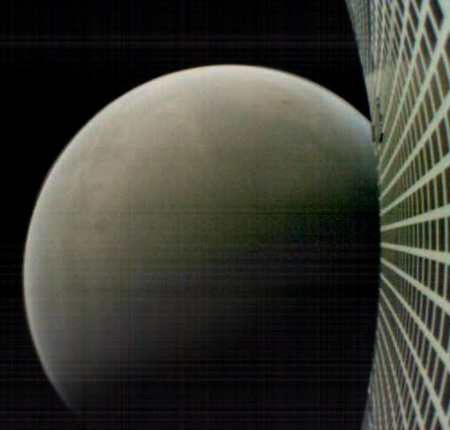
The two MarCO cubesats that successfully relayed data from InSight to Earth during its landing yesterday continue to function, with one even sending back images. The photo on the right, cropped and reduced slightly to post here, was taken by MarCo-B.
Neither of the MarCO CubeSats carry science instruments, but that didn’t stop the team from testing whether future CubeSats could perform useful science at Mars. As MarCO-A flew by, it conducted some impromptu radio science, transmitting signals through the edge of Mars’ atmosphere. Interference from the Martian atmosphere changes the signal when received on Earth, allowing scientists to determine how much atmosphere is present and, to some degree, what it’s made of.
“CubeSats have incredible potential to carry cameras and science instruments out to deep space,” said John Baker, JPL’s program manager for small spacecraft. “They’ll never replace the more capable spacecraft NASA is best known for developing. But they’re low-cost ride-alongs that can allow us to explore in new ways.”
As a bonus, some consumer-grade cameras aboard MarCO provided “drive-by” images as the CubeSats sailed past Mars. MarCO-B was programmed to turn so that it could image the planet in a sequence of shots as it approached Mars (before launch, MarCO-A’s cameras were found to be either non-functioning or too blurry to use).
This engineering test proves that we don’t need to build billion dollar spacecraft every time we wish to send an unmanned scouting ship to another world. Cubesats will soon do the job quite well, and for a tenth the cost.
And there will be a lot of money to be made. Governments and private entities of all types will be eager to buy the services of the garage-built planetary cubesats that private companies are going to soon be building, in large numbers.
The Supreme Court today ruled against the federal government’s attempt to designate private land as a habitat for an endangered species, even though that endangered species doesn’t even inhabit that land.
In a unanimous ruling the justices rejected the federal government’s attempt to designate roughly 1,500 acres in Louisiana as critical space for the dusky gopher frog. “Only the ‘habitat’ of the endangered species is eligible for designation as critical habitat,” Chief Justice John G. Roberts Jr. wrote in the opinion.
The frog hasn’t lived on the land in five decades, having shifted to neighboring counties. But the government, fearing future events might push the frog back, sought to designate the land, which would have imposed severe restrictions on what the owners could do with it.
Consider the chutzpah of the federal government in attempting to do this. If the court had ruled in their favor, it would have allowed them to designate any piece of property anywhere in the country as a habitat for any species, and thus negate all property rights, forever.
Several rocks brought back from the Moon by a Soviet unmanned spacecraft will be auctioned off on November 29, and you can buy them legally!
The lunar samples were originally presented by the Soviet government to Nina Ivanovna Koroleva, the widow of Sergei Korolev, the “Chief Designer” of the Russian space program. Under Korolev’s direction, the Soviet Union successfully put the world’s first satellite into Earth orbit and launched the first human into space. His unexpected death in 1966 came before he could see the outcome of the space race to the moon.
Four years after Korolev died, the Soviets launched Luna 16, the first of three robotic lunar sample return missions. Touching down after the U.S. Apollo 11 and Apollo 12 astronauts had come and gone from the moon, Luna 16 deployed an extendable arm to drill and extract a core sample 14 inches (35 centimeters) deep. The 3.5 ounces (101 grams) of soil and rocks that it collected were then deposited into a capsule for their return to Earth.
The display gifted to Koroleva contains three grains of the Luna 16 material, weighing about 0.0007 ounces (0.2 grams). The central fragment is basalt, typical of the moon’s mare (or “seas”) terrain while the adjoining two larger fragments are regolith with glass coatings caused by an micrometeoroid impact, according to Sotheby’s.
…In 1993, the lunar samples were estimated to sell for $30,000 to $50,000 before commanding eight times the higher valuation. The display, which has been held in the same private American collection for the past quarter century, is now expected to sell for $700,000 to $1 million.
I will not be surprised if this item sells for considerably more than $1 million.
Hat tip Wayne DeVette.
Link here. The author outlines quite nicely the source of today’s vicious war against Trump.
Today a well-entrenched class of professional thinkers largely understands expertise as the product of formal education and relationships to elite universities: You become an expert, or start to, by acquiring academic credentials. Extra points for grad school, and more points still for being a professor like Paul Krugman or Jonathan Gruber. Like the administrative class in Vichy France, or the scholar-officials of imperial China, you’re smart if you go to school a lot and excel on your exams, so you get to be in charge of some piece of the political or cultural mechanism.
But is it working? Are our credentialing instruments producing people who are capable of practical action? To borrow a question from firefighters, can our credential-holders put the wet stuff on the red stuff?
Nearly a decade ago, Angelo Codevilla noticed the calcification of the American ruling class, a thing we sometimes pretend not to have. Our elites, he wrote, are “formed by an educational system that exposed them to the same ideas and gave them remarkably uniform guidance, as well as tastes and habits.” Thoroughly enculturated, the American elite gathers itself around a “social canon” that one does not question. Speaking of societal controversy with the wrong words puts a person outside the circle, out there in flyover country with the deplorables.
Considering the disaster that the federal government has become in the past half century, run as it is by this “class of professional thinkers,” I will say unequivocally that this system is not working. In the past half century this elitist culture has brought us bankruptcy, unmanageable debt, corruption, and a government unable to accomplish anything except to over-regulate and oppress the private citizen.
Read it all. The author describes well the situation we are in, as well as the reasons why there is so much hysterical opposition to Trump. This president poses a direct threat to the power of that elitist culture, and they are doing everything they can to stop him.
Their problem: They don’t know how to really accomplish anything, and for this reason Trump keeps running rings around them. To quote the article again:
For 40 years, with gathering uniformity of purpose, our credentialing institutions have taught postures rather than skills, attitudes rather than knowledge. This isn’t invariably true, and many fine scholars have taught many excellent practitioners, especially outside of the humanities and social sciences. But the overarching trend is toward training in intellectual and psychological uniformity, toward the world of excellent sheep.
The hollowing out of our credentialing institutions has been abundantly clear for years, in well-known examples like the discussion of rape law at Harvard and the “it is not about creating an intellectual space!” tantrum over Halloween costumes at Yale. What credentialing institutions teach is mental rigidity, intellectual cowardice, and the fear of disagreement. They narrow the mind and constrain the ability to act. Our elites largely can’t put the wet stuff on the red stuff, because it’s triggering and unsafe to mention that the red stuff is there, and why are you being so hurtful when I don’t want to talk about this?
But they have great power, and are doing whatever they can to hold onto that power. And worse, it appears that too many Americans support them.
The United Kingdom’s first spaceport, proposed for the northern tip of Scotland, faces strong opposition from the local community as well as within the organization that owns the land.
The land is controlled by the Melness Crofting Estate (MCE), a company that represents about 56 local crofters. Three of its seven directors have resigned over how the plans have been handled.
George Wyper, one of those who stepped down, claimed that much of the community had been kept in the dark. In a ballot, 27 crofters voted to press ahead with talks to lease land to the spaceport while 18 voted against. Ten failed to vote and one ballot was rejected. Mr Wyper believes that important details were not shared. ‘Some people did not know what they were voting for,’ he said. ‘It’s getting quite vicious here — with Facebook and things. It’s causing a split in the community.’
He told the Highland Press & Journal: ‘There is quite a split in the community and a lot of bad feeling about this. It could go to the Scottish Land Court, which could take years to resolve.’
While in many ways some aspects of the opposition here reminds me of the opposition in Hawaii to the Thirty Meter Telescope, the difference is that that here it a large percentage of the landowners protesting. They have real standing, and thus are in a much stronger position to shut the spaceport down.
From what I can gather, the source of the problem here falls to the UK government, which apparently has done a very bad job in negotiating this deal.
InSight engineers have now reported that solar panels have opened and are functioning properly.
NASA’s InSight has sent signals to Earth indicating that its solar panels are open and collecting sunlight on the Martian surface. NASA’s Mars Odyssey orbiter relayed the signals, which were received on Earth at about 5:30 p.m. PST (8:30 p.m. EST). Solar array deployment ensures the spacecraft can recharge its batteries each day. Odyssey also relayed a pair of images showing InSight’s landing site.
“The InSight team can rest a little easier tonight now that we know the spacecraft solar arrays are deployed and recharging the batteries,” said Tom Hoffman, InSight’s project manager at NASA’s Jet Propulsion Laboratory in Pasadena, California.
This was the last major event in the landing sequence, and with it they can now shift to the slow deployment of instruments over the next few weeks. Results from this spacecraft will not be sudden or spectacular. It is going to take time to get the spectrometer placed and than time to gather quake data.
An evening pause: Hat tip Danae.
NASA engineers have received confirmation that InSight has successfully touched down on the Martian surface.
Don’t count your chickens yet. They need to wait about five hours for the dust, kicked up by landing, to settle before they try opening the solar panels. That must succeed, or the mission will fail, having no source of power.
The landing information was relayed through the two MARCO cubesats flying past Mars, a landmark engineering achievement that in a sense is more significant than the landing itself. These cubesats have demonstrated that smallsats can do complex interplanetary tasks. Expect a revolution in the planetary space exploration world.
Another reason to dump Google: Google has been issued patents outlining its plans to establish monitors throughout each customer’s home, monitoring movements, moods, activities, and even their children, with the ability to even control behavior.
But there’s even more. According to The Atlantic:
A second patent proposes a smart-home system that would help run the household, using sensors and cameras to restrict kids’ behavior. Parents could program a device to note if it overhears ‘foul language’ from children, scan internet usage for mature or objectionable content, or use ‘occupancy sensors’ to determine if certain areas of the house are accessed while they’re gone— for example, the liquor cabinet. The system could be set to ‘change a smart lighting system color to red and flash the lights’ as a warning to children or even power off lights and devices if they’re grounded.
The language of these patents makes it clear that Google is acutely aware of the powers of inference it has already, even without cameras, by augmenting speakers to recognize the noises you make as you move around the house. The auditory inferences are startling: Google’s smart-home system can infer ‘if a household member is working’ from ‘an audio signature of keyboard clicking, a desk chair moving, and/or papers shuffling.’ Google can make inferences on your mood based on whether it hears raised voices or crying, on when you’re in the kitchen based on the sound of the fridge door opening, on your dental hygiene based on ‘the sounds and/or images of teeth brushing.’
The key aspect of this is that, at least right now, Google cannot force its way into your home unless you agree to let it. That any free American is not sickened by this invasion of privacy and is even considering allowing it into their home illustrates how different a country we are from only a half century ago. In my youth, for any company to publicly consider these actions would have guaranteed its bankruptcy, within weeks. No one would want anything to do with it.
No longer. Too many Americans are now sheep, wedded to their technology to a point of foolishness.
Update: I realized it will help to add that I have managed to eliminate almost all use of Google in my computer work now for more than a decade. For browser searches I use either Startpage or DuckDuckGo. For awhile I was using gmail as a backup email source, in case my main isp went down, but I dumped it about four years ago. With both Google and gmail I then wiped my history so as to reduce the odds of Google retaining it (something I can’t guarantee as Google has already been caught retaining data it does not own).
The only areas I am still using any Google resources is with youtube and Google Maps, and with both I am constantly looking for alternatives. We should all be doing the same. If anything the competition will force Google to reconsider some of its more odious policies.
The uncertainty of science: Astronomers have discovered a class of quasars that suddenly turn off, something that no theory had predicted possible.
LaMassa, an astronomer now at the Space Telescope Science Institute, was mystified. Until that moment in 2014, she, like so many others, had expected quasars to be relatively stagnant. “Then you see these drastic changes within a human lifetime, and it’s pretty cool,” she said.
Confusion turned into excitement, and a hunt began to find more of these oddities. Although less luminous examples had already been seen, astronomers wanted to know if changes as dramatic as the one LaMassa discovered were common. It was no straightforward task, given that surveys tend not to go back and look at objects they have previously observed. But astronomers searched through archived data and discovered 50 to 100 more of what became known as “changing-look quasars.” Some of these have dimmed substantially more than LaMassa’s first example. Others have transitioned in the space of a month or two. And others, after disappearing, have reappeared again.
“It’s clear that the reason we weren’t finding these objects before is that we weren’t looking for them,” said Eric Morganson, an astronomer at the University of Illinois.
The article does a fine job of explaining the whole problem, including outlining the theories now being posited to explain these events. Bottom line: the universe is always more complicated that expected by initial observations.