Sunspot update: Maybe solar maximum isn’t over?
The uncertainty of science! It is time for another sunspot update. It is also time to note that once again the Sun appears to be confounding the predictions of NOAA’s solar science panel. Below is NOAA’s monthly graph of the sunspot activity on the Earth-facing hemisphere, updated by NOAA to include the activity in January but annotated with extra information by me to illustrate the larger scientific context.
Since April 2025 that science panel has been predicting that the solar maximum has passed and the Sun was beginning the ramp down to solar minimum, now expected to occur around 2031-32. And in the ten months since, sunspot activity has appeared to more or less track that prediction, as indicated by the purple/magenta curve line on the graph below.
It now appears that this prediction might very well have been premature.
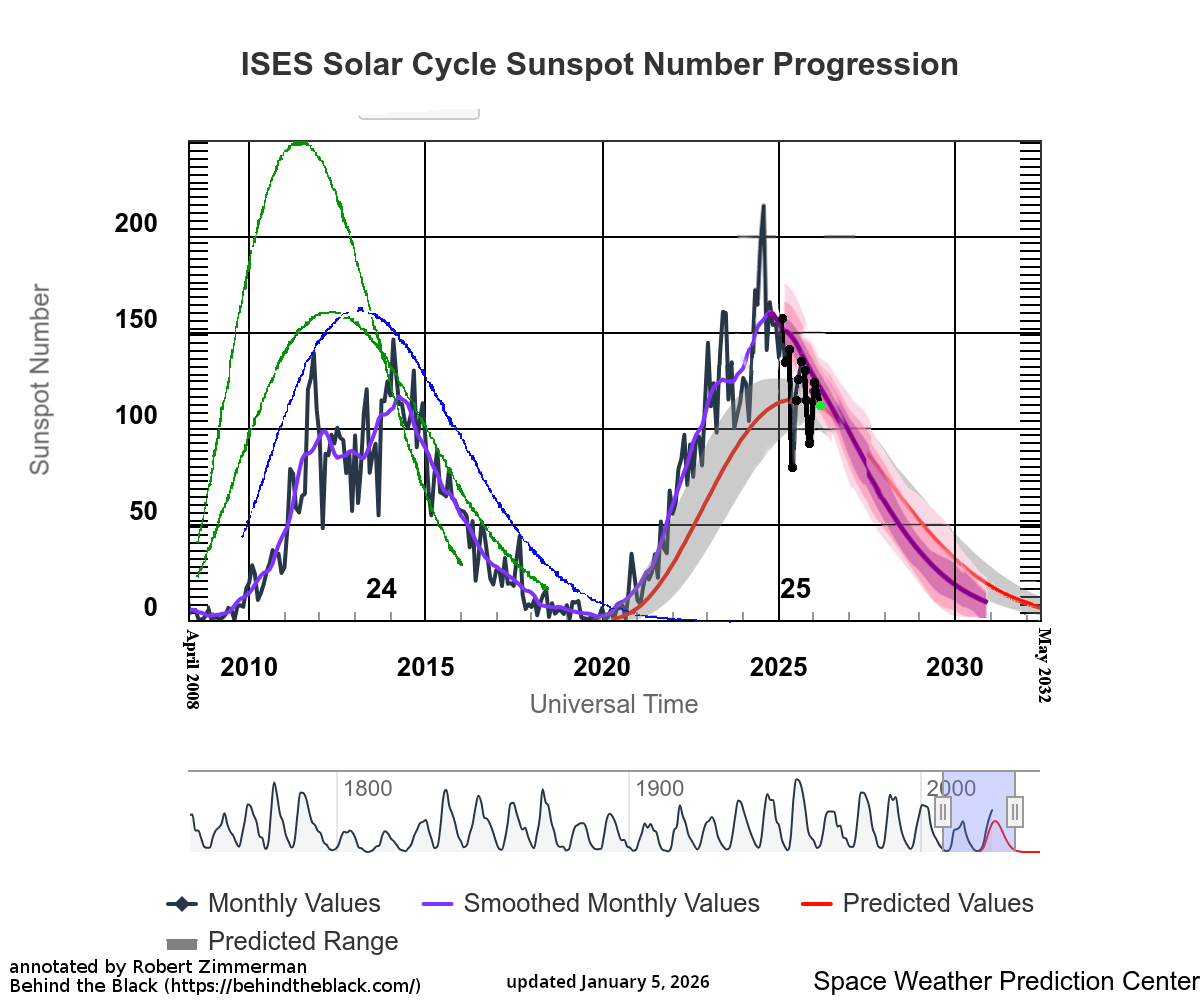
The graph above has been modified to show the predictions of the solar science community for both the previous solar maximum as well as the ongoing maximum. The green curves show the community’s two original predictions from April 2007 for the previous maximum, with half the scientists predicting a very strong maximum and half predicting a weak one. The blue curve is their revised May 2009 prediction. The red curve is the new prediction, first posted by NOAA in April 2020. At the beginning of April 2025 NOAA’s panel of solar scientists added the purple/magenta curve line, predicting that solar maximum was over, and that the ramp down to minimum had begun.
Though solar activity dropped slightly in January, it was doing so from a high number in December. The result is that for the past few months activity has somewhat leveled out, not declined.
From my annotated graph above this leveling is not so obvious. If you click on the graph however to see NOAA’s original version you will see that NOAA’s scientists have revised that purple/magenta curve line, based on the actual data from the last few months, and that it now indicates that leveling.
In other words, NOAA’s panel is once again doing what it has done repeatedly over the years, adjusting its prediction based on new data to make it look like it got things right. As I wrote when they made this ramp down prediction in April 2025:
In other words, it ain’t really a prediction. All they have done is to extrapolate the present decline during the past four months, even though there is no clear evidence to justify that extrapolation. In the previous solar cycle the Sun also started a similar decline, and then activity leaped upward again, producing a double-peaked maximum. Moreover, the extrapolation will result in an extremely short maximum, which will be especially unprecedented because short maximums have routinely been associated with high maximums, not the relative weak maximum we are presently experiencing.
NOAA’s scientists have simply produced a new “prediction” based solely on recent data, because their original prediction simply failed. This games-playing allows these scientists to fool the public into thinking they know what’s going on. What it really tells us is that they continue to guess, but spin those guesses so that they can hide their ignorance.
I also noted at that time that it was still likely that the Sun would repeat what it did in the previous maximum, and instead of ramping down to minimum it could see a new burst of activity, producing another double-peaked maximum. The data from January suggests this may still happen. The recent activity in the past week adds weight to that supposition.
We simply don’t know. It is a shame however that NOAA’s scientists don’t have the courage to admit this fact.

On Christmas Eve 1968 three Americans became the first humans to visit another world. What they did to celebrate was unexpected and profound, and will be remembered throughout all human history. Genesis: the Story of Apollo 8, Robert Zimmerman's classic history of humanity's first journey to another world, tells that story, and it is now available as both an ebook and an audiobook, both with a foreword by Valerie Anders and a new introduction by Robert Zimmerman.
The print edition can be purchased at Amazon or from any other book seller. If you want an autographed copy the price is $60 for the hardback and $45 for the paperback, plus $8 shipping for each. Go here for purchasing details. The ebook is available everywhere for $5.99 (before discount) at amazon, or direct from my ebook publisher, ebookit. If you buy it from ebookit you don't support the big tech companies and the author gets a bigger cut much sooner.
The audiobook is also available at all these vendors, and is also free with a 30-day trial membership to Audible.
"Not simply about one mission, [Genesis] is also the history of America's quest for the moon... Zimmerman has done a masterful job of tying disparate events together into a solid account of one of America's greatest human triumphs."--San Antonio Express-News
Hams everywhere are on the edge of their seats!
I am interested what the integral would look like for any given cycle: Any way to get the total for each cycle?