Mars’ fast moving gigantic lava floods
Click for original image.
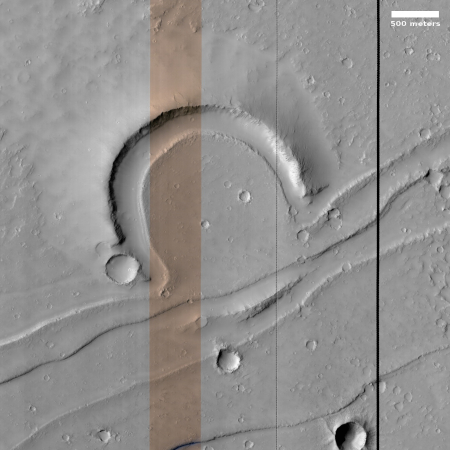
Cool image time! The picture to the right, rotated, cropped, and reduced to post here, was taken on December 12, 2025 by the high resolution camera on Mars Reconnaissance Orbiter (MRO).
The science team labels this a “crater interrupted by flow.” And what a flow! This unnamed 1.4-mile wide crater was not only filled and partly buried by the flow, that flow was so strong it cut through the crater’s rim at two points, refusing to let that rim block it in any way.
The flow in this case is lava, coming down from the Tharsis Bulge where four of Mars’ biggest volcanoes arose. And that flow was quite vast, as the nearest of those volcanoes, Arsia Mons, is almost 800 miles away. Because of Mars’ relative light gravity, about 39% that of Earth’s, lava on Mars can flow across large distances in a very short time. It might have only taken a few weeks for that flow to cover that 800 miles.
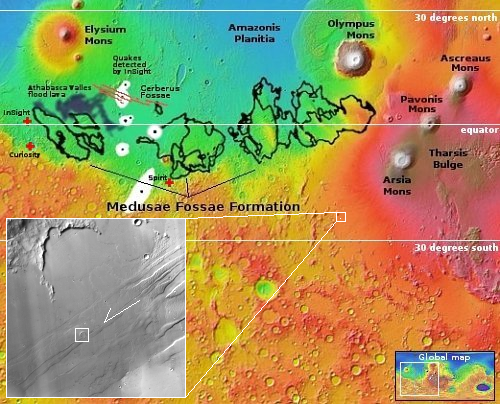
The white dot on the overview map to the right marks the location. The arrow in the inset indicates the downhill grade. This particular crater is on the outer edge of the Tharsis Bulge, which is several thousand miles across. This location however is hardly at the end of the bulge’s extensive lava flows. Note the mountain arc at the top of the inset. That marks the northern rim of a 15-mile-wide crater that is now half buried by that lava.
In fact, that crater illustrates the changing terrain. In this particular region the lava flow was beginning to peter out, no longer be strong enough to completely bury things. Thus, to the southwest more and more craters become visible though many are as buried as the crater in the inset.
In the case of the picture above, the flow itself was guided by the long linear fracture line that is part of the 3,500-mile-long fault line that cuts across three of Mars’ biggest volcanoes and is likely the reason they grew there in the first place.

On Christmas Eve 1968 three Americans became the first humans to visit another world. What they did to celebrate was unexpected and profound, and will be remembered throughout all human history. Genesis: the Story of Apollo 8, Robert Zimmerman's classic history of humanity's first journey to another world, tells that story, and it is now available as both an ebook and an audiobook, both with a foreword by Valerie Anders and a new introduction by Robert Zimmerman.
The print edition can be purchased at Amazon or from any other book seller. If you want an autographed copy the price is $60 for the hardback and $45 for the paperback, plus $8 shipping for each. Go here for purchasing details. The ebook is available everywhere for $5.99 (before discount) at amazon, or direct from my ebook publisher, ebookit. If you buy it from ebookit you don't support the big tech companies and the author gets a bigger cut much sooner.
The audiobook is also available at all these vendors, and is also free with a 30-day trial membership to Audible.
"Not simply about one mission, [Genesis] is also the history of America's quest for the moon... Zimmerman has done a masterful job of tying disparate events together into a solid account of one of America's greatest human triumphs."--San Antonio Express-News

Click for original image.
Cool image time! The picture to the right, rotated, cropped, and reduced to post here, was taken on December 12, 2025 by the high resolution camera on Mars Reconnaissance Orbiter (MRO).
The science team labels this a “crater interrupted by flow.” And what a flow! This unnamed 1.4-mile wide crater was not only filled and partly buried by the flow, that flow was so strong it cut through the crater’s rim at two points, refusing to let that rim block it in any way.
The flow in this case is lava, coming down from the Tharsis Bulge where four of Mars’ biggest volcanoes arose. And that flow was quite vast, as the nearest of those volcanoes, Arsia Mons, is almost 800 miles away. Because of Mars’ relative light gravity, about 39% that of Earth’s, lava on Mars can flow across large distances in a very short time. It might have only taken a few weeks for that flow to cover that 800 miles.
The white dot on the overview map to the right marks the location. The arrow in the inset indicates the downhill grade. This particular crater is on the outer edge of the Tharsis Bulge, which is several thousand miles across. This location however is hardly at the end of the bulge’s extensive lava flows. Note the mountain arc at the top of the inset. That marks the northern rim of a 15-mile-wide crater that is now half buried by that lava.
In fact, that crater illustrates the changing terrain. In this particular region the lava flow was beginning to peter out, no longer be strong enough to completely bury things. Thus, to the southwest more and more craters become visible though many are as buried as the crater in the inset.
In the case of the picture above, the flow itself was guided by the long linear fracture line that is part of the 3,500-mile-long fault line that cuts across three of Mars’ biggest volcanoes and is likely the reason they grew there in the first place.
On Christmas Eve 1968 three Americans became the first humans to visit another world. What they did to celebrate was unexpected and profound, and will be remembered throughout all human history. Genesis: the Story of Apollo 8, Robert Zimmerman's classic history of humanity's first journey to another world, tells that story, and it is now available as both an ebook and an audiobook, both with a foreword by Valerie Anders and a new introduction by Robert Zimmerman.
The print edition can be purchased at Amazon or from any other book seller. If you want an autographed copy the price is $60 for the hardback and $45 for the paperback, plus $8 shipping for each. Go here for purchasing details. The ebook is available everywhere for $5.99 (before discount) at amazon, or direct from my ebook publisher, ebookit. If you buy it from ebookit you don't support the big tech companies and the author gets a bigger cut much sooner.
The audiobook is also available at all these vendors, and is also free with a 30-day trial membership to Audible.
"Not simply about one mission, [Genesis] is also the history of America's quest for the moon... Zimmerman has done a masterful job of tying disparate events together into a solid account of one of America's greatest human triumphs."--San Antonio Express-News
Has anyone ever done some kind of study on the number of impact craters on Mars as compared to Earth?
Every picture taken of the surface of Mars show huge numbers of craters, with newer craters inside the older ones. It seems as though Mars has been rather thoroughly pummeled through the eons, while significant impact craters are rare and old on Earth. Could it be its proximity to the asteroid belt?
Or is it just that the water-based environment on Earth has erased the majority of our craters? Or that our atmosphere causes a significant number of the smaller ones to blow up before they strike the surface? Our Moon is also rather thoroughly cratered, so I’m guessing that the Earth is too…maybe we just don’t see the majority of them.
Blackwing1: Planetary scientists have done extensive crater count surveys of Mars, and have then compared those numbers to the crater counts on the Moon (and the less complete record on Mercury) to get an overall rough map of the impact history in the solar system.
They have then used those counts as a way to roughly date the surface of Mars, though they know this dating is very rough with large error bars.
The Earth does not help much in this, because its active atmosphere and ocean surface has erased too many craters.
I hope this answers your question.
Clearly, this is proof that Killroy was an Ancient Alien.
Mr. Zimmerman:
Thank you for taking the time to respond. I had figured that the combination of Earth’s atmosphere, tectonic activity, and erosion made it essentially impossible to determine if it has had the same intensity of bombardment as our Moon and Mars, but have never really researched the topic.
Best regards, Blackwing1.
Blackwing1-
The Sudbury, Ontario Impact
Alexis Dahl (2021)
https://youtu.be/ycQexghR61w
(18:43)
“1.8 million years ago a 6-mile-wide meteorite struck near Sudbury, Ontario producing a crater estimated at 93 miles wide and excavating material down to 18 miles deep and forming a new rock layer 130 feet thick out to a diameter of 300 miles.”
“Up until the late 60’s Geologists had no idea an impact had occurred…..”
Wayne:
I knew of the Impact, but had not realized Sudbury was that close to Sault St Marie. I’ve wanted to get back to the UP, and this seems like a worthwhile side quest. I’ve explored caldera in the West, but mountain-building, floods of lava, and sheets of ice have pretty well obliterated any impact craters. I am curious if there are any examples of ‘shocked quartz’ (You’re dating a Sedimentary?!) visible.
The write-up at craterexplorer.ca: https://craterexplorer.ca/sudbury-impact-structure/
Fun with numbers: https://impact.ese.ic.ac.uk/ImpactEarth/ImpactEffectsMap/
At the time of impact, the area was covered by a shallow sea. I used 100m depth, 20m/s impact speed, 45° angle, and 3000 kg/m^3 for bolide density. You’d have to be a good long ways away to survive that hit.
Blair–
Great links! (Alexis should have checked ‘craterexplorer!’) Geology in the Upper Peninsula is very interesting; it has more of an “out-West” feel compared to the lower Peninsula.
Yes, apparently shocked quartz and shatter cones are present at the surface in Michigan. (And ejecta can be found in Northern Minnesota.)
From your first link:
“At the time of impact, a 1 km cross section of country rock surrounding the crater was instantaneously melted. This formed about 31,000 cubic kilometers of impact melt. This is about six times the volume of lakes Huron and Ontario combined, and nearly 70 percent more than the melt at Chicxulub.”
—————————–
“(One of) the Biggest Lava Flows on Earth”
The Greenstone Flow, Cliff Copper Mine & the Keweenaw Peninsula
Alexis Dahl (2023)
https://youtu.be/yu-4L_MLY5Q
(13:11)