
Two moons of Saturn against its majestic rings
Click for original image.
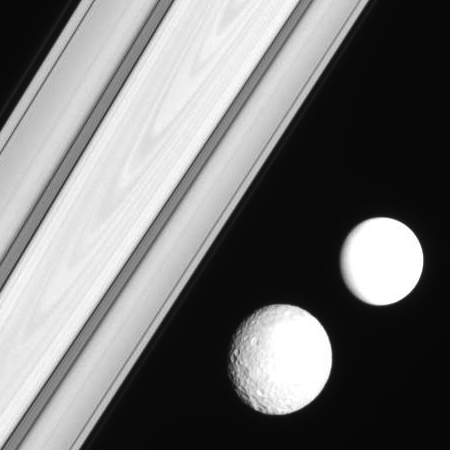
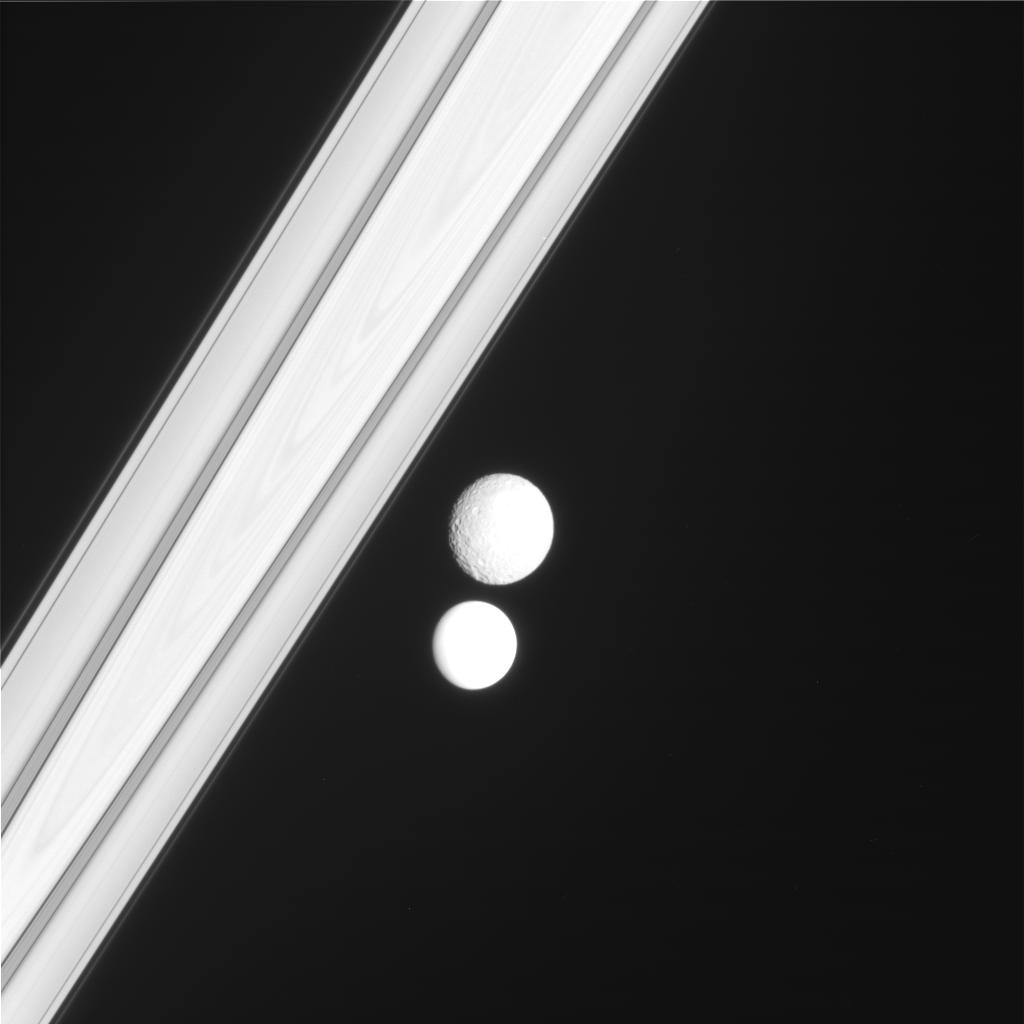
Cool image time! The picture to the right, cropped and enhanced to post here, was taken on December 23, 2005 by Cassini as it orbited Saturn.
The larger cratered moon is Mimas, known best for the single giant crater that dominates one hemisphere. I have not been able to identify the brighter but smaller moon.
Note the pattern within the largest bright central ring in the background. It is possible this is an optical illusion, but it is also possible this pattern is inherent in the ring itself. Other images show similar patterns that scientists have concluded were real.
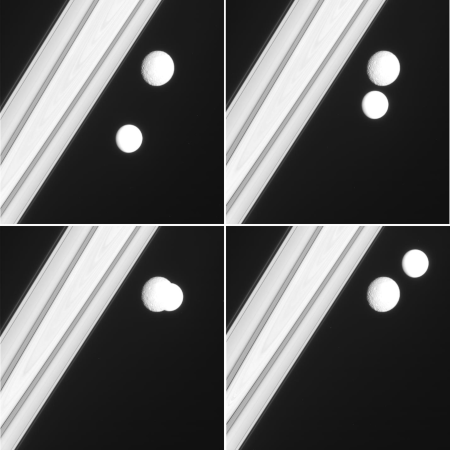
This image was part of a set of eight images all taken in the space of less than two minutes, as the smaller moon moved from the lower left to the upper right and was eclipsed by Minas as it did so. Below are four of those pictures, showing the sequence.
For original images, go here, here,
here, and here.
The four images to the right, cropped and reduced to post here, were all taken on December 12, 2005 over a span of less than two minutes (see here, here, here, and here).
As far as I can determine after some extensive searching, it appears the Cassini science team never issued a press release about this particular eclipse. If so, this means this is the first time these images have been highlighted in the general press.
The speed in which the small moon moves is an illusion. The camera was pointed at Mimas, so it remains still as the scenery around it shifts. In addition, the moons are not as close to each other as this sequence suggests.
That other moon appears to orbit closer to the rings. It also appears brighter with fewer craters. If anyone can identify it please say so in the comments.

On Christmas Eve 1968 three Americans became the first humans to visit another world. What they did to celebrate was unexpected and profound, and will be remembered throughout all human history. Genesis: the Story of Apollo 8, Robert Zimmerman's classic history of humanity's first journey to another world, tells that story, and it is now available as both an ebook and an audiobook, both with a foreword by Valerie Anders and a new introduction by Robert Zimmerman.
The print edition can be purchased at Amazon or from any other book seller. If you want an autographed copy the price is $60 for the hardback and $45 for the paperback, plus $8 shipping for each. Go here for purchasing details. The ebook is available everywhere for $5.99 (before discount) at amazon, or direct from my ebook publisher, ebookit. If you buy it from ebookit you don't support the big tech companies and the author gets a bigger cut much sooner.
The audiobook is also available at all these vendors, and is also free with a 30-day trial membership to Audible.
"Not simply about one mission, [Genesis] is also the history of America's quest for the moon... Zimmerman has done a masterful job of tying disparate events together into a solid account of one of America's greatest human triumphs."--San Antonio Express-News
Click for original image.
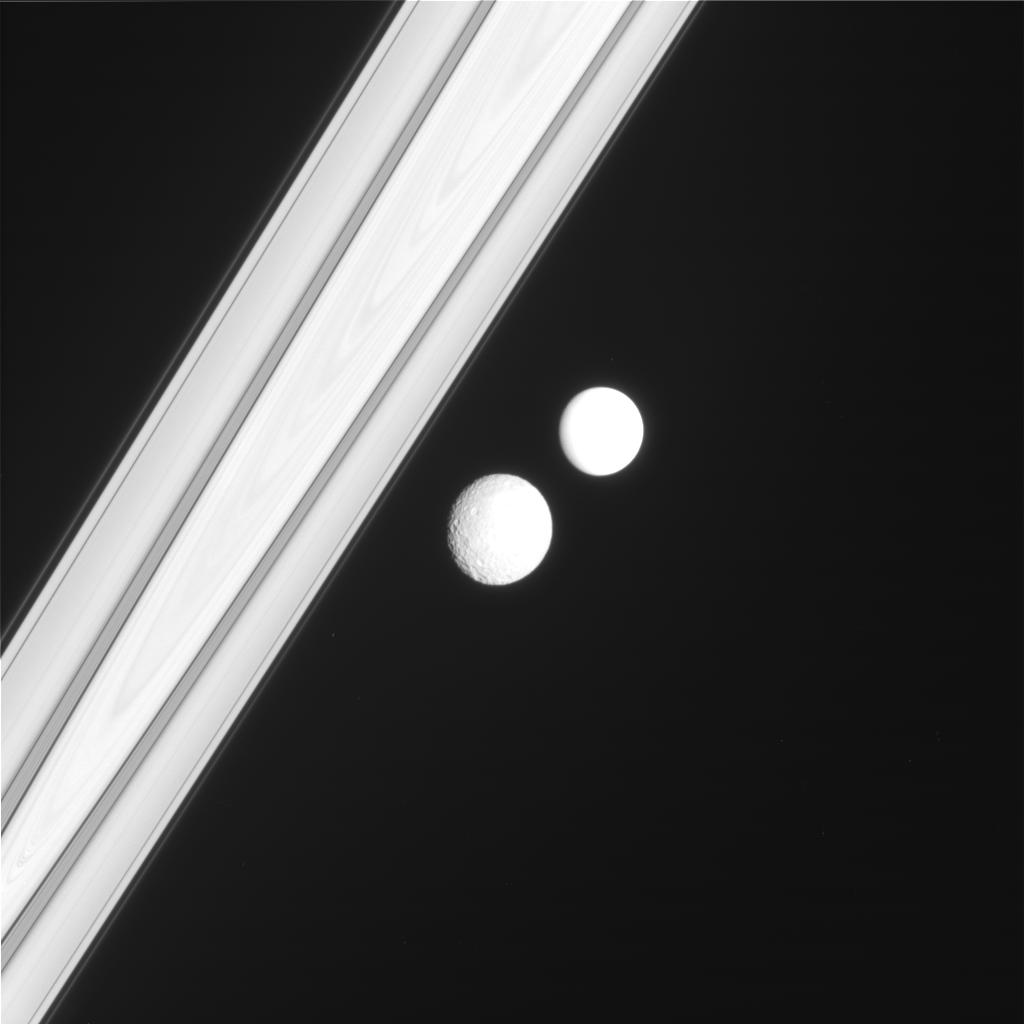
Cool image time! The picture to the right, cropped and enhanced to post here, was taken on December 23, 2005 by Cassini as it orbited Saturn.
The larger cratered moon is Mimas, known best for the single giant crater that dominates one hemisphere. I have not been able to identify the brighter but smaller moon.
Note the pattern within the largest bright central ring in the background. It is possible this is an optical illusion, but it is also possible this pattern is inherent in the ring itself. Other images show similar patterns that scientists have concluded were real.
This image was part of a set of eight images all taken in the space of less than two minutes, as the smaller moon moved from the lower left to the upper right and was eclipsed by Minas as it did so. Below are four of those pictures, showing the sequence.
For original images, go here, here,
here, and here.
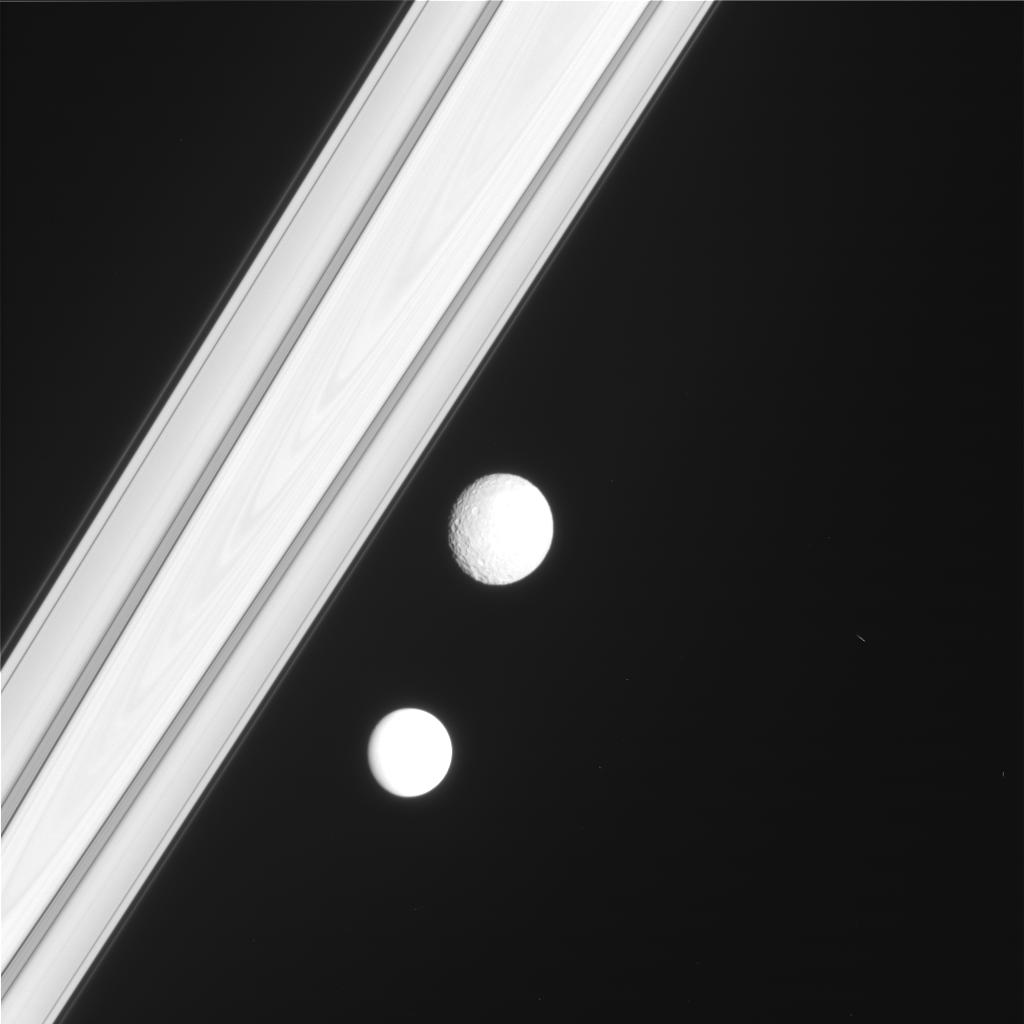

The four images to the right, cropped and reduced to post here, were all taken on December 12, 2005 over a span of less than two minutes (see here, here, here, and here).
As far as I can determine after some extensive searching, it appears the Cassini science team never issued a press release about this particular eclipse. If so, this means this is the first time these images have been highlighted in the general press.
The speed in which the small moon moves is an illusion. The camera was pointed at Mimas, so it remains still as the scenery around it shifts. In addition, the moons are not as close to each other as this sequence suggests.
That other moon appears to orbit closer to the rings. It also appears brighter with fewer craters. If anyone can identify it please say so in the comments.
On Christmas Eve 1968 three Americans became the first humans to visit another world. What they did to celebrate was unexpected and profound, and will be remembered throughout all human history. Genesis: the Story of Apollo 8, Robert Zimmerman's classic history of humanity's first journey to another world, tells that story, and it is now available as both an ebook and an audiobook, both with a foreword by Valerie Anders and a new introduction by Robert Zimmerman.
The print edition can be purchased at Amazon or from any other book seller. If you want an autographed copy the price is $60 for the hardback and $45 for the paperback, plus $8 shipping for each. Go here for purchasing details. The ebook is available everywhere for $5.99 (before discount) at amazon, or direct from my ebook publisher, ebookit. If you buy it from ebookit you don't support the big tech companies and the author gets a bigger cut much sooner.
The audiobook is also available at all these vendors, and is also free with a 30-day trial membership to Audible.
"Not simply about one mission, [Genesis] is also the history of America's quest for the moon... Zimmerman has done a masterful job of tying disparate events together into a solid account of one of America's greatest human triumphs."--San Antonio Express-News
I think . . . the other moon may be Titan, just looking at what Cassini was imaging that month (December 2005) in frame with Mimas. (See this: https://www.jpl.nasa.gov/images/pia07666-mimasand-titan-beyond/ )
If so, this would explain its smooth appearance; though obviously, Titan is farther away from Saturn and its rings, not closer . . . but it is also a much bigger moon than Mimas, too, so it is at least a possibility.
It is frustrating that NASA does not simply identify both moons by name in the image description.
Obviously, I defer to anyone who’s research-fu is better than mine.
Richard M: I have doubts the other moon is Titan. In the picture you link to lighting and distances don’t match well with the image I posted.
At the same time, who knows? We need better information.
I realize that various factors affect reflectivity, but I am a bit troubled by the differences between the two moons. Mimas is clearly exhibiting some shading on its left, but the other moon seems to be showing far less.
Again, I understand that its makeup could simply be overpowering the areas with a lesser amount of shadow, and that the shadow is only evident toward the edge.
F: Both moons have about the same amount of shading on their left sides. It is more obvious with Mimas because of its rough surface producing shadows. If you look closely at the smaller moon, it is clear it is not a perfect sphere, but trimmed on its left side. That area is in shadow.
Note also that to bring out the details in the rings and on Mimas, I darkened this picture slightly.
Both moons are saturated on their right sides, i..e. the individual pixels have reached their maximum values. This was probably expected, with the exposure time set to maximize data from the rings rather than the satellites. I’m with Richard M.; the “smaller” moon looks like Titan to me. Which means that “smaller” is entirely an artifact of “more distant”.
There are only seven spherical Saturnian moons; and my quatloos are on Enceladus. The images of that moon are very similar to the object shown, and the orbital relation to Mimas is correct.
I say Enceladus as well….the rings are in the foreground and we’re looking from underneath. The distance that the two moons would be from the camera, the respective brightness (Enceladus is as bright as a snowball) and sizes (Enceladus is a quarter larger than Mimas and would have been ~ 25,000 miles further away) fits.
Yes, I agree with John and Blair. Enceladus makes sense.