
Three launches, two by SpaceX and one by China
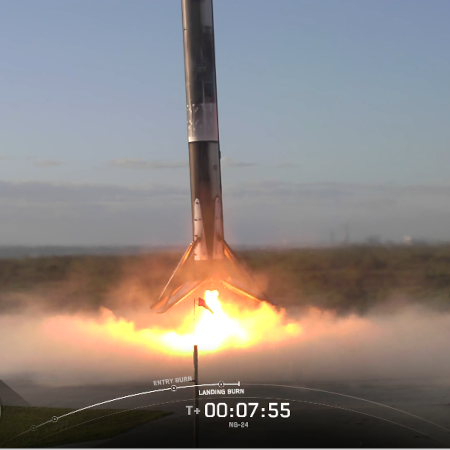
Falcon 9 landing for its seventh time on today’s
third launch. See below.
Since last night there were three launches globally, two by SpaceX, and one by China.
First, in the wee hours of the morning SpaceX placed 25 more Starlink satellites into orbit, its Falcon 9 rocket lifting off from Vandenberg Space Force Base in California. The first stage (B1063) completed its 32nd flight, landing on a drone ship in the Pacific. With this flight, 43 days after the stage’s previous flight, it moved into a tie for fourth place in the rankings of the most reused launch vehicle:
39 Discovery space shuttle
34 Falcon 9 booster B1067
33 Atlantis space shuttle
32 Falcon 9 booster B1071
32 Falcon 9 booster B1063
30 Falcon 9 booster B1069
28 Columbia space shuttle
27 Falcon 9 booster B1077
27 Falcon 9 booster B1078
Next China launched a classified satellite to test “internet technology”, its Smart Dragon-3 (Jielong-3) rocket lifting off from a sea platform in international waters in the South China Sea. Though China has launched numerous times from this sea platform, previous launches were very close to the shore. This was the first time the platform was moved this far into the ocean.
Finally, SpaceX completed its second launch in less than eight hours, sending Northrop Grumman’s Cygnus capsule on its way to ISS with 11,000 pounds of cargo, its Falcon 9 rocket lifting off from Cape Canaveral Space Force Station in Florida. The first stage completed its seventh flight, landing back at Cape Canaveral. Of the two fairings, one was making its first flight, while the other was on its fifth flight.
This was SpaceX’s fourth Cygnus launch for Northrop Grumman. The company originally launched Cygnus on its own Antares rocket, but when that rocket ran out of its Russian first stage engines it was grounded. The company hired Firefly to build a new first stage, but that project remains uncompleted.
Cygnus is scheduled to berth with ISS in two days, on Monday, April 13, at 12:50 pm (Eastern).
The leaders in the 2026 launch race:
44 SpaceX
19 China
5 Rocket Lab
5 Russia
For the third straight year SpaceX continues to lead the entire world combined in total launches, 44 to 34.

On Christmas Eve 1968 three Americans became the first humans to visit another world. What they did to celebrate was unexpected and profound, and will be remembered throughout all human history. Genesis: the Story of Apollo 8, Robert Zimmerman's classic history of humanity's first journey to another world, tells that story, and it is now available as both an ebook and an audiobook, both with a foreword by Valerie Anders and a new introduction by Robert Zimmerman.
The print edition can be purchased at Amazon or from any other book seller. If you want an autographed copy the price is $60 for the hardback and $45 for the paperback, plus $8 shipping for each. Go here for purchasing details. The ebook is available everywhere for $5.99 (before discount) at amazon, or direct from my ebook publisher, ebookit. If you buy it from ebookit you don't support the big tech companies and the author gets a bigger cut much sooner.
The audiobook is also available at all these vendors, and is also free with a 30-day trial membership to Audible.
"Not simply about one mission, [Genesis] is also the history of America's quest for the moon... Zimmerman has done a masterful job of tying disparate events together into a solid account of one of America's greatest human triumphs."--San Antonio Express-News
I wish I had the money to buy a bunch of new Falcons to create a big Saturn IB type deal…landing legs beside the cores.
That might have flown as regularly.
One big Raptor for an upper stage.
Jeff Wright,
Your Kerbal-ish fantasies are still based too much in the past, but at least you’re picking better parts to use. Maybe there’s hope for you yet.
A bundle of eight Falcon 9 hulls would have about 80% more liftoff thrust than a Saturn V. Gary Church wouldn’t be happy with you, though – 72 engines.
Engine number doesn’t bother me as much as long as each “cell” has nine or fewer.
Here’s the thing–you could slide out each core independently…Ship of Theseus style….there would be a top and bottom and in my concept, the legs come straight down.
This is the opposite of SH, that has to be caught.
Here, I am thinking the legs might be tall enough to allow the first stage to land and take off.
I liked Energia because of modularity. You like Starship for reusability.
A cluster approach enables both.
The Chinese want to land three in a row–but I don’t think they can do that…three abreast
I know Elon wants Starship –but I bet Shotwell would be more amenable. Elon is more inflexible than me. I’d prefer Stage-and-a-half hydrolox….but I could live with kerolox. Kerosene is easier to find in the field, and perhaps of more use to the military.
The biggest advantage?
I’d have this Falcon cluster also able to have solid augmentation–to keep Utah happy, and reduce refueling flights.
Imagine 8 (9?) Falcon 9s and four SRBs.
The Falcon cluster
Jeff Wright,
Good luck staying in business with such a contraption, and with the NRE required to make it work. You’re dramatically increasing your costs, and doing so in the face of cheaper competition. The only way for it to survive would be similar to the SLS-funded by the government in defiance of economic reality.
Watched the replay of the Cygnus launch;
That was definitely one of the Top 30 flawlessly produced launch-coverage broadcasts from SpaceX, I have seen. I challenge anyone to watch the Artemis 2 launch and compare.
No signal dropouts, no phrenetic Amphetamine or Ritalin fueled camera switching, perfect amount of narration without stepping on control-chatter, excellent continuous visual telemetry for both stages. Practically a 100% long-range stable tracking lock from all cameras. 8 minutes up and down and I know exactly what happened.
(And I always enjoy seeing the shockwave at Max-Q and state-separation, from both angles.)
Question– I was hearting some babble about “low-data rates” as they approached the Moon as an excuse for CRUMMY live video.
Just exactly what Vital Scientific Experiments were they claiming to do at the expense of good video? It’s a PR stunt, with crummy publicity. P.T. Barnum is spinning in his grave!
Interestingly enough, while the Chinese news Xinhua translates jielong (捷龙) as “smart dragon”, there are alternative definitions that are actually more fitting: “agile dragon”, or “swift dragon”. I think these fit better because the rocket is small, solid-fueled, and can be launched quickly.
Theoretically, the next Cygnus resupply mission is supposed to launch on the first flight of the new Antares 330. But I can virtually nothing on its present status of development.
Well, I believe NG has an option on another Falcon 9 launch, if it’s really delayed.
To Nate,
Modularity means ease of service.
At what used to be Brown-Minneapolis Tank in Birmingham, came a new Sherman Superock block plant in 2000
The folks at Besser offered a second line just for a maintenance contract. Sherman balked, sent their equipment to Mexico…and invested in an automated system called “Tiger” from Japan I think it was. Big mistake.
Rocketry needs propping up….same with shipbuilding. There are only a handful of folks who can weld armor plate properly.
Now, I hope Starship really does become what you hope it is
Forget Boca or Michoud….a rocket on the Moon, made out of Starship steel, could be much larger…wider than tall with no atmosphere/MaxQ
THOSE need to be your Mars ships, cyclers
Mass drivers are cute, but LV growth is what is going to open things up, not frequency alone.
Submariners, not pilots, should be the model. I want to see average people in rotating stations that don’t have to be multi-trained decathlon runners…folks in a ring station seized with an idea that he can test in microgravity that is a walk–not a launch-away.
Elon wants Rocketship XM, I just want infrastructure..
One cottage industry among Star Trek fans are blueprint production ..before CGI ruined things. Nice swam ships, etc.
My favorite, though, was this ugly thing—
https://www.cygnus-x1.net/links/lcars/ss-vadenda.php
Build a factory ship on the Moon, launch it…and go after asteroids instead of whales.
Modularity does not mean that. It all depends on how something is designed. The rocket you suggest above would require more maintenance time, a more complex setup just to keep it operating, and a larger workforce to handle the multiple types of engines. You’d balloon your costs for little benefit.
The private sector is doing an excellent job of paying for new launch vehicles on its own (with 8 operational or under development to date), it doesn’t need propped up by the government.
Plumping for Mars cyclers at this juncture is like telling Columbus to wait for steam-powered ships.
I think you’ve got something confused here, and don’t really understand what a mass driver is for.
Who is paying for this?
More and more it seems that NASA will need to launch on January 1st, 2nd, or 3rd in 2027 in order to make it into Bob’s Launch Leaderboard.
For five minutes…
Jeff Wright,
I’ll start by echoing everything Nate P said.
Anent additional engineering considerations, the chopstick catch technique was developed to allow dispensing with the parasitic mass of landing tackle on both the Super Heavy booster and Starship upper stage. As every engineering decision is a trade-off, the trade, in this case, was that vehicles lacking landing tackle can only land where there are catch towers to catch them. Given the dominant concepts of operations for Starship stacks, this is a good trade and an element of incremental superiority over older siblings Falcons 9 & H.
Keeping landing gear and even lengthening it would simply increase parasitic mass over even current F9/H levels. And I wouldn’t advise that all landing legs deploy straight down. Peripheral landing legs should still deploy to a considerable angle for stability during and after landing.
The key question is just what benefit all of this parasitic mass would gain you. I don’t see any. You mention the military and the availability of kerosene as though you expect such giant boosters to land at ordinary USAF bases. That seems unlikely. Ordinary USAF bases won’t have vast quantities of LOX on-hand and LOX constitutes a much higher percentage of needed propellant mass than does kerosene. To re-launch, one also needs a launch facility with a flame trench and water deluge. Starship’s IFT-1 test flight already demonstrated what one can expect when launching a super-heavy-class booster with only a concrete pad below. And you will not be able to make the landing legs tall enough to avoid damage upon launch to the booster from shock waves reflected straight back up from the ground. It would, frankly, be both easier and cheaper to erect towers capable of both catch and re-launch from extreme height than to build suitable surface-level launch facilities. One would still need the tank farms and propellant super-chillers to support re-launch in any case.
The above arrangements would be far easier to provide, at the necessary scale, if just an upper stage launched by such a large booster was what needed to be accommodated for landing and re-launch at a large USAF base located far from the continental US where all current and planned large rocket launch facilities are located. The remaining additional logistics facilities at such a base would till need to be considerable, just a lot less than for accommodating giant boosters.
So your notional F9 cluster would still be much better off being caught back at its launch site than to rely on landing legs.
The pointless and complex addition of giant solid rocket boosters to the stack would vastly increase expense, require additional giant crawler-transporters to make such stacks portable and complicate every aspect of vehicle logistics. These are not disadvantages worth incurring just “to keep Utah happy.” Utah needs to get used to the fact that time and technology have passed it by. If Utah is going to have a case of the sulks about this it might as well start sooner rather than later. Just rip that particular band-aid off ASAP.
Finally, there should be an additional word on your last sentence but adding it would contravene the policies of our host so I will simply note its absence.
Richard M,
Firefly is designing and building the new Antares 330 1st stage for NorGrum. The identical stage will also be used on Firefly’s own Eclipse vehicle in combination with a different upper stage. Eclipse was supposed to make a first flight sometime this year, but that estimate was made quite some time ago and I have seen no update since. As with everything space-related, it will fly when it is ready but I think NorGrum will need at least one more Cygnus to be launched by SpaceX before it can take back that chore on its own new hardware.
Jeff Wright,
The goal is low cost. Reusability provides that in the way that was predicted many decades ago. Modularity does not and can add to cost if not done properly. SLS provides neither, Starship provides the important part, reusability, as well as greater payload for similar cost and pricing as the Falcons.
We must advance the technology, hardware, methods, and software in order to improve efficiencies, especially financial efficiencies.
An up-and-coming young man
https://m.youtube.com/watch?v=MgJEWF5z-ac
Reusability and robustness go together.
The cluster approach is packaging for Falcon cores, and they know about that.
Solids are tough, and reducing complexity is worth something a bit massy.
If you go down the weight savings road–you will just end up with Centaur.
The first stage can be as stout as it likes. An upper stage is another matter.
Now, maybe a giant Centaur can be opened up and the skin used as a reflector.
Edward,
One would think that lowering costs, so we can do more with our resources, would be widely popular. Yet it is not. There are large swathes of the space community who react to cost-cutting as if it is a demon. I sometimes wonder if it’s because they don’t believe there’s all that much you can really do in space, and think our technical ability has hit its apex, so cutting costs is impossible without doing irreversible damage to the space sector. I’d think the significant changes in projects under development, new launch vehicles, thousands of new satellites, and new markets gradually opening up would be enough to persuade the reluctant, but instead they get more defensive still.
I don’t think that is a space thing Nate. A lot of people see efficiency as a way to cost them their jobs. I see resistance to change in construction with some trades virtually unchanged from the 70s when I started. It’s more obvious to us space fans because we’re paying attention. I’ve repeatedly seen better techniques set aside as soon as guys can get away with it.
Most people not seeing efficiency as life enhancing is the core problem IMO.
john hare,
Yes, that’s true. I wasn’t attempting to address all possible fields though, just space. And here a goodly percentage of the people I’m referring to are not employed by the space industry in any way, even tangentially, though for some of them, such as Jeff Wright, they see improved efficiency as impacting employment in their state. Still doesn’t explain why they often think there’s not much to do in space and that we’ve reached the pinnacle of technology.
Do you hear me lamenting ULA? They are in my State too, Nate.
This is about human dignity
The Right and the Left have the same hate for the common man… useful idiots, useless eaters, NPC.
Wall Street efficiency gurus and Greens see their fellow men not as a resource, but a problem.
Lenin was all but wedded to Taylorism.
Some days, Elon sounds like AOC in universal income.
https://finance.yahoo.com/news/elon-musk-predicts-universal-high-160726163.html
One of my favorite TV series was the original (film) Twilight Zone….not the one with feminazis who murdered veterans returning in NASP, or the newer one.
One of the best episodes is this:
https://en.wikipedia.org/wiki/The_Brain_Center_at_Whipple%27s
It is progressive, but not foolishness, due to one important fact:
Efficiency is the enemy of involvement.
During the Depression, people saved their pennies for movies. This was not foolishness, but uplift. The excitement of children of those standing armies….those kids are your allies against those who are anti-space….yet you concede nothing.
NASA and SpaceX have different reasons to exist
The latter’s reason to exist is to bring people to space.
The former? To bring space to the people.
This is complementary.
Even though I laughed a bit when Whipple joined Hanley at a pub, having been a victim of his own cost-cutting…he came across sympathetic….there are some things men must do to remain men.
Jeff Wright,
Elon may, superficially, sound a bit like AOC of late, but the difference is in the mechanism that would support their visions.
Being, as are all lefties, completely innumerate as well as completely ignorant of the origins of wealth creation, AOC thinks it’s just a matter of increased confiscation – take enough money from the rich by force and give it to the poor and all will be well with the world.
The problem with socialism, as the late Margaret Thatcher concisely put it, was that sooner or later one runs out of other peoples’ money. If the entire net worth of every American billionaire could be simultaneously confiscated and turned to cash at current valuations – an economic impossibility, by the way – the yield would still only allow current levels of government expenditure for a single year. What happens next year? The AOCs of the world have no answer because there isn’t one to be had.
Elon’s notion of Sustainable Abundance, though, is that his Optimus robots will produce such a rise in productivity that everyone – in the US at first, but eventually everywhere – can enjoy a present-day American level of lifestyle without needing to work and that this lifestyle will continue to improve over time.
There are definitely some potential large psychological pitfalls that might well ensue, but Elon is not wrong to be kicking around ideas for a future economic system that is neither socialism nor capitalism in their classic senses. Socialism, of course, has never worked because humans are still the key productive resource and socialism is fundamentally contrary to human nature in any social order larger than a tribe the size of a military company.
Capitalism works far better at scale, but has also always depended upon an expanding population with younger population cohorts outnumbering their elders. In much of the world today, neither of those conditions apply. Unmodified capitalism is finding the going increasingly difficult under such circumstances.
Elon sees AI and armies of autonomous androids as potential answers to these dilemmas. He may or may not prove to be right, but he’s at least given the matter some serious thought and done so without ideological blinders on. Perhaps “socialism” of a sort can actually work if the “workers” don’t so much own the means of production but, instead, largely are the means of production with most of said workers being non-sentient non-humans.
I suspect we shall see as time goes on. Elon would be able to test out his notions first on his own workforces and expand from there. Don’t be surprised if that begins to happen sometime in the next few years.
Jeff Wright,
If that’s so, then we shouldn’t give people makework jobs, as those are an affront to dignity.
Perhaps if one aggressively misunderstands him. I think he’s missing a trick here, but for a very different reason than the DSA types.
Efficiency and involvement are independent variables.
What am I supposed to be conceding? Your own analogy says involvement can come in the form of observation, not active participation, which undercuts your employment argument.
Seems arbitrary and unjustified. SpaceX itself employs nearly so many people as NASA, and will probably surpass it in a few years. The private space sector as a whole employs more than ten times as many people as NASA. Ergo, they’re the ones bringing space to the people.
Ah, I see. You view cost-cutting exclusively as firing people. Riddle me this, then: SpaceX has a far larger workforce than ULA, yet routinely sells launches for less. If the only means of cost-cutting is firing workers, why isn’t SpaceX always more expensive?
To return to your point about concessions, you offer nothing worth conceding, and you offer little in exchanging for conceding something to you. What incentives does anyone else here have for giving you what you want?
re: Make work
https://www.youtube.com/watch?v=aDf4b_Trbhg
Midnight in the Garden of Good and Evil
Jeff Wright,
You wrote: “Wall Street efficiency gurus and Greens see their fellow men not as a resource, but a problem.”
Just shows how little you know. Wall Street efficiency gurus know that when fewer people can produce just as much, then the number of people that you have can produce more. Sometimes that “more” is produced within the same company, and sometimes it is produced by other companies. If the same company produces that “more,” then the gurus are worth their paycheck.
The United States works much, much more efficiently today than we did 100 years ago, yet so many more Americans are employed this year than in 1926. Not despite the efficiency but because of it.
The Wall Street efficiency gurus see their fellow men as their resource, one that must be able to work as efficiently as possible.
_________
Dick Eagleson wrote: “If the entire net worth of every American billionaire could be simultaneously confiscated and turned to cash at current valuations – an economic impossibility, by the way – the yield would still only allow current levels of government expenditure for a single year”
Bill Whittle did a video showing how long the wealth of the rich can fund the government during the low-spending 2011 and what other revenue sources and spending cuts would get to the end of the year: “Eat the Rich” https://www.youtube.com/watch?v=661pi6K-8WQ (10 minutes)
Just remember Apollo was killed due to cost cutting–which would have saved American lives had the Vietnam War been its target.
Nate-thinking is why we haven’t been to the Moon in over half a century.
Jeff Wright,
You could do me the courtesy of addressing my points rather than a strawman.
nothing “straw” about the fact that Artemis II was done in spite of you and yours trying to kill it in the crib.
Lori Garver has given way to Lori Glaze…and even the Everyday Astronaut has found the SLS bashing tedious.
Jeff Wright,
There are a lot of reasons we hadn’t been back to the Moon in over 50 years. Nate-thinking is not among them.
Savor Artemis 2 while you can. SLS and Orion have maybe three more missions in them and then it’s the churchyard.
Hello Jeff,
“Just remember Apollo was killed due to cost cutting–which would have saved American lives had the Vietnam War been its target.”
We stuck around in Vietnam through 1973 because there was still far more public support for some kind of military commitment than there was for NASA’s lunar program, even after Tet and all the anti-war protests. It sucks, but that was the reality. It’s borne out by all the public polling we have for that period. You have to blame the American voters, too.
I hate having to repeat this, but the other thing that worked against Apollo was the very high risk of those lunar missions — that wasn’t as *public* a factor, but it weighed greatly on key decision-makers. NASA never did an official probability risk assessment, but even by the J-class missions (when NASA was getting fairly proficient at the whole thing) the odds of a loss of mission were likely little better than Russian Roulette odds (we had one 1 LOM in 7 attempted lunar surface missions, so that’s about right), and the odds of a loss of crew not much better. There were senior NASA leaders like Bob Gilruth and Chris Kraft who wanted to end the whole thing after Apollo 11. Apollo 13’s close shave with death freaked out Nixon, who was close to the astronauts, and there is evidence that it was one of the factors in Thomas Paine’s decision to cancel Apollo 15 and Apollo 19 in September 1970, which was less than 5 months after Apollo 13. It doesn’t take anything away from the sheer brilliance and dedication of the men of Apollo to observe that we likely got lucky that we never lost a crew going to the Moon in 1968-72.
There was just a lot working against Apollo, and I think we should marvel that we got what we did. By all rights, we shouldn’t have gone to the Moon until a couple generations later.
Nate P,
“There are large swathes of the space community who react to cost-cutting as if it is a demon. I sometimes wonder if it’s because they don’t believe there’s all that much you can really do in space, and think our technical ability has hit its apex, so cutting costs is impossible without doing irreversible damage to the space sector. I’d think the significant changes in projects under development, new launch vehicles, thousands of new satellites, and new markets gradually opening up would be enough to persuade the reluctant, but instead they get more defensive still.”
I have noticed that for the past several decades the engineers have been focusing heavily on improving the performance of rockets rather than caring about the cost of getting into orbit. The focus has been on doing battle with the rocket equation rather than economy, which is why hydrogen fuel has been popular for upper stages, but these efforts sometimes added to the cost of launch. Higher cost is fine, if the customer is a government that can tax its people or can borrow or print money so that price is no object.
The rocket equation shows us how few pounds we can get into Earth orbit per hundred pounds of fueled rocket. Rocket scientists and engineers have been rather proud of improving that ratio, slowly iterating better performance on the engines and reducing the dry weight of the rocket. Although this is a noble effort, three decades ago commercial space operators, one of the customer bases, begged the launch industry for cheaper launches ($2,000 per pound) so that more companies could afford to do different business with satellites and probes. Up to then, only communication was making a profit in space. These operators pointed out that the airline industry was affordable because they reuse their expensive aircraft — planes that cost about as much as a rocket — and asked how much would a ticket or a pound of freight cost if an airplane had to be thrown away with each flight. The response in the U.S. was the Evolved Expendable Launch Vehicle (EELV) project, which only resulted in even more expensive launches.
A decade and a half ago, some commercial launch companies worked on reusable, recoverable rockets. The results were the Falcons, New Shepard, SpaceShip Two, and New Glenn. These have reduced the cost per pound into the range that has greatly increased the number of different businesses that use space for profit and prosperity. Annual orbital launches were rarely more than a hundred, but now launches are approaching three hundred per year, with the first reusable orbital vehicle launching over a hundred times annually, carrying an enormous amount of mass to orbit, over the course of a year.
These days, SpaceX is once again doing battle with the rocket equation, but they are doing so while putting priority on low cost. One would think that the entire space community would cheer this effort, but some prefer the expensive, less capable Space Launch System (SLS) to Starship. Others question whether an air-dropped rocket is really a rocket.
You are right, Nate P, that we would think that this result would convince the entire space community that cheaper is better, that enabling a robust and very active space industry is preferred to the wimpy, useless space industry of the previous six decades of government controlled space. New markets are not gradually opening up but are doing it rapidly.
The defensive part of the space community, reluctant to accept progress in space, seems to be more upset that the older companies, the ones that traditionally iterated slightly better rockets, are losing jobs. It is emotional, not rational. They do not see or — more likely — do not care that there are many, many more jobs being created by this vibrant new space industry. These reluctant people are more stuck with their traditional ways than accepting of the results in space that we had expected half a century ago. These are the results we had expected to have with the Space Shuttle, before it demonstrated its inability to reduce costs or to operate frequently.
Many think that the Space Shuttle was a wonderful project, moving us farther in our use of space, but the experience drove large swaths of the space community into preferring the old-style rockets over the low cost rockets. Fortunately, we have many engineers willing to innovate the industry in ways that the customer base had begged for, three decades ago.