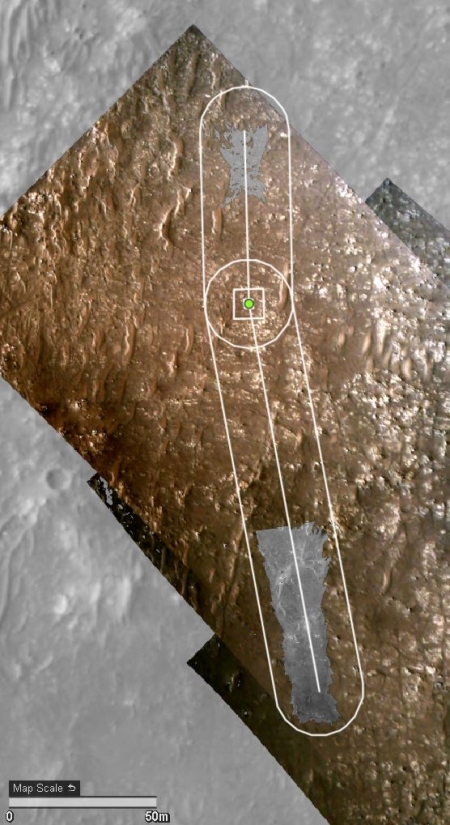
Ingenuity completes fifth flight; lands in new location

On May 7th, 2021 Ingenuity completed its fifth flight on Mars, this time landing at a new location for the first time.

The robot craft took off at ‘Wright Brothers Field’ – the same spot where the it had risen and landed on all its other flights – but landed at an airfield 423 feet (129 metres) to the south. Landing in a new place is another first for the rotorcraft.

This new landing site places the helicopter in a good position to leap frog along with Perseverance as it moves south in this general area studying the floor of Jezero Crater.

27 comments

SpaceX launches and lands 1st stage for record 10th time

During a launch yesterday of another sixty Starlink satellites, the first stage of SpaceX’s Falcon 9 rocket successfully completed its tenth flight, a new record for such boosters.

The turnaround time for this booster is noted at the link, and shows that they have been steadily shortening that time to less than two months.

The leaders in the 2021 launch race:

14 SpaceX
12 China
7 Russia
2 Rocket Lab

The U.S. now leads China 19 to 12 in the national rankings.

13 comments

Long March 5B core stage falls to Earth

Around 10:15 pm (Eastern) the Long March 5B core stage reentered the atmosphere over the Arabian Peninsula, with pieces landing in the Indian Ocean north of the Maldives to the southwest of India.

China has attempted to minimize its behavior here, claiming that most of the rocket burned up and that the chance of any damage was low. Big deal! If you are a responsible spacefaring nation you don’t build rockets that are designed to do this.

Remember, at least three more Long March 5B launches are scheduled in the next the years. As presently designed all will dump that core stage somewhere on Earth in an entirely uncontrolled manner.

8 comments

Today’s blacklisted American: You are supporting the blacklisting of someone, no matter what you do

Rick, stating the truth in Casablanca
Click for video.

Today’s column on blacklisting won’t point out any particular person or group being blacklisted. Instead, I want to make it clear to my readers how completely dominate the intolerant culture of blackballing and censorship has become in America.

This intolerance has been well documented for years in the political, academic, and artistic communities. If you dare to be an outspoken conservative or Republican you will quickly find yourself an outcast, your job threatened and your future squashed. I know. I have been both a filmmaker and a film teacher, and am now a journalist writing often about political matters, and have had to face blacklisting myself more than a few times.

It is only in the last year that it has become evident that the the business community wishes to join in.

To fight this, many open-minded and tolerant Americans try to avoid companies that oppress people for their political views or ethnicity, in the hope that the loss of income will force these companies to change their behavior. In fact, there is now even a webpage, Cancel This Company, that tries to provide a complete list of the worst and most oppressive companies, while also carefully documenting that bad behavior so you know your decision is based on fact.

Sounds good, doesn’t it? Well it ain’t that easy.
» Read more

29 comments

A Martian mud volcano

A Martian mud volcano?
Click for full image.

Cool image time! The photo to the right, rotated, cropped, and reduced to post here, was taken on January 6, 2021 by the high resolution camera on Mars Reconnaissance Orbiter (MRO). It shows a distinct conelike knob in an area of the northern lowland plains of Mars dubbed Acidalia Mensa.

According to this paper [pdf], this is possibly a mud volcano.

Bright pitted cones are common in the northern plains of Mars and have been documented to occur in numerous locations including Acidalia Planitia. Various interpretations of these features have been
proposed but growing consensus in recent literature has favored mud volcanism as the most likely formation mechanism. Mud volcanoes are provocative targets for exploration because they bring to the surface sedimentary materials otherwise inaccessible by normal surface exploration and can aid in reconstructing the sedimentary history of the northern plains. Also, by sampling fluids and sediments from deep in the Martian crust, mud volcanoes may be among the best places to search for ancient and extant life.

A previous cool image post, “Baby volcanoes on Mars”, showed another example in the same general area of Mars.

Though this conclusion is not yet confirmed, the multi-layered apron that surrounds the cone certainly suggests repeated eruptions of muddy water over time.

Scientists have taken many images of this area and cone using MRO’s context camera. (See this image as and example.) All show a very rough terrain, with cracks, fissures, and many smaller cones and knobs. This particular knob however dominates the landscape as one of the largest features. The aprons around it are darker, and appear to have been overlain on top of the nearby rough ground.

If such cones are mud volcanoes, they represent a geological process that is pretty much unique to Mars. There are some comparable features on Earth, but they are rare and do not match exactly.


1 comment

Long March 5B booster reentry prediction narrows again

Long March 5B landing prediction, May 7, 2021
Click for original.

The Aerospace Corporation has once again narrowed the reentry window for the 21-ton core stage of China’s Long March 5B rocket, launched on April 29th, as shown by the map above. The window is now only eleven hours long, centered over a point in the Indian Ocean at just before midnight on May 8th. The yellow tracks indicate its path after that centerpoint, while the blue lines show its path prior to it. Tick marks show five minute intervals.

The last orbit as shown by this prediction puts it over the following land areas. If the core stage crashes 5 to 20 minutes early, it would land anywhere from Spain to Africa. Another fifteen minutes earlier and Florida and Mexico would be in the landing zone. If it lands 45 to 50 minutes later, it will land somewhere on the continental United States.

China however might be lucky with this booster. The centerpoint of the prediction has definitely begun to stabilize around the Indian Ocean.

With future boosters, who knows? China plans at least three more Long March 5B launches, two in ’22 to launch modules for its space station, and one in ’24 to launch a Hubble-class space telescope to fly in formation with that space station. We shall see this same Keystone cop charade on all three flights, with the core stage tumbling out-of-control and falling back to Earth to crash somewhere that cannot be predicted.

10 comments

Ingenuity’s fifth flight later today

The flight path of Ingenuity's fourth flight
The flight path of Ingenuity’s 3rd and 4th flights.
Click for original image.

According to Ingenuity’s engineering team, the helicopter will make its fifth flight today, and unlike the previous flights, it will not return to is initial take-off point, but will instead land to the south, putting it in a better position to tag along with Perseverance. As noted by Josh Ravitch, Ingenuity’s mechanical engineering lead at JPL,

We are traveling to a new base because this is the direction Perseverance is going, and if we want to continue to demonstrate what can be done from an aerial perspective, we have to go where the rover goes.

The map to the right show’s the flight paths of Ingenuity’s third and fourth flights, with the fourth heading south. Based on the data obtained they scouted out its likely landing place for the fifth flight.

[The] targeted takeoff time is 12:33 p.m. local Mars time (3:26 p.m. EDT, or 12:26 p.m. PDT), with data coming down at 7:31 p.m. EDT (4:31 p.m. PDT). Ingenuity will take off at Wright Brothers Field – the same spot where the helicopter took off and touched back down on all the other flights – but it will land elsewhere, which is another first for our rotorcraft. Ingenuity will climb to 16 feet (5 meters), then retrace its course from flight four, heading south 423 feet (129 meters).

This April 30th Ingenuity update by Håvard Grip, Ingenuity’s chief pilot, provides a very detailed explanation of what they are learning about flight on Mars, describing issues of take-off, landing, dust, and maneuvering. Engineers (or any geeks in general) will find Grip’s commentary most interesting.

3 comments

China Long March 2C rocket launches military satellite

China today used its Long March 2C rocket to put in orbit what it calls a “remote-sensing” satellite that is likely for use by its military.

Launched from an interior spaceport, this rocket’s first stage (using very toxic hypergolic fuels) will fall to Earth somewhere in China’s Guizhou Province. This has been China’s standard operating procedure for decades, sometimes resulting in such stages landing near residential areas.

The leaders in the 2021 launch race:

13 SpaceX
12 China
7 Russia
2 Rocket Lab

The U.S. still leads China 18 to 12 in the national rankings.

2 comments

Boeing and NASA set July 30th for 2nd unmanned Starliner demo mission

Capitalism in space: Boeing and NASA today announced that they have now scheduled the second unmanned Starliner demo mission to ISS for July 30th.

In separate statements, the agency and the company said they were planning to launch the Starliner on a United Launch Alliance Atlas 5 at 2:53 p.m. Eastern July 30 on the Orbital Flight Test (OFT) 2 mission. A launch that day would allow the spacecraft to dock with the International Space Station on the evening of July 31.

The new launch date comes after NASA and Boeing completed an “integrated mission dress rehearsal” for the mission using a simulator at a Boeing facility in Houston. The five-day simulation covered activities starting 26 hours before launch and going through landing, including docking and undocking from the station.

Both Boeing and NASA are still hopeful that the first manned flight of Starliner can still take place before the end of this year. Whether it does or not will largely depend on how well things go on this unmanned demo flight.

1 comment

No plans to shoot down Long March 5B booster; revised prediction

The Biden administration will make no attempt to shoot down the 21-ton core stage of China’s Long March 5B rocket, according to the Defense secretary Lloyd Austin:

At this point we don’t have a plan to shoot the rocket down. We’re hopeful it will land in a place where it won’t harm anyone. Hopefully in the ocean or someplace like that. I think this speaks to the fact that for those of us who operate in the space domain that there should be a requirement to operate in a safe and thoughtful mode and make sure that we take those kinds of things into consideration as we plan and conduct operations.

Meanwhile, the predicted reentry window has shrunk again, to 16 hours, and shifted so that its centerpoint is now over Egypt, as shown on this map by the Aerospace Corporation:
» Read more

12 comments
1 939 940 941 942 943 2,914