Don McMillan – Comedy for scientists
An evening pause: I wonder how many of my readers will get that last joke.
Hat tip Tom Biggar. And a great weekend to all.
An evening pause: I wonder how many of my readers will get that last joke.
Hat tip Tom Biggar. And a great weekend to all.
Courtesy of BtB’s stringer Jay.
The press release [pdf] provides more details.
The company, Black Sky, appears a long way from actual launches.
Essentially they put the gear in the airlock, and then the robot arm, operated by an astronaut, pulls it out. From there however a spacewalk is usually required to install the gear, depending on what it is.
“Nearby” is an understatement, especially considering this is a rocket using toxic hypergolic fuel. The videographer couldn’t have been more than a half mile away, and maybe as close as a quarter of a mile.
This decision illustrates the critical importance of acting fast in a competitive market. SpaceX moves fast, gets launched first, and thus automatically gets priority when conflicts occur with other systems that are only proposed.
Ticket prices will start at $125K per person.
This agreement, like the Biden administration’s call for a similar ban, is worthless. When it comes time that someone wants to use force in space, force will be used, whether morally right or not. And the victim will have no choice but to respond in kind. That simply is the way of all things.

On Christmas Eve 1968 three Americans became the first humans to visit another world. What they did to celebrate was unexpected and profound, and will be remembered throughout all human history. Genesis: the Story of Apollo 8, Robert Zimmerman's classic history of humanity's first journey to another world, tells that story, and it is now available as both an ebook and an audiobook, both with a foreword by Valerie Anders and a new introduction by Robert Zimmerman.
The print edition can be purchased at Amazon or any other book seller. If you want an autographed copy the price is $60 for the hardback and $45 for the paperback, plus $8 shipping for each. Go here for purchasing details. The ebook is available everywhere for $5.99 (before discount) at amazon, or direct from my ebook publisher, ebookit you don't support the big tech companies and the author gets a bigger cut much sooner.
"Not simply about one mission, [Genesis] is also the history of America's quest for the moon... Zimmerman has done a masterful job of tying disparate events together into a solid account of one of America's greatest human triumphs."--San Antonio Express-News
Click for original image.
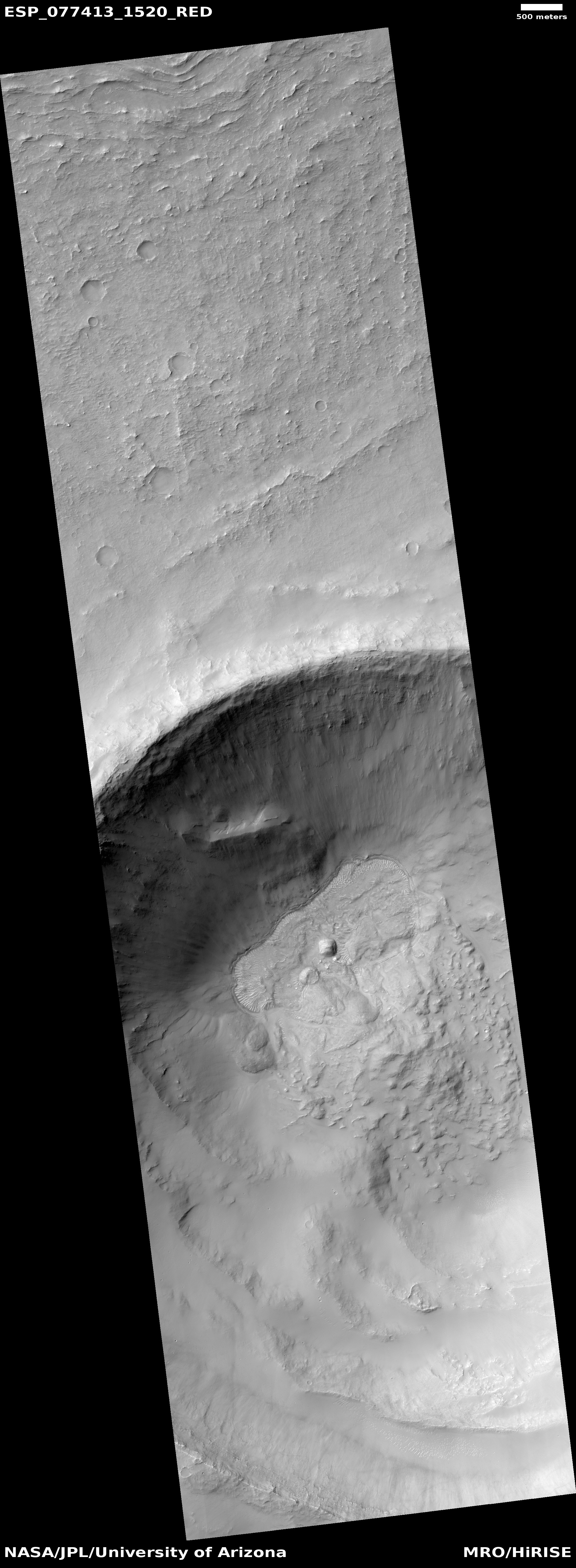
Today’s cool image from Mars is not so much unique visually as it is unique in terms of its location. The picture to the right, rotated, cropped, reduced, and sharpened to post here, was taken on January 31, 2023 by the high resolution camera on Mars Reconnaissance Orbiter (MRO). It shows the northern rim of a small crater, with its floor filled with an intriguing mound of material.
The picture was labeled a “terrain sample”, which suggests it wasn’t taken as part of any specific research project by instead to fill a gap in the camera’s schedule. To maintain the camera’s proper temperature, it is necessary to take pictures regularly, and when the camera team finds a gap that is too long, they fill it by choosing some almost random target in that gap that might be interesting. Sometimes it is, sometimes not.
In this case I strongly suspect this target was hardly random. The picture title also mentions MRO’s now retired radar CRISM instrument, which was used to detect evidence of underground ice. My guess is that the camera team thus likely decided to image this crater in high resolution because that radar data suggested the presence of underground ice.
This guess is strongly confirmed by a context camera picture taken of this crater on September 1, 2008. The crater appears surrounded by the typical splash apron one routinely sees around impact craters in the mid- and high-latitude northern lowland plains, where there is a lot of near surface ice.
The bumpy mound seen in high resolution on the floor of this crater could very well be buried glacial ice, as it mimics similar features in the many craters in the mid-latitudes of Mars. But is it buried ice? The location says otherwise.
» Read more

Tim Tizon (r) discussing free speech with another student on
March 3, 2022 at that banned YAL table on the ASU campus.
They’re coming for you next: Today’s story is a followup of a February blacklist story. Tim Tizon, a Arizona State University (ASU) student at the time of the incident in March 2022, had been charged with trespass by the university when he set up a Young Americans for Liberty (YAL) table on campus to hand out free copies of the U.S. Constitution.
The location was a designated space for free speech and had not been reserved by anyone. His table was not blocking anything, as numerous witness testified. Yet, school officials showed up and demanded he leave, moving his table to a remote part of the campus where no one would see it. Apparently, Arizona State University officials were uncomfortable with the ideals of freedom and law as stated by Constitution and the Bill of Rights.
Tizon however refused to move, and was charged with trespass, convicted, and sentenced to a fine $300 plus fifteen hours of community service.
» Read more

Now available in hardback and paperback as well as ebook!
From the press release: In this ground-breaking new history of early America, historian Robert Zimmerman not only exposes the lie behind The New York Times 1619 Project that falsely claims slavery is central to the history of the United States, he also provides profound lessons about the nature of human societies, lessons important for Americans today as well as for all future settlers on Mars and elsewhere in space.
“Zimmerman’s ground-breaking history provides every future generation the basic framework for establishing new societies on other worlds. We would be wise to heed what he says.” —Robert Zubrin, founder of the Mars Society.
All editions are available at Amazon, Barnes & Noble, and all book vendors, with the ebook priced at $5.99 before discount. All editions can also be purchased direct from the ebook publisher, ebookit, in which case you don't support the big tech companies and the author gets a bigger cut much sooner.
Autographed printed copies are also available at discount directly from the author (hardback $29.95; paperback $14.95; Shipping cost for either: $6.00). Just send an email to zimmerman @ nasw dot org.
Click for original image.
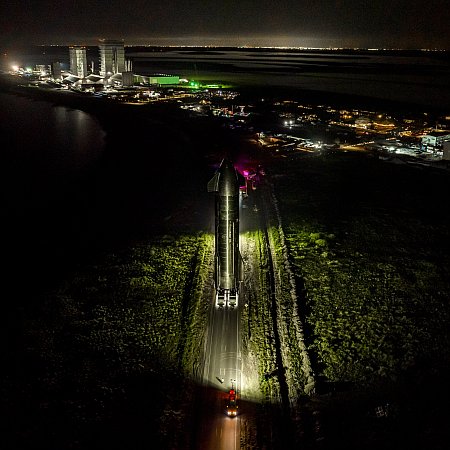
SpaceX yesterday evening rolled its 25th prototype of its Starship spacecraft to its suborbital launchpad at Boca Chica, as shown on the image to the right, for a planned static fire engine test of its six Raptor engines.
If all goes well, the company hopes to stack this prototype on top of the ninth prototype of Superheavy and complete the second test orbital flight of the entire rocket as early as June 15, 2023, with a launch window as long as six months according to the company’s FCC communications license application.
The actual launch date however remains very uncertain, for several reasons. The FAA must issue a launch license, and it won’t do that until it is satisfied the investigation into the first launch failure is complete. That launch approval will also likely be delayed because of the lawsuit against that agency for issuing the previous launch license.

Click for original image.
The smallsat engineering test lunar orbiter Capstone has now successfully ended its primary mission, completing six months of operation in the near-rectilinear halo orbit that NASA’s Lunar Gateway manned space station intends to fly.
To put a final touch on that main mission, in May mission managers at the private company Advanced Space also completed two additional experiments. On May 3, 2023 they performed a close-fly of the Moon, using the spacecraft’s camera for the first time to take the picture of the Moon to the right.
Then, on May 9 Capstone successfully tested navigation technology in conjunction with NASA’s Lunar Reconnaissance Orbiter (LRO), also in orbit around the Moon.
During the May 9 experiment, CAPSTONE sent a signal to LRO designed to measure the distance and relative velocity between the two spacecraft. LRO then returned the signal to CAPSTONE, where it was converted into a measurement. The test proved the ability to collect measurements that will be utilized by CAPS software to determine the positioning of both spacecraft. This capability could provide autonomous onboard navigation information for future lunar missions.
The mission now enters its extended mission, planned to last at least a year.

Leaving Earth: Space Stations, Rival Superpowers, and the Quest for Interplanetary Travel, can be purchased as an ebook everywhere for only $3.99 (before discount) at amazon, Barnes & Noble, all ebook vendors, or direct from my ebook publisher, ebookit.
If you buy it from ebookit you don't support the big oppressive tech companies and I get a bigger cut much sooner.
"Leaving Earth is one of the best and certainly the most comprehensive summary of our drive into space that I have ever read. It will be invaluable to future scholars because it will tell them how the next chapter of human history opened." -- Arthur C. Clarke
Lucy’s route through the solar system
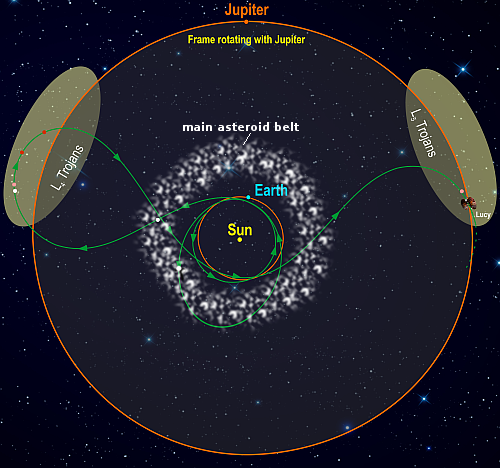
The asteroid probe Lucy on May 9, 2023 fired its engines to successfully make a minor course correction in preparation for a fly by of the asteroid Dinkinesh, located in the main asteroid belt between Mars and Jupiter.
Even though the spacecraft is currently travelling at approximately 43,000 mph (19.4 km/s), this small nudge is enough to move the spacecraft nearly 40,000 miles (65,000 km) closer to the asteroid during the planned encounter on Nov. 1, 2023. The spacecraft will fly a mere 265 miles (425 km) from the small, half-mile- (sub-km)-sized asteroid, while travelling at a relative speed of 10,000 mph (4.5 km/s).
Dinkinesh, the white dot inside the main asteroid belt in the lower left of the map to the right, is the first of eight asteroids Lucy will fly past.
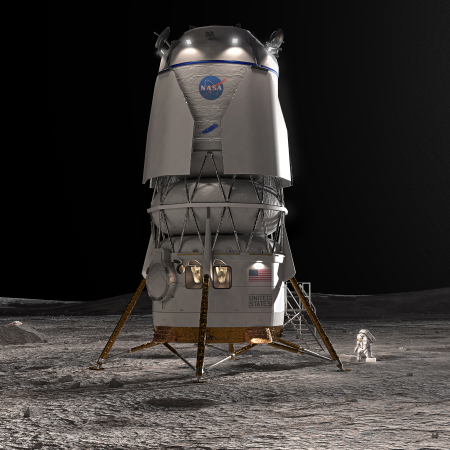
An artist’s concept of Blue Moon
NASA today announced that it has chosen the partnership led by Blue Origin to build a second manned lunar lander for its Artemis program.
Blue Origin will design, develop, test, and verify its Blue Moon lander to meet NASA’s human landing system requirements for recurring astronaut expeditions to the lunar surface, including docking with Gateway, a space station where crew transfer in lunar orbit. In addition to design and development work, the contract includes one uncrewed demonstration mission to the lunar surface before a crewed demo on the Artemis V mission in 2029. The total award value of the firm-fixed price contract is $3.4 billion.
The other partners in the contract are Draper, Astrobotic, and Honeybee Robotics.
This is NASA’s second contract for a lunar lander, with SpaceX’s Starship the first. The idea is to have two landers available from competing companies for both competition and redundancy, similar to the approach the agency has used for its manned ferry service to ISS, using SpaceX and Boeing. I wonder if NASA’s experience on the Moon will be similar to that ferry service, whereby only SpaceX so far has been able to deliver. The track record of Blue Origin suggests it will do about as poorly as Boeing has with Starliner.
Using its Falcon 9 rocket SpaceX early today successfully launched another 22 upgraded Starlink satellites into orbit, lifting off from Cape Canaveral.
The first stage completed its fifth flight, landing successfully on a drone ship in the Atlantic. The fairings completed their eighth flight.
The leaders in the 2023 launch race:
32 SpaceX
18 China
6 Russia
4 Rocket Lab
American private enterprise now leads China 36 to 18 in the national rankings, and the entire world combined 36 to 30. SpaceX by itself only trails the entire world combined, including American companies, 32 to 34.
An evening pause: Music is of course Ravel’s Bolero. This provides us an elegant thumbnail history of the Soviet Union using dance, choreography, and clever filming. And it is honest, showing how the whole thing was run by gangstas, as all such top-down communist/socialist societies are, and as America is now adopting. More information about the entire work here.
Hat tip Dave McCooey.

The goal of college diversity programs for Jews
They’re coming for you next: Rather than write a column today (I feel very burnt out by all that I read), I would instead like to point my readers to this detailed overview of the return of wide-spread and pervasive anti-Semitism at American universities, all under the guise of the “diversity, equity, and inclusion” (DEI) mantra, which in itself is merely a restatement of “critical race theory,” which is also merely a rewording of basic Marxist racism.
This quote sums the article up:
[T]he DEI regime is key to understanding the climate on college campuses for Jewish students. Our desire to quantify everything has led the network of Jewish advocacy groups in the United States to measure anti-Semitism by “incidents.” That is certainly part of it—but only part. It is unnerving to see a swastika or “from the river to the sea” scrawled in chalk on the sidewalk outside a campus Hillel. But what those incident reports don’t show are actions and thought leadership sometimes orders of magnitude more sinister.
In an atmosphere where DEI has great sway, merely to denounce anti-Semitic violence is to risk one’s job, reputation, career, livelihood. And to express one’s Judaism openly on college campuses in that atmosphere requires a dose of courage no one should be required to show just to live a day-to-day life. In 2021, the Louis D. Brandeis Center for Human Rights Under Law surveyed “openly Jewish” college students and found that nearly 70 percent “personally experienced or were familiar with an anti-Semitic attack in the past 120 days.” In addition, more than 65 percent “have felt unsafe on campus due to physical or verbal attacks, with one in 10 reporting they have feared they themselves would be physically attacked.” And, the Brandeis Center continues, roughly 50 percent “have felt the need to hide their Jewish identity.”
Of those who hid their identity on campus, 30 percent did so because they were worried about how their professors would treat them. And why wouldn’t they worry? George Washington University sided with the professor who harassed Jewish students and retaliated when they objected—all in the name of “diversity.”
The story recounts many examples of this kind of bigotry, all endorsed and even instigated by the diversity officers at the colleges, with many of those stories already specifically described by me in past blacklist columns. What makes this article useful is how it takes a wider view to clearly illustrate how the administrative culture of academia is now hand-in-glove with anti-Semitism, and is working hard to encourage it at all levels.
Courtesy of BtB’s stringer Jay.
The company has still not announced a launch date.
This version, not yet launched, is not reusable in any way, but the pseudo-company also shows video of a future version landing exactly like the Falcon 9.
Of all the companies in Blue Origin’s Orbital Reef space station partnership, Sierra Space appears to be getting the most done, with the partnership’s “leader” Blue Origin far in the rear, apparently accomplishing nothing.
We should know Virgin Orbit’s fate on May 24th.

Click for full image.vi
Today’s cool image takes us to a part of the cratered southern highlands of Mars that I have not featured much previously. The picture to the right, rotated, cropped, and reduced to post here, was taken on March 7, 2023 by the high resolution camera on Mars Reconnaissance Orbiter (MRO). It shows what appears to be a collection of rough hills and mesas surrounded by a sea of smooth ground that at the base of the cliffs seems to end abruptly.
The smooth ground is probably mantled by a layer of dust and debris. Since this location is at 36 degrees south latitude, there is also probably near surface ice under that layer. The abrupt edges likely indicate where the increasing slope next to the mesas and mounds caused that ice to be exposed and thus sublimate away.
As for the location, we must go to the overview map.
» Read more
Using data from a variety of space- and ground-based telescopes astronomers have discovered Earth-sized exoplanet orbiting a red dwarf star 90 light years away.
The exoplanet is dubbed LP 791-18 d, and is thought to be slightly bigger than the Earth. Its orbit, close to the star, causes it to be tidally-locked, with one hemisphere always facing the star. In addition, the presence of another much larger exoplanet in the system causes other tidal effects.
Astronomers already knew about two other worlds in the system before this discovery, called LP 791-18 b and c. The inner planet b is about 20% bigger than Earth. The outer planet c is about 2.5 times Earth’s size and more than seven times its mass.
During each orbit, planets d and c pass very close to each other. Each close pass by the more massive planet c produces a gravitational tug on planet d, making its orbit somewhat elliptical. On this elliptical path, planet d is slightly deformed every time it goes around the star. These deformations can create enough internal friction to substantially heat the planet’s interior and produce volcanic activity at its surface. Jupiter and some of its moons affect Io in a similar way.
The press release makes a big deal about the volcanism, even suggesting it could produce an atmosphere that, because the exoplanet sits on the inner edge of the habitable zone, could make the exoplanet habitable. These speculations are silly, considering the uncertainties, the exoplanet’s evolving orbit, and the star it orbits, and are being pushed mostly because the press office thinks this will be the only way the public will have any interest in the discovery.
While there is an infinitesimal chance there could be life here, a more likely scenario is that it is a lifeless volcano world like Jupiter’s moon Io. Even more probably however is that it is completely different than anything we have yet observed, in ways we can’t yet predict. To find out however we would need close-up observations that will likely not be possible without an interstellar mission.
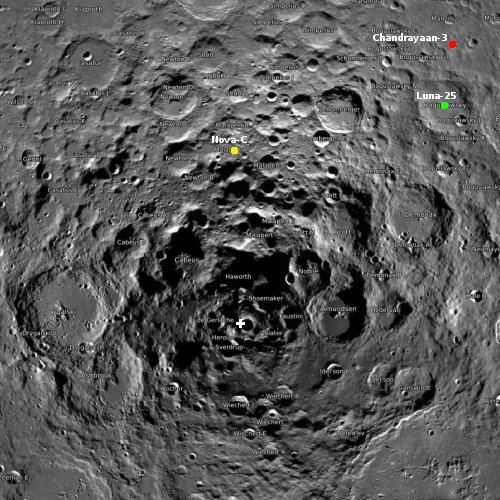
Click for interactive map.
Engineers at India’s space agency ISRO have begun the installation of the payloads onto its lunar lander/rover, Chandrayaan-3, which is still targeting a mid-July launch.
The map shows the landing location (red dot) near the Moon’s south pole (indicated by the cross). Nova-C is Intuitive Machines private lander, now aiming for a late summer launch at the earliest. Luna-25 is Russia’s first lunar lander since the 1970s, and is also targeting a launch in July.
India’s first attempt, Chandryaan-2, to land a rover at this spot on the Moon failed in 2019. This new mission is essentially a re-do, except that it does not include an orbiter, since the orbiter from Chandrayaan-2 is still operational and can do the job.
All in all, it increasingly looks like the next six months will see a lot of new landing attempts on the Moon.
On April 16, 2023 students from the Embry-Riddle Aeronautical University launched a model rocket that more than doubled the altitude record for liquid-fueled model rockets.
The rocket reached an altitude of 47,732 feet, setting multiple records, including the highest undergraduate and collegiate amateur liquid rocket launch in the United States. It more than doubled the previous record of 22,000 feet.
Named Deneb after one of the brightest stars in the northern hemisphere, the rocket had a total burn time of 26.1 seconds, reaching a velocity of 1,150 mph (Mach 1.5).
I have embedded the live stream below, set to begin just before launch.
» Read more
Embedded below the fold in two parts.
To listen to all of John Batchelor’s podcasts, go here.
» Read more
An evening pause: Performed live 1992. Now an ode to a city that no longer exists.
Hat tip Judd Clark.
Courtesy of BtB’s stringer Jay.
A lot of blather, but his discussion of the radiation problem was interesting. I also found it most amusing that his NASA slide showing how NASA intends to return to the Moon very specifically did not include Starship as the manned lunar lander.
If true, this indicates that the company is dead, since no one has stepped forward to buy it whole and take it out of bankruptcy.
The PowerPoint slide at the link however provides no timeline at all.

Click for original image.
Cool image time! The picture to the right, cropped to post here, was taken on February 17, 2023 by the high resolution camera on Mars Reconnaissance Orbiter (MRO), and shows what the science team labels “regularly textured ground on Pavonis Mons.”
The arrow in the picture indicates the downhill trend. If you look at the full image, you will see that this texture pattern extends in all directions for a considerable distance, both uphill and down, and even covers the entire floor of a depression that appears to contour along the grade instead of going downhill.
The latitude here is very close to the equator. So, even though the elevation is high, being on the slopes of a giant volcano, there is probably no near surface ice here.
» Read more
Robert Pratt today posted the second part of our long discussion begun last week about some of the more egregious recent examples of blacklisting in America. You can listen to it at the Pratt on Texas podcast, at this link. I have also embedded it below.
This might have been one of the best discussions between Robert and myself about the Enlightenment, about rational thought, about religion, and about critical thinking (or the lack thereof in modern society). I strongly urge my readers to spend 26 minutes listening. It is well worth it.
» Read more

Liam Morrison, wearing the evil shirt that he wore the
second time teachers at Nichols Middle School sent
him home.
They’re coming for you next: When 12-year-old Liam Morrison came to Nichols Middle School in Massachusetts on March 21, 2023 wearing a T-shirt with the words “There are only two genders” on the front, two teachers pulled him from class and told him he would have to remove the shirt or he couldn’t return to class. He refused, and so his father came to pick him up.
The teachers claimed he was causing a disruption, that some other unnamed students felt unsafe seeing the shirt. Liam however had experienced the exact opposite. Not only did he hear no complaints, he found many other students telling him they liked the shirt and wanted one for themselves.
Rather than retell his tale in its entirety, however, let’s hear it from his own mouth. I have embedded below Liam Morrison’s statement to the Middleborough School Committee on April 13. Note how clear and articulate he is. If I had to guess, he is getting a lot of education outside of his Massachusetts public school, because based on these events I would have no faith they are teaching him anything of value.
» Read more
The uncertainty of science: Using a variety of telescopes, astronomers have not only made the first radio observations of key type of supernova, they have also detected helium in the data, suggesting that this particular supernova of that type was still atypical.
This marks the first confirmed Type Ia supernova triggered by a white dwarf star that pulled material from a companion star with an outer layer consisting primarily of helium; normally, in the rare cases where the material stripped from the outer layers of the donor star could be detected in spectra, this was mostly hydrogen.
Type Ia supernovae are important for astronomers since they are used to measure the expansion of the universe. However, the origin of these explosions has remained an open question. While it is established that the explosion is caused by a compact white dwarf star that somehow accretes too much matter from a companion star, the exact process and the nature of the progenitor is not known. [emphasis mine]
The highlighted sentences are really the most important take-away from this research. Type Ia supernovae were the phenomenon used by cosmologists to detect the unexpected acceleration of the universe’s expansion billions of years ago. That research assumed these supernovae were well understood and consistently produced the same amount of energy and light, no matter how far away they were or the specific conditions which caused them.
This new supernovae research illustrates how absurd that assumption was. Type Ia supernovae are produced by the interaction of two stars, both of which could have innumerable unique features. It is therefore unreasonable as a scientist to assume all such supernovae are going to be identical in their output. And yet, that is what the cosmologists did in declaring the discovery of dark energy in the late 1990s.
It is also what the scientists who performed this research do. To quote one of the co-authors: “While normal Type Ia supernovae appear to always explode with the same brightness, this supernova tells us that there are many different pathways to a white dwarf star explosion.”
Forgive me if I remain very skeptical.

Click for original image.
The uncertainty of science: Though astronomers have long believed that the Milky Way galaxy is a barred spiral galaxy, defined as having a major straight arm coming out in two directions from its nucleus with other spiral arms surrounding it, determining the exact structure has been difficult because of our presence within the galaxy.
The image to the right, taken from a paper just published, shows three different types of barred spirals. On the left is one where the surrounding spiral arms hardly exist. In the center the central bar is surrounded by multiple arms. On the right is a barred spiral with just one major spiral arm.
Though it has been generally accepted that the Milky Way belongs in the center category, astronomers remain unsure about the actual spiral structure. Previous work had suggested the galaxy actually had four major arms, not two as seen by most barred spirals. As noted in the paper, “If that is the case, the [Milky Way] may be an atypical galaxy in the universe.”
The research from the new paper however now proposes that the Milky Way is actually not atypical, but instead more resembles the center image, with two main arms and multiple segmented arms beyond. From the abstract:
Using the precise locations of very young objects, for the first time, we propose that our galaxy has a multiple-arm morphology that consists of two-arm symmetry (the Perseus and Norma Arms) in the inner parts and that extends to the outer parts, where there are several long, irregular arms (the Centaurus, Sagittarius, Carina, Outer, and Local Arms).
The astronomers cheerfully admit that this conclusion is uncertain, and will need many further observations for confirmation.
After three years of upgrades, the engineers running Italy’s Virgo gravitational wave detector have decided to delay its restart later this month due to unexplained noise issues found inside some older components.
Getting to these parts to find the cause of the noise however will not be simple, as they are housed inside a vacuum chamber.
[According to Virgo spokesperson Gianluca Gemme. “Until we break the vacuum and open the towers to check the interferometer components directly, we cannot be one hundred percent sure what the problem is. … We therefore decided to take action now to resolve the technical issue that is slowing down the interferometer’s sensitivity growth. These are operations that, apart from the work we will have to do, involve time to remove and then restore the ultra-high vacuum conditions.
Once this work is completed it will then require further testing to make sure all is well. It is therefore unclear when Virgo will resume observations.
Meanwhile, the two detectors in the United States plan to resume operations as scheduled later this month. Without Virgo working in tandem, however, the resolution for any detections will be reduced.
After completing a tanking test, engineers have now moved ULA s first Vulcan rocket back to the assembly building for some additional work prior to the first wet dress rehearsal countdown and static fire test.
A ULA spokesperson said the company’s engineers “collected excellent data” during the May 12 tanking test, which mimicked a launch countdown with holds, readiness polls, and other milestones. “Based on the test, there are several parameters that will be adjusted prior to conducting the Flight Readiness Firing,” the ULA spokesperson said in a statement. “We are rolling back to the Vertical Integration Facility, where our access is better and the vehicle is protected to isolate and perform those adjustments.”
The static fire test will occur prior to attaching two strap-on solid-fueled side boosters, provided by Northrop Grumman, that are needed for the first launch. That launch is presently scheduled for sometime this summer, but first the static fire test has to take place successfully, with no issues, and these boosters need to be attached.
China early on Wednesday, May 17, 2023 (China time) used its Long March 3B to successfully launch a GPS-type satellite, adding one more satellite to its constellation of similar satellites.
As the launch was from the Xichang Satellite Launch Center in the interior, the rocket’s core stage and four strap-on boosters crashed somewhere inside China. No word on whether they landed near habitable areas.
The leaders in the 2023 launch race:
31 SpaceX
18 China
6 Russia
4 Rocket Lab
American private enterprise still leads China 35 to 18 in the national rankings, and the entire world combined 35 to 30. SpaceX by itself trails the entire world, including other American companies, 31 to 34 in launches this year.
Courtesy of BtB’s stringer Jay.
This is the engine they are selling for use on larger rockets.
If so, this means the crew would have had no problem coming home in that spacecraft.
These military contracts are designed to help new rocket companies, but are always only a tiny amount of the money the companies need to survive. On that note, there is this next link:
Both have serious financial issues, but Momentus probably a better chance of surviving since it is actually flying its Vigoride tugs. Astra has nothing flying at the moment.
Whether the two planned spaceports can find private investment capital to replace this money remains unclear.
A video of the test can be seen here. If used in Superheavy/Starship, the total rocket would have three times the power of a Saturn-5.
This is not the launch license, only the communications permit.
As Jay notes, it looks like a stony carbonaceous chondrite.
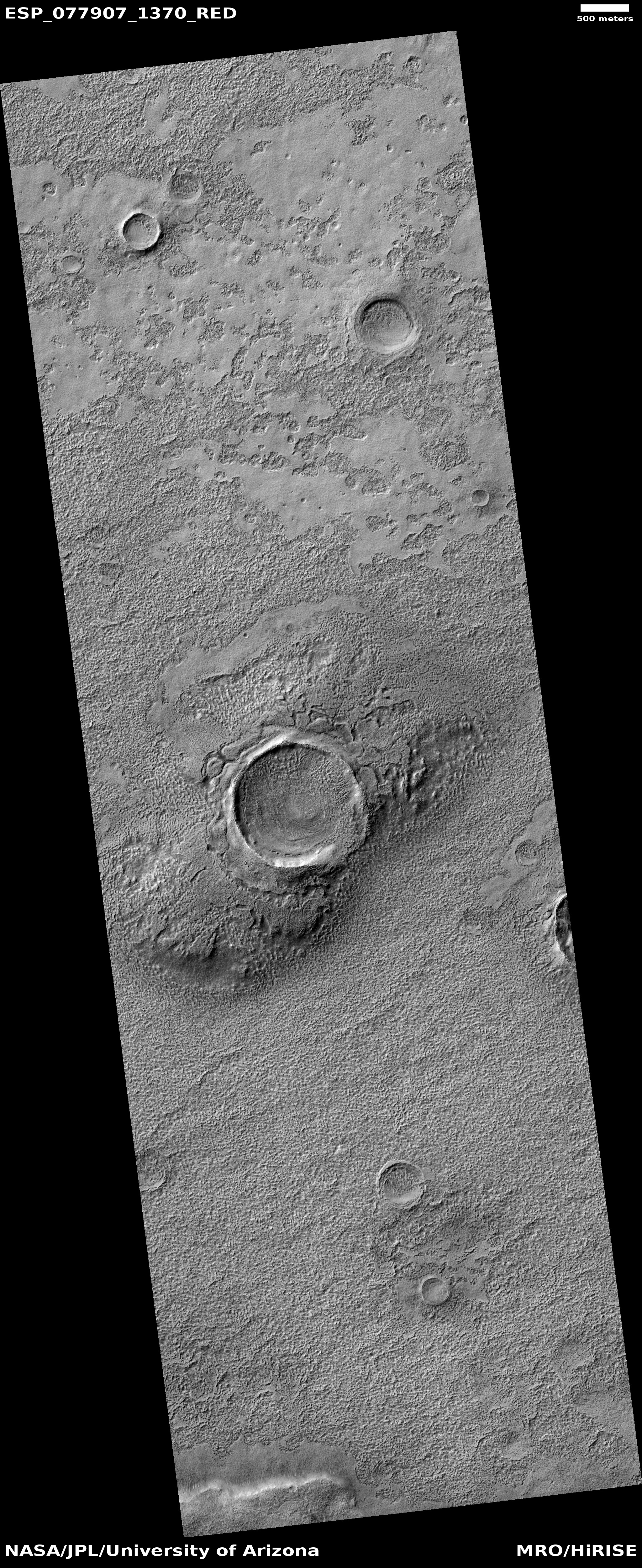
Click for original image.
Cool image time! The picture to the right, cropped, reduced, and sharpened to post here, was taken on March 10, 2023 by the high resolution camera on Mars Reconnaissance Orbiter (MRO).
As I noted in a cool image only two weeks ago, brain terrain is a geological feature wholly unique to Mars that planetary geologists still do not understand or can explain. They know its knobby interweaving nodules (resembling the convolutions of the human brain) are related to near surface ice and its sublimation into gas, but no one has much confidence in any of the theories that posit the process that forms it.
In this case the brain terrain not only fills the crater, it appears to surround it as well, but only appearing at spots where a smooth top layer has begun to break apart. Moreover, the crater appears to be a pedestal crater, whereby much of the less dense surrounding terrain has vanished, leaving the compacted crater sitting higher.
» Read more