June 12, 2026 Zimmerman/Batchelor podcast
Embedded below the fold in two parts.
To listen to all of John Batchelor’s podcasts, go here.
» Read more
Embedded below the fold in two parts.
To listen to all of John Batchelor’s podcasts, go here.
» Read more
An evening pause: If you notice, beginning in 1970 the styles exhibit variety, but no longer appear unique to any time period. Before, you could look at the clothes and pin down the decade pretty closely. After, you’d be hard pressed to identify if it was 1980 or 2025. (Except for that idiotic mask in 2020).
Enjoy the weekend!
Hat tip Mike Nelson.
1900 – 2025: 125 anos de evolução na moda feminina.
🎞️ vgraphs/IG. pic.twitter.com/SgVfBrH2dW
— Arquivo Curioso (@arquivocurioso) May 30, 2026

On Christmas Eve 1968 three Americans became the first humans to visit another world. What they did to celebrate was unexpected and profound, and will be remembered throughout all human history. Genesis: the Story of Apollo 8, Robert Zimmerman's classic history of humanity's first journey to another world, tells that story, and it is now available as both an ebook and an audiobook, both with a foreword by Valerie Anders and a new introduction by Robert Zimmerman.
The print edition can be purchased at Amazon or any other book seller. If you want an autographed copy the price is $60 for the hardback and $45 for the paperback, plus $8 shipping for each. Go here for purchasing details. The ebook is available everywhere for $5.99 (before discount) at amazon, or direct from my ebook publisher, ebookit. If you buy it from ebookit you don't support the big tech companies and the author gets a bigger cut much sooner.
"Not simply about one mission, [Genesis] is also the history of America's quest for the moon... Zimmerman has done a masterful job of tying disparate events together into a solid account of one of America's greatest human triumphs."--San Antonio Express-News
The uncertainty of science: In a new study, researchers attempted to replicate and thus confirm the results of several hundred social science papers, and found that the results of only half could be replicated.
Researchers from a variety of universities looked at “164 quantitative papers published from 2009 to 2018 in 54 journals in the social and behavioural sciences,” according to the summary in the Nature article. The team “attempted replications of 274 claims of positive results” but found only about half could be replicated. The researchers found that many published findings did not consistently hold up when tested again, although the exact replication rate varied depending on how success was measured.
This result jives with other reports over the years that found most science research difficult if not impossible to replicate or confirm.
In fact, every study in the past two decades that attempted to replicate earlier work has consistently found that about half the papers published in the scientific literature in the soft sciences (psychology, social sciences, biology, medicine, pharmaceuticals) could not be confirmed.
In other words, a very very large percentage of science research is junk and should be ignored. In fact, no study or research result should be given any credence until someone else has been able to duplicate the results independently. We should especially pay no attention to declarations by any government health officials, as such declarations are routinely completely divorced from any research at all.
Courtesy of BtB’s stringer Jay. This post is also an open thread. I welcome my readers to post any comments or additional links relating to any space issues, even if unrelated to the links below.

Now available in hardback and paperback as well as ebook!
From the press release: In this ground-breaking new history of early America, historian Robert Zimmerman not only exposes the lie behind The New York Times 1619 Project that falsely claims slavery is central to the history of the United States, he also provides profound lessons about the nature of human societies, lessons important for Americans today as well as for all future settlers on Mars and elsewhere in space.
“Zimmerman’s ground-breaking history provides every future generation the basic framework for establishing new societies on other worlds. We would be wise to heed what he says.” —Robert Zubrin, founder of the Mars Society.
All editions are available at Amazon, Barnes & Noble, and all book vendors, with the ebook priced at $5.99 before discount. All editions can also be purchased direct from the ebook publisher, ebookit, in which case you don't support the big tech companies and the author gets a bigger cut much sooner.
Autographed printed copies are also available at discount directly from the author (hardback $29.95; paperback $14.95; Shipping cost for either: $6.00). Just send an email to zimmerman @ nasw dot org.
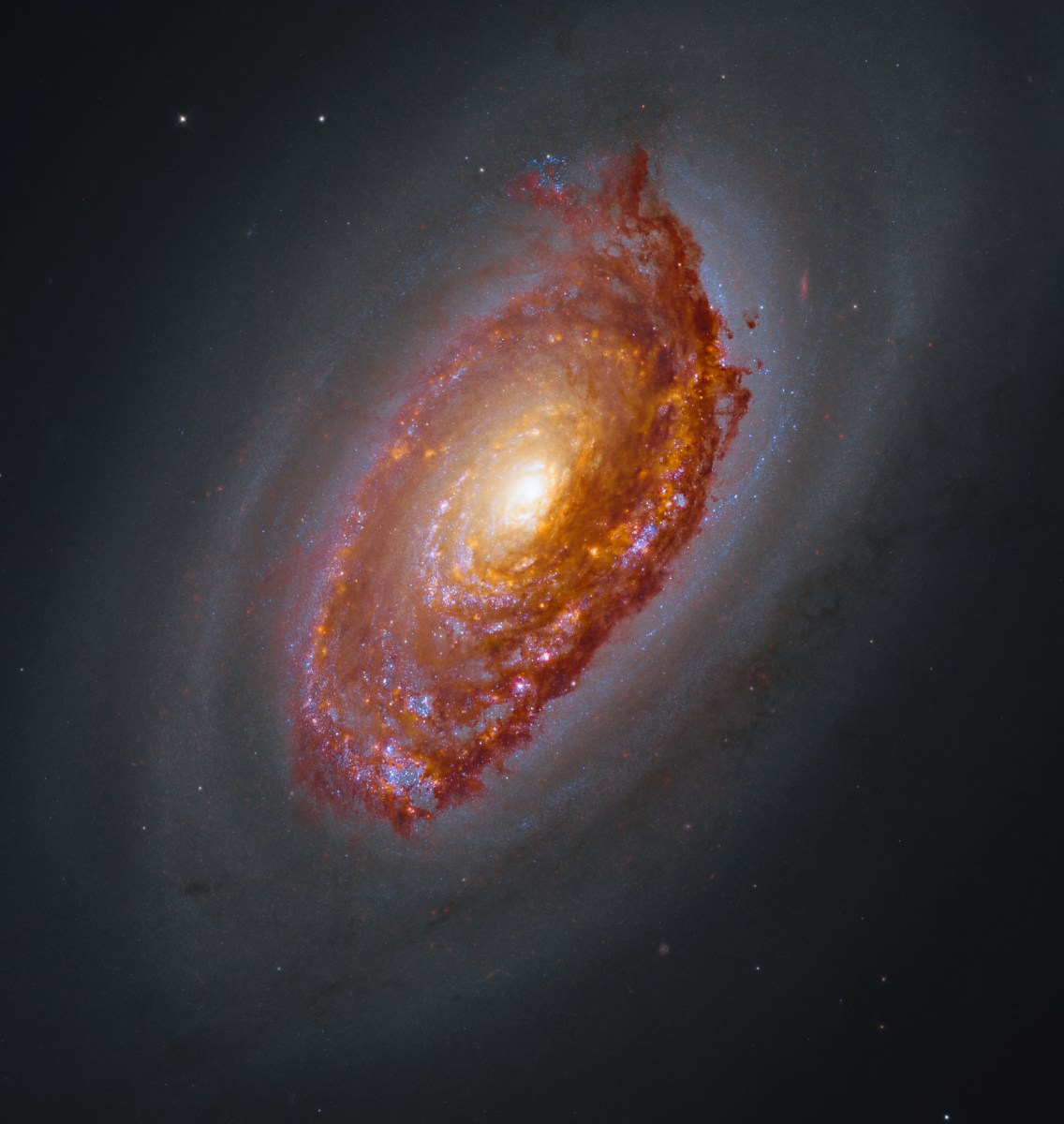
Click for original image.
Cool image time. The picture to the right, cropped and reduced to post here, was taken on March 20, 2026 in a coordinated observations by both the Hubble and Webb space telescopes.
This March 20, 2026, image of Messier 64, or the Black Eye Galaxy, is a composite view from NASA’s Hubble Space Telescope and James Webb Space Telescope. It shows Messier 64 captured at near- and mid-infrared wavelengths by Webb, while Hubble’s image shows the galaxy in ultraviolet, visible, and near-infrared light.
Messier 64 is characterized by its bizarre internal motion. The gas in the outer regions of this spiral galaxy is rotating in the opposite direction from the gas and stars in its inner regions. This strange behavior may be the result of a merger between M64 and a satellite galaxy over a billion years ago.
The red in this image is dust, as the galaxy gets its nickname from the dark streak that wraps around its nucleus on its left side. In optical that streak is dark. Here Webb’s infrared view sees it in false color red.
READERS: It appears that it is a very slow news day today. Other than SpaceX’s IPO, which is on-going and too soon to post any reports, I can so far find nothing much of great significance on which to report.
The beat goes on! Even as SpaceX proceeds today with the largest initial public offering of stock ever, raising an expected $75 billion in cash for its long term plans, the global launch industry marched on with two launches today.
First, Japan’s space agency JAXA successfully launched its H3 rocket on a test flight following a launch failure in December 2025. The rocket lifted off from JAXA’s Tanegashima spaceport in southern Japan, using its simplest configuration, with no solid-fueled strap-on boosters. Though the rocket deployed some cubesats, its main payload was a dummy satellite to test the rocket’s deployment system, which caused the 2025 failure by not holding its satellite in place. On today’s launch, the deployment system worked as planned, which means JAXA can now resume operational launches with H3.
This was Japan’s first launch in 2026.
Next, SpaceX placed another 29 Starlink satellites into orbit, its Falcon 9 rocket lifting off from Cape Canaveral Space Force Station in Florida. The first stage completed its 27th flight, landing on a drone ship in the Atlantic (58 days after its previous flight).
The leaders in the 2026 launch race:
70 SpaceX
36 China
8 Russia
8 Rocket Lab (plus two suborbital HASTE launches)
For the third straight year SpaceX leads the entire world combined in total launches, 70 to 63.

Leaving Earth: Space Stations, Rival Superpowers, and the Quest for Interplanetary Travel, can be purchased as an ebook everywhere for only $3.99 (before discount) at amazon, Barnes & Noble, all ebook vendors, or direct from my ebook publisher, ebookit.
If you buy it from ebookit you don't support the big oppressive tech companies and I get a bigger cut much sooner.
"Leaving Earth is one of the best and certainly the most comprehensive summary of our drive into space that I have ever read. It will be invaluable to future scholars because it will tell them how the next chapter of human history opened." -- Arthur C. Clarke
An evening pause: Performed live 2023. I won’t try to explain it.
Hat tip Judd Clark.
Courtesy of BtB’s stringer Jay. This post is also an open thread. I welcome my readers to post any comments or additional links relating to any space issues, even if unrelated to the links below.
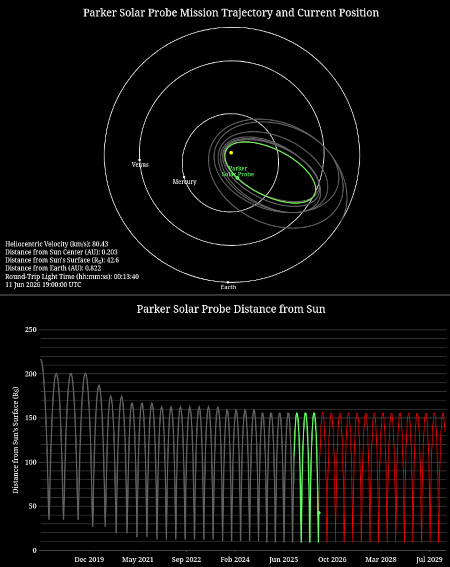
The overall flight plan for Parker. The green indicates
this most recent close approaches.
The Parker Solar Probe this past week successfully completed its 28th close fly-by of the Sun, zipping past its surface at a distance of only 3.8 million miles.
During this solar encounter, which started June 3 and ends Saturday, June 13, Parker’s four scientific instrument packages gathered data from inside the Sun’s atmosphere, or corona. Parker will begin returning detailed spacecraft telemetry on June 14, with science data transmission set to run from Wednesday, June 17 to Tuesday, June 30.
…Parker also equaled its record-setting speed of 430,000 mph — a mark that, like Parker’s distance to the Sun, was set during a close approach on Dec. 24, 2024, and matched during five flybys since, most recently on March 11. Parker will continue matching these speed and distance records during future flybys.
Engineers estimate the spacecraft’s heat shield experiences temperatures exceeding 1,700 degrees Fahrenheit with each close pass.
With each pass the spacecraft dives deep into the Sun’s corona and gathers data about it unobtainable from a distance. It is also gathering that data over time, as it first arrived in 2018, when the Sun was at its solar minimum with little sunspot activity. Since then it has ramped up to maximum and is presently thought to be on its way back down to minimum (though this still remains uncertain). Parker’s ability to gather data cross this timeline is invaluable for gaining a better understanding of the Sun’s behavior.

The scientific method, according to some cosmologists
The uncertainty of science: In two somewhat self-righteous press releases today from two different academic organizations, scientists who have been for three decades touting the somewhat uncertain evidence that the expansion of the universe is accelerating, thus requiring the ad hoc creation of something they label “dark energy” to explain it, insisted that their theory is still right despite publication of a paper last year that said their evidence was weak and unconvincing.
The headlines of the first press release is especially insulting to the very concept of the scientific method:
Both press releases have an arrogant attitude to those questioning the theory of dark energy, but the first is truly egregious. It is filled with bombastic claims, such as calling it “a crisis” for anyone to dare question the theory. It also uses a reliance on authority to justify its position (“The researchers … include two Nobel Laureates and represent institutions worldwide”). And finally, it demands that such questioning end, so “we can get back to trying to understand what this dark energy actually is, rather than wondering if it exists at all.”
The 2025 study that questioned the existence of dark energy — claiming the universe’s expansion rate was not accelerating — was actually part of a string of similar results. It did not occur in a vacuum, and actually stemmed from the overall uncertainty of the original supernova data.
Scientists in the 1990s had begun by assuming the brightness of a certain type of supernova is always the same, no matter when or where it happened. They then measured such supernovae in the early universe and found their brightness suggested the universe was expanding faster than predicted.
Since then, multiple studies have noted the weakness of that basic assumption. We don’t know enough about these supernovae, nor do we know enough about the environment in which they occur in the early universe.
The bottom line: The theory of dark energy might fit the facts as we have them now, but those facts remain uncertain and open to doubt. It is perfectly reasonable to question those facts, and to try to stifle that questioning violates the very fundamentals of the scientific method, which demands you question everything, that you search for truth wherever it may lead.
Sadly, this pattern of arrogance by cosmologists is not new. It has grated on my nerves since my first interview with a cosmologist in 1995, when she got insulted and huffy because I dared ask her some tough questions. This arrogance has gotten so bad that in 2022 24 scientists signed a petition protesting the censorship of their work for questioning the Big Bang theory.
Meanwhile, the data remains uncertain and actually contradictory. One set of data says the Hubble constant (the expansion rate) is one number, while another equally trustworthy data set says the constant is another number. And almost a decade of intense research has failed to resolve the conflict.
This new work might have proven the dark energy theory is still viable, but the press releases do little to convince anyone.
The beat goes on! Since last night both China and SpaceX successfully completed orbital launches.
First, China used its most powerful operating rocket, the Long March 5, to place what its state-run press called “a new communication technology test satellite” into orbit, the rocket lifting off from its coastal Wenchang spaceport. As the Long March 5 can haul very large payloads into orbit, it suggests this one satellite is unusually heavy.
Next, SpaceX successfully placed another 24 Starlink satellites into orbit, its Falcon 9 rocket lifting off from Vandenberg Space Force Base in California.
The first stage (B1071) successfully completed its 34th flight (38 days after its previous flight), landing on a drone ship in the Pacific. With this flight the stage moved past the space shuttle Atlantis, putting it in third place in the rankings for the most reused launch vehicle:
39 Discovery space shuttle
35 Falcon 9 booster B1067
34 Falcon 9 booster B1071
33 Atlantis space shuttle
32 Falcon 9 booster B1063
31 Falcon 9 booster B1069
28 Columbia space shuttle
28 Falcon 9 booster B1077
28 Falcon 9 booster B1078
Though it was not an orbital launch and thus isn’t added to my launch totals, Rocket Lab also launched last night, using its HASTE suborbital version of its Electron rocket to do a suborbital hypersonic test for the War Department, as part of its $190 million contract to do twenty such test flights. This appears to be the first of those launches.
UPDATE: The HASTE launch appears to have actually been an orbital one, with a second stage and kick stage, both of which reached orbit. No information has been released on the status of the classified payload, which I suspect was a test hypersonic missile that was accelerated to orbital speeds by that second stage and kick stage, but then flew a guided high speed planned suborbital test flight. Since this launch did place objects in orbit, and appears to have been 100% successful as planned I am including it in my launch totals below.
The leaders in the 2026 launch race:
69 SpaceX
36 China
8 Russia
8 Rocket Lab (plus two suborbital HASTE launches)
For the third straight year SpaceX leads the entire world combined in total launches, 69 to 62.
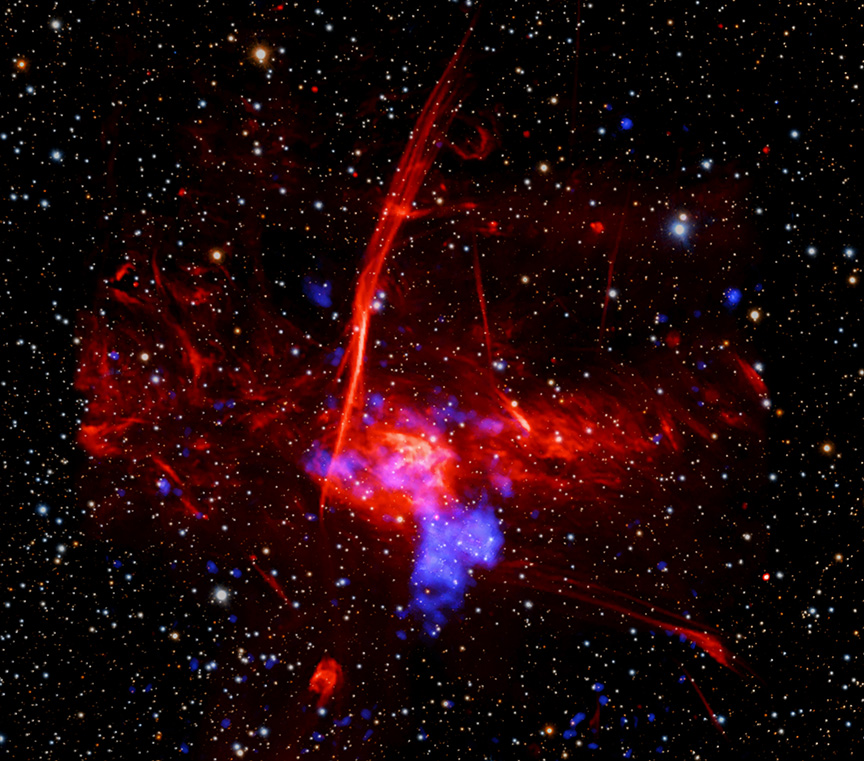
Click for original image.
Using two X-ray space telescopes, astronomers now think they have detected evidence of a supernova remnant very close to the center of the Milky Way.
You can read their paper here [pdf]. The image to the right is a composite of optical (the stars), radio (the red nebula), and Chanda’s X-ray data (the blue nebula). From the press release:
The evidence for the new supernova remnant, located about 26,000 light-years from Earth, comes from X-ray data from Chandra and XMM-Newton. The X-ray data reveals a “blob” of X-ray emission [indicated by blue] that may come from the remains of a massive star that self-destructed as a supernova, buried within the larger cloud of expanding gas.
The location of this suspected supernova remnant in the image is [that blue region]. It is in bubble of gas [the surrounding larger and smaller red objects] that has had electrons stripped away from hydrogen — called an “H II region” — surrounding a massive, young star. If this is indeed a supernova remnant, then it is expanding at about two million miles per hour and is at least about 1,700 years old.
,..The long filaments seen in the radio image are caused by energetic particles travelling along magnetic fields that are mostly directed perpendicular to the plane of the galaxy.
According to the paper, this supernova remnant is found on the western edge of a vast energized gas cloud called the Central Molecular Zone (CMZ), 1,600 to 1,900 light years across, that spans the Milky Way’s center. The features seen in the image above are part of a feature on the CMZ’s western edge called Sagittarius C, which apparently has not been studied as much as other parts of the CMZ.
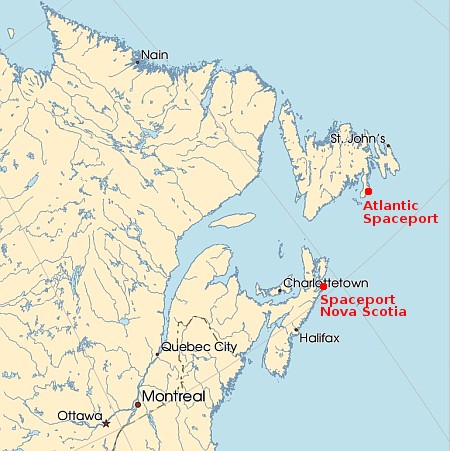
Proposed Canadian spaceports
For the second time in less than seven months the Canadian startup company T-Minus unsuccessfully attempted a suborbital test launch from the proposed Spaceport Nova Scotia, owned and operated by the company Maritime Launch Services and funded mostly by a major $200 million lease by the Canadian government.
The launch was conducted from Spaceport Nova Scotia under approved regulatory and safety frameworks. The demonstration strengthened coordination among launch site teams and partners while refining launch operational procedures and the safety and security systems that govern all activities at the spaceport.
While two suborbital flights had been planned for today’s demonstration, the decision was made to conclude operations following the first flight in order to review mission data and incorporate lessons learned into future testing activities. The demonstration featured the launch of the Barracuda, a hypersonic, single-stage, solid-fuel suborbital vehicle capable of carrying payloads of up to 40 kilograms to altitudes of approximately 80 kilometres.
Full analysis of the flight data will continue over the coming weeks. However, initial data indicate that the vehicle operated nominally during the powered phase of flight before experiencing an anomaly late in the boost phase.
In other words, the first launch did not operate as expected, which forced the cancellation of the second launch. T-Minus had a similar result in its November 2025 test, making its record 2-for-2 in failures.
This launch was really designed as a PR event, not a space launch. Maritime invited numerous government officials and celebrities to watch, even as the leftist Carney government has tried to falsely sell its spaceport lease as a way to establish a sovereign launch capability for Canada.
Maritime itself has been trying to get this spaceport off the ground since 2016, with no success. Only in the last year it has come back to life due to that $200 million government lease. With that financing, Maritime has been able to sign up two different rocket startups to consider launching from Spaceport Nova Scotia, the German company Isar Aerospace and the South Korean company Innospace.
However, no orbital launches are presently scheduled, and it is likely none will occur before 2028. And when or if it happens, it will not be by a Canadian rocket company.
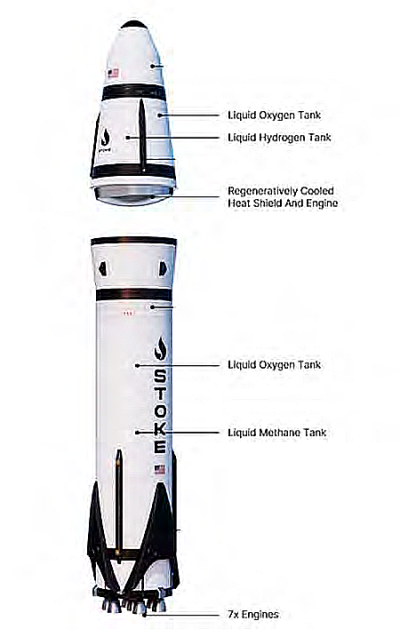
Stoke’s Nova rocket, designed to be
completely reusable.
The rocket startup Stoke Space announced earlier this week it has successfully completed all tank tests for 1st stage of its Nova rocket, thus increasing the odds that the rocket’s first launch will occur before the end of this year.
During this campaign, the team filled both tanks above their maximum expected pressure conditions, demonstrated automated pressure control across a range of fill levels, and operated the vehicle through challenging environmental conditions, including hurricane-force winds and a severe lightning storm. More than just a successful structural test campaign, the result was a broader demonstration that Nova’s hardware, software, ground systems, and operations approach are maturing together.
The company noted that it is not unusual for new rockets to experience explosions and other failures during this testing phase, thus making its complete success without a failure “a significant achievement.”
Stoke has consistently refused to set a launch date as it has been developing its rocket. It approach has been simply “We will launch when we are ready.” It has had this luxury in that it has successfully raised $1.34 billion in private investment capital, attracted to the company because of its rocket’s radical design that will allow both its first and second stages to be reusable. The first stage will land vertically, as does SpaceX’s Falcon 9.
The second stage uses a revolutionary nozzle design that makes its return possible. Instead of a single central nozzle, the engine has a ring of small nozzles on the outside edge of its heat shield. The stage will then return to Earth like a capsule, with those nozzles adding force to control and slow its descent.
The rocket itself has a smaller payload capacity than a Falcon 9, but its ability to be completely reusable means its second stage is far more capable. It can fly multiple times, thus lowering the launch costs for its customers. It can also provide an orbital manufacturing site, like a Varda capsule, which will attract a much larger customer base.
Embedded below the fold in two parts.
To listen to all of John Batchelor’s podcasts, go here.
» Read more
An evening pause: Performed live 2014 by the U.S Marine Band.
Hat tip Diane Zimmerman.
.jpg)
Katalyst’s proposed Swift rescue mission.
Click for original image.
Katalyst’s Link rescue spacecraft that is going to try to raise the orbit of the Swift-Gehrels Space Telescope before it decays has now been installed on Northrop Grumman’s last Pegasus rocket, in preparation for a launch hopefully before the end of this month.
Engineers completed installation of Katalyst Space’s LINK robotic servicing spacecraft into a Northrop Grumman Pegasus XL rocket on Tuesday, June 9, at NASA’s Wallops Flight Facility in Virginia. Launch is anticipated later this month.
NASA contracted Katalyst to build and launch LINK to raise the altitude of the agency’s Neil Gehrels Swift Observatory. Our planet’s atmosphere creates drag for spacecraft in low Earth orbit, gradually reducing their altitudes if they don’t have propulsion systems to counteract the effect. Recent solar activity magnified this effect on Swift, and its orbit decayed faster than anticipated.
This mission is one of the most daring ever financed by NASA and attempted by a private company. First, Gehrel-Swift has no attachment points. To grab it and then raise its orbit requires the robotic tentacles shown in the graphic to the right. Such a robotic grab in orbit has never been done before.
Second, Katalyst is a satellite servicing startup that has not yet serviced anything in orbit. The Link spacecraft was originally intended as a demo mission. When NASA put out a call for rescue proposals, the company decided to revise it to save Gehrels-Swift, because doing so was fast and made a rescue possible.
If Katalyst succeeds in this mission it will immediately leap to the top of the orbital servicing heap. Expect investment capital to quickly pour in afterward. And even if the mission fails but gets close, the company might still get a lot of investment capital, simply because it got so close.
Finally, this will be the final launch of the Pegasus rocket. After this flight Northrop Grumman has no more in stock, and it will retire it and its Stargazer L-1011 airplane that is used as its first stage.
Courtesy of BtB’s stringer Jay. This post is also an open thread. I welcome my readers to post any comments or additional links relating to any space issues, even if unrelated to the links below.

Click for original image.
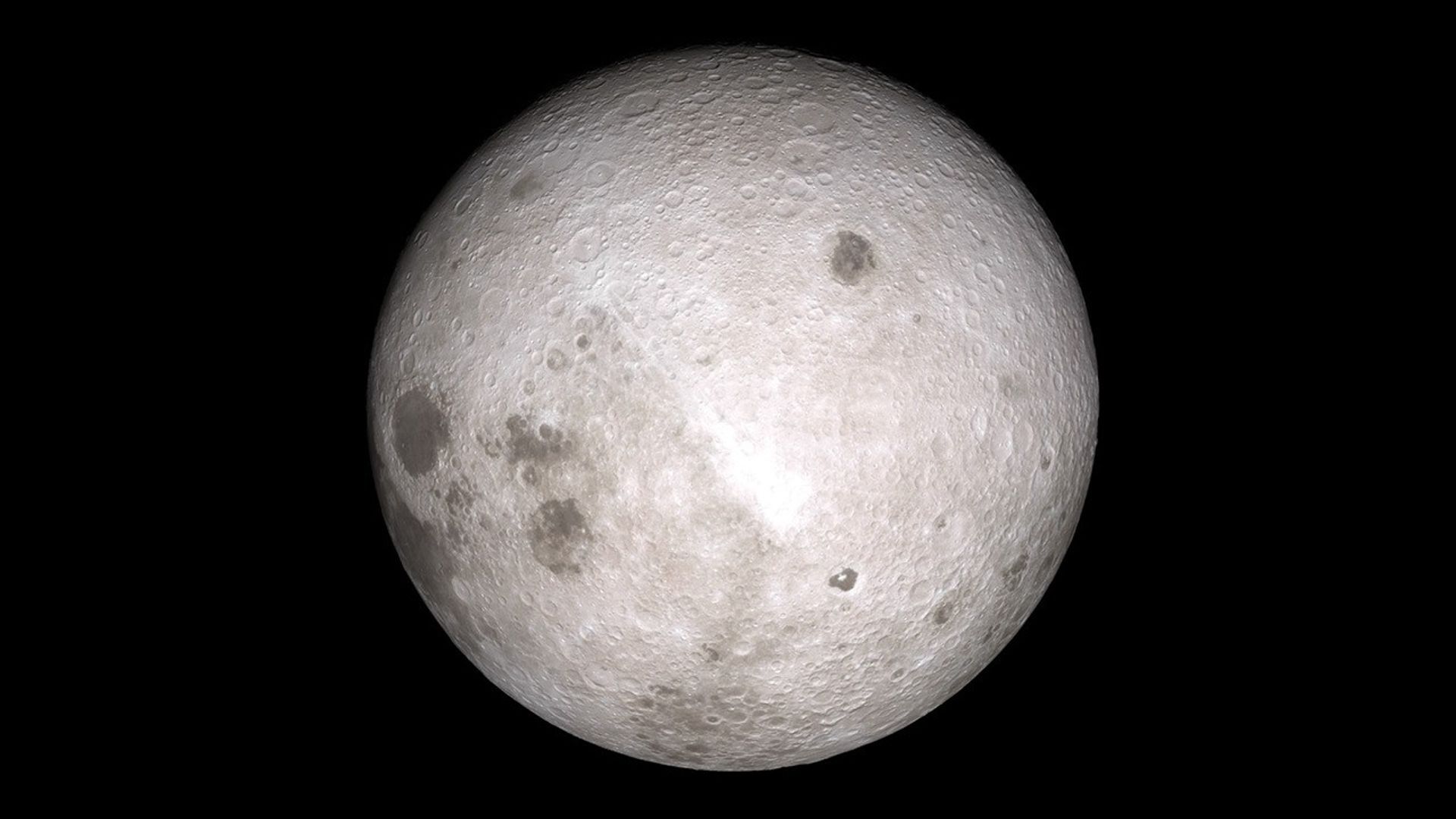
Today’s cool image is being posted not because of its beauty or high resolution, but because it was a significant first that shined a light on a mystery that had baffled all humanity since the first time a human being in Africa looked up and observed the Moon.
The picture to the right, reduced slightly and smoothed to remove some camera artifacts, was the first picture ever taken of the hidden far side of the Moon, captured by the Soviet Union’s Luna-3 probe on October 7, 1959, one day after it had passed less than 3,900 miles above the surface. As it moved away, it looked back, and took this picture from a distance of about 40,000 miles.
The picture ain’t what we are used to nowadays from space, but you need to put yourself back in time to truly appreciate it. For literally the entire history of humanity, this view had been hidden. Dreamers, philosophers, scientists, and ordinary people would look at the near side of the Moon almost nightly, but no one knew what was on the other side. Whole religious myths grew up about this unknown. Some science fiction writers of the 19th century fantasized there was air and water there and thus housed an alien civilization, purposely positioned so we couldn’t see it.
Suddenly, with this picture, that side was no longer hidden. This one Luna-3 picture showed humanity that the Moon’s far side was not much different than the near side, though much more cratered with fewer dark mare regions. It had no air or water. Nor were there alien civilizations.
But that age-old mystery was now solved. For those living in the 1950s, it was something of a revelation to see this picture. For those who came after, it is important to try to imagine the significance of that revelation. Suddenly, the mysteries of the universe were no longer unsolvable. Suddenly, we had the ability to solve them.
This picture, like all new knowledge, also brought with it new mysteries, based not on a hidden view but on real data and real questions. Now the goal was understand that data in order to solve the history of the Moon’s geology and how it fit into the formation of the Earth and the entire solar system. That endeavor is still on-going, with its solution not yet entirely in sight.
One last point: Though this picture is woefully inadequate compared to modern planetary images, it also carries a remarkable amount of good information that has since been confirmed by other spacecraft. To get an idea, compare it with a similar global view produced using Lunar Reconnaissance Orbiter (LRO)’s full dataset. The features match quite well, and a close look at the Luna 3 picture reveals many details not immediately evident that match well with the LRO image. The Russian engineers who made this happen should be rememberd and honored for their achievement.
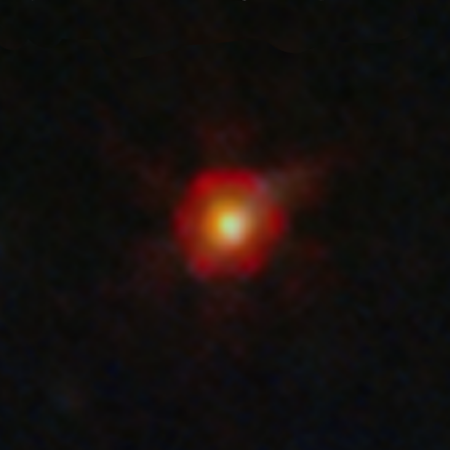
Little Red Dot GLIMPSE-17775
Using spectroscopic infrared data obtained by the Webb Space Telescope, astronomers now posit that the mysterious little red dots found by Webb in the very early universe are supermassive black holes embedded in a dense cloud of ionized gas.
The scientists focused Webb on the little red dot dubbed GLIMPSE-17775, shown to the right in a false color image produced by Webb’s near infrared camera. You can read their paper here [pdf].
The spectroscopic data collected by Webb contains multiple lines of evidence that support the interpretation that little red dot GLIMPSE-17775 is a black hole star: a rapidly accreting, or growing, black hole enveloped in a dense gas cocoon, which is reprocessing the light emitted from near the black hole and producing the features seen in the spectrum.
Among the 40-plus lines that the team detected in GLIMPSE-17775’s spectrum were various independent indicators that all align with the BH* scenario [the name the scientists use for this model]. For example, the team found that many of the spectral lines, such as hydrogen, oxygen, and helium, do not fit a simple model of a rotating gas cloud. Instead, the best fit model includes a broadening effect known as electron scattering, a telltale sign that a dense, layered gas cocoon is enshrouding this source.
The strength and ratios of certain lines to each other, most notably the 16 iron lines that compose what the team has dubbed an “iron forest” and certain oxygen lines, require a high-energy source to produce them, like a rapidly accreting black hole. Additionally, astronomers noted the fluorescence and absorption of helium in the spectrum, both of which individually suggest that there is a dense medium enveloping a powerful source.
The researchers claim this theory will work to explain all the other little red dots that Webb has detected in the early universe. They also claim it explains how the dots could be there so soon after the Big Bang, as they don’t have to be as supermassive as first believed. If very large, there wasn’t time for them to coalesce following the Big Bang. This model suggests instead that they can be much smaller black holes, thus allowing time for their formation without contradicting present Big Bang cosmology.
There is of course a lot of uncertainty here. For example, GLIMPSE-17775’s data is microlensed, which distorts it. While scientists think they understand the distortions fully, their inability to see this object and the foreground object doing the microlensing from multiple perspectives requires them to make many assumptions that cannot be proven, and could very well be wrong.