
Republican healthcare bill faces defeat in House
It appears the Republican leadership lacks the votes in the House needed to pass its Obamacare replacement bill.
It appears that the Freedom Caucus in the House is generally holding firm, with more than 21 members agreeing that this is a bad bill, just as bad as Obamacare. Why vote for it, and make yourself a partner in this bad business? Consider for example this quote:
Rep. Rod Blum (R-Iowa), one of the few Freedom Caucus members who has a close relationship with GOP leadership, said Trump’s remarks in conference — and the building pressure — just “steels my resolve.”
“The way it stands right now, no,” he would not vote for the bill, Blum told POLITICO. “Not because of the Freedom Caucus, but because I’m a free-marketer and I’m a businessman. … And the present bill doesn’t give us a free market. I want health insurance premiums to come down. … This bill doesn’t give us a free market.”
The Republican leadership was able to successfully pass numerous full repeals of Obamacare when Obama was president and could veto them. Now that we have Trump, a president who will sign a repeal, they suddenly seem incapable of finding where they put those repeal bills. Very shameful.
Repeal the thing. Cleanly. This is what the American people want. They will thank you for it.
It appears the Republican leadership lacks the votes in the House needed to pass its Obamacare replacement bill.
It appears that the Freedom Caucus in the House is generally holding firm, with more than 21 members agreeing that this is a bad bill, just as bad as Obamacare. Why vote for it, and make yourself a partner in this bad business? Consider for example this quote:
Rep. Rod Blum (R-Iowa), one of the few Freedom Caucus members who has a close relationship with GOP leadership, said Trump’s remarks in conference — and the building pressure — just “steels my resolve.”
“The way it stands right now, no,” he would not vote for the bill, Blum told POLITICO. “Not because of the Freedom Caucus, but because I’m a free-marketer and I’m a businessman. … And the present bill doesn’t give us a free market. I want health insurance premiums to come down. … This bill doesn’t give us a free market.”
The Republican leadership was able to successfully pass numerous full repeals of Obamacare when Obama was president and could veto them. Now that we have Trump, a president who will sign a repeal, they suddenly seem incapable of finding where they put those repeal bills. Very shameful.
Repeal the thing. Cleanly. This is what the American people want. They will thank you for it.

On Christmas Eve 1968 three Americans became the first humans to visit another world. What they did to celebrate was unexpected and profound, and will be remembered throughout all human history. Genesis: the Story of Apollo 8, Robert Zimmerman's classic history of humanity's first journey to another world, tells that story, and it is now available as both an ebook and an audiobook, both with a foreword by Valerie Anders and a new introduction by Robert Zimmerman.
The print edition can be purchased at Amazon or any other book seller. If you want an autographed copy the price is $60 for the hardback and $45 for the paperback, plus $8 shipping for each. Go here for purchasing details. The ebook is available everywhere for $5.99 (before discount) at amazon, or direct from my ebook publisher, ebookit you don't support the big tech companies and the author gets a bigger cut much sooner.
The audiobook is also available at all these vendors, and is also free with a 30-day trial membership to Audible.
"Not simply about one mission, [Genesis] is also the history of America's quest for the moon... Zimmerman has done a masterful job of tying disparate events together into a solid account of one of America's greatest human triumphs."--San Antonio Express-News
The changes seen by Rosetta on Comet 67P/C-G
A new study released today describes in detail the many changes seen by scientists in the data collected by Rosetta during its two years in close proximity to Comet 67P/C-G.
“We saw a massive cliff collapse and a large crack in the neck of the comet get bigger and bigger,” said El-Maarry. “And we discovered that boulders the size of a large truck could be moved across the comet’s surface a distance as long as one-and-a-half football fields.”
In the case of the boulder, Rosetta’s cameras observed a 282-million-pound (130-million-kilogram), 100-feet-wide (30-meter) space rock to have moved 150 yards (460 feet, or 140 meters) from its original position on the comet’s nucleus. The massive space rock probably moved as a result of several outburst events that were detected close to its original position.
The warming of 67P also caused the comet’s rotation rate to speed up. The comet’s increasing spin rate in the lead-up to perihelion is thought to be responsible for a 1,600-foot-long (500-meters) fracture spotted in August 2014 that runs through the comet’s neck. The fracture, which originally extended a bit longer than the Empire State Building is high, was found to have increased in width by about 100 feet (30 meters) by December 2014. Furthermore, in images taken in June 2016, a new 500- to 1,000-foot-long (150 to 300 meters) fracture was identified parallel to the original fracture.
“The large crack was in the ‘neck’ of the comet — a small central part that connects the two lobes,” said El-Maarry. “The crack was extending–indicating that the comet may split up one day.”
It is almost a shame that Rosetta did not see that break-up. The images would have been breath-taking, and the science learned priceless.
A new study released today describes in detail the many changes seen by scientists in the data collected by Rosetta during its two years in close proximity to Comet 67P/C-G.
“We saw a massive cliff collapse and a large crack in the neck of the comet get bigger and bigger,” said El-Maarry. “And we discovered that boulders the size of a large truck could be moved across the comet’s surface a distance as long as one-and-a-half football fields.”
In the case of the boulder, Rosetta’s cameras observed a 282-million-pound (130-million-kilogram), 100-feet-wide (30-meter) space rock to have moved 150 yards (460 feet, or 140 meters) from its original position on the comet’s nucleus. The massive space rock probably moved as a result of several outburst events that were detected close to its original position.
The warming of 67P also caused the comet’s rotation rate to speed up. The comet’s increasing spin rate in the lead-up to perihelion is thought to be responsible for a 1,600-foot-long (500-meters) fracture spotted in August 2014 that runs through the comet’s neck. The fracture, which originally extended a bit longer than the Empire State Building is high, was found to have increased in width by about 100 feet (30 meters) by December 2014. Furthermore, in images taken in June 2016, a new 500- to 1,000-foot-long (150 to 300 meters) fracture was identified parallel to the original fracture.
“The large crack was in the ‘neck’ of the comet — a small central part that connects the two lobes,” said El-Maarry. “The crack was extending–indicating that the comet may split up one day.”
It is almost a shame that Rosetta did not see that break-up. The images would have been breath-taking, and the science learned priceless.
The rings of Saturn

Cool image time! The image to the right, cropped to post here, is part of one of the closest and highest resolution images that Cassini has yet taken of Saturn’s rings. The image was taken in January during one of the spacecraft’s ring grazing orbits, and has a resolution of 2,300 feet per pixel. And yet, as noted by the Cassini science team, “Even at this level of detail, it is still not fine enough to resolve the individual particles that make up the ring.”
In prepping the image, all I did was crop it to show the closest rings. I purposely did not reduce its resolution, so that you can see that no individual particles are visible. The rings of Saturn are truly made up of billions of small objects, behaving in many ways like liquid floating in the gravity well of Saturn. If you don’t believe me, download the full image and zoom in on it as much as you like. All you will see are pixels.
The fundamental science question therefore is not how Saturn’s rings behave (though this is certainly important and quite fascinating) but why did those rings end up the way they are. No other planet has rings anything like Saturn’s in their density and make-up. Why? Are Saturn’s rings a normal process that only occurs for short times around planets, which is why only Saturn has these types of rings at present? Or is it a rare event, so rare that we happen to be very lucky to see such a thing at all?
Even more important, Saturn’s rings and their behavior are likely linked closely to the same phenomenon that describe the formation of planets around a star. The more we can learn about why these rings exist, the more we will learn about why planets exist, both here circling the Sun as well as around stars everywhere else.
Cool image time! The image to the right, cropped to post here, is part of one of the closest and highest resolution images that Cassini has yet taken of Saturn’s rings. The image was taken in January during one of the spacecraft’s ring grazing orbits, and has a resolution of 2,300 feet per pixel. And yet, as noted by the Cassini science team, “Even at this level of detail, it is still not fine enough to resolve the individual particles that make up the ring.”
In prepping the image, all I did was crop it to show the closest rings. I purposely did not reduce its resolution, so that you can see that no individual particles are visible. The rings of Saturn are truly made up of billions of small objects, behaving in many ways like liquid floating in the gravity well of Saturn. If you don’t believe me, download the full image and zoom in on it as much as you like. All you will see are pixels.
The fundamental science question therefore is not how Saturn’s rings behave (though this is certainly important and quite fascinating) but why did those rings end up the way they are. No other planet has rings anything like Saturn’s in their density and make-up. Why? Are Saturn’s rings a normal process that only occurs for short times around planets, which is why only Saturn has these types of rings at present? Or is it a rare event, so rare that we happen to be very lucky to see such a thing at all?
Even more important, Saturn’s rings and their behavior are likely linked closely to the same phenomenon that describe the formation of planets around a star. The more we can learn about why these rings exist, the more we will learn about why planets exist, both here circling the Sun as well as around stars everywhere else.

Now available in hardback and paperback as well as ebook!
From the press release: In this ground-breaking new history of early America, historian Robert Zimmerman not only exposes the lie behind The New York Times 1619 Project that falsely claims slavery is central to the history of the United States, he also provides profound lessons about the nature of human societies, lessons important for Americans today as well as for all future settlers on Mars and elsewhere in space.
Conscious Choice: The origins of slavery in America and why it matters today and for our future in outer space, is a riveting page-turning story that documents how slavery slowly became pervasive in the southern British colonies of North America, colonies founded by a people and culture that not only did not allow slavery but in every way were hostile to the practice.
Conscious Choice does more however. In telling the tragic history of the Virginia colony and the rise of slavery there, Zimmerman lays out the proper path for creating healthy societies in places like the Moon and Mars.
“Zimmerman’s ground-breaking history provides every future generation the basic framework for establishing new societies on other worlds. We would be wise to heed what he says.” —Robert Zubrin, founder of the Mars Society.
All editions are available at Amazon, Barnes & Noble, and all book vendors, with the ebook priced at $5.99 before discount. All editions can also be purchased direct from the ebook publisher, ebookit, in which case you don't support the big tech companies and the author gets a bigger cut much sooner.
Autographed printed copies are also available at discount directly from the author (hardback $29.95; paperback $14.95; Shipping cost for either: $6.00). Just send an email to zimmerman @ nasw dot org.
Trump signs NASA authorization
President Trump today signed the NASA authorization bill, initially written and sponsored by Senator Ted Cruz.
The most significant aspect of this authorization is what is not in it. The bill outlines what Congress wants NASA to focus on, and makes literally no mention of any Earth science research at all. Essentially, it tasks NASA to focus on space exploration, and space exploration only.
In many ways this is merely a symbolic act, since it is the budget that really determines what NASA will do, and the budget that Trump put forth last week only cut NASA’s Earth science budget by 5%. Nonetheless, the authorization bill gives us a sense of where the politics are heading. I expect that by the time Congress gets done with NASA’s budget there will be more cuts to that Earth science budget.
President Trump today signed the NASA authorization bill, initially written and sponsored by Senator Ted Cruz.
The most significant aspect of this authorization is what is not in it. The bill outlines what Congress wants NASA to focus on, and makes literally no mention of any Earth science research at all. Essentially, it tasks NASA to focus on space exploration, and space exploration only.
In many ways this is merely a symbolic act, since it is the budget that really determines what NASA will do, and the budget that Trump put forth last week only cut NASA’s Earth science budget by 5%. Nonetheless, the authorization bill gives us a sense of where the politics are heading. I expect that by the time Congress gets done with NASA’s budget there will be more cuts to that Earth science budget.
Atlas 5/Cygnus launch delayed until next week due to technical issue
The launch of the next Cygnus freighter to ISS has been delayed by ULA until next week in order to fix “a hydraulic issue found on ground support equipment.”
The launch had been delayed previously because of a hydraulic issue in the rocket itself.
The launch of the next Cygnus freighter to ISS has been delayed by ULA until next week in order to fix “a hydraulic issue found on ground support equipment.”
The launch had been delayed previously because of a hydraulic issue in the rocket itself.

Leaving Earth: Space Stations, Rival Superpowers, and the Quest for Interplanetary Travel, can be purchased as an ebook everywhere for only $3.99 (before discount) at amazon, Barnes & Noble, all ebook vendors, or direct from my ebook publisher, ebookit.
If you buy it from ebookit you don't support the big oppressive tech companies and I get a bigger cut much sooner.
Winner of the 2003 Eugene M. Emme Award of the American Astronautical Society.
"Leaving Earth is one of the best and certainly the most comprehensive summary of our drive into space that I have ever read. It will be invaluable to future scholars because it will tell them how the next chapter of human history opened." -- Arthur C. Clarke
SpaceX signs lease for Florida warehouse to refurbish 1st stages
The competition heats up: SpaceX has signed a five year lease for a Florida warehouse near Port Canaveral store and refurbish its recovered Falcon 9 and Falcon Heavy first stages.
This lease just firms up the reality that SpaceX is shifting from expendable first stages to a fleet of reusable first stage. Any rocket company that does not do the same is going to be left in the dust.
The competition heats up: SpaceX has signed a five year lease for a Florida warehouse near Port Canaveral store and refurbish its recovered Falcon 9 and Falcon Heavy first stages.
This lease just firms up the reality that SpaceX is shifting from expendable first stages to a fleet of reusable first stage. Any rocket company that does not do the same is going to be left in the dust.
Tom Jobim – Waters of March/Águas de Março
<An evening pause: A stream of consciousness song in tribute to March and spring.
Hat tip Edward Thelen.
Ariane 5 launch delayed by labor strike
The launch of two communications satellites on an Ariane 5 was delayed today by a strike at Arianespace’s French Guiana spaceport.
A work stoppage at the Ariane 5 rocket’s launch base in South America prevented rollout of the booster to the launch pad Monday, pushing back the liftoff of two communications satellites for Brazil and South Korea until at least Wednesday.
The fully-assembled launcher was set to roll out of the final assembly building Monday morning for the 1.7-mile (2.7-kilometer) journey to the ELA-3 launch zone at the Guiana Space Center. Arianespace officials were aiming for a launch attempt Tuesday evening.
But the rollout did not happen due to a “social movement” at the spaceport, according to Arianespace. Officials blamed the postponement on a strike among a segment of the workforce at the Guiana Space Center, which is managed by CNES, the French space agency, with support from the European Space Agency and numerous European contractors.
The article suggests that this was not a sanctioned strike, based on the expiration of a contract. Instead it appears to have been a wildcat strike, created to apply the most pressure in order to blackmail the company into giving the strikers more money. If so, and if Arianespace agrees to terms, its labor relations in French Guiana are going to decline quickly.
The launch of two communications satellites on an Ariane 5 was delayed today by a strike at Arianespace’s French Guiana spaceport.
A work stoppage at the Ariane 5 rocket’s launch base in South America prevented rollout of the booster to the launch pad Monday, pushing back the liftoff of two communications satellites for Brazil and South Korea until at least Wednesday.
The fully-assembled launcher was set to roll out of the final assembly building Monday morning for the 1.7-mile (2.7-kilometer) journey to the ELA-3 launch zone at the Guiana Space Center. Arianespace officials were aiming for a launch attempt Tuesday evening.
But the rollout did not happen due to a “social movement” at the spaceport, according to Arianespace. Officials blamed the postponement on a strike among a segment of the workforce at the Guiana Space Center, which is managed by CNES, the French space agency, with support from the European Space Agency and numerous European contractors.
The article suggests that this was not a sanctioned strike, based on the expiration of a contract. Instead it appears to have been a wildcat strike, created to apply the most pressure in order to blackmail the company into giving the strikers more money. If so, and if Arianespace agrees to terms, its labor relations in French Guiana are going to decline quickly.
Conservatives “violently threatened” at Lutheran college
Fascists: A survey of conservative students at St. Olaf College in Minnesota has found that many have been “violently threatened” because of their political beliefs, with most finding they do not have the ability to express their beliefs in public on campus.
On the night of the election, a student in the Pause threatened to beat up [College Republicans President Emily] Schaller, calling her a “f***ing moron.” Over the next couple of days, she overheard multiple students threaten to hurt the next conservative or Republican they saw. Vice President of St. Olaf College Republicans Kathryn Hinderaker ’19 had a similar experience.
“I think one of the hardest things was, the second day, I went into Buntrock and someone yelled from the bottom, ‘if you voted for Trump, you better be f***ing scared.’ Everyone clapped and applauded,” Hinderaker said. “Obviously, it didn’t feel super safe.”
This story is only a sample, but it illustrates the fascist and totalitarian culture of the left. I just wish that these conservatives had more courage. Had I been a student in that class where everyone applauded the idea of intimidating Trump voters I would have stood up and said, “Come on, show me how much you stand for liberty and freedom of speech and try and shut me up!”
The only proper response to a bully is to get in their face and tell them they are one. That always stops them in their tracks. Backing down to them in turn only emboldens them, and it certainly doesn’t make you safer.
Fascists: A survey of conservative students at St. Olaf College in Minnesota has found that many have been “violently threatened” because of their political beliefs, with most finding they do not have the ability to express their beliefs in public on campus.
On the night of the election, a student in the Pause threatened to beat up [College Republicans President Emily] Schaller, calling her a “f***ing moron.” Over the next couple of days, she overheard multiple students threaten to hurt the next conservative or Republican they saw. Vice President of St. Olaf College Republicans Kathryn Hinderaker ’19 had a similar experience.
“I think one of the hardest things was, the second day, I went into Buntrock and someone yelled from the bottom, ‘if you voted for Trump, you better be f***ing scared.’ Everyone clapped and applauded,” Hinderaker said. “Obviously, it didn’t feel super safe.”
This story is only a sample, but it illustrates the fascist and totalitarian culture of the left. I just wish that these conservatives had more courage. Had I been a student in that class where everyone applauded the idea of intimidating Trump voters I would have stood up and said, “Come on, show me how much you stand for liberty and freedom of speech and try and shut me up!”
The only proper response to a bully is to get in their face and tell them they are one. That always stops them in their tracks. Backing down to them in turn only emboldens them, and it certainly doesn’t make you safer.
College eliminates English and math placement tests
The coming dark age: A West Virginia community college has stopped giving English and math placement tests, while also eliminating any comparable remedial classes.
A careful read of the article suggests that this decision is a desperate attempt by the college to deal with its influx of unqualified students, as noted by this quote:
“We are still getting some students who literally cannot read above a third-grade level, and I have never learned how to help such students,”
The college still wants these students to attend (which is a cash cow for the college) but it finds itself struggling to find the right approach for teaching them. Since there is no right approach (these individuals should simply not be in college), the situation results in a poorer learning environment for everyone.
The coming dark age: A West Virginia community college has stopped giving English and math placement tests, while also eliminating any comparable remedial classes.
A careful read of the article suggests that this decision is a desperate attempt by the college to deal with its influx of unqualified students, as noted by this quote:
“We are still getting some students who literally cannot read above a third-grade level, and I have never learned how to help such students,”
The college still wants these students to attend (which is a cash cow for the college) but it finds itself struggling to find the right approach for teaching them. Since there is no right approach (these individuals should simply not be in college), the situation results in a poorer learning environment for everyone.
Capitalism in Space:
Private Enterprise and Competition Reshape the Global Aerospace Launch Industry
After much delay and discussion, my policy paper for the Center for a New American Security, Capitalism in Space: Private Enterprise and Competition Reshape the Global Aerospace Launch Industry, has finally been published.
You can download the pdf here or at the Center here. Please feel free to distribute this widely. If you visit other websites please pass it on to them. This should be read by as many people as possible, especially since the space policy of the Trump administration remains at present undecided. This policy paper will help them work out a wise policy, with the paper’s key data point contained in this table:
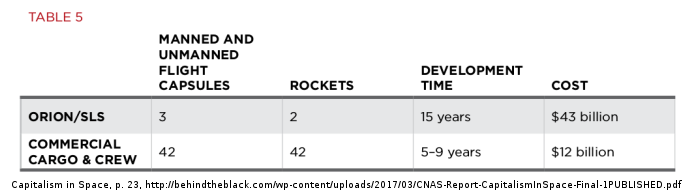
I document my numbers very carefully. The result illustrates clearly how much a failure the government model has been and continues to be. We have spent a lot of money since the 1970s on NASA and space, and have generally gotten very little for that investment, as demonstrated by the comparison between the accomplishments of private and government space in the past two decades. Going forward it is going to be very difficult for SLS/Orion to compete with the heavy lift rockets coming from SpaceX and Blue Origin.
My concluding words:
» Read more
Faron Young – Sweet Dreams
An evening pause: From a 1956 television show, with all the cheesiness that goes with it.
Hat tip Jim Mallamace.
An evening pause: From a 1956 television show, with all the cheesiness that goes with it.
Hat tip Jim Mallamace.
March 16, 2017 Zimmerman/Batchelor podcast
Embedded below the fold. John wanted to start by talking about the non-story of Budweiser looking at the technical difficulties of brewing beer on Mars. After that, we then spent the bulk of the segment talking about Trump’s budget proposals.
» Read more
Embedded below the fold. John wanted to start by talking about the non-story of Budweiser looking at the technical difficulties of brewing beer on Mars. After that, we then spent the bulk of the segment talking about Trump’s budget proposals.
» Read more
The layered mesas of Mars

Cool image time! The image above, reduced and cropped to post here, shows the layered deposits and complex erosion that has taken place in this area of Mars dubbed Uzboi Vallis. As noted at the Mars Reconnaissance Orbiter post,
Layered deposits in Uzboi Vallis sometimes occur in alcoves along the valley and/or below where tributaries enter it. These deposits may record deposition into a large lake that once filled Uzboi Vallis when it was temporarily dammed at its northern end by the rim of Holden Crater and before it was overtopped and breached allowing water to drain back out of the valley.
It is important when looking at these erosion patterns, including the strangely shaped rippled sand dunes scattered through the larger image, that wind possibly plays an even more important part in causing erosion on Mars than liquid water might have in the far past.
Either way, the terrain here has the same stark and fascinating beauty as that seen in the American southwest. If we can ever make it possible to live on Mars, this will definitely be a place to visit when on vacation.
Cool image time! The image above, reduced and cropped to post here, shows the layered deposits and complex erosion that has taken place in this area of Mars dubbed Uzboi Vallis. As noted at the Mars Reconnaissance Orbiter post,
Layered deposits in Uzboi Vallis sometimes occur in alcoves along the valley and/or below where tributaries enter it. These deposits may record deposition into a large lake that once filled Uzboi Vallis when it was temporarily dammed at its northern end by the rim of Holden Crater and before it was overtopped and breached allowing water to drain back out of the valley.
It is important when looking at these erosion patterns, including the strangely shaped rippled sand dunes scattered through the larger image, that wind possibly plays an even more important part in causing erosion on Mars than liquid water might have in the far past.

Either way, the terrain here has the same stark and fascinating beauty as that seen in the American southwest. If we can ever make it possible to live on Mars, this will definitely be a place to visit when on vacation.
Japan launches military satellite
Japan yesterday successfully launched a military surveillance satellite, dubbed the Information Gathering Satellite Radar 5 (IGS Radar-5).
Japan started the IGS program in 1998, presumably in response to North Korean missile tests around that time that sent missiles close to, or flying over, Japan.
In the years since, North Korea has repeatedly threatened to annihilate Japan (and South Korea and the United States), and continued to develop its nuclear-weapon and missile programs. The IGS satellites keep tabs on such efforts, help the Japanese government respond to natural disasters and perform several other functions, experts believe.
The first IGS craft lifted off in 2003. IGS Radar 5 is the 15th one in the program to take flight, though not all have made it to orbit. Two were lost to a launch failure in November 2003.
Japan yesterday successfully launched a military surveillance satellite, dubbed the Information Gathering Satellite Radar 5 (IGS Radar-5).
Japan started the IGS program in 1998, presumably in response to North Korean missile tests around that time that sent missiles close to, or flying over, Japan.
In the years since, North Korea has repeatedly threatened to annihilate Japan (and South Korea and the United States), and continued to develop its nuclear-weapon and missile programs. The IGS satellites keep tabs on such efforts, help the Japanese government respond to natural disasters and perform several other functions, experts believe.
The first IGS craft lifted off in 2003. IGS Radar 5 is the 15th one in the program to take flight, though not all have made it to orbit. Two were lost to a launch failure in November 2003.
The terrorist protesters in North Dakota
Fascists: The protesters in North Dakota who had tried for the past year to prevent construction of an oil pipeline appeared to spend as much time threatening the families and children of police officers as they did protesting the pipeline.
While protesters were fueling worldwide outrage and fundraising over allegations of police brutality, an aggressive cohort of agitators was terrorizing the families of law-enforcement officers with threats of death, rape and arson. “There were threats made to us, mostly that they were going to come burn down our houses or rape us while our husbands were gone,” said Allison Engelstad, who’s married to Jon Engelstad, a sheriff’s deputy in Morton County, North Dakota.
She had good reason to fear that protesters knew where they lived. The North Dakota State and Local Intelligence Center compiled a 41-page document of social media posts with threats along with photos, names, addresses and contact information for officers involved with the protest. “Every one of these cops has familys [sic] … Make there [sic] family pay,” read one Facebook post.
A live video feed taken from a January protest on the Backwater Bridge includes the voice of an activist shouting, “We’re going to gang-rape,” “Watch your family,” and “We’re going to kill your daughters, your mothers, your fathers, your grandparents, even you!” [emphasis mine]
I think even more revealing is this tidbit from the article:
Figures released March 1 by law enforcement showed that 661 of the 709 arrests involved out-of-state protesters. Of those arrested, 227 had a total of 1,503 previous citations and charges, including domestic violence, child abuse, robbery, burglary, drug possession and driving under the influence.
This was not a grassroots campaign. This protest was staged, and its intent was hostile to America and to the people who live in it. Pay close attention to which politicians align themselves with this protest, because that will reveal to you what they really believe.
Fascists: The protesters in North Dakota who had tried for the past year to prevent construction of an oil pipeline appeared to spend as much time threatening the families and children of police officers as they did protesting the pipeline.
While protesters were fueling worldwide outrage and fundraising over allegations of police brutality, an aggressive cohort of agitators was terrorizing the families of law-enforcement officers with threats of death, rape and arson. “There were threats made to us, mostly that they were going to come burn down our houses or rape us while our husbands were gone,” said Allison Engelstad, who’s married to Jon Engelstad, a sheriff’s deputy in Morton County, North Dakota.
She had good reason to fear that protesters knew where they lived. The North Dakota State and Local Intelligence Center compiled a 41-page document of social media posts with threats along with photos, names, addresses and contact information for officers involved with the protest. “Every one of these cops has familys [sic] … Make there [sic] family pay,” read one Facebook post.
A live video feed taken from a January protest on the Backwater Bridge includes the voice of an activist shouting, “We’re going to gang-rape,” “Watch your family,” and “We’re going to kill your daughters, your mothers, your fathers, your grandparents, even you!” [emphasis mine]
I think even more revealing is this tidbit from the article:
Figures released March 1 by law enforcement showed that 661 of the 709 arrests involved out-of-state protesters. Of those arrested, 227 had a total of 1,503 previous citations and charges, including domestic violence, child abuse, robbery, burglary, drug possession and driving under the influence.
This was not a grassroots campaign. This protest was staged, and its intent was hostile to America and to the people who live in it. Pay close attention to which politicians align themselves with this protest, because that will reveal to you what they really believe.
OneWeb breaks ground on satellite factory
The competition heats up: OneWeb today broke ground on its new Florida satellite factory where the company hopes to build more than 2,000 satellites for its internet satellite constellation.
The competition heats up: OneWeb today broke ground on its new Florida satellite factory where the company hopes to build more than 2,000 satellites for its internet satellite constellation.
Europe’s Trace Gas Orbiter has passed its check out
Europe’s ExoMars 2016 Trace Gas Orbiter has completed its science instrument checkout in Mars orbit and will now begin a year of aerobraking to lower its orbit.
When the aerobraking is completed they will settle into a 250-mile circular orbit to study the Martian atmosphere.
Europe’s ExoMars 2016 Trace Gas Orbiter has completed its science instrument checkout in Mars orbit and will now begin a year of aerobraking to lower its orbit.
When the aerobraking is completed they will settle into a 250-mile circular orbit to study the Martian atmosphere.
The math hidden in Van Gogh’s Starry Night
An evening pause: This pause is very apropos to some of Juno’s more recent Jupiter images.
Hat tip to Mike Nelson.
By the way, I am open to Evening Pause suggestions from all my readers. If you have seen something that you think might fit as an evening pause, make a comment here telling me you have a suggestion. Don’t provide the link to the suggestion. I will email you so that you can send it to me direct and I can then schedule it.
March 15, 2017 Zimmerman/Batchelor/Livingston podcast
Embedded below the fold. Batchelor invited me to be the guest on his regular Wednesday Hotel Mars segment with David Livingston of The Space Show to discuss Capitalism in Space.
» Read more
Embedded below the fold. Batchelor invited me to be the guest on his regular Wednesday Hotel Mars segment with David Livingston of The Space Show to discuss Capitalism in Space.
» Read more
Trump budget proposal
The Trump administration today released its overall rough budget plan for 2018. This is not a detailed budget, but an summary of their plan, indicating where they wish to cut and where they wish to increase budgets. The proposal is also not complete, making no mention of the administration’s budget plans for many departments, such as the National Science Foundation.
Science research in the federal government is significantly impacted, but not as badly as most of the articles you will read in the mainstream anti-Trump, Democratic Party press. A few examples:
- Science: NIH, DOE Office of Science face deep cuts in Trump’s first budget
- Science: A grim budget day for U.S. science: analysis and reaction to Trump’s plan
- Nature: US science agencies face deep cuts in Trump budget
- Washington Post: NASA budget would cut Earth science and education
- Washington Post: Federal health department would face a nearly 18 percent cut
I must note that not all the news stories are blindly hostile to this budget proposal:
- Washington Post: Trump would increase Energy Department funds to manage nuclear stockpile
- SpacePolicyOnLine: Trump Budget Request Kills ARM, Supports SLS/Orion and Public Private Partnerships
- USA Today: Trump’s NASA budget preserves Mars mission, cuts Earth science, asteroid trip, education
Of all the science agencies, NASA probably came off with the least change. The budget cuts only about 5% from the agency’s Earth science budget, while cutting some specific Earth science missions. The budget also supports SLS/Orion, though it finally puts the nail in the coffin of the asteroid redirect mission, an Obama proposal that has never garnered any interest from anyone else.
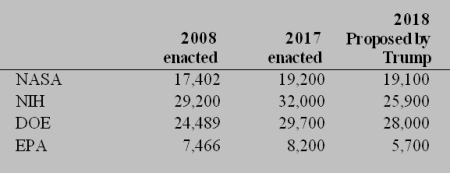
The key to understanding all these budget cuts is to see them in context, to compare the 2018 proposed budgets with the budgets these agencies received in the past. The table on the right gives some of this context (numbers shown are in millions) for several of the science agencies most effected by the proposal. The proposal is not detailed enough to pin down the changes for many other science agencies, but from this table it is clear that the Trump administration is not calling for the end of science, and is proposing some reasonable cost cutting, something that has been rare in government for many years.
What will be missed by most of the press about this Trump budget proposal is that it is not trying to trim the size of the federal government. While it cuts spending in many departments, those cuts are entirely aimed at providing room to raise the budget of the Defense Department by $54 billion. While I can applaud the desire of the Trump administration to be revenue neutral, the stark fact remains that by remaining revenue neutral Trump still leaves us with a gigantic annual federal deficit. They have made no effort to balance the overall budget.
Worse, this proposal would repeal the Budget Control Act of 2011, which imposed sequestration to the federal budget and has actually done the most in the past half century to bring that budget under control. Once this act is repealed, it will allow the spenders in Congress (of which the Republicans are as guilty as the Democrats) to open the floodgates once again. This will not be good.
Let me add one good aspect of the Trump budget. It proposes to eliminate a whole range of government political agencies that accomplish nothing but provide pork or to propagandize the Democratic Party’s positions:
The Budget also proposes to eliminate funding for other independent agencies, including: the African Development Foundation; the Appalachian Regional Commission; the Chemical Safety Board; the Corporation for National and Community Service; the Corporation for Public Broadcasting; the Delta Regional Authority; the Denali Commission; the Institute of Museum and Library Services; the Inter-American Foundation; the U.S. Trade and Development Agency; the Legal Services Corporation; the National Endowment for the Arts; the National Endowment for the Humanities; the Neighborhood Reinvestment Corporation; the Northern Border Regional Commission; the Overseas Private Investment Corporation; the United States Institute of Peace; the United States Interagency Council on Homelessness; and the Woodrow Wilson International Center for Scholars.
Getting these eliminated will at least be a start to cleaning up the mess in Washington.
Want to watch a nuclear bomb go off? You can!
Engineers at Lawrence Livermore National Laboratory (LLNL) have obtained declassified films of many of the nuclear tests performed by the U.S. from 1945 to 1962 and are digitally scanning them and preserving them for posterity.
Conducted by LLNL weapon physicist Greg Spriggs and a team of film experts, archivists, and software developers, the project’s goal was to track down as many as possible of the ten-thousand 2,400 frames per second reels of film. This was because the cine film, and its immense historical and scientific value, was in danger of being lost for all time. The reels were mostly of acetate stock that was not stored under anything like ideal conditions and was slowly decaying or being attacked by fungus and microbes.
“You can smell vinegar when you open the cans, which is one of the byproducts of the decomposition process of these films,” says Spriggs. “We know that these films are on the brink of decomposing to the point where they’ll become useless. The data that we’re collecting now must be preserved in a digital form because no matter how well you treat the films, no matter how well you preserve or store them, they will decompose. They’re made out of organic material, and organic material decomposes. So this is it. We got to this project just in time to save the data.”
You can view a number of the films at the second link above. I have embedded below the fold just one, from Operation Teapot in 1955. This was a series of 14 tests in Nevada. In this particular video the explosion occurs in the air, and you can sense the incredible force of the explosion when the shock wave hits the ground and bounces back, producing the mushroom cloud. Not much would have survived that impact.
» Read more
Engineers at Lawrence Livermore National Laboratory (LLNL) have obtained declassified films of many of the nuclear tests performed by the U.S. from 1945 to 1962 and are digitally scanning them and preserving them for posterity.
Conducted by LLNL weapon physicist Greg Spriggs and a team of film experts, archivists, and software developers, the project’s goal was to track down as many as possible of the ten-thousand 2,400 frames per second reels of film. This was because the cine film, and its immense historical and scientific value, was in danger of being lost for all time. The reels were mostly of acetate stock that was not stored under anything like ideal conditions and was slowly decaying or being attacked by fungus and microbes.
“You can smell vinegar when you open the cans, which is one of the byproducts of the decomposition process of these films,” says Spriggs. “We know that these films are on the brink of decomposing to the point where they’ll become useless. The data that we’re collecting now must be preserved in a digital form because no matter how well you treat the films, no matter how well you preserve or store them, they will decompose. They’re made out of organic material, and organic material decomposes. So this is it. We got to this project just in time to save the data.”
You can view a number of the films at the second link above. I have embedded below the fold just one, from Operation Teapot in 1955. This was a series of 14 tests in Nevada. In this particular video the explosion occurs in the air, and you can sense the incredible force of the explosion when the shock wave hits the ground and bounces back, producing the mushroom cloud. Not much would have survived that impact.
» Read more
SpaceX successfully launches commercial satellite
The competition heats up: SpaceX tonight successfully launched Echostar 23.
This launch is almost four weeks after their last launch, which sent a Dragon capsule to ISS. Their goal this year has been to do one launch every two weeks, a goal they have not yet reached. The next launch, which will also place a commercial communications satellite into orbit, is tentatively set for March 27, and will also be the first launch that reuses a first stage. If they make that happen it will be first time they have hit the two week launch rate this year. They will then try to follow with another Dragon resupply mission, this time reusing a Dragon capsule for the first time.
The competition heats up: SpaceX tonight successfully launched Echostar 23.
This launch is almost four weeks after their last launch, which sent a Dragon capsule to ISS. Their goal this year has been to do one launch every two weeks, a goal they have not yet reached. The next launch, which will also place a commercial communications satellite into orbit, is tentatively set for March 27, and will also be the first launch that reuses a first stage. If they make that happen it will be first time they have hit the two week launch rate this year. They will then try to follow with another Dragon resupply mission, this time reusing a Dragon capsule for the first time.
Less evidence of dark matter in early universe
The uncertainty of science: Astronomers have discovered less evidence of dark matter surrounding galaxies in early universe.
Stars in the outer regions of some far-off galaxies move more slowly than stars closer to the center, indicating a lack of dark matter, astronomer Reinhard Genzel and colleagues report online March 15 in Nature. If confirmed, the result could lead astronomers to reconsider the role dark matter played in early galaxy evolution and might also offer clues to how nearby elliptical galaxies evolved.
In contrast with these distant galaxies, stars orbiting on the outskirts of the Milky Way and other nearby galaxies move too fast for their velocities to result only from the gravity of gas and stars closer to the galactic center. If visible galactic matter is embedded in a cloud of invisible dark matter, though, gravity from the invisible matter can explain the high stellar velocities. Using stars’ orbital velocities in nearby galaxies as a reference, astronomers expected that stars in galaxies farther away would behave similarly. “Turns out that is not the case,” says study coauthor Stijn Wuyts of the University of Bath in England.
In other words, scientists at this moment really have no idea what causes the faster rotation in the outskirts of modern nearby galaxies.
The uncertainty of science: Astronomers have discovered less evidence of dark matter surrounding galaxies in early universe.
Stars in the outer regions of some far-off galaxies move more slowly than stars closer to the center, indicating a lack of dark matter, astronomer Reinhard Genzel and colleagues report online March 15 in Nature. If confirmed, the result could lead astronomers to reconsider the role dark matter played in early galaxy evolution and might also offer clues to how nearby elliptical galaxies evolved.
In contrast with these distant galaxies, stars orbiting on the outskirts of the Milky Way and other nearby galaxies move too fast for their velocities to result only from the gravity of gas and stars closer to the galactic center. If visible galactic matter is embedded in a cloud of invisible dark matter, though, gravity from the invisible matter can explain the high stellar velocities. Using stars’ orbital velocities in nearby galaxies as a reference, astronomers expected that stars in galaxies farther away would behave similarly. “Turns out that is not the case,” says study coauthor Stijn Wuyts of the University of Bath in England.
In other words, scientists at this moment really have no idea what causes the faster rotation in the outskirts of modern nearby galaxies.
Jack Bruce – I Feel Free
An evening pause: Bruce had co-wrote this song for the band Cream. And yes, that’s Ringo Starr on the drums.
Hat tip Edward Thelen.
March 14, 2017 Zimmerman/Batchelor podcast
Embedded below the fold. Batchelor noted during the interview that the host of commercial space stories highlighted in this podcast did a nice job of underlining the points I have made in Capitalism in Space.
» Read more
Embedded below the fold. Batchelor noted during the interview that the host of commercial space stories highlighted in this podcast did a nice job of underlining the points I have made in Capitalism in Space.
» Read more
Titan’s fizzy oceans?
New research suggests that the hydrocarbon lakes of Titan might periodically fizz with nitrogen bubbles.
A recent NASA-funded study has shown how the hydrocarbon lakes and seas of Saturn’s moon Titan might occasionally erupt with dramatic patches of bubbles.
For the study, researchers at NASA’s Jet Propulsion Laboratory in Pasadena, California, simulated the frigid surface conditions on Titan, finding that significant amounts of nitrogen can be dissolved in the extremely cold liquid methane that rains from the skies and collects in rivers, lakes and seas. They demonstrated that slight changes in temperature, air pressure or composition can cause the nitrogen to rapidly separate out of solution, like the fizz that results when opening a bottle of carbonated soda.
These results might help explain the mysterious islands that seem to appear and disappear and then reappear in Titan’s lakes. Rather than islands, they might be patches of nitrogen bubbles.
New research suggests that the hydrocarbon lakes of Titan might periodically fizz with nitrogen bubbles.
A recent NASA-funded study has shown how the hydrocarbon lakes and seas of Saturn’s moon Titan might occasionally erupt with dramatic patches of bubbles.
For the study, researchers at NASA’s Jet Propulsion Laboratory in Pasadena, California, simulated the frigid surface conditions on Titan, finding that significant amounts of nitrogen can be dissolved in the extremely cold liquid methane that rains from the skies and collects in rivers, lakes and seas. They demonstrated that slight changes in temperature, air pressure or composition can cause the nitrogen to rapidly separate out of solution, like the fizz that results when opening a bottle of carbonated soda.
These results might help explain the mysterious islands that seem to appear and disappear and then reappear in Titan’s lakes. Rather than islands, they might be patches of nitrogen bubbles.
Minneapolis: another American city destroyed by Democrats
Link here. Democrats will see this as a partisan attack. It really isn’t. It is instead another attempt to point out the stark fact that the leftwing policies put forth by the Democratic Party in the past half century have been routinely disastrous.
But by 1988, then-mayor Donald Fraser—a member of the DFLP—had grown troubled by the stark contrast he saw between the majority of his city and who were thriving economically, and a number of African-American neighborhoods where crime, teenage pregnancy, and welfare dependency were experiencing a growth spurt. Taking a page out of the same playbook other big city Democrat mayors were using, Fraser believed that the cure was redistribution of income. He decided to revamp the way in which social-welfare expenditures were allocated and believed, specifically, that federal and local agencies needed to focus more of their resources on the economic problems confronting unwed mothers (who were disproportionately black) and their children.
Fraser’s successors as mayors of Minneapolis—Sharon Sayles Belton (1994-2001), R.T. Rybak (2002-2013), and Betsy Hodges (2014-present)—have shared this same core belief in the importance of massive public expenditures on social-welfare programs and wealth-redistribution initiatives.
The result has been disastrous. As of 2015, the poverty rate in Minneapolis was 25.3%, nearly twice the 14% statewide rate for Minnesota and the 14.3% rate for the United States as a whole. In 2010, a study of 142 metro areas in Minnesota found that only 15 bore a heavier property-tax burden than Minneapolis, and that was before the city raised its property taxes by 4.7% in 2011.
More recently, Minneapolis property taxes increased by 3.4% in 2016, and by a crippling 5.5% in 2017.
Notwithstanding the growth in revenues generated by these taxes, the government of Minneapolis has been incapable of balancing its budget. In 2015, for example, the Minneapolis Public Housing Authority’s budget included $84 million in federal subsidies and grants. In 2017, the Metropolitan Council—which describes itself as “the regional policy-making body, planning agency, and provider of essential services for the Twin Cities metropolitan region”—received $91 million in federal funding. That same year, the Minneapolis Public Schools operated with a budget deficit of nearly $17 million.
This pattern has repeated itself throughout the United States. For the past half century almost every urban area has been dominated politically by Democrats. In that same time period, those urban areas have seen a distinct worsening of their economic situation. Even as these American cities have imposed a higher and higher tax burden on their successful citizens, they have seen higher and higher deficits. At the same time, poverty and economic failure has increased.
The important thing to note here is that the policies of the Democratic Party are a failure. Since that party seems incapable of changing those policies, it is essential that voters stop voting for it, either to force a change within that party or to remove that party from any position of power. Those are our choices, if we wish to improve the future of the United States.
Link here. Democrats will see this as a partisan attack. It really isn’t. It is instead another attempt to point out the stark fact that the leftwing policies put forth by the Democratic Party in the past half century have been routinely disastrous.
But by 1988, then-mayor Donald Fraser—a member of the DFLP—had grown troubled by the stark contrast he saw between the majority of his city and who were thriving economically, and a number of African-American neighborhoods where crime, teenage pregnancy, and welfare dependency were experiencing a growth spurt. Taking a page out of the same playbook other big city Democrat mayors were using, Fraser believed that the cure was redistribution of income. He decided to revamp the way in which social-welfare expenditures were allocated and believed, specifically, that federal and local agencies needed to focus more of their resources on the economic problems confronting unwed mothers (who were disproportionately black) and their children.
Fraser’s successors as mayors of Minneapolis—Sharon Sayles Belton (1994-2001), R.T. Rybak (2002-2013), and Betsy Hodges (2014-present)—have shared this same core belief in the importance of massive public expenditures on social-welfare programs and wealth-redistribution initiatives.
The result has been disastrous. As of 2015, the poverty rate in Minneapolis was 25.3%, nearly twice the 14% statewide rate for Minnesota and the 14.3% rate for the United States as a whole. In 2010, a study of 142 metro areas in Minnesota found that only 15 bore a heavier property-tax burden than Minneapolis, and that was before the city raised its property taxes by 4.7% in 2011.
More recently, Minneapolis property taxes increased by 3.4% in 2016, and by a crippling 5.5% in 2017. Notwithstanding the growth in revenues generated by these taxes, the government of Minneapolis has been incapable of balancing its budget. In 2015, for example, the Minneapolis Public Housing Authority’s budget included $84 million in federal subsidies and grants. In 2017, the Metropolitan Council—which describes itself as “the regional policy-making body, planning agency, and provider of essential services for the Twin Cities metropolitan region”—received $91 million in federal funding. That same year, the Minneapolis Public Schools operated with a budget deficit of nearly $17 million.
This pattern has repeated itself throughout the United States. For the past half century almost every urban area has been dominated politically by Democrats. In that same time period, those urban areas have seen a distinct worsening of their economic situation. Even as these American cities have imposed a higher and higher tax burden on their successful citizens, they have seen higher and higher deficits. At the same time, poverty and economic failure has increased.
The important thing to note here is that the policies of the Democratic Party are a failure. Since that party seems incapable of changing those policies, it is essential that voters stop voting for it, either to force a change within that party or to remove that party from any position of power. Those are our choices, if we wish to improve the future of the United States.
House leans to less regulation of commercial space
During a hearing on March 8 of the House subcommittee on space the representatives overall pushed for less regulation of commercial space activities.
The overall problem was once again dealing with the Outer Space Treaty:
At a March 8 hearing of the subcommittee, members and witnesses grappled with the issue of how the government should oversee emerging commercial space activities in order to comply with obligations to the Outer Space Treaty, including whether such oversight is, in fact, required. Such “authorization and continuing supervision,” as specified in Article 6 of the treaty, is handled today by various agencies for commercial communications and remote sensing satellites and for launch. It’s less clear who would regulate new activities, ranging from commercial lunar landers to satellite servicing efforts, creating uncertainty in industry about who, if anyone, could provide that authorization and continuing supervision.
An April 2016 report delivered to Congress by the White House’s Office of Science and Technology Policy, required by Section 108 of the Commercial Space Launch Competitiveness Act of 2015, recommended what it called a “mission authorization” approach for providing that oversight. This approach would be modeled on the payload reviews performed by the Federal Aviation Administration during the launch licensing process, including an interagency review of proposed missions. While the mission authorization concept had won support from many in industry, as well as the FAA and some members of Congress, a change of administrations and its approach to regulation has emboldened some who want to limit industry regulation.
“Unfortunately, the Obama administration issued a report last year that called for expansive regulations over all types of private space activities,” said Rep. Lamar Smith (R-Texas), chairman of the House Science Committee, at the hearing. He cited a “crisis of overregulation” in general as a reason to oppose the previous administration’s proposal.
The House members and the witnesses apparently rejected the regulatory proposals that had been put forth by the Obama administration, and were instead searching for ways to limit the amount of regulation required under the Outer Space Treaty.
I say, dump the treaty. Nothing in it helps the development of space by private individuals or companies. Everything in it encourages bureaucracy and the limitation of private property.
During a hearing on March 8 of the House subcommittee on space the representatives overall pushed for less regulation of commercial space activities.
The overall problem was once again dealing with the Outer Space Treaty:
At a March 8 hearing of the subcommittee, members and witnesses grappled with the issue of how the government should oversee emerging commercial space activities in order to comply with obligations to the Outer Space Treaty, including whether such oversight is, in fact, required. Such “authorization and continuing supervision,” as specified in Article 6 of the treaty, is handled today by various agencies for commercial communications and remote sensing satellites and for launch. It’s less clear who would regulate new activities, ranging from commercial lunar landers to satellite servicing efforts, creating uncertainty in industry about who, if anyone, could provide that authorization and continuing supervision.
An April 2016 report delivered to Congress by the White House’s Office of Science and Technology Policy, required by Section 108 of the Commercial Space Launch Competitiveness Act of 2015, recommended what it called a “mission authorization” approach for providing that oversight. This approach would be modeled on the payload reviews performed by the Federal Aviation Administration during the launch licensing process, including an interagency review of proposed missions. While the mission authorization concept had won support from many in industry, as well as the FAA and some members of Congress, a change of administrations and its approach to regulation has emboldened some who want to limit industry regulation.
“Unfortunately, the Obama administration issued a report last year that called for expansive regulations over all types of private space activities,” said Rep. Lamar Smith (R-Texas), chairman of the House Science Committee, at the hearing. He cited a “crisis of overregulation” in general as a reason to oppose the previous administration’s proposal.
The House members and the witnesses apparently rejected the regulatory proposals that had been put forth by the Obama administration, and were instead searching for ways to limit the amount of regulation required under the Outer Space Treaty.
I say, dump the treaty. Nothing in it helps the development of space by private individuals or companies. Everything in it encourages bureaucracy and the limitation of private property.