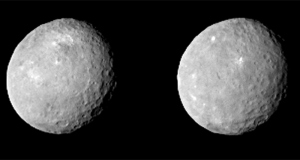
A closer close-up of Ceres’ double bright spot

Closer look at Ceres' double bright spot

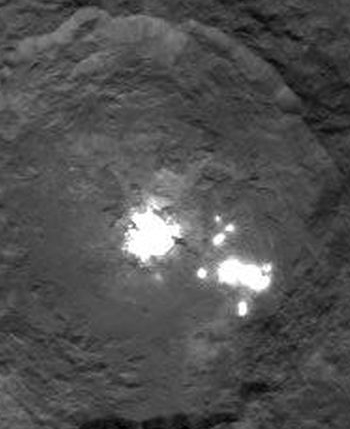
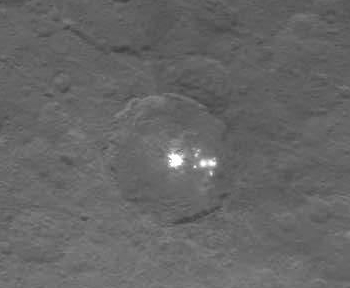
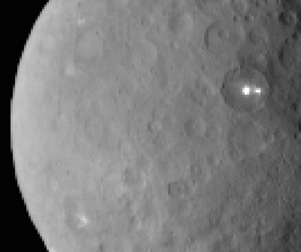
Cool image time! In a new press release, the Dawn science team has unveiled a new close-up of Ceres’ double bright spot, shown on the right.

At least eight spots can be seen next to the largest bright area, which scientists think is approximately 6 miles (9 kilometers) wide. A highly reflective material is responsible for these spots — ice and salt are leading possibilities, but scientists are considering other options, too.

In other words, they still have not confirmed through spectroscopy, that these bright spots are ice.

Note also that they have reduced the image’s brightness so that the bright spots do not over expose as much as in past images. This not only allows more details to come out, but it portrays Ceres’ very dark surface more accurately. Even so, the image still shows that surface as brighter than it actually is.

A mountain on Ceres

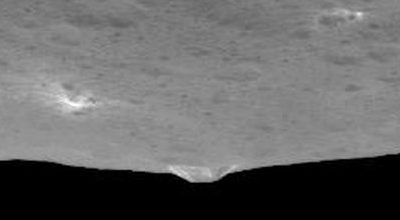
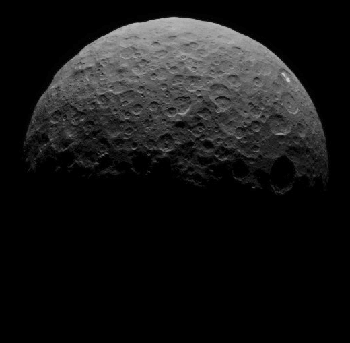
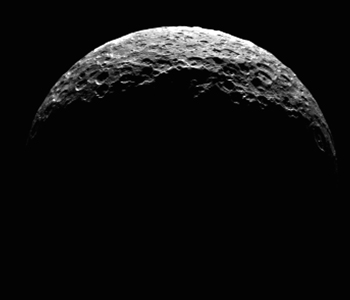
The press release also described a second image, showing a single lonely mountain on the planet’s horizon, rising up three miles from the planet’s surface, shown in the cropped image to the left. Overall this image, as well as the others, suggest that the surface of Ceres is generally far less rough than we should expect.

Another science mystery to unravel!

New close-up image of Ceres’s double bright spots

close-up of Ceres's bright spots

Cool image time! The Dawn science team has released a some new close-up images of Ceres, including a much higher resolution image of the dwarf planet’s double bright spot, which now resolves itself into a cluster of two larger spots with a half dozen smaller spots scattered nearby.

The region with the brightest spots is in a crater about 55 miles (90 kilometers) across. The spots consist of many individual bright points of differing sizes, with a central cluster. So far, scientists have found no obvious explanation for their observed locations or brightness levels.

“The bright spots in this configuration make Ceres unique from anything we’ve seen before in the solar system. The science team is working to understand their source. Reflection from ice is the leading candidate in my mind, but the team continues to consider alternate possibilities, such as salt. With closer views from the new orbit and multiple view angles, we soon will be better able to determine the nature of this enigmatic phenomenon,” said Chris Russell, principal investigator for the Dawn mission based at the University of California, Los Angeles.

To my eye, these bright areas resemble a wide flat caldera of a volcano. Instead of being at the top of a peak, the caldera is like a lava pool, almost like a large lake. In this case, the large spots are lakes of frozen ice that periodically melt and flow. The smaller spots are likely smaller vents where water can bubble up from below during active periods. When not active, the water will be frozen. Since ice is white and Ceres is very dark, the pools and vents appear extremely bright in these images.

I am speculating however. We will have to wait for much better images to know for sure.

Rare large meteorite stolen from Australian museum

In a heist reminiscent of a Hollywood movie, two thieves in hooded jumpers and white masks stole a 25 pound meteorite the size of a soccer ball on Monday.

The only value of such a meteorite is among collectors, but to sell such a large and unique meteorite without being noticed would be impossible. It is theorized that the thieves might chop it up and sell the pieces to collectors instead.

Dawn makes a movie of Ceres

Cool image time! Using images that Dawn has accumulated since it entered orbit around Ceres, scientists have created an animation showing the dwarf planet as it rotates.

Video below the fold. Note that this is an animation. They have filled in the gaps between images to make the rotation smooth, exaggerated the scale two times to bring out details, and added a background of stars that is not visible in the original images. Even so, this video is scientifically useful, as it shows Ceres in its entirety. It is also very spectacular.
» Read more

Rosetta team proposes landing on comet to finish mission

Rather than simply turn off the spacecraft when its funding runs out at the end of 2015, Rosetta’s science team have proposed that the mission get a nine month extension, during which they will slowly spiral into the comet and gently land.

Their proposal is similar to what American scientists did with their NEAR spacecraft, which hadn’t been designed to land on an asteroid but was successfully eased onto the surface of Eros, where it operated for a very short time.

It looks like the Moon!

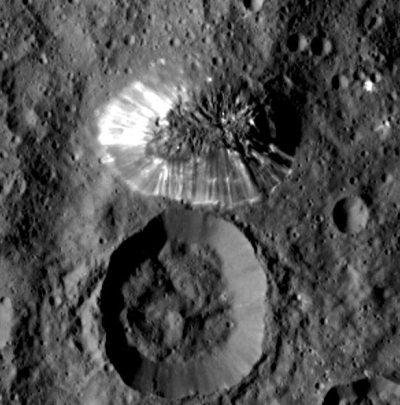
craters on Ceres

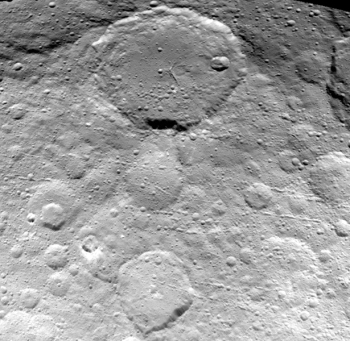
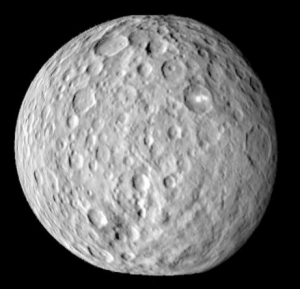
Cool image time! Dawn has now swooped down to 3,200 miles, and provided a very nice image of the cratered surface of Ceres. Though it does appear to resemble the Moon, there are some differences that come to mind if you take a close look at the full resolution image. The surface appears smoother. All of the craters appear worn or eroded or less rugged. Also, there are no mountains. The terrain resembles the Moon’s lowlands or maria, but more so.

Note that the region in this picture is tantalizingly close to the double bright spot, but does not include it. Because Dawn is still easing its way into its first survey orbit of 2,700 miles elevation, it only takes pictures when it stops firing its ion engine, which it is doing almost all the time to get where it wants to be. Thus, they apparently only had time for this image.

The spacecraft enters its mapping orbit on June 3. Expect some cool images, including the first good images of the double bright spots, shortly thereafter.

New Horizons spots all of Pluto’s 5 known moons

New Horizons has now been able to image all of Pluto’s known moons.

Pluto’s five known satellites are Charon, Hydra, Nix, Kerberos and Styx. At 648 miles (1,043 km) in diameter, Charon is nearly half as wide as Pluto itself, but the other four moons are minuscule. Kerberos and Styx, for example, are thought to be just 4 to 13 miles (7 to 21 km) and 6 to 20 miles (10 to 32 km) wide, respectively.

That the spacecraft has been able to spot them all this soon bodes well for what it will see when if flies past Pluto in July.

New images of Dawn’s double bright spot

The double spot on Ceres

Cool image time! Dawn has released a new animation made from images taken in early May, showing more details of the dwarf planet’s double bright spot.

As they note at the link, the double spot is now “revealed to be composed of many smaller spots.” As they also add, “Their exact nature remains unknown.”

Dawn’s engineers are now beginning to ease the spacecraft down to its survey orbit, about 2,700 miles above the surface.

New studies struggle to explain the origin of the Moon

The uncertainty of science: Three new studies on the mystery of the origin of the Moon all appear to better confirm the theory that it was created when the Earth collided with a Mars-sized planet.

It is important to be aware of the uncertainties here. All these studies were done to try to address problems with the impact theory, and though they kind of answer the questions, they leave behind some important doubts.

ALMA captures the rotation of the large asteroid Juno

The large ground-based telescope ALMA has captured a series of images of the large asteroid Juno, allowing scientists to estimate its rotation and overall shape.

Linked together into a brief animation, these high-resolution images show the asteroid rotating through space as it shines in millimeter-wavelength light. “In contrast to optical telescopes, which capture the reflected light from the Sun, the new ALMA images show the actual millimeter-wavelength light emitted by the asteroid,” said Todd Hunter, an astronomer with the National Radio Astronomy Observatory (NRAO) in Charlottesville, Va.

…The complete ALMA observation, which includes 10 separate images, documents about 60 percent of one rotation of the asteroid. It was conducted over the course of four hours on 19 October 2014 when Juno was approximately 295 million kilometers from Earth. In these images, the asteroid’s axis of rotation is tilted away from the Earth, revealing its southern hemisphere most prominently.

Dawn’s chief engineer gives us a detailed update

Link here. Chief engineer Marc Rayman loves to write about Dawn, and his posts on the Dawn blog are probably the most information-packed of any spacecraft blog I have ever read. Key quote this time:

Dawn’s extensive photographic coverage of the sunlit terrain in early May will include these bright spots. They will not be in view, however, when Dawn spies the thin crescent of Ceres in its next optical navigation session, scheduled for April 10.

The orientation of the spacecraft and asteroid now are such that there is no point taking pictures, as most of the asteroid is in darkness.

Read it all, however. He gives a masterful overview of what is going to happen in the coming months.

NASA has decided to grab an asteroid rock rather than bag an asteroid

Rather than try to bag an entire small asteroid with an unmanned probe and bring that back to Earth, NASA has decided to send an unmanned probe into orbit around an asteroid and use it to grab one of the asteroid’s boulders.

The $1.25 billion mission, which is planned to launch in December 2020, would send a robotic spacecraft for a rendezvous with an asteroid in 2022. After touching down on the asteroid’s surface, the spacecraft would snatch a boulder several meters across. The spacecraft would then orbit the asteroid for up to 400 days, testing out an idea for defending Earth from a catastrophic asteroid impact: using the spacecraft’s own gravitational field to subtly alter the asteroid’s orbit. Next, the spacecraft would bring the snatched rock back to Earth’s vicinity in 2025. Finally, as part of preparations for a possible mission to Mars, astronauts would visit and examine the rock for some 25 days, using the planned Orion spacecraft to make the trip.

From both a science perspective as well as a manned space perspective, the unmanned part of this plan is a very good idea. Whether it will get funded depends upon Congress, since its roots go back to President Obama’s April 2010 commitment to send astronauts to an asteroid by 2025. Such a commitment was never really realistic, so it has devolved to capturing a rock and sending astronauts to visit it, thus meeting Obama’s commitment in a Potemkin Village sort of way.

Much better to bring the rock back to Earth orbit where it can be captured and brought to ISS by any number of vehicles and studied there. Whether Congress will fund this in the manner proposed in order to help Obama meet his commitment however remains very doubtful.

Posted from Santa Barbara, California.

Water ice volcanoes on Ceres

Data collected by Dawn since it entered orbit around Ceres on March 6 now strongly suggests that the bright spots on the surface are produced by venting water,

Andreas Nathues, principal investigator for Dawn’s framing camera, says the feature has spectral characteristics that are consistent with ice. Intriguingly, the brightness can be seen even when the spacecraft is looking on edge at the crater rim, suggesting that the feature may be outgassing water vapor above the rim and into space. “Ceres seems to be indeed active,” he says. The feature brightens through the course of the day, and then shuts down at night. Nathues says the behavior is similar to that of comets.

More here. By mid-April Dawn should finally settle this with high resolution images.

Dawn bears down on Ceres

Ceres' cratered surface

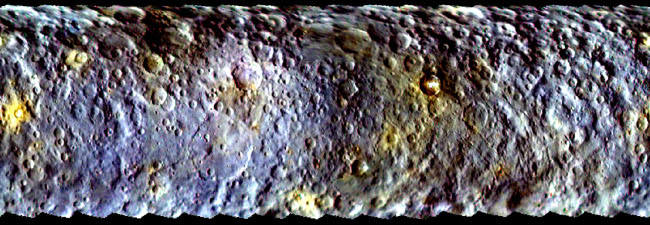
More cool images! As Dawn moves in on Ceres and prepares to enter orbit on March 6, it has managed to assemble enough images to produce a global map of the almost spheroid-shaped giant asteroid.

The bright spots however remain a mystery which cannot be answered until we get higher resolution images from much closer. Hopefully, Dawn will be able to do this once it is in orbit.

Earth’s other moon

Link here.

What you might not know is that the moon is not the Earth’s only natural satellite. As recently as 1997, we discovered that another body, 3753 Cruithne, is what’s called a quasi-orbital satellite of Earth. This simply means that Cruithne doesn’t loop around the Earth in a nice ellipse in the same way as the moon, or indeed the artificial satellites we loft into orbit. Instead, Cruithne scuttles around the inner solar system in what’s called a “horseshoe” orbit.

The brightest spot on Ceres has a partner

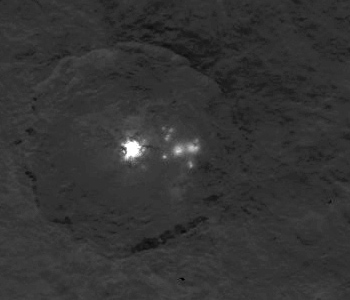
Ceres' double bright spots

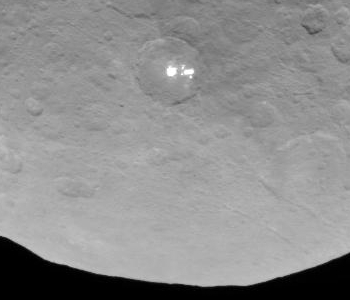
Cool images! Dawn’s newest images have revealed that the brightest spot on Ceres, shown on the right in a cropped version of the full image, has a dimmer companion.

“Ceres’ bright spot can now be seen to have a companion of lesser brightness, but apparently in the same basin. This may be pointing to a volcano-like origin of the spots, but we will have to wait for better resolution before we can make such geologic interpretations,” said Chris Russell, principal investigator for the Dawn mission, based at the University of California, Los Angeles.

The spots are still too small for Dawn’s camera to resolve. That they are inside what looks like a crater is very puzzling. If they are water-ice, why are they so bright and distinct? One one think the ice would pile up along the crater wall, but then, that’s what we think based on our experience here on Earth with wind, rain, and our heavy gravity. Ceres is cold, has no atmosphere, and a tiny gravitational field. Every geological process will proceed in a different manner.

Ceres comes into focus

Ceres as since on February 12, 2015 by Dawn

Cool images! The Dawn science team has released new even sharper images of the giant asteroid Ceres, taken by Dawn on February 12 at a distance of 52,000 miles.

Though the surface appears to have many of the typical craters, scientists continue to be puzzled by the bright spots. This newest image suggests that they are ice-filled craters, but don’t hold me to that guess. For one thing, why are only a handful of craters filled with ice, and none of the others?

Origin of Chelyabinsk meteorite remains unknown

The uncertainty of science: The origin of the Chelyabinsk meteorite that crashed over that Russian city two years ago remains murky to scientists.

Originally, astronomers thought that the Chelyabinsk meteor came from a 1.24-mile-wide (2 kilometers) near-Earth asteroid called 1999 NC43. But a closer look at the asteroid’s orbit and likely mineral composition, gained from spectroscopy, suggests few similarities between it and the Russian meteor.

The scientists noted in their paper that you really can’t use the similarity of orbits to link different asteroids, as their orbits are chaotic and change too much.

OSIRIS-REx to get more fuel for its asteroid mission

In what might be a first for the planetary science/engineering community, an unmanned probe, being built to bring samples back from the asteroid Bennu, is turning out to be lighter than expected, thus allowing engineers to stuff its tanks with extra fuel to extend its mission.

The OSIRIS-REx spacecraft, being built at a Lockheed Martin facility in Denver, is coming in lighter than the lift capability of the Atlas 5 rocket, which will lift off in its “411” configuration with a four-meter payload fairing, a single-engine Centaur upper stage, and one strap-on solid rocket booster.

The proposal — described as a “heavy launch option” — would add an extra 341 pounds of fuel to the spacecraft’s fuel tank.

Planetary probes never end up lighter than planned, at least until now. During construction scientists have always found it impossible to resist adding more instruments or capabilities, and thus engineers always struggle to get the spacecraft built within its weight budget. For OSIRIS-REx to have this wonderful problem is surely astonishing.

Hayabusa-2 in “tip-top” shape

Launched in December for a 2018 rendezvous with an asteroid, Hayabusa-2 has successfully completed its initial check-out according to Japanese officials.

Checkups on early-phase functionality are being carried out over a three-month period. Although the first Hayabusa had suffered malfunctions of its ion engines, it is confirmed that the four ion engines of Hayabusa-2 are functioning properly, JAXA said. Kuninaka said: “With the engines functioning, the explorer can set out on its voyage with a lot of leeway. I feel like, ‘Way to go!’”

1 18 19 20 21 22 31