Confirmed: Hayabusa-2 grabbed got a sample of Ryugu

The Hayabusa-2 science team has confirmed that in the spacecraft’s quick touchdown on the surface of the asteroid Ryugu today it successfully snagged an asteroid sample.

Mission team members announced at about 6:30 p.m. EST (2330 GMT) today that the order to fire the bullet had been issued, and that Hayabusa2 had moved away from Ryugu as planned. But it took a few more hours for them to confirm that the bullet had indeed fired, and that sample collection occurred.

…The collected samples are key to this objective: The Ryugu material will come down to Earth in a special return capsule in December 2020. Scientists in labs around the world can then scrutinize the stuff with far more advanced equipment than the Hayabusa2 team could pack onto a single spacecraft.

The sample bounty will include more than just the material Hayabusa2 collected today. The mothership is expected to grab two more samples in the coming weeks and months. The second sampling sortie will unfold much like today’s did, but the third will be dramatically different: Hayabusa2 will fire a copper projectile into Ryugu, wait a bit for the dust to clear, and then swoop in to grab material from the newly created crater. This formerly subsurface stuff will be pristine, unaffected by weathering from deep-space radiation.

More thrills to come, obviously.

3 comments

Hayabusa-2 has begun approach to Ryugu

Ryugu during approach

Hayabusa-2 has begun its approach to Ryugu, aiming for a quick touchdown and sample grab at approximately 7:06 pm (Eastern) tonight. The image at the right is the most recent taken during the approach.

The risks? From the Hayabusa-2 website:

Our original schedule planned for touchdown in late October of last year (2018). However, Ryugu was revealed as a boulder strewn landscape that extended across the entire surface, with no flat or wide-open regions. Before arriving at Ryugu, it was assumed there would be flat areas around 100 meters in size. But far than finding this, we have not even seen flat planes 30 meters across!

During the scheduled time for touchdown in late October, we did not touchdown but descended and dropped a target marker near the intended landing site. We were able to drop the target marker in almost the planned spot and afterwards we examined the vicinity of the target marker landing site in detail. Finally, the area denoted L08-E1 was selected as the place for touchdown.

From the first link above you can see approach images as they are downloaded today, about once every half hour.

0 comments

Hayabusa-2 prepares to land

Ryugu's northern hemisphere

The JAXA science team has released a set of images taken in January by Hayabusa-2 of its landing site on Ryugu, describing how those images helped map the region where touchdown will occur on February 22. The image on the right is one such image.

[It] shows a diagonally imaged photograph of Ryugu, captured by moving the spacecraft towards the direction of the north pole. The upper side of the image shows the north pole and reveals a landscape dominated with many large boulders. The white band extending to the left and right slightly below the center of the image is the equatorial ridge (Ryujin Ridge). The arrow tip marks the planned touchdown site and you can see this site is on the main ridge.

This is the first time we have images the northern hemisphere of Ryugu. In this observation, we acquired data on the equatorial region of Ryugu, the southern and northern hemisphere. Imaging the entire area is very important for creating accurate global shape models for Ryugu.

They should begin beaming images down of the landing approach sometime tomorrow, and will do so about every 30 minutes throughout the sequence.

0 comments

Asteroid to eclipse Sirius, the sky’s brightest star, on February 18

On February 18, 2019 a four-mile wide asteroid is going to pass in front of Sirius, the sky’s brightest star, and block its light for just under two seconds.

Can a 7-kilometer-wide asteroid make Sirius disappear? You bet it can. That just might happen on Monday night, February 18th. That evening around 10:30 p.m. MST (5:30 UT February 19th), there’s a good probability that the 17th-magnitude 4388 Jürgenstock will occult the sky’s brightest star for up to 1.8 seconds. Visibility stretches along a narrow path from the southern tip of Baja California to the Las Cruces–El Paso region, up through the Great Plains, and north to the Winnipeg area. While only a limited number of people may see this event, anytime Sirius disappears, however briefly, it’s news!

In the U.S. the narrow path cuts through New Mexico, Colorado, Nebraska, South Dakota, and North Dakota. If you live in or near this path, this is definitely worth watching, especially since it will be happening at a convenient hour in the evening.

0 comments

Recent Cuba meteorite estimated to have weighed about 360 tons

Using its imaged track from several sources, scientists have now estimated the size and weight of the recent spectacular fireball over Cuba as being several meters across and weighing about 360 tons.

After reconstructing the trajectory in the atmosphere, the Colombian astronomers “played back” the impact and found that the culprit, a rock with an estimated size of several meters and a weight of about 360 tons, came from an eccentric orbit around the Sun with an average distance to our star of 1.3 astronomical units (1 astronomical-unit = 150 million km). Before impacting the Earth, the rock completed a turn around the Sun every 1.32 years. All that came to an end on February 1, 2019 when both, the rock and the Earth, found themselves at the same point in space, at the same time. The worse part was for the rock!

The article spends most of its time selling a computer model the scientists have developed that they claim can predict the approach trajectory of meteorites, something I find quite unconvincing. However, the result above is important for different reasons. Routinely astronomers today discover new small asteroids just days before they zoom harmlessly past the Earth. Each time one of these new near Earth asteroids is found, the press automatically goes into “Chicken Little mode,” suggesting that should this object have hit the Earth it would have caused massive damage.

Most of these newly discovered asteroids are about the same size as the Cuba meteorite, if not smaller. Thus, this meteorite gives us a clear idea of how completely harmless these other near Earth asteroids are. In fact, this impact suggests to me that in most cases an asteroid would have to be about ten times larger to pose a significant threat.

Keep this number — 360 tons — in mind the next time another near Earth asteroid is discovered.

4 comments

New Horizons’ farewell image of Ultima Thule

Ultima Thule's shape

The New Horizons science team has released the last sequence of images taken by the spacecraft as flew away after its flyby.

The link has a nice video of that sequence. However, it is the information gleaned from this sequence that is most interesting.

The newly released images also contain important scientific information about the shape of Ultima Thule, which is turning out to be one of the major discoveries from the flyby.

The first close-up images of Ultima Thule – with its two distinct and, apparently, spherical segments – had observers calling it a “snowman.” However, more analysis of approach images and these new departure images have changed that view, in part by revealing an outline of the portion of the KBO that was not illuminated by the Sun, but could be “traced out” as it blocked the view to background stars.

Stringing 14 of these images into a short departure movie, New Horizons scientists can confirm that the two sections (or “lobes”) of Ultima Thule are not spherical. The larger lobe, nicknamed “Ultima,” more closely resembles a giant pancake and the smaller lobe, nicknamed “Thule,” is shaped like a dented walnut.

The image on the right shows their preliminary guess at Ultima Thule’s overall shape, as suggested by these new images.

The spacecraft has still not sent back the images it took during its closest approach, so there are likely more surprises coming.

15 comments

Rare asteroid orbiting near Venus discovered

The Zwicky Transient Facility (ZTF), a new sky survey telescope whose main goal is to find Near Earth asteroids, has discovered a rare asteroid orbiting near Venus.

A state-of-the-art sky-surveying camera, the Zwicky Transient Facility, or ZTF, detected the asteroid on January 4, 2019. Designated 2019 AQ3, the object has the shortest “year” of any recorded asteroid, with an orbital period of just 165 days. It also appears to be an unusually big asteroidal specimen. “We have found an extraordinary object whose orbit barely strays beyond Venus’ orbit—that’s a big deal,” said Quanzhi Ye, a postdoctoral scholar at IPAC, a data and science center for astronomy at Caltech. Ye called 2019 AQ3 a “very rare species,” further noting that “there might be many more undiscovered asteroids out there like it.”

…The orbit, as it turns out, is angled vertically, taking 2019 AQ3 above and below the plane where the planets run their laps around the sun. Over its short year, 2019 AQ3 plunges inside of Mercury, then swings back up just outside of Venus’ orbit.

The telescope, in operation since March 2018, and so far found

nearly 60 new near-Earth asteroids. Two of these were spotted in July 2018 mere hours before they gave Earth quite a close shave. Designated 2018 NW and 2018 NX, the duo of bus-sized asteroids whipped past at a distance of about 70,000 miles, or only a third of the way to the moon. Fortunately, the newfound 2019 AQ3 poses no threat; the closest it ever comes to Earth is about 22 million miles.

1 comment

Rock from Earth, found on Moon?

The uncertainty of science: Scientists studying rocks brought back by the Apollo 14 lunar mission have concluded that one sample originally came from the Earth, and if so would be the oldest known Earth rock.

It is possible that the sample is not of terrestrial origin, but instead crystallized on the Moon, however, that would require conditions never before inferred from lunar samples. It would require the sample to have formed at tremendous depths, in the lunar mantle, where very different rock compositions are anticipated. Therefore, the simplest interpretation is that the sample came from Earth.

The team’s analyses are providing additional details about the sample’s history. The rock crystallized about 20 kilometers beneath Earth’s surface 4.0-4.1 billion years ago. It was then excavated by one or more large impact events and launched into cis-lunar space. Previous work by the team showed that impacting asteroids at that time were producing craters thousands of kilometers in diameter on Earth, sufficiently large to bring material from those depths to the surface. Once the sample reached the lunar surface, it was affected by several other impact events, one of which partially melted it 3.9 billion years ago, and which probably buried it beneath the surface. The sample is therefore a relic of an intense period of bombardment that shaped the Solar System during the first billion years. After that period, the Moon was affected by smaller and less frequent impact events. The final impact event to affect this sample occurred about 26 million years ago, when an impacting asteroid hit the Moon, producing the small 340 meter-diameter Cone Crater, and excavating the sample back onto the lunar surface where astronauts collected it almost exactly 48 years ago (January 31–February 6, 1971).

The scientists also admit that their conclusion is controversial and will be disputed. If true, however, it suggests that there is significant material on the Moon from the early Earth that can provide a window into parts our planet’s history that are presently inaccessible.

2 comments

Oblique close-up image of Ceres

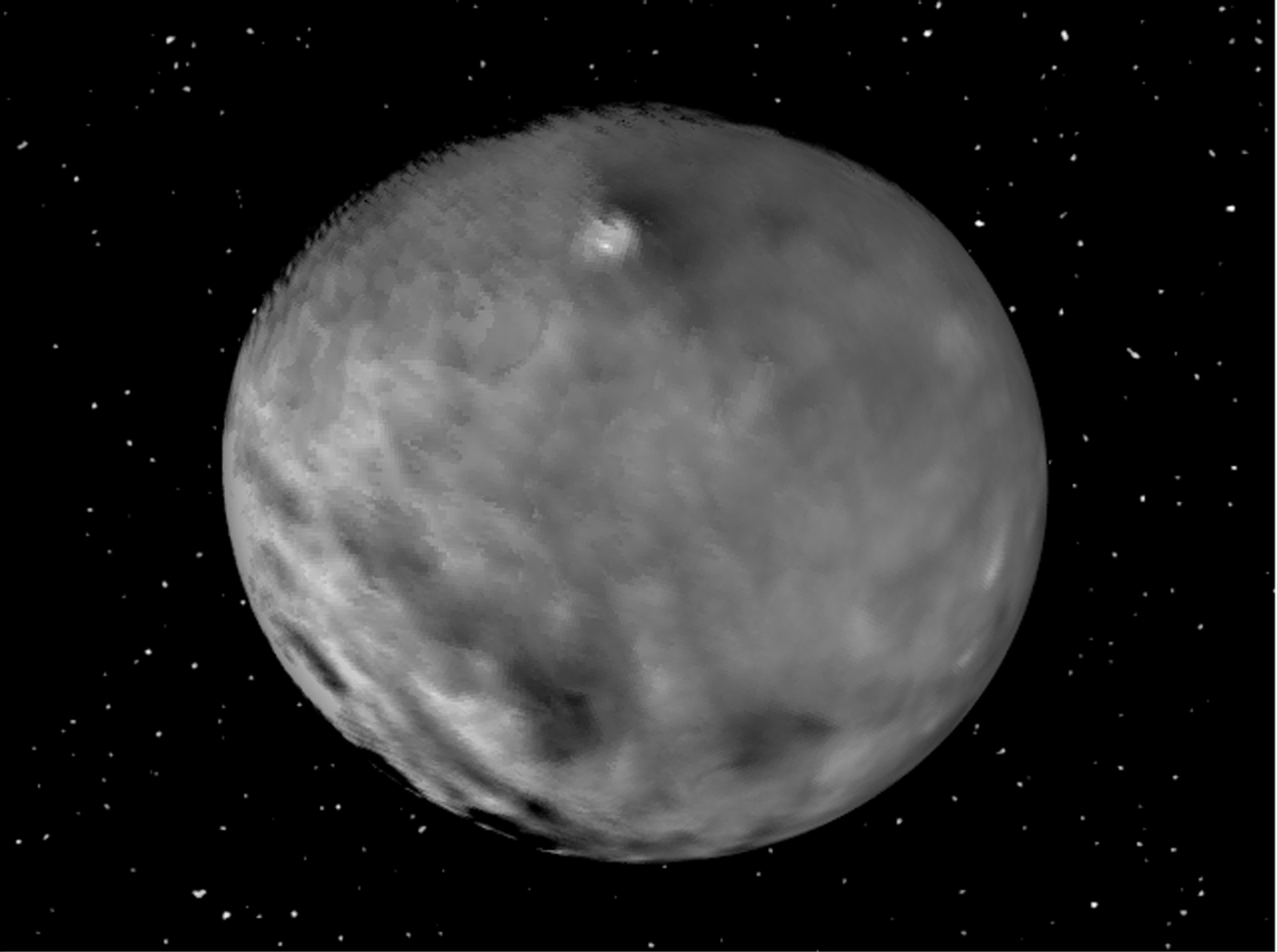
Ceres from Dawn

The Dawn science team has released an oblique close-up image of Ceres, taken in May 2018 before the Dawn mission ended. To the right is a reduced resolution version, with the full resolution photograph viewable if you click on it.

Dawn captured this view on May 19, 2018. The image shows the limb of Ceres at about 270E, 30N looking south. The spatial resolution is about 200 feet (60 meters) per pixel in the nearest parts of the image. The impact crater to the right (only partially visible) is Ninsar, named after a Sumerian goddess of plants and vegetation. It is about 25 miles (40 kilometers) in diameter.

Bright seeps running down the interior rims of several craters are visible. To my eye, the image also suggests an overall softness to Ceres. Its surface is like a sandbox, easily reshaped significantly by each impact.

1 comment

Orbital images of Bennu

Close-up of Bennu's southern hemisphere

The OSIRIS-REx science team has released two new images of Bennu’s southern hemisphere, taken from orbit. The image on the right is a cropped section of the highest resolution version of a montage of two images. Click on the image to see the entire two-image montage.

These two OpNav images of Bennu’s southern hemisphere, which each have an exposure time of about 1.4 milliseconds, were captured Jan. 17 from a distance of about one mile (1.6 km). They have been cropped and the contrast has been adjusted to better reveal surface features. The large boulder – fully visible in the middle of the left frame and in partial shadow in lower portion of right frame – is about 165 feet (50 meters) across.

The cropped section to the right shows that large boulder in the middle of the frame.

I’m sorry, but when I look at this rubble-pile asteroid I cannot help but think of the cat-litter clumps I remove from our cats’ litter box. The only fundamental difference is that the grains in cat litter are made to be a uniform size, while at Bennu the grains are much coarser and not uniform. Nonetheless, this asteroid is a clump of many grains, just like those cat litter clumps, and will likely crumple easily into a cloud of grains if smacked just hard enough.

This knowledge is actually very critical, as Bennu is a potentially dangerous asteroid with an orbit that might have it impact the Earth in about two hundred years.

4 comments

New impact on the Martian south polar cap

New impact on Mars' south pole

Cool image time! The image to the right, cropped to post here, was taken on October 5, 2018 by the high resolution camera on Mars Reconnaissance Orbiter (MRO) and shows a recent meteorite impact that occurred sometime between July and September of 2018 on the Martian polar cap . If you click on the image you can see the entire photograph. As noted in the captioned press release,

It’s notable because it occurred in the seasonal southern ice cap, and has apparently punched through it, creating a two-toned blast pattern.

The impact hit on the ice layer, and the tones of the blast pattern tell us the sequence. When an impactor hits the ground, there is a tremendous amount of force like an explosion. The larger, lighter-colored blast pattern could be the result of scouring by winds from the impact shockwave. The darker-colored inner blast pattern is because the impactor penetrated the thin ice layer, excavated the dark sand underneath, and threw it out in all directions on top of the layer.

Location on edge of south polar cap

It is not known yet the size of this meteorite. The location is shown in the overview image to the right, with the impact indicated by the white dot. The black circle in the middle of the image is the south pole itself, an area where MRO’s orbit does not allow imagery. This location, on the edge of the Martian polar cap, is helpful to scientists because it has excavated material from below the cap, providing them a peek into previously unseen the geology there. Had the impact been farther south, on the thicker cap, that hidden material below the cap would likely not have been exposed.

The cap itself is made up of both ice and frozen carbon dioxide, though the CO2 is mostly seen as frost during winter months that evaporates during the summer.

2 comments
1 29 30 31 32 33 78