Psyche completes its Mars fly-by

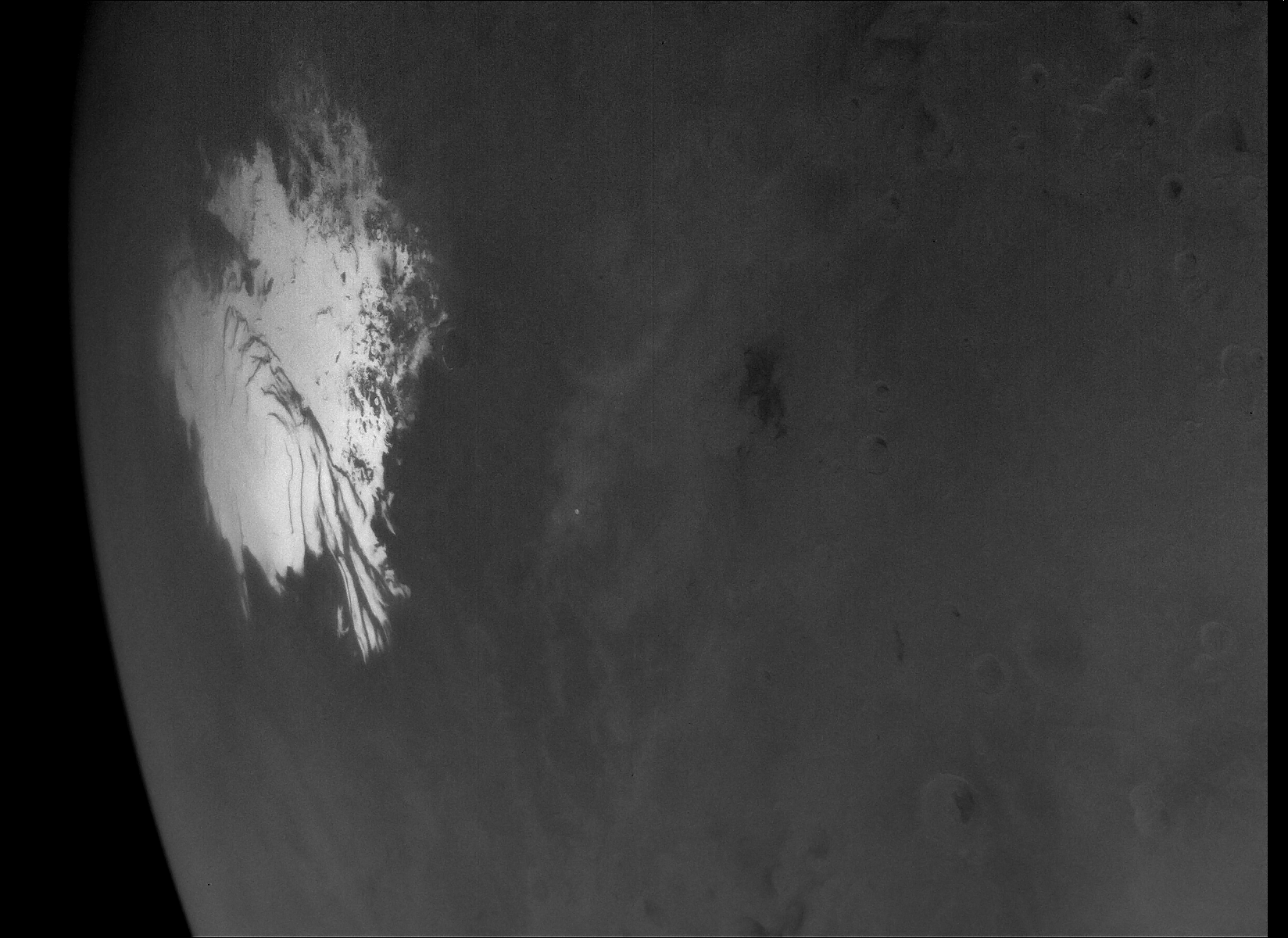
Mars' south pole as seen by Psyche@
Click for original image.

The asteroid probe Psyche on May 15, 2026 successfully completed its last fly-by of Mars, sending the spacecraft on its way to the asteroid Psyche, with a planned arrival in 2029.

The image to the right, cropped, rotated, and, reduced to post here, was the highest resolution image released by the science team of the Martian south polar icecap.

The image scale is around 0.7 miles per pixel (1.14 kilometers per pixel). The cap itself extends across more than 430 miles (700 kilometers). The image was acquired with Imager A on May 15, 2026, at about 1:53 p.m. PDT.

The white material is the perennial dry ice cap overlaying a water ice cap of larger size.

NASA also released several other images taken during the fly-by, including a close-up of the 290-mile-wide Huygens Crater, located in the Martian southern cratered highlands.

The pictures reveal no significant science, but they prove once again that Psyche’s cameras are working and the spacecraft is pointing accurately.

1 comment

Psyche approaches Mars

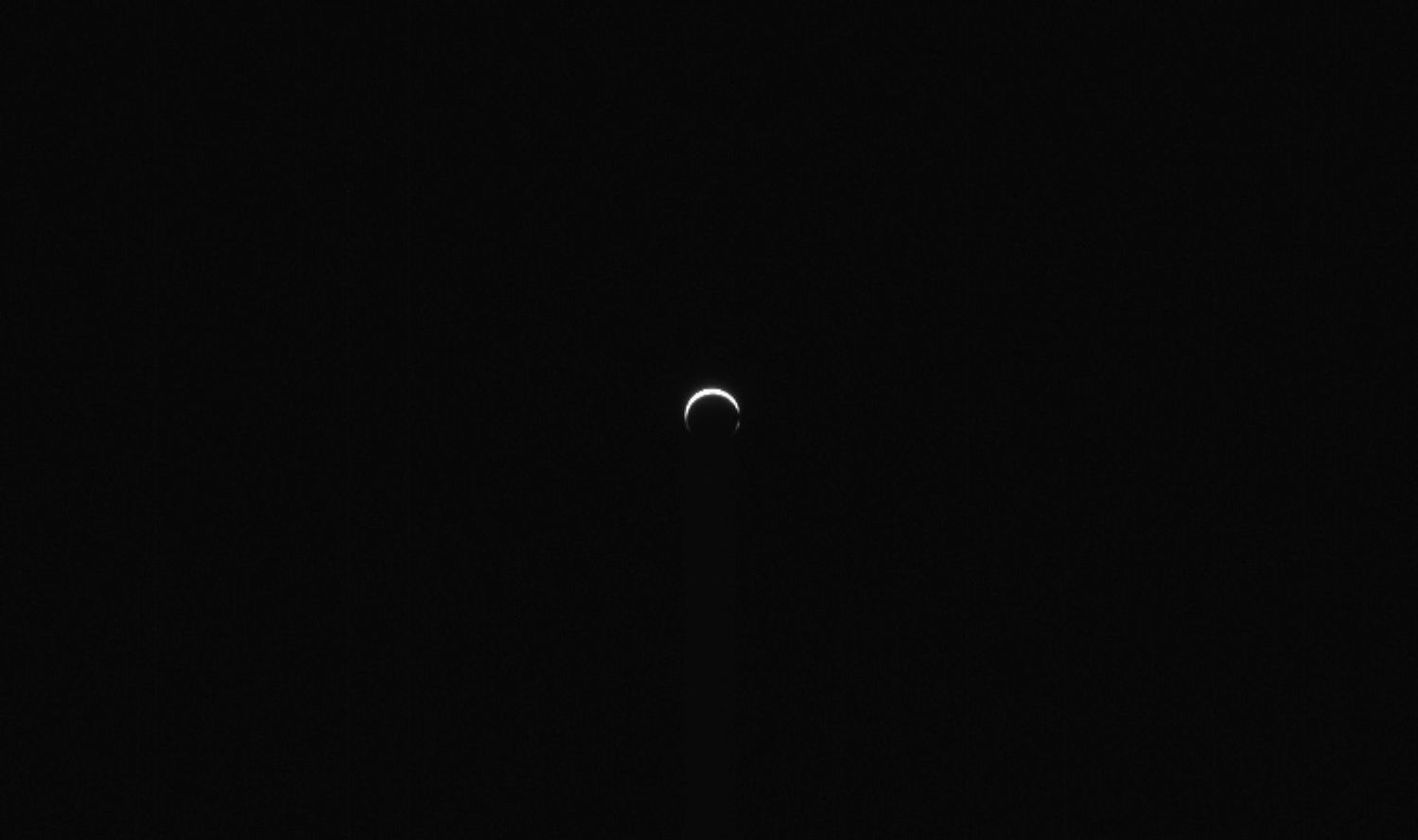
Mars as seen by Psyche
Click for original image.

The asteroid probe Psyche is now approaching Mars for a May 15, 2026 fly-by that will slingshot it out to the metal asteroid Psyche in 2029.

The image to the right, cropped and expanded to post here, was taken on May 3, 2026 when the spacecraft was still about three million miles away.

The observation was acquired by the multispectral imager instrument’s panchromatic or broadband filter, with an exposure time of just 2 milliseconds. Even with this very short exposure time, the crescent is extremely bright and parts of the image are oversaturated. The light seen here is sunlight reflected off the surface of Mars and also scattered by dust particles in its atmosphere. Because the quantity of dust in the atmosphere can vary rapidly over time, the anticipated brightness of the crescent was hard to predict before this early image was acquired.

The dustiness of Mars leads to sunlight being scattered by its atmosphere, making the crescent appear to extend farther around the planet than if it had no atmosphere (as with our Moon).Of note, on the right side of the extended crescent, there appears to be a gap, which coincides with the planet’s icy north polar cap. The cap is currently in winter and mission specialists hypothesize that seasonal clouds and hazes may be forming in that region, possibly blocking the atmospheric dust’s ability to scatter sunlight like it does elsewhere around the planet.

Though the spacecraft had had a thruster issue last year, all seems well at this time.

10 comments

The new Rubin telescope discovers over 11,000 new asteroids in first observations

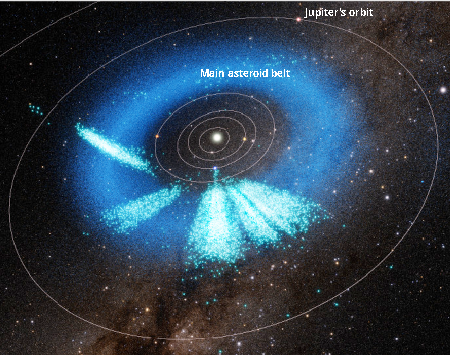
Rubin's first asteroid discoveries
Click for full animation.

The new Rubin Observatory, a ground-based telescope in Chile, has discovered over 11,000 new asteroids in its first preliminary observations, with most in the main asteroid belt but a large number in the Kuiper Belt beyond Neptune and 33 previously unknown near-Earth asteroids.

The graphic to the right, annotated by me to post here, shows all of Rubin’s asteroid detections in light blue.

The submission to MPC [Minor Planet Center] comprises approximately one million observations, taken over the span of a month and a half, of over 11,000 new asteroids and more than 80,000 already known asteroids, including some that had previously been observed but were later “lost” because their orbits were too uncertain to predict their future locations. You can interact with all of Rubin’s asteroid discoveries in the Rubin Orbitviewer, which uses real data to provide an intuitive way to explore the structure of our cosmic backyard in three dimensions and in real time. Also, visit the Rubin Asteroid Discoveries Dashboard to learn about the new objects Rubin has uncovered.

…Among the newly identified objects are 33 previously unknown near-Earth objects (NEOs), which are small asteroids and comets whose closest approach to the Sun is less than 1.3 times the distance between Earth and the Sun. None of the newly discovered NEOs pose a threat to Earth, and the largest is about 500 meters wide.

Astronomers predict that Rubin will eventually find 90,000 new near-Earth objects, with some expected to pose a risk of hitting the Earth. It does this by repeatedly surveying the southern sky with its large mirror, then identifying new objects with its sophisticated software.

2 comments

Private mission to Apophis gets another customer, two student-built landers

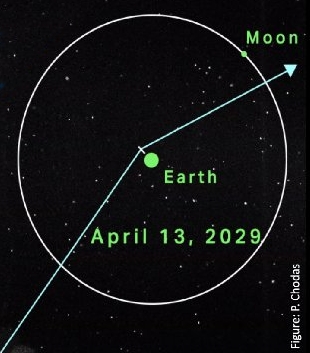
Apophis' path past the Earth in 2029
A cartoon (not to scale) showing Apophis’s
path in 2029.

The orbital tug startup Exlabs has signed up a second payload customer to fly on its private ApophisExL mission to rendezvous with the potentially dangerous asteroid Apophis when it makes its April 13, 2029 close fly-by of the Earth.

ExLabs has announced its partnership with Japan’s Chiba Institute of Technology (ChibaTech) and its Planetary Exploration Research Center (PERC) to send university-led payloads to the surface of asteroid Apophis during its rare near-Earth flyby in 2029. ApophisExL is the world’s first commercial deep-space rideshare and is supported by mission design and operations collaboration with NASA’s Jet Propulsion Laboratory (JPL) operated by Caltech.

Under the leadership of planetary scientist and PERC Director, Dr. Tomoko Arai, ChibaTech students and researchers are developing two landing payloads to be deployed on the asteroid’s surface.

An Australian satellite startup, Fleet Space Technologies, had already signed on to fly a mapping instrument on ApophisExL.

Though the press release at the link calls this private mission “a new model,” using private enterprise rather than relying on the government for doing planetary missions, it actually harks back to the way things were done in the U.S. before World War II, when the private sector did most of this pure research. In fact, as late as the 1960s there was at least one company, American Science and Engineering, doing the first X-ray astronomical observations flying suborbital rockets. It later won contracts from NASA and other agencies to help build several later orbiting X-ray telescopes.

Over time the government space agencies became dominant, so that most of this design work was either done by them or by universities, with private companies relegated to the roles of minor subcontractors.

This new model is simply an extension of the capitalism model that is taking over the entire space industry, shifting power and ownership from big, expensive, and inefficient government programs to small, cheap, and economical private missions. Those space agencies can still do missions, but they do it by buying payload space on these private missions.

Below is a list of the missions going to Apophis in 2029:
» Read more

2 comments

Terran Orbital wins contract to build cubesat to go to Apophis with ESA’s Ramses probe

Apophis' path past the Earth in 2029
A cartoon (not to scale) showing Apophis’s
path in 2029.

The satellite company Terran Orbital, owned by Lockheed Martin, has won a contract from the European Space Agency (ESA) to build a cubesat to fly with its Ramses probe that will launch in 2028 and rendezvous with the potentially dangerous asteroid Apophis when it makes its very close fly-by of the Earth on April 13, 2029.

The CubeSat is named after Italian scientist Paolo Farinella and is backed by the Italian Space Agency. After successfully completing the Critical Design Review in January 2026, Tyvak International [a subsidiary of Terran Orbital] will begin the implementation phase, with launch currently planned for 2028.

…Operating aboard the RAMSES spacecraft, developed by OHB Italia, the Farinella CubeSat will be one of two spacecraft deployed to explore the asteroid’s subsurface using low-frequency radar. The satellite will also carry Horus, an optical instrument that acts as both a science imager and navigation camera, and Vista, a dust detector previously flown on the Milani CubeSat from ESA’s Hera mission.

Apophis is estimated to be about 1,200 feet across. When it does its fly-by in ’29 it will get within 20,000 miles of the Earth, dipping within the orbits used by geosynchronous satellites. It will then pass within 60,000 miles of the Moon. At its closest it will for a short time be visible to the naked eye.

Apophis’ orbit means that it has the potential in the next century or so to impact the Earth. This particular fly-by is significant because the Earth/Moon’s gravity will change the asteroid’s path in an unpredictable manner that could either increase or decrease that impact possibility on future fly-bys. And we won’t know until after the fly-by is complete.

1 comment

Dart changed the orbit of the Didymos/Dimorphos binary asteroids around the Sun

Dimorphos just after impact

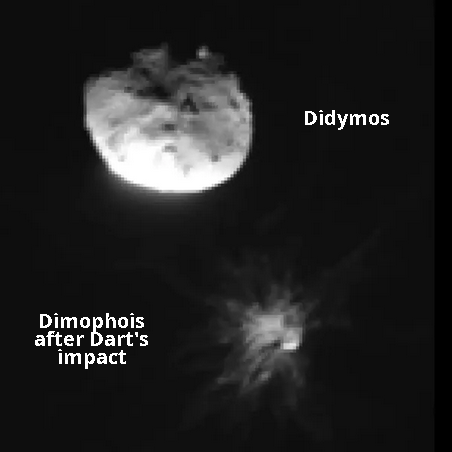
When the Dart spacecraft impacted the asteroid Dimorphos in September 2022, it not only shortened Dimophos’ orbit around its companion asteroid Didymos by about 33 minutes while reshaping the asteroid, a new study has found that it also changed very slightly the orbit of both asteroids around the Sun.

The image to the right, annotated to post here, was taken by the Italian LICIACube spacecraft moments after the September 26, 2022 impact.

The research paper describing this research can be found here. From the press release:

The new study shows the impact ejected so much material from the binary system that it also changed the binary’s orbital period around the Sun by 0.15 seconds. “The change in the binary system’s orbital speed was about 11.7 microns per second, or 1.7 inches per hour,” said Rahil Makadia, the study’s lead author at the University of Illinois Urbana-Champaign. “Over time, such a small change in an asteroid’s motion can make the difference between a hazardous object hitting or missing our planet.”

To be precise, the orbital speed was slowed 1.7 inches per hour, which while tiny would mean its solar orbit is now slightly shortened.

The result proves that a similar impact could be used on some asteroids to deflect them from hitting the Earth, though we would need to know a lot about that asteroid prior to launching the mission to accurately predict the orbital change. Otherwise, any impact could be a dangerous crap shoot that could do more harm than good.

2 comments

New Webb data says asteroid 2024 YR4 will miss the Moon in 2032

Asteroid 2024 YR4 as seen by Webb in the mid-infrared
Asteroid 2024 YR4 as seen by Webb in the
mid-infrared in April 2025. Click for original image.

New Webb data collected in February has now eliminated any chance the potentially dangerous asteroid 2024 YR4 will hit either the Earth or the Moon when it makes its next close pass on December 22, 2032.

Using data from NASA’s James Webb Space Telescope observations collected on Feb. 18 and 26, experts from NASA’s Center for Near-Earth Object Studies at the agency’s Jet Propulsion Laboratory in Southern California have refined near-Earth asteroid 2024 YR4’s orbit and are ruling out a chance of lunar impact on Dec. 22, 2032. With the new data, 2024 YR4 is expected to pass by the lunar surface at a distance of 13,200 miles (21,200 km).

Earlier less precise data had suggested 2024 YR4 had a 4.3% chance of hitting the Moon in 2032. That chance is now zero. This result is actually disappointing, in that an impact of this asteroid, estimated to be about 200 feet in diameter, would have not only been spectacular, but would have been scientifically useful. We would have been able to observe it closely with many ground- and space-based telescopes, and garnered a lot of useful information about the asteroid, the Moon, and the very nature of impacts.

The impact would have also eliminated the chance this asteroid might hit the Earth in the future. 2024 YR4 orbits the Sun about every four years. Previous calculations suggested another potentially dangerous fly-by of Earth in 2047, but these numbers are unreliable because the orbit will be changed by the 2032 fly-by in ways that cannot be predicted as yet.

2 comments

OHB Italia wins $96 million contract to build Ramses probe to visit the asteroid Apophis

Apophis' path past the Earth in 2029
A cartoon (not to scale) showing Apophis’s
path in 2029

The European Space Agency (ESA) yesterday announced that it has awarded the aerospace company OHB Italia a $96 million contract to build Ramses probe to rendezvous with the potentially dangerous asteroid Apophis when it makes its next close fly-by of Earth in 2029.

This contract is in addition to the $75 million development contract awarded OHB Italia in 2024. According to the company’s press release here:

The launch is scheduled for April 2028, with a rendezvous with Apophis planned for February 2029, approximately two months before its close approach to Earth. The spacecraft will accompany the asteroid until August 2029, in order to observe in detail how Earth’s tidal forces modify its shape, rotation, orbit and surface characteristics.

The initiative also benefits from strong international cooperation. The Japan Aerospace Exploration Agency (JAXA), drawing on its well-established expertise in asteroid science, will contribute by providing launch service onboard an H3 rocket, the spacecraft’s solar arrays and a Thermal Infrared Imager, further reinforcing the project’s global dimension.

In addition, two cubesats will be launched with Ramses and deployed once the spacecraft reaches Apophis.

This schedule is very tight, which places great pressure on OHB, especially because European space projects are traditionally built slowly after years of planning. ESA almost never does things fast like this.

At the moment, Osiris-Apex (formerly Osiris-Rex) is the only spacecraft that is on its way to Apophis.

1 comment

A galaxy’s swirling dust lanes

A galaxy with swirling dust lanes
Click for original image.

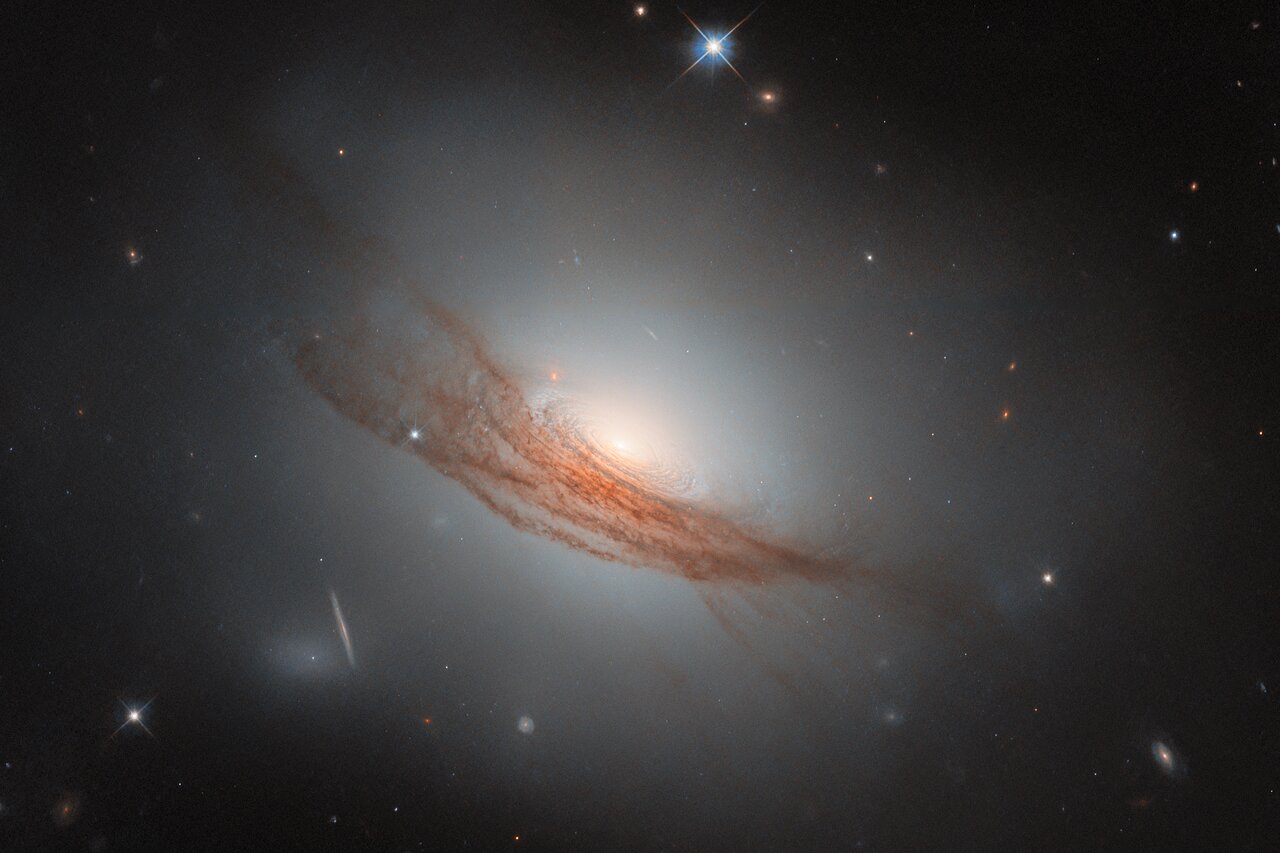
Cool image time! The picture to the right, cropped, reduced, and enhanced to post here, was taken by the Hubble Space Telescope as part of follow-up observations of a now faded supernovae that occurred there two years earlier.

This was on purpose: the aim of the observations was to witness the aftereffects of the supernova and examine its surroundings, which can only be done once the intense light of the explosion is gone.

The galaxy itself, NGC 7722, is 187 million light years away, and is unusual in itself.

A “lenticular”, meaning “lens-shaped”, galaxy is a type that sits in between the more familiar spiral galaxies and elliptical galaxies. It is also less common than these — partly because when a galaxy has an ambiguous appearance, it can be hard to determine if it is actually a spiral, actually an elliptical galaxy, or something in between. Many of the known lenticular galaxies sport features of both spiral and elliptical galaxies. In this case, NGC 7722 lacks the defined arms of a spiral galaxy, while it has an extended, glowing halo and a bright bulge in the center similar to an elliptical galaxy. Unlike elliptical galaxies, it has a visible disc — concentric rings swirl around its bright nucleus. Its most prominent feature, however, is undoubtedly the long lanes of dark red dust coiling around the outer disc and halo.

The streak in the lower left is a very distant background galaxy, seen on edge.

1 comment

Comet K1/Atlas has broken apart, not interstellar Comet 3I/Atlas

the end of Comet K1/Atlas

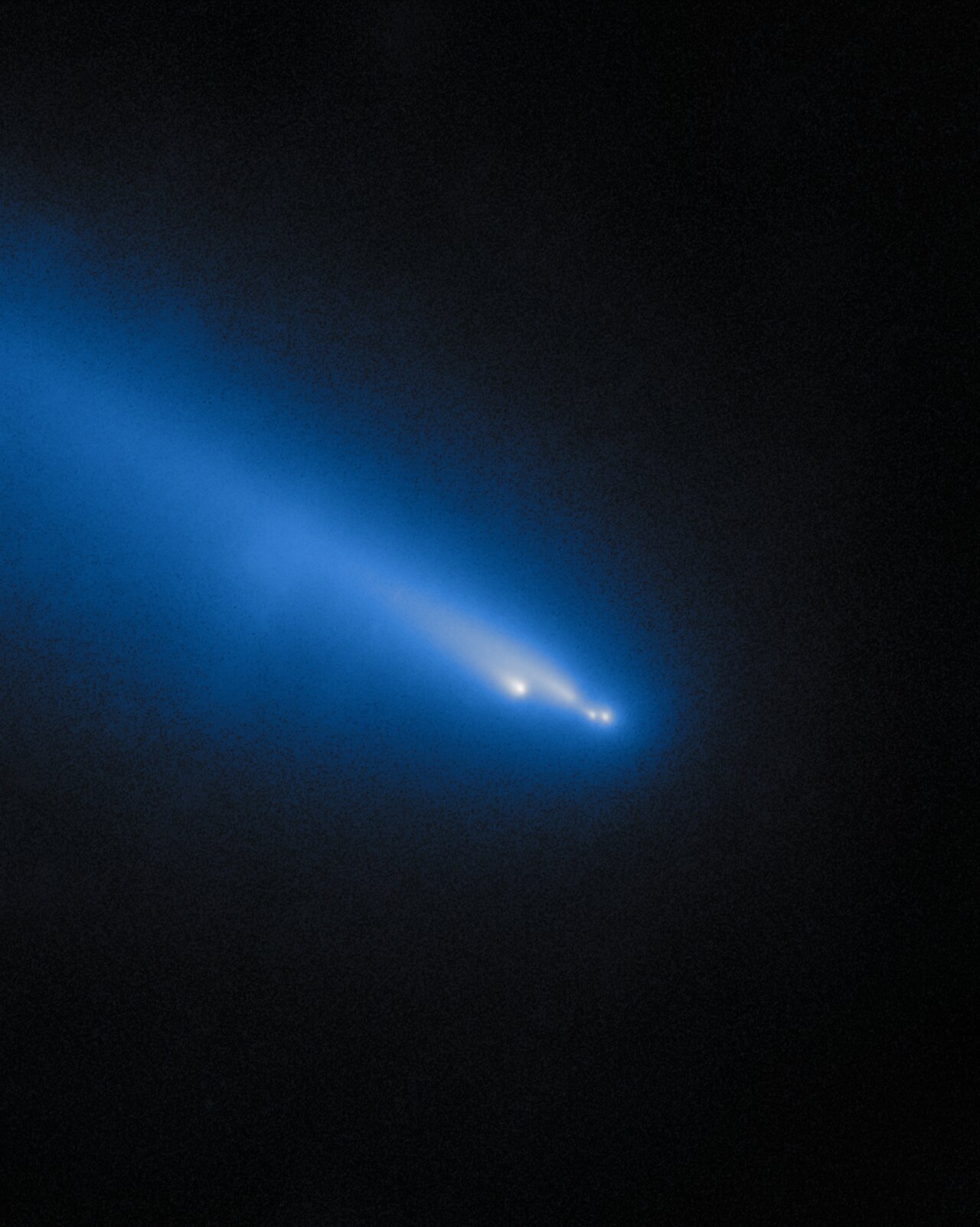
CORRECTION: The image to the right is not that of interstellar Comet 3I/Atlas, as I reported earlier today. I misread the Gemini Telescope release. This is comet K1/Atlas, another comet from our own solar system that made its close approach to the Sun in October, when it broke up.

The the latest image from the Gemini North Telescope in Hawaii shows at least four sections slowly drifting apart.

The picture to the right, cropped to post here, was taken on December 6, 2025. Gemini’s previous image, taken in November 11th, shows about the same number of objects, but clustered much more closely together.

It appears that as the comet made its closest approach, the stress was too great. This is not surprising, as it happens to many comets that get too close to the Sun.

Sorry for the error and hat tip to reader Tom Laskowski for letting me know. I need to look at the names of comets named after the ATLAS telescope, as they are very similar and most are NOT interstellar comet 3I/Atlas.

8 comments

Billionaire to fund construction of an orbiting optical telescope larger than Hubble

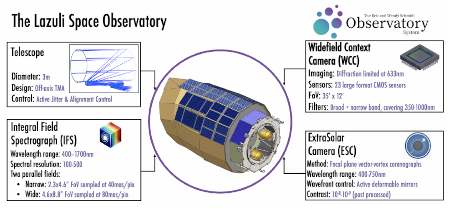
Lazuli
Figure 1 from the proposal paper [pdf].

Schmidt Sciences, a foundation created by one of Google’s founders, announced yesterday it is financing the construction of four new research telescopes, one of which will be an orbiting optical telescope with a mirror 3.1 meters in diameter, larger than the 2.4 meter primary mirror on the Hubble Space Telescope.

Today at a meeting of the American Astronomical Society, Schmidt Sciences, a foundation backed by billionaires Eric and Wendy Schmidt, announced one of the largest ever private investments in astronomy: funding for an orbiting observatory larger than NASA’s Hubble Space Telescope, along with funds to build three novel ground-based observatories. The project aims to have all four components up and running by the end of the decade.

“We’re providing a new set of windows into the universe,” says Stuart Feldman, president of Schmidt Sciences, which will manage the observatory system. Time on the telescopes will be open to scientists worldwide, and data harvested by them will be available in linked databases. Schmidt Sciences declined to say how much it is investing but Feldman says the space telescope, called Lazuli, alone will cost hundreds of millions of dollars.

Eric Schmidt was once CEO of Google, and in recent years has been spending his large fortune (estimated to exceed $50 billion) on space ventures. For example, in March 2025 he acquired control of the rocket startup Relativity.

While the three new ground-based telescopes will do important work, the Lazuli space telescope is by far the most important, not only scientifically but culturally. » Read more

29 comments

Rubin Observatory’s first observations detects more than 2,000 asteroids

The first look patch, in which 2,103 asteroids were detected
The first look patch, in which 2,103 asteroids
were detected. Figure 1 of the paper.

Scientists have now published the first results from the Rubin Observatory in Chile during its on-going commissioning phase, during which they detected more than 2,000 asteroids in just one patch in the sky, most of which had been unknown previously and many rotating at record-breaking speeds.

You can read the paper here [pdf]. From the press release:

The study presents 76 asteroids with reliable rotation periods. This includes 16 super-fast rotators with rotation periods between roughly 13 minutes and 2.2 hours, and three ultra-fast rotators that complete a full spin in less than five minutes.

All 19 newly identified fast-rotators are longer than the length of an American football field (100 yards or about 90 meters). The fastest-spinning main-belt asteroid identified, named 2025 MN45, is 710 meters (0.4 miles) in diameter and it completes a full rotation every 1.88 minutes. This combination makes it the fastest-spinning asteroid with a diameter over 500 meters that astronomers have found.

All but one of these fast-rotators are in the main asteroid belt, with the exception a near-Earth asteroid.

This work essentially completes Rubin’s commissioning. It will begin full observations in 2026. From the paper:

Toward the start of 2026, the observatory will begin conducting the Legacy Survey of Space and Time (LSST), a decade-long campaign to repeatedly image the southern sky in multiple bands. The main LSST survey will use six filters spanning near-ultraviolet to near-infrared wavelengths, revisiting the same pointing twice each night, returning to take additional pairs every few nights. … The cadence is designed to result in a dataset capable of answering numerous and varied science cases, from understanding the nature of dark energy to discovering and characterizing millions of asteroids, comets, interstellar objects, and transneptunian objects (TNOs) in the solar system.

In building Rubin the astronomers have always thought their biggest problem was archiving and accessing this large dataset, and much work was spent developing a usable and accessible archive system. Even so, it will take thousands of scientists many decades to mine the discoveries that will be hidden there.

6 comments
1 2 3 78