
Axiom signs $125 million deal with startup Gravitics to build a module for its space station
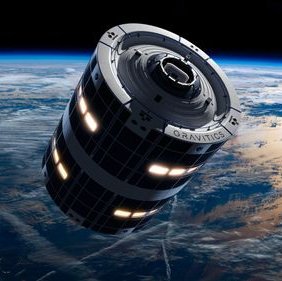
Artist conception of Gravitics' Starmax module
Artist conception of Gravitics’ Starmax
module, designed to fit inside Starship

The space station company Axiom on July 9, 2024 awarded a $125 million contract to the Seattle-based startup Gravitics to build a module for its upcoming space station.

The space station modules Gravitics is designing range from 3 meters (9 feet) to 8 meters (26 feet) in diameter. The largest module, which the company boasts will have the “largest interior volume in a standalone spacecraft,” is dubbed StarMax, a name inspired by SpaceX’s towering Starship rocket.

“We started by looking at Starship and saying, ‘Someone is going to maximize that payload volume,'” Doughan said.

It appears this contract is for one of the company’s smaller modules, though this could change with time.

Up until now, Axiom has hired the European company Thales Alenia to build the modules for its Axiom space station, with the first modules to initially be docked with ISS and then undocked to fly independent when ready. This contract, which is not exclusive, indicates Axiom’s desire to develop resources in America.
2 comments

Japanese company proposes building a module to add to Axiom’s space station

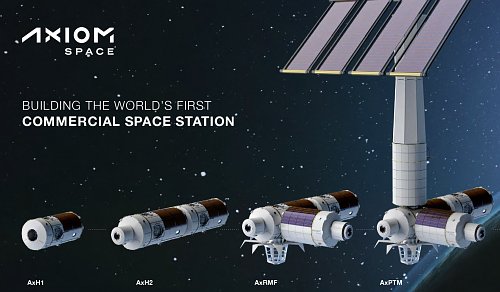
Axiom's space station assembly sequence
The assembly sequence for Axiom’s space station while attached to ISS.
Click for original image.

The Japanese company Mitsui has now proposed building a module — based on Japan’s HTV cargo freighter that did several missions to ISS — and sell it to the commercial space stations now under construction.

Mitsui has created a subsidiary called LEO Shachu to develop the module. What makes this project very likely to happen is that Mitsui is also an investor in Axiom’s space station, and according to the article at the link, a Axiom official who is also a retired Japanese astronaut who flew to ISS has expressed interest in it.

This story also helps outline the international landscape of the future stations. While Voyager Space’s Starlab station has been partnering extensively with Europe and Airbus, Axiom appears to be partnering more closely with NASA and Japan. The third station that has obtained NASA money, Blue Origin’s Orbit Reef, had made an earlier deal with Mitsubishi, but appears to have obtained few other outside partners, and that Mitsubishi deal only involved “development work,” not specific hardware. Moreover, Mitsubishi later made a new deal with the Starlab station, suggesting it had broken up with Blue Origin.

A fourth station, being built by the private company Vast with no NASA money, has partnered with SpaceX and ESA. It is also likely to be the first to launch its first module in August 2025, followed soon thereafter by a 30 day 4-person Dragon mission.

2 comments

Collins reportedly in the process of canceling its NASA spacesuit contract

As if NASA didn’t have enough spacesuit problems, with a ISS spacewalk this week canceled because one of the NASA-built suits on the station began leaking water again, Collins Aerospace, one of the two companies that won contracts to build new spacesuits, is now in negotiations to end that contract.

But Collins’ role in the program has been bumpy and development has fallen behind schedule, and the company has been in talks with NASA officials on how to wind down its role in the program, the two people said. “After a thorough evaluation, Collins Aerospace and NASA mutually agreed to descope Exploration Extravehicular Activity Services (xEVAS) task orders,” a Collins spokeswoman said in a statement, referring to the spacesuit contract.

If this story is confirmed, it means at present only Axiom is building new spacesuits that can either be used on ISS or on future Artemis missions to the Moon and Gateway. Whether NASA will put out the Collins contract for bid again is unknown. In its original cargo capsule contracts early in the 2010s, one company failed to raise sufficient funds to build its capsule, so NASA cancelled it and awarded Orbital Sciences and its Antares rocket and Cygnus capsule the deal.

If the contract is put out for new bidding, SpaceX would be in a very strong position to win, as its own internally financed spacewalk spacesuits are about to get their first flight test on Jared Isaacman’s Polaris Dawn mission on the Resilience Dragon capsule later this summer.

The failure of Collins here is disturbing, and might be an indicator of an overall loss in American engineering capabilities. Once a challenge like this would have posed no problem for any American aerospace company. Now such tasks are increasingly difficult and unachievable.

5 comments

Axiom commercial manned mission to ISS splashes down safely

The four astronauts on Axiom’s third commercial manned mission to ISS successfully splashed down safely today in the Atlantic off the coast of Florida, with SpaceX recovery crews quickly picking them and the capsule Freedom up from the water.

The crew, made up of three European passengers and one Axiom employee, spent 21 days in space, about 17 on ISS. Axiom sold the tickets, and then purchased the ride from SpaceX and the time on ISS from NASA.

2 comments

Freedom capsule undocks from ISS with AX-3 commercial crew

SpaceX’s Freedom capsule today undocked from ISS at 9:20 am (Eastern), carrying three European passengers and one commander, with a planned splashdown in the Atlantic off the coast of Florida at 8:30 am (Eastern) on February 9, 2024.

Ax-3 astronauts Michael López-Alegría, Walter Villadei, Marcus Wandt, and Alper Gezeravci will complete 18 days aboard the orbiting laboratory at the conclusion of their mission. The SpaceX Dragon will return to Earth with more than 550 pounds of science and supplies, including NASA experiments and hardware.

Live stream for that splashdown can be found here. The mission is a private one. Axiom sold the tickets, and purchased from SpaceX the Falcon 9 launch and use of its Freedom capsule. It also rented time on ISS from NASA for its crew and passengers.

6 comments

Weather stops everything by SpaceX in the last 24 hours

SpaceX found itself stymied in the past 24 hours due to poor weather conditions on both coasts, with two launches and the return of a Dragon capsule from space all scrubbed.

First a Falcon 9 launch from Vandenberg of 22 Starlink satellites was scrubbed, the launch pushed back from yesterday to tonight at 5.39 pm (Pacific).

Then a launch of a NASA climate satellite on a Falcon 9 rocket from Cape Canaveral was scrubbed shortly thereafter, the launch rescheduled for 1:33 am (Eastern) tonight.

Finally, the return of Axiom’s Ax-3 commercial passenger flight to ISS was scrubbed today because of poor weather conditions.

NASA, Axiom Space, and SpaceX are standing down from the Tuesday, Feb. 6, undocking opportunity of Axiom Mission 3 from the International Space Station. Mission teams will continue to review weather conditions off the coast of Florida, which currently are not favorable for return, and set a new target opportunity for space station departure and splashdown of the Dragon spacecraft and Axiom crew members.

The undocking is now tentatively set for tomorrow morning, but this remains unconfirmed. The three passengers and the Axiom commander have so far spent 18 days in orbit. The original plan was for a 14 day mission, most of which to be spent on ISS, but weather can always extend such plans.

The launch scrubs illustrate the challenge SpaceX faces in reaching its stated goal of 150 launches in 2024. It appears the company is now capable of technically meeting that goal. To do it however it needs to launch almost every other day, and weather simply might not allow a pace like this during some parts of the year in both Florida and California. Whether the company can make-up for these delays with multiple daily launches at other times remains unknown. If it does, it will be another feather in the cap for SpaceX.

8 comments

Next manned mission to ISS to launch tomorrow

The next manned mission to ISS, a private mission by the company Axiom carrying three European astronauts and commanded by an Axiom astronaut, is presently scheduled to launch tomorrow, January 18, 2024, at 4:49 pm (Eastern).

This is a private mission by Axiom, launched on SpaceX’s Falcon 9 and flying the astronauts in its Freedom Dragon manned capsule. This will be Freedom’s third flight to ISS. The launch was originally scheduled for today, but SpaceX scrubbed the mission today in order to give it “additional time allows teams to complete pre-launch checkouts and data analysis on the vehicle.” It appears during normal prelaunch checkouts engineers found the joints between the upper stage and the capsule were not tightened the proper amount. The company decided to replace the joints, which caused this one day delay.

The crew will spend up to fourteen days at ISS.

I have embedded a live stream of the launch below.
» Read more

0 comments

NASA updates status of three private space stations

NASA today posted a short update of the development status for the three private space stations for which it has signed contracts.

Not surprisingly, Axiom’s station appears to be the most advanced.

Axiom Space, which holds a firm-fixed price, indefinite-delivery, indefinite-quantity contract with NASA, is on schedule to launch and attach its first module, named Axiom Hab One, to the International Space Station in 2026. A total of four modules are planned for the Axiom Commercial Segment attached to the station. After the space station’s retirement, the Axiom Commercial Segment will separate and become a free-flying commercial destination named Axiom Station.

With the remaining two stations, Starlab and Orbital Reef, the update provided no schedule information. While both Starlab, being built by a consortium led by Voyager Space, and Orbital Reef, being built by a consortium led by Blue Origin, appear to be making progess, the former appears to be accomplishing more than the latter, though that impression could simply be what NASA decided to report. For example, in describing the work being done on Orbital Reef, NASA chose for some reason to say nothing about the testing Sierra Space has been doing to test the inflatible module planned for the station. By leaving that out it makes it appear as if less has been done in developing that station.

These are not the only private space stations being proposed, only the ones that have contracts with NASA. A fourth station, Vast, is being built using funding from private sources, and is partnering with SpaceX.

0 comments

The hull of Axiom’s first space station module nears completion

The hull of Axiom’s first space station module is nearing completion, according to officials of the Italian company Thales Alenia Space that is building it.

“The first module shell is effectively completed,” Jason Aspiotis, Axiom’s director of in-space infrastructure and logistics, said at AIAA’s Ascend conference here on Oct. 23. “A lot of the subsystems that will populate the underlying structure–think about life support systems, avionics, propulsion, [guidance, navigation and control systems], power, communications, all that good stuff–we’re developing in a lab in Houston.” Hab One hatches have also been fabricated, tested and prepared for delivery to Thales Alenia Space to support Hab One pressure testing, the company says.

The first module is to be shipped to Houston by 2024 for final assembly and integration at Axiom Space’s factory at Ellington Airport. The company plans to launch the Hab One module in 2026.

Based on this news report, Axiom’s schedule has not experienced any further delays since it pushed back the launch from 2024 in June.

The article also says, almost as an aside, that ISS is planned for decommission “in 2031”, which is one year later than any previous report I’ve seen. I suspect this is correct, but is information that NASA really didn’t want revealed to the public as yet, as it had enough trouble convincing its international European and Japanese partners to stay on until 2030. Moreover, there remains serious concerns the older Russian modules themselves might fail before then, based on the number of stress fractures found in their hulls, so admitting NASA hopes to keep the station flying till ’31 will appear questionable at best.

0 comments

Axiom signs deal with the United Kingdom to fly all British mission

The space agency of the United Kingdom today announced that it has signed a deal with Axiom to fly an manned mission in space, with four astronauts spending up to two weeks in space (likely in a SpaceX Dragon capsule).

The flight, estimated to cost around £200 million, is being organized in cooperation with the European Space Agency (ESA), though all the astronauts will be British. The announced commander, Tim Peake, spent six months on ISS in 2015, and has come out of retirement to do the flight.

It is also unclear at this moment whether it will fly to ISS, or simply remain in orbit. In fact, few specific details have yet been released.

The bottom line however is that the new American space industry is going to make money from Britain’s desire to be a space power. Seems like a good deal to me.

4 comments

Axiom partners with clothing fashion company Prada on its spacesuit design

Capitalism in space: The commercial space station company Axiom is now partnering with the Italian fashion company Prada to create its lunar spacesuits, being developed under a $228.5 million NASA contract.

Prada will assist Axiom in working on the outer layer of its spacesuit, which has to protect the suit’s inner layers from the space environment, including lunar dust, without hindering its mobility. “When it comes to the design side of that piece of it makes a lot of sense because Prada has a lot of experience in the design, the look and feel,” Suffredini said. “More importantly, there’s these technological challenges to try to overcome as well.”

The article at the first link emphasizes Prada’s experience with high tech fabrics, including composites, but this deal is inspired as much by good public relations. Both companies get some good publicity by this deal.

2 comments

Axiom raises $350 million in private investment capital

Axiom's space station assembly sequence
The assembly sequence for Axiom’s space station while attached to ISS.
Click for original image.

Axiom announced today that in its most recent round of funding it raised an additional $350 million in private investment capital, almost tripling the private capital it has obtained in total.

Axiom Space announced today that it secured $350 million in its Series-C round of growth funding, lifting the total funds raised to over $505 million from investors and achieving more than $2.2 billion in customer contracts.

To date, Aljazira Capital and Boryung Co., Ltd., have anchored the round, paired with support from an array of diverse backers that include deep-tech venture capital funds and strategic brand partners, positioning Axiom Space as second to SpaceX for the most amount of money raised by a private space company in 2023, based on available pitchbook data.

The press release also reaffirms the company’s planned schedule for its space station project, with the first module launching and attaching to ISS in 2026. The graphic shows the assembly sequence, with the rear docking port the one linked to ISS. When assembly reaches the stage of the fourth image it will then be able to separate from ISS and fly independently in 2031. That last number however is one year later than NASA’s previous predictions for the retirement of ISS, suggesting Axiom knows something NASA has not yet told us.

Hat tip to Jay, BtB’s stringer.

4 comments

Axiom signs deal with Poland and ESA to send Polish astronaut to Axiom’s future space station

Capitalism in space: Axiom last week signed an agreement jointly with Poland and the European Space Agency (ESA) to send Polish astronaut to Axiom’s space station, expected to launch sometime in 2026.

This was the second European astronaut Axiom has signed a deal to fly to space, with the ESA in both cases providing support.

In April 2023, Axiom Space and the Swedish National Space Agency signed a letter of intent to send an ESA astronaut to the ISS. Through this agreement, the upcoming Axiom Space mission, Ax-3 now targeting launch in January 2024, will be the first commercial mission to the ISS to include an ESA project astronaut.

The date for the flight of the Polish astronaut was not announced. Nor is it clear whether this astronaut will fly to Axiom’s first module, attached to ISS, or wait until Axiom’s completes its station and separates from ISS entirely.

1 comment

NASA agrees to let Axiom fly a fourth private manned mission to ISS

NASA and Axiom have now signed a new agreement allowing Axiom to fly a fourth private manned mission to ISS, tentatively scheduled for no earlier than August 2024.

Through the mission-specific order, Axiom Space is obtaining from NASA crew supplies, cargo delivery to space, storage, and in-orbit resources for daily use. The order also accommodates up to seven contingency days aboard the space station. This mission is subject to NASA’s pricing policy for the services that are above space station baseline capabilities.

The order also identifies capabilities NASA may obtain from Axiom Space, including the return of scientific samples that must be kept cold and other cargo, and the capability to use the private astronaut mission commander’s time to complete NASA science or perform tasks for the agency.

The company has already hired SpaceX to provide the transportation to and from ISS, using its Falcon 9 rocket and one of its fleet of four manned Dragon capsules.

1 comment

NASA awards new spacesuit contracts

NASA yesterday issued two relatively small spacesuit contracts to the two companies it already has hired to develop different spacesuits, one for the Moon (Axiom) and the other for orbital spacewalks (Collins).

The new contract awards provides each company $5 million to begin design work for adapting their suits for the other tasks, with the goal aimed at having two different suits for Moonwalks and spacewalks, from two different companies. For the companies, having suits that work both in orbit and the Moon will enhance their product. For Axiom, it will also allow it to develop its own suit it can use on its own space station.

The original contracts awarded Axiom $228.5 million for its Moonsuit, and Collins $97.2 million for a new orbital suit. NASA has previously spent about a billion dollars and fourteen years trying to build its own new orbital spacesuit, and had failed to create anything.

2 comments

Axiom delays launch of first space station module to ’26

Buried in a Space.com article today about Axiom was the important revelation that the company has now officially delayed the launch of its first space station module that will be attached to ISS from 2024 to 2026, with the rest of its follow-up modules delayed as well.

In January 2020, Axiom won NASA’s contract to construct the first commercially manufactured module for the ISS. “Our first module is going to be in 2026,” David Zuniga, senior director of in-space solutions at Axiom, told Space.com. This is an update to the company’s previously stated target of 2024.

Axiom’s first station component will attach to the forward port of the ISS’ Harmony module and serve as the springboard for the remaining pieces of the company’s planned space station architecture. Axiom is planning to attach a second module in 2027 and a third module a year later. Finally, a thermal power module, scheduled for sometime before 2030, will allow Axiom’s space station to detach from the ISS and become a free-flying, commercially run low Earth orbit (LEO) destination.

This schedule puts Axiom at some risk. ISS is likely going to be retired in 2030. Axiom has to therefore be able to detach its space station before that happens. It seems however with this new schedule that it might not be ready. And if it can’t, it will then need to arrange some deal with NASA and ISS’s international partners to either take over operations of ISS temporarily or convince these nations to operate it a little longer.

8 comments

Axiom offers package space program deals for other countries

The private space station and human spaceflight company Axiom announced this week a set of package space program deals it is marketing to other countries.

In the base tier, Axiom provides countries with advice and insight, and gives those countries priority access on upcoming missions. The second tier enables research and development activities by counties. The third tier offers human spaceflight missions on a regular basis. A fourth tier offers countries the ability to co-develop parts of Axiom’s station.

The first country to join the program is Azerbaijan, which will work with Axiom on satellite solutions and inspiring students to pursue space research and development activities. New Zealand and Uzbekistan are also participating, as well as Rakia Mission, an Israeli space education and research organization involved with the Ax-1 private astronaut mission to the ISS a year ago. Italy is another nation working with Axiom through a partnership that dates back to 2018. An Italian astronaut is slated to fly on Axiom’s Ax-3 mission to the ISS, currently scheduled for late 2023. Two astronauts from Saudi Arabia are flying on the Ax-2 mission in May.

The company also notes that it has found its customers divide into three components, government, private citizens, and corporations. At present this is their order in terms of market share, though the company thinks that corporations will eventually become its biggest customer.

0 comments

Axiom sets date for next commercial manned flight to ISS

Axiom and NASA yesterday announced May 8, 2023 as the launch date for the private company’s second commercial flight to ISS, this time carrying three passengers out of a crew of four, two from Saudi Arabia and the third, John Shoffner, completing his second paid flight with Axiom.

Two of its crewmates are Rayyanah Barnawi and Ali AlQarni, members of the first Saudi Arabian astronaut class. Barnawi will become the first Saudi woman ever to reach space, and she and AlQarni will be the first people from the kingdom to travel to the ISS.

Retired NASA astronaut Peggy Whitson will command the mission for Axiom. The Dragon capsule used will be Freedom, making its second flight, lifting off on a Falcon 9 rocket with a new first stage. The plan is to be docked to ISS for ten days, which means for that time period ISS will have three Arab astronauts on board, including the UAE’s astronaut, Sultan Al Neyadi, who is in the middle of a six month mission and is about to do his first spacewalk.

0 comments

NASA agrees to Axiom’s third planned commercial passenger mission to ISS

NASA today announced that it has given Axiom the go-ahead for its third planned commercial passenger mission to ISS, now tentatively scheduled for November 2023.

Axiom Mission 3 (Ax-3) is expected to spend 14 days docked to the space station. A specific launch date is dependent on spacecraft traffic to the space station and in-orbit activity planning and constraints. NASA and Axiom Space mission planners will coordinate in-orbit activities for the private astronauts to conduct in coordination with space station crew members and flight controllers on the ground.

As NASA did in announcing its agreement to Axiom’s previous flight, the agency’s press release makes believe it “selected” Axiom for this flight, as if it had the power and right to do so. Hogwash. Axiom has purchased the flight from SpaceX, and wishes to rent space on ISS for two weeks for its customers. All NASA has done is agree to the deal, while also charging Axiom very large fees for that rental.

0 comments

NASA outlines its expected needs as a space station customer

NASA has now published an updated detailed specification of what it will want to do on the four private space stations being built to replace ISS.

NASA published two white papers Feb. 13 as part of a request for information (RFI) for its Commercial Low Earth Orbit Destinations effort to support development of commercial stations. The documents provide new details about how NASA expects to work with companies operating those stations and the agency’s needs to conduct research there.

One white paper lists NASA’s anticipated resource needs for those stations, including crew time, power and volume, broken out for each of the major agency programs anticipated to use commercial stations. Companies had been seeking more details about NASA requirements to assist in the planning of their stations.

,,,The second white paper outlines the concept of operations NASA envisions for its use of commercial space stations. The 40-page document described in detail what it expects from such stations in terms of capabilities, resources and operations, as well as what oversight the agency anticipates having.

At the moment NASA has contracts with four different space station companies or partnerships, Axiom, Blue Origin, Nanoracks and Northrop Grumman, each of which is building its own station. Because NASA will initially be the biggest customer for these stations its requirements will help shape those stations significantly, which is why this information is of critical importance for the private companies.

At the same time, NASA is not dictating specific designs. The agency remains the customer, buying time on private facilities that will be owned privately and be free to sell their product to others. Thus, the designs of these stations might not match exactly what NASA desires, since even now there are other customers interested in buying space station time and space.

2 comments
1 2 3 4 5 6