Axiom’s CEO provides update on corrosion and the timetable for its space station
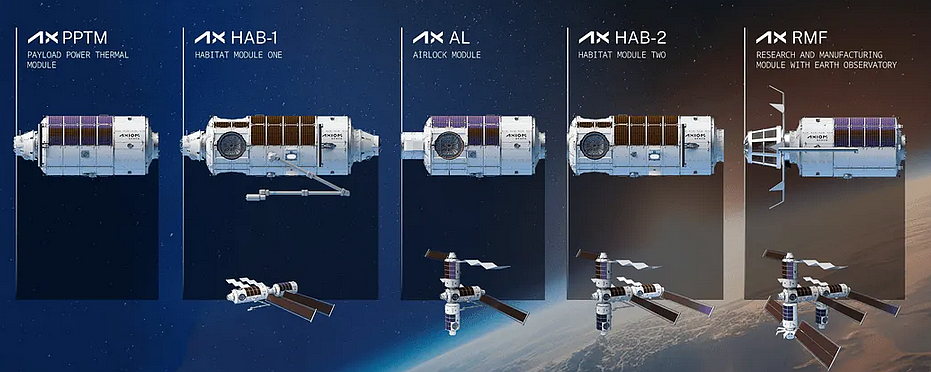
Axiom's module assembly sequence
Axiom’s module assembly sequence

Jonathan Cirtain, the CEO of the space station startup Axiom, this week gave an interview where he provided a short update on the status of their station’s construction, including the present launch timetable as well as the corrosion issue known to exist on the two module hulls that Thales-Alenia is presently building for the company.

It [the corrosion] was actually observed during ISS using a similar manufacturing technique. They mitigated it.

Now it’s come back. … We’re going to fix it the same way they fixed it for the International Space Station, the Columbus module, which has been operational now for eighteen, nineteen years. Had that same challenge. So we’re working our way through that. That should get resolved by the end of the month of June.

Because this interview took place just prior to NASA’s announcement yesterday that it has abandoned its core module concept proposed last month, Cirtain describes how the company was considering some design and construction changes to deal with it. That issue however has now vanished.

Cirtain added that the module’s hulls will next be shipped from the Thales-Alenia factory in Europe to the U.S., where Axiom will then begin installing the interior and exterior components of each, with a planned launch of the first, dubbed the PPTM, by 2028, the same target date the company announced in January 2026. That the date has not changed six months later suggests either the corrosion issue did not delay things, or it was the cause of that delay.

As I noted in January, Axiom’s schedule margins for getting its station launched, docked to ISS, loaded with ISS equipment, and then separated before ISS retires in 2030 are extremely tight. It cannot afford any further delays.

In other Axiom news, the company announced yesterday that it has established a a wholly owned subsidiary based in Switzerland, dubbed Axiom Switzerland, thus establishing itself within the Europe to facilitate future contracts with the European Space Agency, the European Union, and the member nations of both.

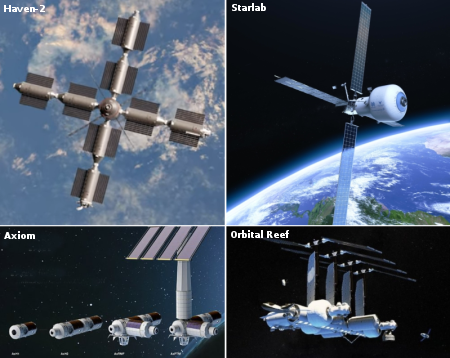
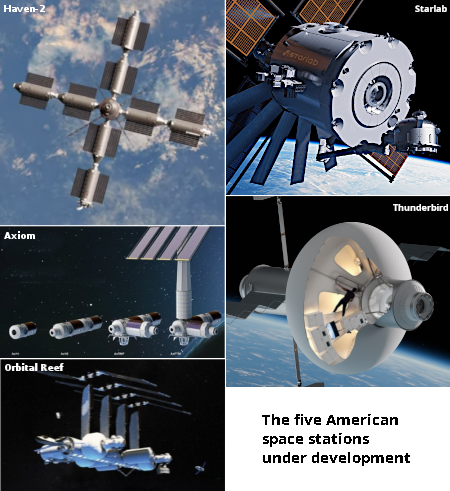
Below are my updated rankings of the five American space stations presently under development:
» Read more

3 comments

NASA abandons core module idea for its commercial space station program

The American space stations under development

Bowing to the unanimous opposition by the three most advanced commercial space station startups, NASA official Bethany Stevens yesterday announced that it is abandoning its proposed core module space station concept and returning its commercial space station program to its original plan, whereby the private stations all compete independently.

Industry has provided extensive feedback making the case for a sustainable commercial market in which NASA is one customer among many, along with assurances regarding available transportation capabilities. The industry position will now shape the path forward as NASA proceeds with the original commercial strategy.

Over the coming weeks, NASA will work with stakeholders and industry to refine flexible requirements and acquisition plans, with a draft RFP expected later this month.

The original plan was for the private sector to compete for one or two major construction contracts from NASA. The core module approach, put forth under NASA administrator Jared Isaacman’s leadership in March, instead made them all part of a government space station, like ISS, at least initially. Under that plan the new commercial space stations would attach their first modules to a government-built core module that NASA would first build and own. Isaacman proposed this because he and NASA believed it didn’t have the budget to finance more than one commercial station, and that the agency didn’t think there was sufficient market to make up the difference.

Officials from Vast, Starlab, Axiom and elsewhere all expressed opposition to the core module plan, insisting there was sufficient market to finance their stations, even without NASA. They also opposed the core module plan because it would require major changes in their present designs, and they had great doubt NASA could build that core module quickly enough for their financial purposes.

Isaacman and NASA apparently listened to these objections, and were convinced their idea was a mistake and the industry was right. It is now reviewing its budget and will decide whether it can do what it originally hoped, award two stations a major contract.

Either way, the recent news from all these three stations suggests they are increasingly in a strong position, whether or not they win that NASA contract.

6 comments

NASA’s IG: With only Axiom building NASA’s future spacesuits, the agency’s lunar program faces great scheduling risk

Axiom's two spacesuits being tested underwater
Axiom’s two spacesuits being tested underwater in October 2025.
Click for original.

According to NASA’s inspector general’s report today [pdf] on the state of NASA’s effort to create new spacesuits for use by its astronauts on future space stations as well as in its Artemis lunar program, the planned schedules for the lunar landing and those stations are threatened because the agency presently has only one contractor, Axiom, building new suits, and has not established any spacesuit standardization rules should it want to issue contracts to others. From the report’s conclusion:

While NASA is taking steps to mitigate schedule risk, it must also contend with the unique risks inherent to a single-provider environment until future competition is introduced. … If Axiom cannot satisfy its contractual requirements in a timely or cost-effective manner, then NASA could be forced to continue using the problematic EMUs throughout the life of the ISS and significantly adjust its lunar plans. [EMUs are the complex suits presently used on ISS, and would not work well for any lunar landing mission.]

While xEVAS [the new suit concept] is flexible enough to allow for additional providers, doing so may not help the Agency meet its more immediate Artemis goals. Critically, NASA must address existing design and safety risks resulting from the lack of standard requirements for spacesuits to be compatible with various lunar spacecraft and assets.

As shown by the photo above, the development of Axiom’s spacesuit has been proceeding, and seems likely to be available for next year’s Artemis-3 Earth orbit test mission. At the same time, it is still behind schedule, a fact that has been mitigated because NASA’s entire Artemis program is equally behind schedule.

The report lists three commercial companies that might be able to provide alternative suits, and thus some redundancy, as shown by the image below.
» Read more

9 comments

The space station startups: NASA’s new space station plan is mistaken

The American space stations under development

At a conference event this week officials from three of the five American space station startups expressed strong disagreement with NASA’s new space station plan.

The new plan would have NASA build and launch its own new core module, dock it with ISS, and have the new stations attach their first modules to it prior to flying freely. NASA proposed this plan because it does not believe there is enough market to sustain the stations independently and NASA doesn’t have the budget to fully fund them.

The officials repeatedly disagreed about the market issue.

“We believe not only we can be ready by 2030” when the International Space Station is slated to be retired, “but we also believe that we can be profitable on the current market, not waiting for the future market we all will develop and will be successful at,” said Max Haot, CEO of Vast [building the Haven-1 and Haven-2 stations].

…Haot and executives from Axiom Space and Starlab Space said their responses to NASA’s request for information — which were due April 8 — show otherwise. “We put in 390 pages of independent analysis, research studies, datas, contracts, those types of things,” said Marshall Smith, CEO of Starlab Space, which is targeting 2029 for its station to be on orbit. “We’re being very clear and what we can do and how that works.”

One prominent revenue stream the panelists pointed to is other space agencies and nations eager to send their astronauts and payloads to space. “We’ve flown 12 people to space that paid us money to do that,” said Jonathan Cirtain, CEO of Axiom Space, referring to the four private astronaut missions it’s conducted to ISS. “We’ve flown 166 payloads today. All of those are paying payloads that generate revenue for the company.” The Texas company plans to begin operating in 2028 when its first two station modules are slated to be in orbit, then gradually grow the station to five modules.

The officials also said the core module idea would actually slow things down. NASA would have to first build and launch it, and would be starting from scratch to do so. It takes years to build such a thing, and it will certainly not be ready by 2030, when ISS is presently supposed to be retired. Moreover, forcing them to dock to this module would force them all to completely change their own plans, something they all find counter-productive.

In announcing NASA’s core module plan, NASA administrator Jared Isaacman also stated that he was open to industry feedback. I suspect that his core module proposal is going to die, and be replaced with the more direct transition from ISS to these private stations, the approach these companies favor.

I should add that the three startups that spoke up at this conference are also the three that are in the lead to build their stations, according to my rankings below. As far as I can tell, they are all tied for first place, with their station development very robust and well financed.
» Read more

26 comments

Axiom wins slot for next tourist mission to ISS

NASA yesterday announced that it awarded the space station startup Axiom the next slot for a tourist mission to ISS.

NASA and Axiom Space have signed an order for the fifth private astronaut mission to the International Space Station, targeted to launch no earlier than January 2027 from the agency’s Kennedy Space Center in Florida.

…Axiom Mission 5 is expected to spend up to 14 days aboard the space station. A specific launch date will depend on overall spacecraft traffic at the orbital outpost and other planning considerations.

Both Axiom and the space station startup Vast had been bidding for the fifth and sixth tourist slots. That Axiom had already done this four times previously was probably NASA’s reasons for choosing it. The agency has not yet decided on who will get the sixth slot, targeting a mission likely in 2028. My bet is that it will give to Vast, because by then Vast’s own demo station Haven-1 will have launched and been visited, thus giving that company some of the experience Axiom already has.

4 comments

German startup Spark Microgravity to build first space-based commercial cancer lab

The American space stations under construction
The American space stations under development

The German startup Spark Microgravity announced yesterday it is negotiating with two commercial space stations, one re-entry capsule company, and one French rocket startup to launch the first commercial cancer lab in space.

SPARK Microgravity is collaborating with Axiom Space and Voyager Technologies on commercial low Earth orbit (LEO) opportunities, with ATMOS Space Cargo supporting future return missions. A first flight demonstration with Swedish Space Corporation is scheduled in May. The cancer research will be launched in partnership with HyPrSpace, which developed Baguette-One, the first rocket to be launched from France.

Axiom hopes to launch its first modules in ’28, while Voyager’s Starlab station can’t launch until Starship is operational, possibly about the same time. ATMOS is a German startup developing a returnable capsule that can fly in orbit for several months. It has a deal with Hyperspace to fly a demo capsule on Baguette-1, which is a suborbital rocket.

Similar research has been done on ISS, but NASA’s rules forbid that research to produce a product for sale. Those rules won’t apply on the private stations, and Spark’s existence is a reflection of this new profit-oriented reality. Spark is going to attract investment capital from the pharmaceutical and academic communities, and thus is another profit center for the commercial space stations, outside of government funding.

The market for these new space stations is growing, making any NASA construction contracts less critical in the long run.

6 comments

Axiom has delayed the launch of its first space station module to ’28

Axiom's module assembly sequence
Axiom’s module assembly sequence

When Axiom announced in September 2025 that Redwire would be building the solar panels for the first module of its space station, dubbed the PPTM, it also said that module would launch in late 2027, which was a delay of one year from the original launch date of 2026.

That schedule has now apparently been delayed again. In an interview yesterday, the company’s vice president of human spaceflight, former NASA astronaut Peggy Whitson, indicated the launch was now targeting 2028.

Plans call for the initial Axiom Station to be comprised of two modules, the PPTM — short for Payload Power Thermal Module — and a habitat module. The PPTM, which is to be shipped shortly to Houston for final assembly and integration, is slated to be launched in early 2028, with the second module following just months later. From there, Axiom aims to swiftly begin welcoming crew, Peggy Whitson, the company’s vice president of human spaceflight, told me in an interview.

This schedule almost guarantees that the Axiom station will not detach from ISS as quickly as originally intended. PPTM has a large hatch opening connecting it to ISS, allowing for the easy transfer of much of the research racks held on ISS. Before Axiom can become a free-flying station that ISS equipment must be moved, a process that will take time, likely months. To get it done the company will probably have to also attach its second habitation module so that crews can arrive and begin this transfer process.

In other words, Axiom’s schedule margins for getting its station launched, docked to ISS, loaded with ISS equipment, and then separated before ISS retires in 2030 are shrinking. It can ill afford further delays.

Below are my rankings of the five American space stations presently under development. Note that I now consider Axiom and Starlab tied for second.
» Read more

12 comments

Axiom gets $100 million of investment capital from Hungarian company

Axiom's new module assembly sequence
Axiom’s assembly sequence for its planned station, initially attached to ISS but subsequently detached

The space station startup Axiom has now obtained a $100 million investment by the Hungarian communications provider 4iG.

The company said Dec. 19 it has committed to invest $30 million in Axiom by the end of 2025, followed by an additional $70 million by March 31, 2026.

In October, 4iG announced a non-binding commitment letter to evaluate a potential $100 million investment in Axiom Space. The agreement outlined a separate $100 million framework for cooperation on the development of orbital data center systems over the next five years. 4iG said in a news release that the Axiom investment would provide Hungary with an opportunity to secure a long-term role in orbital data centre programs and space-based data processing and storage, but did not provide details.

In 2024 there were rumors the company had a serious cash shortage, though since then construction of its first two modules has proceeded as planned, with a launch of the first module still set for sometime in 2026. This new infusion of cash should shore up Axiom’s station construction considerably.

My rankings of the commercial space stations now under development:

» Read more

36 comments

Axiom successfully tests two of its lunar spacesuits underwater

Axiom's two spacesuits being tested underwater
Axiom’s two spacesuits being tested underwater.
Click for original.

The space station startup Axiom this week successfully completed underwater testing of two of its lunar spacesuits, making them ready for astronaut training.

Axiom won the contract to build these suits for NASA in 2022. It speaks well of the company that only three years later the suits are now ready for use. It also shows NASA’s own incompetence, because before it awarded this contract to Axiom the agency tried to build its own suits, spending more than a billion dollars and fourteen years to produce nothing.

Furthermore, this success underlines yesterday’s NASA inspector general report that lambasted Collins Aerospace’s incompetence in maintaining the spacesuits on ISS. Collins in 2022 had won a similar spacesuit contract to build new space station suits, but two years later backed out of the deal, unable to get the job done.

For Axiom, this spacesuit success adds an essential component to its own space station plans. Though these suits are intended for the Moon, the company now has the basics down for its own space station suit. It owns this suit design, and will not only sell suits to NASA, it can market the suits to any one else.

0 comments

Axiom hires Redwire to build the solar panels for its first station module

Axiom's new module assembly sequence
Axiom’s assembly sequence for its planned station, initially attached to ISS but subsequently detached

The space station startup Axiom today announced that it has signed an agreement with the space hardware company Redwire to build the solar panels for its first station module, now under construction.

The companies announced Sept. 25 that Redwire will provide a version of its Roll-Out Solar Array, or ROSA, to Axiom for use on Axiom Station’s Payload Power Thermal Module, known as AxPPTM. AxPPTM is the first module Axiom plans to launch for its commercial station. Under a revised assembly schedule announced last December, AxPPTM will berth with one of two ports on the International Space Station used by Cygnus cargo spacecraft.

It would remain there until Axiom launches a second module, called Hab1. At that point, AxPPTM would unberth from the ISS and dock with Hab1, forming the initial station that can support four-person crews. Axiom would later add more modules.

At present Axiom is targeting a 2026 launch of the AxPPTM module. The hull, built by Thales Alenia, is presently being tested in Europe, and is expected to shipped to Houston for integration later this year.

The four commercial stations under development, ranked by me based on their present level of progress:
» Read more

12 comments

Space station startup Vast endorses NASA’s new strategy that no longer requires a continuous human presence in space

The American space stations under construction
The American space stations under development

Officials from the space station startup Vast revealed at a conference last week that they endorse NASA’s new strategy that, not only no longer requires the commercial stations to immediately establish a continuous human presence in space, will also award multiple development contracts to the commercial stations.

Speaking Sept. 11 at the Global Aerospace Summit, Max Haot [chief executive of Vast] endorsed NASA’s new strategy, announced more than a month ago, that calls for multiple Space Act Agreements to support development leading to a four-person, 30-day demonstration mission. “We think it’s really the right direction,” he said, noting it accelerates the award timeline. NASA said in a draft solicitation this month it expects to award multiple funded agreements by April 2026, months sooner than under earlier plans.

The original plan had been to choose at most two, but likely only one of the four consortiums/companies that are developing station proposals. The winner would have gotten a big contract that would have also required it to push hard for continuous full time occupation, from day one.

The new plan will instead award smaller development contracts to as many as three of the four station projects, aimed at getting them off the ground and operating, even if astronauts only fly in them intermittently. Eventually the hope is that their capabilities will expand quickly to permanent occupation, especially if they start earning revenue from the private sector, outside NASA. In fact, the smaller government contracts will force them to seek investment and profits elsewhere.

The four commercial stations under development, ranked by me based on their present level of progress:
» Read more

0 comments

Axiom completes first set of underwater tests of its commercial spacesuit

Axiom's moonsuit
Click for original image.

Axiom, in partnership with the company KBR, has successfully now completed its first set of manned underwater tests of its commercial spacesuit, being built for NASA but owned by Axiom and available for use by others.

These initial crewed tests involved an astronaut being fully submerged in the NBL’s 6.2-million-gallon pool while wearing Axiom Space’s next-generation spacesuit, the AxEMU, which is being developed for use on NASA’s Artemis III mission. The goal was to evaluate the suit’s integrity in an environment that closely simulates the weightlessness of space.

Throughout the tests, the suit remained completely sealed and airtight, signifying it’s ready for more advanced evaluations, and ultimately, future missions.

For Axiom, having its own spacesuit makes its space station project more viable. None of the other proposed stations presently have suits, though Vast’s Haven project is closely tied with SpaceX, and thus would likely work with that company to upgrade SpaceX’s spacesuit used on Jared Isaacman’s last private orbital mission.

The four commercial stations under development, ranked by me based on their present level of progress:
» Read more

4 comments

Axiom’s ticket price for India’s astronaut on Ax-4 mission: $59 million

According to reports today in the India press, the price Axiom charged India’s space agency ISRO for training and then flying its astronaut on the just completed Ax-4 two-week mission to ISS was $59 million.

The expenditure by ISRO includes cost of [Shubhanshu] Shukla’s training for the mission as well as that of a seat on SpaceX’s Dragon spacecraft for the 20-day trip that launched Shukla, and three others — Peggy Whitson from the US, Slawosz Uznanski-Wisniewski of Poland and Tibor Kapu of Hungary — to space.

Earlier reports had suggested Axiom was charging $70 million per ticket. If the $59 million is accurate and applies to the charges Poland and Hungary paid, then Axiom’s revenue for the flight was $177 million. From that it would have to pay SpaceX (for the launch and the use of its Grace capsule) and NASA (for the use of ISS). Based on past history, SpaceX likely charged around $70 million for the launch. The cost for using Grace is unknown. NASA’s fees for a two-week visit to ISS were probably around $10 million plus.

My guess, based on this very limited information, is that Axiom made some profit from the flight, ranging from $20 to $50 million.

1 comment

Axiom’s commercial manned mission to ISS splashes down safely

Axiom’s fourth commercial manned mission to ISS successfully splashed down off the coast of California early this morning, returning its astronaut commander, employed by Axiom, and three government passengers from India, Poland, and Hungary after spending two weeks at the space station and eighteen days total in space.

For all three nations this was their second manned flight, and the first in more than four decades. All three had previously flown astronauts on Soviet era Soyuz missions, with Poland and Hungary’s astronauts visiting the Salyut 6 station in 1978 and 1980 respectively, and India’s astronaut visiting the Salyut 7 station in 1984.

The mission also marked the inaugural flight of SpaceX’s new Grace reusable manned Dragon capsule, the fifth such spacecraft in its fleet. SpaceX’s fleet is now larger that NASA’s space shuttle fleet ever was.

If you watch the live stream at the link, it is once again important to note that everyone you see on the screen, except for these three government astronauts, are employees of SpaceX or Axiom. There is no government involvement at all in the splash down procedure. It is entirely commercial and private affair.

In other words, who needs NASA for spaceflight? It clearly is not required.

7 comments

Dragon capsule undocks from ISS carrying four Axiom’s passengers

After spending 18 days in space, 14 on ISS, the Dragon capsule early this morning undocked from ISS with a splashdown scheduled for early tomorrow.

The mission was financed by the space station company Axiom, and was commanded by former NASA astronaut Peggy Whitson, now employed by Axiom as a professional astronaut. The three paying passengers were all government astronauts from India, Poland, and Hungary.

The capsule, dubbed Grace, is the newest addition to SpaceX’s fleet of five manned reusable capsules, flying on its first mission.

Splashdown is scheduled for the wee hours of July 15th tomorrow off the coast of California. The live stream can be found here.

0 comments

Axiom’s manned mission docks with ISS

SpaceX’s newest manned Dragon capsule, dubbed Grace, this morning successfully brought Axiom’s fourth commercial passenger mission to ISS, docking with the space station after launching yesterday on a Falcon 9 rocket.

The spacecraft docked at 6:31 a.m. to the space-facing port of the space station’s Harmony module. Former NASA astronaut Peggy Whitson, ISRO (Indian Space Research Organisation) astronaut Shubhanshu Shukla, ESA (European Space Agency) astronaut Sławosz Uznański-Wiśniewski of Poland, and Tibor Kapu of Hungary now are aboard the space station after launching at 2:31 a.m. on June 25, on the company’s Falcon 9 rocket from Launch Complex 39A at NASA’s Kennedy Space Center in Florida for the fourth private astronaut mission to the orbiting laboratory, Axiom Mission 4.

The plan is for them to stay on ISS for two weeks.

0 comments

SpaceX launches Axiom’s fourth commercial manned mission to ISS

SpaceX last night successfully launched Axiom’s fourth commercial manned mission to ISS, dubbed Ax-4, its Falcon 9 rocket lifting off from the Kennedy Space Center in Florida.

The first stage completed its second flight, landing back at Cape Canaveral. The Dragon capsule, the newest and fifth ship in SpaceX’s fleet of manned capsule, was dubbed “Grace,” as announced by Axiom mission commander and former NASA astronaut Peggy Whitson. The three paying passengers are government astronauts from India, Hungary, and Poland.

The capsule will dock with ISS tomorrow (Thursday) at 7 am (Eastern), where it and its crew will spend about one to two weeks before returning to Earth.

The leaders in the 2025 launch race:

79 SpaceX
35 China
8 Rocket Lab
7 Russia

SpaceX now leads the rest of the world in successful launches, 79 to 58.

The overall lack of excitement about this manned space mission speaks directly to how successful SpaceX has become as a private commercial rocket company. Its rockets and capsules work routinely well, with almost no problems, making these manned space missions seem as boring as an airline trip from New York to Washington.

6 comments

NASA sets another new date for Axiom’s Ax-4 commercial manned mission to ISS

NASA today announced a new launch date of June 25, 2025 for Axiom’s Ax-4 commercial manned mission to ISS carrying a three passengers from India, Poland, and Hungary respectively and commanded by former NASA astronaut Peggy Whitson (now working for Axiom).

As with previous announcements, the information provided was sparse:

NASA, Axiom Space, and SpaceX are targeting 2:31 a.m. EDT, Wednesday, June 25, for launch of the fourth private astronaut mission to the International Space Station, Axiom Mission 4.

The mission will lift off from Launch Complex 39A at NASA’s Kennedy Space Center in Florida. The crew will travel to the orbiting laboratory on a new SpaceX Dragon spacecraft after launching on the company’s Falcon 9 rocket. The targeted docking time is approximately 7 a.m. Thursday, June 26. NASA will provide more details and its coverage information shortly.

The launch had previously been delayed several times because NASA and Russia wanted to first assess the repair work on the leaks in the Russian Zvezda module before allowing another docking at the station. No information however has been released so far detailing that assessment. Though there have been indications that the loss of air in ISS was stopped by the repair, neither NASA nor Roscosmos have provided any specific data.

7 comments

NASA delays Axiom manned mission again

Without providing any specific details, NASA today announced that it has once again scrubbed the June 22, 2025 launch of Axiom’s Ax-4 manned mission to ISS as it assesses the Russian repairs to the air leaks in the Russian Zvezda module.

The space agency needs additional time to continue evaluating International Space Station operations after recent repair work in the aft (back) most segment of the orbital laboratory’s Zvezda service module. Because of the space station’s interconnected and interdependent systems, NASA wants to ensure the station is ready for additional crew members, and the agency is taking the time necessary to review data.

No new launch date has been set. Because the agency provides so little specific information, we don’t know if the air leak repairs are working, are failing, or have indicated even more serious problems that make any station docking a greater risk. Almost certainly, this latter fear is unfounded and the repairs have succeeded in stopping or slowing the loss of air, but the paucity of information from NASA allows for wild speculations. It would be better if the agency told us what it has so far learned, and exactly why that knowledge requires it to extend the data-gathering time period.

1 comment

NASA/Axiom announce another four-day launch delay for Axiom’s fourth manned mission

NASA and Axiom today announced that they have rescheduled the launch of Axiom’s fourth manned mission to ISS, dubbed Ax-4, to June 22, 2025 in order to give Russian and American engineers more time to assess the leak repairs in the station’s Russian Zvezda module.

The press announcement provided little information, simply stating that:

The change in a targeted launch date provides NASA time to continue evaluating space station operations after recent repair work in the aft (back) most segment of the International Space Station’s Zvezda service module.

It would be nice if the agency would release some actual data. Earlier reports had suggested that the repairs had completely sealed the leaks and that the station was no longer losing air. The vagueness of today’s report suggests that the repairs might not have been as successful as hoped. It could also be engineers simply want more data for a longer period to prove the repairs have worked.

The lack of detailed information causes unnecessary speculation.

1 comment
1 2 3 6