A fine collection of Rosetta images

Comet 67P/C-G

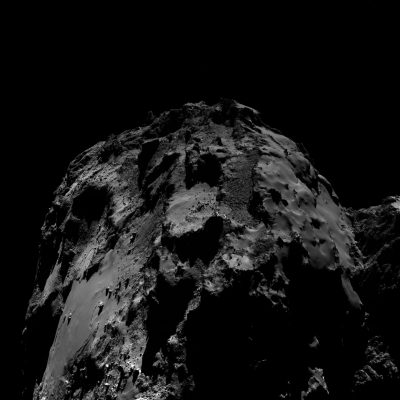
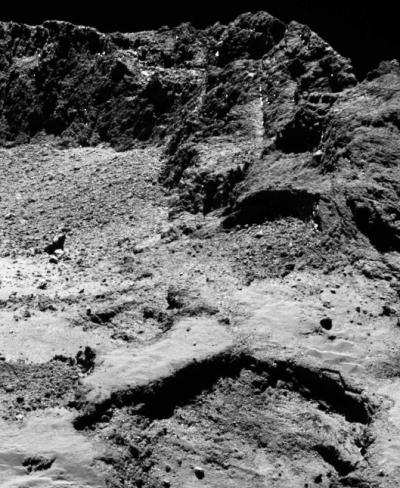
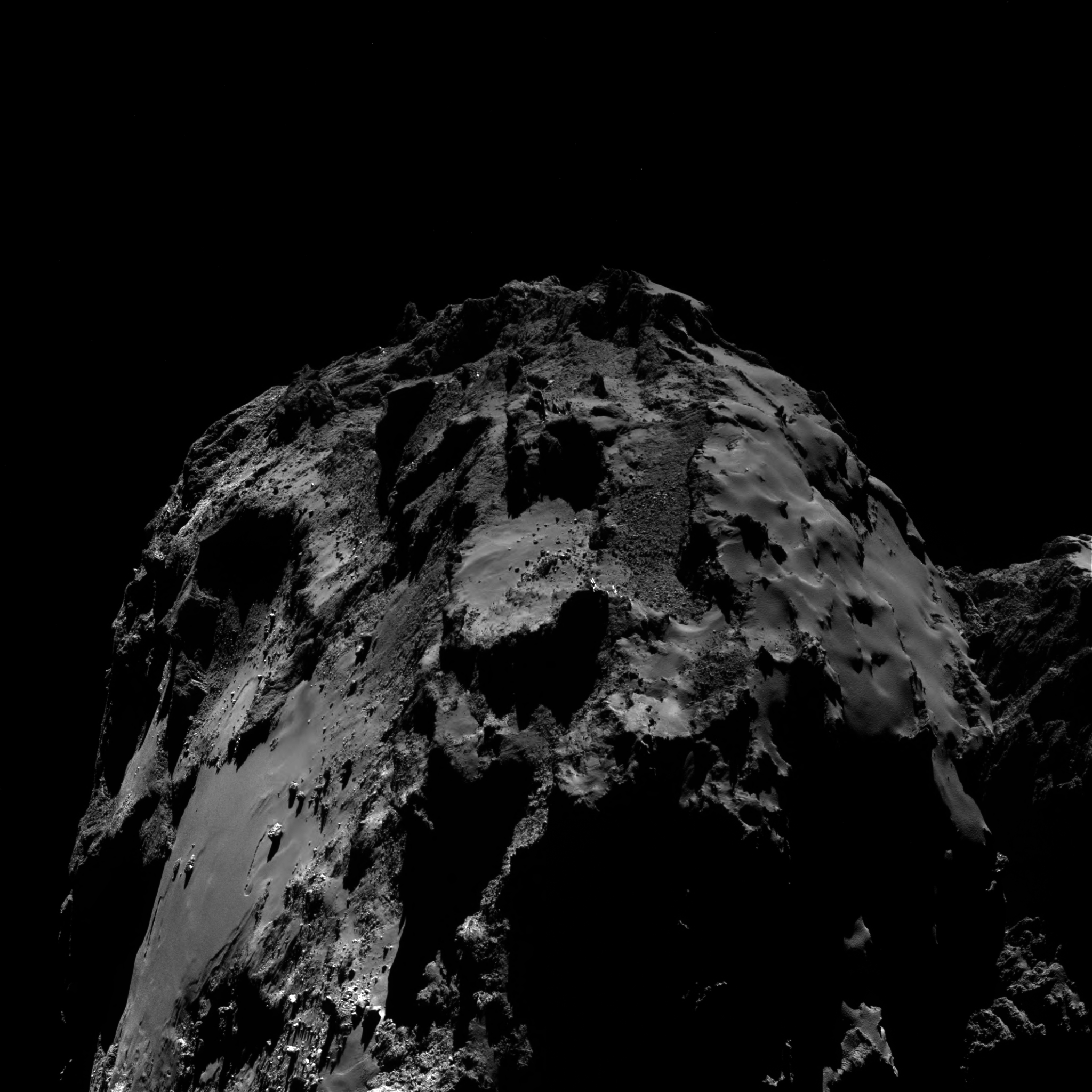
Many cool images! The Rosetta team has released a bunch of very nice images taken of Comet 67P/C-G during August when the spacecraft was flying in close. The image on the right, cropped and reduced in resolution to post here, shows the comet’s large lobe, with the narrow neck to the left. Make sure you check out the full resolution image. It was taken on August 10, 2016 from about 8 miles away, and has a resolution of less than four feet per pixel. If a person was standing there you could just see them!

What I find most fascinating is the incredible curvature of the comet’s surface. The smooth area on the left, dubbed Imhotep (images of which have been posted here previously), has several big boulders on its flat surface. If you stood there, the ground would be down and horizontal. Walk only a short distance and you quickly reach the curving horizon and that flat area would look like a steep slope dropping down behind you. Yet, the boulders do not roll down hill! Walk a short distance more and you begin to enter the neck region, with giant walls rising above you, until you start to walk up them and they become the floor!

5 comments

How Comet 67P/C-G was made

Using the data from Rosetta, scientists have developed a detailed scenario for the birth process that created Comet 67P/C-G.

During its two-year sojourn at Comet 67P/Churyumov–Gerasimenko, Rosetta has revealed a picture of the comet as a low-density, high-porosity, double-lobed body with extensive layering, suggesting that the lobes accumulated material over time before they merged.

The unusually high porosity of the interior of the nucleus provides the first indication that this growth cannot have been via violent collisions, as these would have compacted the fragile material. Structures and features on different size scales observed by Rosetta’s cameras provide further information on how this growth may have taken place.

Earlier work showed that the head and body were originally separate objects, but the collision that merged them must have been at low speed in order not to destroy both of them. The fact that both parts have similar layering also tells us that they must have undergone similar evolutionary histories and that survival rates against catastrophic collision must have been high for a significant period of time.

In other words, the comet’s two lobes formed slowly as separate bodies but always in the same general region, and then moved closer and closer together until they gently merged. Based on this scenario, Comet 67P/C-G had to have formed very early in the solar system, and also was not in the inner solar system — as it is now — when the great early bombardment occurred there about a billion years ago.

1 comment

Rosetta says goodbye to Philae

The Rosetta science team has decided to shut off tomorrow the communications equipment the spacecraft uses in its continuing attempts to re-establish communications with its Philae lander.

Switching off the ESS is part of the preparations for Rosetta’s end of mission. By the end of July 2016, the spacecraft will be some 520 million km from the Sun, and will start facing a significant loss of power – about 4W per day. In order to continue scientific operations over the next two months and to maximise their return, it became necessary to start reducing the power consumed by the non-essential payload components on board.

Though until now they have never stopped trying to contact Philae, they have heard nothing since July 2015. Moreover, the recent close sweeps down to the comet’s surface have failed so far to locate the lander. Unless they are holding back the lander’s discovery for a big splash press conference, it appears that we will never known exactly where the lander touched down.

That is, we will never know. Someday, many decades in the future, some asteroid/comet mining operation will show up and find it. I hope at that time they will carefully pack it up and bring it back for humans to admire as a testament to our human ability to push the unknown. Even better, I hope they put it in the “History of Space” museum, located not on Earth but on Mars, built to educate the children of the colonists who are making possible the expansion of humanity out to the stars.

0 comments

Rosetta’s landing site chosen

Rosetta's end

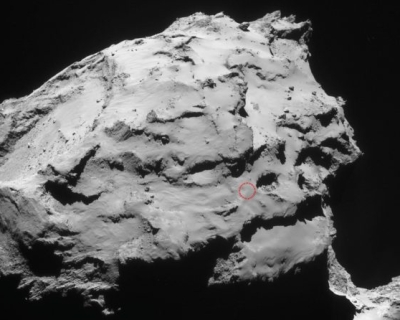
The Rosetta science team has chosen the spacecraft’s landing site on Comet 67P/C-G. The picture on the right shows this region, dubbed Ma’at, located on the comet’s smaller lobe. I also note that this decision makes no mention of Philae, and that there has been no word from the scientists on whether their recent close-up imagery of the comet has located the lander.

I had hoped that they would find it and then aim the final descent toward it, but this apparently is not happening.

2 comments

Rosetta’s finale set for September 30

The Rosetta science team has set September 30th as the date when they will complete the spacecraft’s mission with a controlled descent onto Comet 67P/C-G’s surface.

Unlike in 2011, when Rosetta was put into a 31-month hibernation for the most distant part of its journey, this time it is riding alongside the comet. Comet 67P/Churyumov-Gerasimenko’s maximum distance from the Sun (over 850 million km) is more than Rosetta has ever journeyed before. The result is that there is not enough power at its most distant point to guarantee that Rosetta’s heaters would be able to keep it warm enough to survive.

Instead of risking a much longer hibernation that is unlikely to be survivable, and after consultation with Rosetta’s science team in 2014, it was decided that Rosetta would follow its lander Philae down onto the comet. The final hours of descent will enable Rosetta to make many once-in-a-lifetime measurements, including very-high-resolution imaging, boosting Rosetta’s science return with precious close-up data achievable only through such a unique conclusion. Communications will cease, however, once the orbiter reaches the surface, and its operations will then end.

The decision to end the mission this way makes great sense. I only question their decision to purposely end all communications upon impact. Though it is likely that communications will be lost anyway, wouldn’t it be better to try to get data back, like the scientists did with the American NEAR spacecraft when it touched down on the asteroid Eros at the end of its mission?

6 comments

Rosetta almost lost during weekend

Because Rosetta’s star tracker became confused by dust particles, the spacecraft lost contact with Earth, went into safe mode, and required the entire weekend for engineers to regain control.

“We lost contact with the spacecraft on Saturday evening for nearly 24 hours,” says Patrick Martin, ESA’s Rosetta mission manager. “Preliminary analysis by our flight dynamics team suggests that the star trackers locked on to a false star – that is, they were confused by comet dust close to the comet, as has been experienced before in the mission.” This led to spacecraft pointing errors, which triggered the safe mode. Unfortunately the star trackers then got hung in a particular sub mode requiring specific action from Earth to recover the spacecraft.

“It was an extremely dramatic weekend,” says Sylvain Lodiot, ESA’s Rosetta spacecraft operations manager.”

The spacecraft has been diving to within only a few miles of the surface of Comet 67P/C-G, which means it is flying close to the comet’s coma. The increased dust in that region has confused the star tracker in the past, but this appears to have been the most serious event yet.

0 comments

Rosetta finds organic compounds at Comet 67P/C-G

Rosetta’s scientists have detected the amino acid glycine as well as other organic molecules in the atmosphere of Comet 67P/C-G.

Glycine is very hard to detect due to its non-reactive nature: it sublimates at slightly below 150°C, meaning that little is released as gas from the comet’s surface or subsurface due to its cold temperatures. “We see a strong correlation of glycine to dust, suggesting that it is probably released from the grains’ icy mantles once they have warmed up in the coma, perhaps together with other volatiles,” says Altwegg. At the same time, the researchers also detected the organic molecules methylamine and ethylamine, which are precursors to forming glycine. Unlike other amino acids, glycine is the only one that has been shown to be able to form without liquid water. “The simultaneous presence of methylamine and ethylamine, and the correlation between dust and glycine, also hints at how the glycine was formed”, says Altwegg.

0 comments

An update on Philae

Link here. No big news. The lander remains silent, and has not yet been precisely located on the surface, though they have a pretty good idea where it is. They expect to get images of it on the surface sometime before September, when Rosetta’s mission will end with its own attempted touchdown on Comet 67P/C-G.

1 comment

Funds needed to identify “Wow!” signal

An astronomer who thinks the “Wow!” radio signal was not from aliens but caused by two comets that were not known at the time is trying to crowd-source the funds he needs to obtain radio telescope time to prove his theory.

Comet 266P/Christensen will pass the Chi Sagittarii star group again on 25 January 2017, while 335P/Gibbs will make its passage on 7 January 2018. Paris plans to observe these events to look for a recurrence of the mystery signal. But time is not on his side for using an existing radio telescope – they are all booked out.

So, he has launched a crowdfunding campaign on gofundme to raise the $13,000 he needs to buy a radio telescope to make the observation. Donations are rolling in and he is already most of the way to his target. “I would like to [be fully funded] in May, order the stuff so that I can have it by October,” he says. This would give him time to construct the dish, test it and prepare for the January encounter.

0 comments

The changing color of Comet 67P/C-G

Data from Rosetta has found that Comet 67P/C-G has changed color and brightness since the spacecraft’s arrival.

Even when Rosetta first rendezvoused with the comet far from the Sun, ices hidden below the surface were being gently warmed, sublimating into gas, and escaping, lifting some of the surface dust away and contributing to the comet’s coma and tail. VIRTIS shows that as the ‘old’ dust layers were slowly ejected, fresher material was gradually exposed. This new surface was both more reflective, making the comet brighter, and richer in ice, resulting in bluer measurements.

On average, the comet’s brightness changed by about 34%. In the Imhotep region, it increased from 6.4% to 9.7% over the three months of observations

The changes are similar to those found on the Moon when the surface there is disturbed. The old surface is very dark. When hit by a meteorite or scrapped by an astronaut’s foot, it brightens. In the case of Comet 67P, the underlying ice pushes outward when heated, the dust is removed, and the surface gets brighter.

0 comments

Looking back at Comet 67P/C-G

Comet 67P/C-G backlit

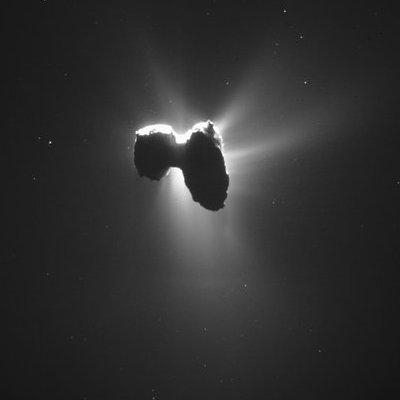
Cool image time! As part of its research plan, Rosetta has been moved outward from Comet 67P/C-G for the next few weeks in order to better study its coma and tail. In this new position, engineers were able to maneuver the spacecraft so that it was flying about 600 miles farther from the Sun and could look back and see the Sun being eclipsed by the comet.

Thanks to the combination of a long, four-second exposure, no attenuation filter and a low-gain setting on the analogue signal processor of NAVCAM (a setting that is used to image bright targets), the image reveals the bright environment of the comet, displaying beautiful outflows of activity streaming away from the nucleus in various directions. It is interesting to note hints of the shadow cast by the nucleus on the coma below it, as well as a number of background stars sprinkled across the image.

In the next week the spacecraft will move back in close to the comet.

2 comments

Another Rosetta close-up of Comet 67P/C-G

Close-up Comet 67P/C-G

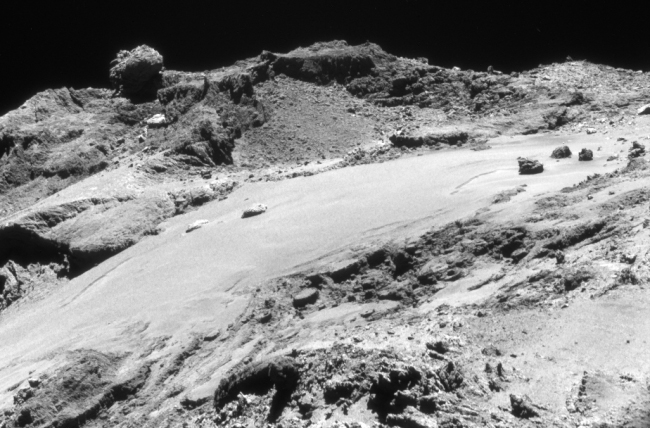
Cool image time! As Rosetta completes a several weeks of in-close observations it took the above oblique view (cropped and reduced to show here) of Comet 67P/C-G. The image was taken from about 7.5 miles with a resolution of about 3 feet per pixel. It shows the Imhotep flat area with the large 80-foot-high Cheops boulder in the center. It is worthwhile to compare this image with one taken in January.. Though the angle is far different, you can recognize the same areas in Imhotep where some of the surface has apparently evaporated away.

What I especially like about today’s image is that it really gives one a feel for what it would be like to stand on the surface here. The light gravity allows some strange rock configurations, such as that giant weird balancing outcrop on the horizon. If you were standing in Imhotep that outcrop would hang above you threateningly.

The spacecraft is now moving away from the comet for the next few weeks

Following the brief encounter at these close distances, Rosetta is now heading out on an anti-sunward excursion to around 1000 km to investigate the comet’s wider coma, tail and plasma environment. Today, 24 March, Rosetta is already over 200 km away from the comet. The current plan is for Rosetta to make a 30 km zero phase flyby around 9 April, before entering back into closer bound orbits by 21 April.

2 comments

Getting real close to Comet 67P/C-G

Close-up of Comet 67P/C-G

Cool image time! As Comet 67P/C-G moves away from the sun and cools down, the Rosetta science team has been able to move the spacecraft back in close to the comet. The image on the right was taken on March 5 from only 12.6 miles above the comet’s surface, and has a resolution of 14 inches per pixel.

I have brightened the image and cropped it to show it here. At this scale, if they managed to photograph the location where Philae sits we would see it with no problem at all. As it is, the detail is remarkable. For example, look at the slope below the cliff in the lower right. You can see what look like a very faint series of terraces, suggesting the existence of onion-like layers below the surface.

Go to the link. There is a second high resolution image there that is as amazing.

4 comments

Rosetta detects magnetic-free bubble around comet

Scientists using Rosetta have finally detected the expected bubble or region surrounding Comet 67P/C-G where there is no magnetic field and the Sun’s solar wind does not enter.

The bubble is caused by the material being ejected from the comet. Scientists had detected the same thing around Halley’s Comet back in 1986, but it turns out the bubble around Comet 67P/C-G is larger than expected based on those previous measurements, and also fluctuates in size more than predicted.

2 comments

The final search for Philae

This review of the journey of Rosetta’s lander Philae, now dead on the surface of Comet 67P/C-G, includes information about the science’s team upcoming last effort to locate the lander.

The comet’s level of activity is now decreasing, allowing Rosetta to safely and gradually reduce its distance to the comet again,” says Sylvain Lodiot, ESA’s Rosetta spacecraft operations manager. “Eventually we will be able to fly in ‘bound orbits’ again, approaching to within 10–20 km – and even closer in the final stages of the mission – putting us in a position to fly above Abydos close enough to obtain dedicated high-resolution images to finally locate Philae and understand its attitude and orientation.”

“Determining Philae’s location would also allow us to better understand the context of the incredible in situ measurements already collected, enabling us to extract even more valuable science from the data,” says Matt Taylor, ESA’s Rosetta project scientist.

They intend to try to re-establish communications with the lander, but do not have much expectations that it is able to function.

0 comments

A look inside Comet 67P/C-G

The Rosetta science team has determined that Comet 67P/C-G has no voids or large caverns in its interior, and that its low density is because its dust and water ice have mixed to produce a “fluffy” density.

In a new study, published in this week’s issue of the journal Nature, a team led by Martin Pätzold, from Rheinische Institut für Umweltforschung an der Universität zu Köln, Germany, have shown that Comet 67P/Churyumov-Gerasimenko is also a low-density object, but they have also been able to rule out a cavernous interior. This result is consistent with earlier results from Rosetta’s CONSERT radar experiment showing that the double-lobed comet’s ‘head’ is fairly homogenous on spatial scales of a few tens of metres.

The most reasonable explanation then is that the comet’s porosity must be an intrinsic property of dust particles mixed with the ice that make up the interior. In fact, earlier spacecraft measurements had shown that comet dust is typically not a compacted solid, but rather a ‘fluffy’ aggregate, giving the dust particles high porosity and low density, and Rosetta’s COSIMA and GIADA instruments have shown that the same kinds of dust grains are also found at 67P/Churyumov-Gerasimenko.

1 comment
1 3 4 5 6 7 15