SETI confirms through extensive radio observations: Comet 3I/Atlas has no alien technology

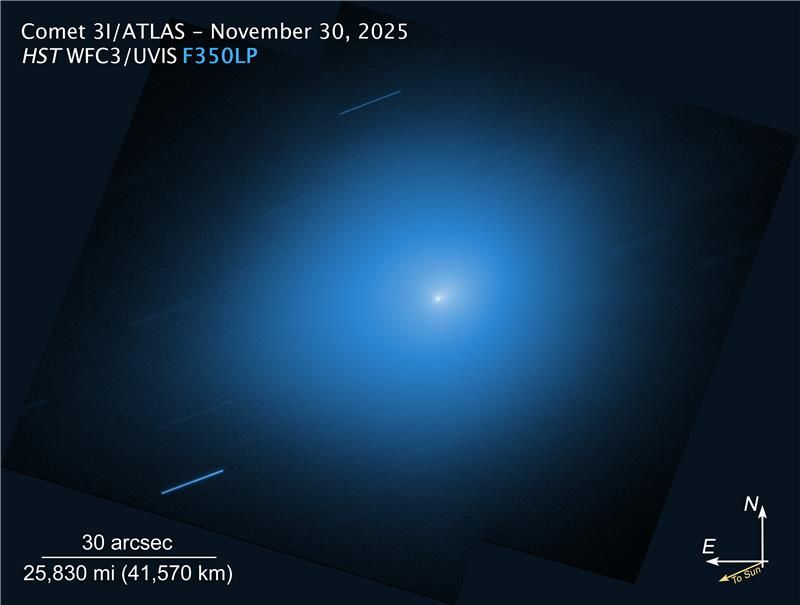
New Hubble image of 3I/Atlas
Comet 3I/Atlas as seen by Hubble
in November 2025. Click for original.

Hardly a surprise: In order to put an end to the stupid clickbait speculations of some hack scientists, the SETI Institute has just completed seven hours of detailed radio observations of interstellar comet 3I/Atlas, and has confirmed that it has no alien technology and is nothing more than a comet, albeit unusual because it comes from outside our solar system.

The team identified nearly 74 million narrowband signals. After removing human interference and filtering for signals matching 3I/ATLAS’s movement, only about 200 remained for review. All traced back to technology on the surface of the Earth or our own Earth-orbiting satellites.

While no technosignatures were found, the study sets new constraints reinforcing that 3I/ATLAS is a natural object. The observations place upper limits on the power of any radio transmitter on or near 3I/ATLAS, ruling out signals stronger than about 10–110 watts, approximately the power of a household appliance, over the detected frequencies.

In other words, the comet is a comet. This research also demonstrated new astronomical capabilities that can quickly do similar observations when new interstellar objects show up.

5 comments

Webb detects methane being released by interstellar comet 3I/Atlas

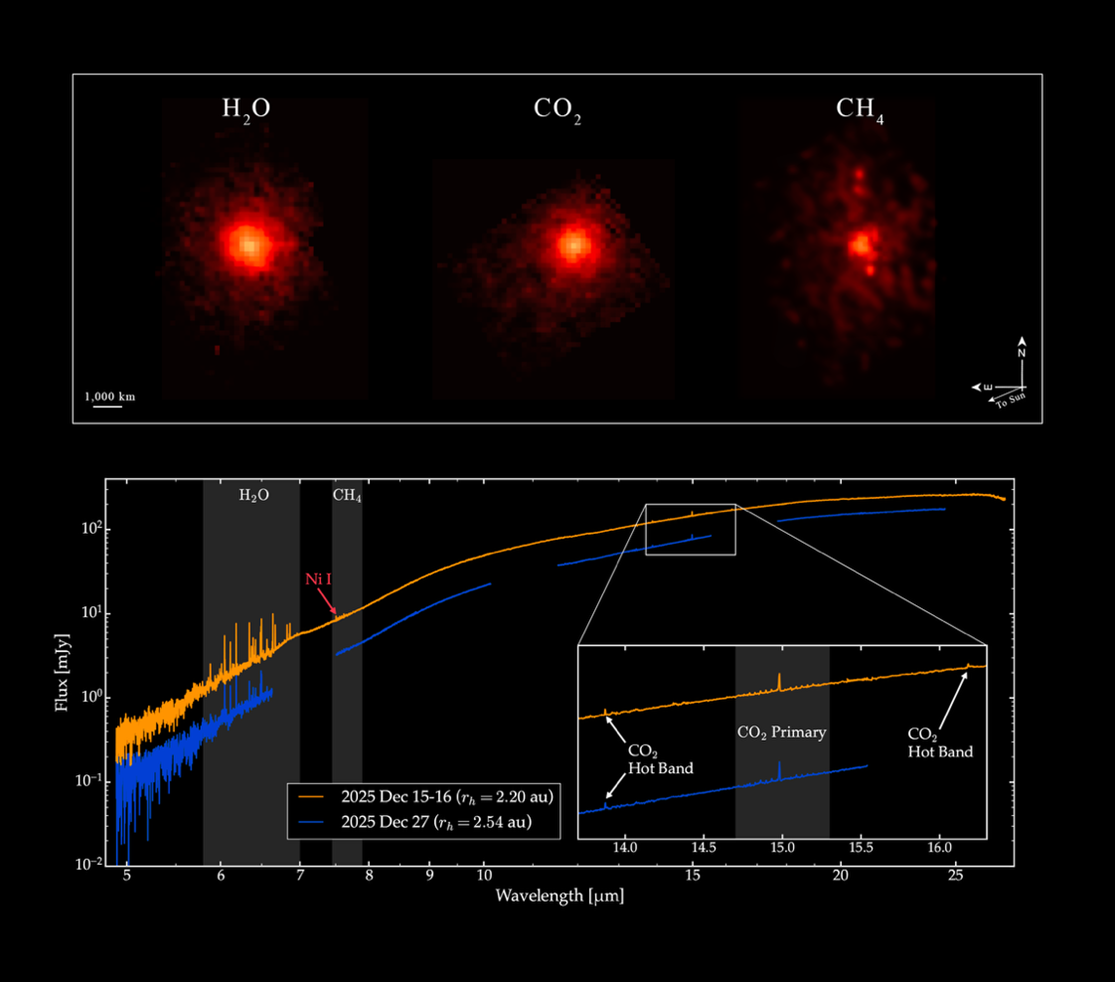
Comet 3I/Atlas's methane as seen by Webb
Comet 3I/Atlas’s methane as seen by Webb.
Click for full image.

Using the Webb Space Telescope, astronomers have now detected methane in the cloud of material released by the interstellar comet 3I/Atlas as it zipped past the Sun last fall.

The observations were taken using Webb’s MIRI (Mid-Infrared Instrument) on two separate dates as the comet traveled back out of our solar system after whipping around the Sun (post-perihelion). The first observation occurred Dec. 15 to 16, when the comet was about 205 million miles from the Sun. This was followed by a second observation Dec. 27, when the comet was about 236 million miles from the Sun.

For the first time on an interstellar visitor, Webb directly detected methane gas. Methane is highly volatile, meaning it sublimates from solid ice into a gas very easily. Its delayed appearance in comet 3I/ATLAS suggests it was buried below the comet’s top surface layer and protected from sublimation until heat from the comet’s close pass to the Sun reached deeper parts of the icy subsurface. The amount of methane relative to water found is surprisingly high, with few similar analogs in our own solar system.

Webb’s observations also confirmed that comet 3I/ATLAS remains unusually rich in carbon dioxide, releasing far more carbon dioxide relative to water when compared to typical solar system comets.

You can read their peer-reviewed paper here [pdf]. This new data confirms that Comet 3I/Atlas is not from our solar system, as its make-up is sufficiently different from solar system comets to show this. It also gives us a hint as to the solar system it came from. At the same time, the comet’s behavior is remarkably similar to solar system comets, suggesting our solar system evolved much like others.

0 comments

Europa Clipper and Juice make simultaneous UV light observations of interstellar comet 3I/Atlas

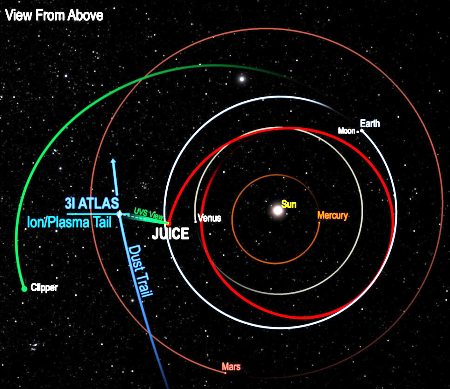
Overview of November observations
Overview of November 2025 observations.
Click for original image.

By viewing interstellar comet 3I/Atlas when it was between the Jupiter probes Europa Clipper and Juice (on their way to Jupiter) in November 2025, the science teams for both were able to get a 360 degree view of the comet in ultraviolet wavelengths.

“As the comet passed between Juice and Europa Clipper, we were able to informally coordinate observations between the two spacecraft,” said Dr. Kurt Retherford, the principal investigator of Juice-UVS and Europa-UVS. “Crucially, we observed hydrogen, oxygen and carbon emissions. These elements are produced when gases escaping the comet’s nucleus break apart into atoms when exposed to sunlight.”

…“Observing the interstellar comet was some exciting bonus science. The resulting rare and unique dataset includes gas emissions and scattered dust,” said SwRI’s Dr. Philippa Molyneux, co-deputy principal investigator for the Juice-UVS instrument. “This was the first time we’ve had simultaneous direct views of a comet’s coma of escaping gas from two directions. Europa Clipper showed us the night side of the comet, with a great deal of scattered dust, while Juice imaged mostly glowing gas on the day side.”

…The researchers found higher levels of carbon emissions from 3I/ATLAS than expected early on, especially in comparison to typical comets from our solar system, corroborating similar findings through other observations about the interstellar comet’s origin and composition. Observing the trends of emissions over several days revealed how the ratios of these molecules changed and how the comet evolved during its journey through our solar system.

These results confirm once again that while Comet 3I/Atlas is from outside our solar system and has some unique features, it is still remarkably similar to ordinary comets found within our solar system.

0 comments

New data says interstellar Comet 3I/Atlas IS different from comets in our solar system

Using spectroscopic data from the ALMA telescope in Chile, astronomers have determined that interstellar comet 3I/Atlas is enriched in deuterium (sometimes called “heavy water”), with quantities as much as 30 times that found in ordinary solar system comets and 40 times that found in Earth’s oceans.

You can read the peer-reviewed paper here. From its abstract:

3I/ATLAS shows a deuterium enrichment exceeding Earth’s ocean value by more than a factor of about 40 and typical Solar System cometary values by more than a factor of about 30. The elevated deuterium enrichment points to water that formed under colder, less irradiated conditions and from less thermally processed material, consistent with an origin in a planetary system that formed under different physical and chemical conditions than our own.

In other words, the conditions in which Comet 3I/Atlas’ solar system formed were very different from those when our own solar system formed.

This conclusion is wonderful, but it raises more questions than it answers. Since we do not know how old the comet is, nor do we really know where it came from, there is little else we can glean from this result, other than it proves the conditions when solar systems form can vary widely.

7 comments

Astronomers detect the first comet whose nucleus’ reversed its rotation

Astronomers using data collected by the orbiting Gehrels Swift and Hubble space telescopes now think the nucleus of a small comet reversed its rotation sometime in 2017, caused by the force of the material sublimated off its surface.

From the abstract of their paper [pdf]:

The rotations of cometary nuclei are known to change in response to outgassing torques. The nucleus of the Jupiter-family comet 41P/Tuttle–Giacobini–Kresak exhibited particularly dramatic rotational changes when near perihelion in 2017 April. Here, we use archival Hubble Space Telescope observations from 2017 December to study the postperihelion lightcurve of the nucleus and to assess the nucleus size.

From both Hubble photometry and nongravitational acceleration measurements, we find a diminutive nucleus with effective radius 500 ± 100 meters. Systematic optical variations are consistent with a two-peaked (i.e., rotationally symmetric) lightcurve with period 0.60 ± 0.01 days, substantially different from periods measured earlier in 2017. The spin of the nucleus likely reversed between perihelion in 2017 April and December as a result of the outgassing torque.

In plain English: the thrust of the material being thrown from the surface as the comet made its close approach to the Sun was sufficient to slow and then reverse the nucleus’s rotation. This process was helped by the relatively small size of the nucleus compared to the material being sublimated from it.

The data also suggests the nucleus was once much larger, and has been whittled down to its present small size as it made its multiple close fly-bys of the Sun during the past 1,500 years. Rather than break-up, as most comets do at some point as their nucleus gets smaller, this comet’s nucleus simply kept shrinking, to the point that the thrust of that material could change its rotation.

0 comments

Interstellar comet 3I/Atlas is unusually enriched with windshield wiper fluid

New Hubble image of 3I/Atlas
Comet 3I/Atlas as seen by Hubble
in November 2025. Click for original.

While interstellar comet 3I/Atlas is remarkably like most comets from our own solar system, scientists have now found new evidence that it spalled off unusual amounts of methanol (CH3OH) — material normally used as windshield washer fluid, carburetor fluid, and cooking fuel — when it made its close fly-by of the Sun in the fall of 2025.

You can read the paper here [pdf] . The research also detected large amounts of prussic acid (HCN). As the comet made its closest pass to the Sun, the numbers increased. From the paper’s abstract:

The CH3OH production rate increased sharply from August through October, including an uptick near the inner edge of the H2 O sublimation zone at r H = 2 au. Compared to comets measured to date at radio wavelengths, the derived CH3 OH/HCN ratios in 3I/ATLAS of 124+30 −34 and 79−14 +11 on September 12 and 15, respectively, are among the most enriched values measured in any comet, surpassed only by anomalous solar system comet C/2016 R2 (PanSTARRS).

Though the numbers are high, they aren’t outside the range of what has been found in comets from our own solar system. Instead, this data suggests — as has all data so far — that Comet 3I/Atlas is a normal comet, but unique in its own way, as are all comets and in fact every object in space.

4 comments

Europe’s Jupiter probe Juice releases its first image of interstellar comet 3I/Atlas

Comet 3I/Atlas as seen by Juice
Click for original image.

The European Space Agency’s (ESA) probe Juice, presently on its way to Jupiter, yesterday released its first image of interstellar comet 3I/Atlas from the data it gathered in November 2025 but only now has been able to send back to Earth.

That picture is to the right, cropped and reduced to post here. From the press release:

[T]he science camera on ESA’s Jupiter Icy Moons Explorer (Juice) shows interstellar comet 3I/ATLAS spewing dust and gas. The tiny nucleus of the comet (not visible) is surrounded by a bright halo of gas known as the coma. A long tail stretches away from the comet, and we see hints of rays, jets, streams and filaments. The inset in the image shows the same data, but processed to highlight the coma structure.

As also noted in the release, though this comet is from outside our solar system, “its behaviour is completely in line with that expected from a ‘normal’ comet.”

The picture was taken on November 6, 2025, just seven days after the comet made its closest pass to the Sun. At that time Juice took 120 images, which could not be sent back until now because the Sun was in the way. The science team is presently analyzing that data, and plans a full release of its work next month.

0 comments

A realistic plan to send a spacecraft to interstellar Comet 3I/Atlas

Scientists have devised a mission profile that could actually get a spacecraft close to Comet 3I/Atlas sometime around 2085.

…the team found that an intercept could be achieved via a Solar Oberth maneuver, but the launch would have to occur in 2035 to achieve optimal alignment between Earth, Jupiter and 3I/ATLAS. The flight duration would be 50 years (though Hibberd notes that this could be reduced marginally). “2035 is optimal because the alignments of the celestial bodies involved (i.e. the Earth, Jupiter, Sun, and 3I/ATLAS) are the most propitious to reach 3I/ATLAS with a minimum Solar Oberth propulsion requirement from the probe, a minimum performance requirement for the launch vehicle, and a minimum flight time to the target,” he said.

The Solar Oberth maneuver has the spacecraft fire its engines at the moment it is zipping past the Sun at its closest and fastest, taking full advantage of that gravitational velocity.

You can read their paper here [pdf] As they note in their conclusion, this entire mission is based on using “a Starship Block 3 upper stage fully-refuelled in Low Earth Orbit.” It assumes that by 2035 Starship will be flying routinely and cheaply, and could be purchased at a reasonable cost for such a mission.

Or maybe donated in the name of science by some billionaire who happens to care about making the human race multi-planetary. Know anyone?

Personally, I wonder it this mission profile could be adapted to reach the first known interstellar object, Oumuamua. 3I/Atlas appears to simply be a comet. Though a visit would be of value it would not Earth-shaking. Oumuamua however was not a comet, but more importantly it was strange in every way. Though astronomers in 2019 declared based on the available data that it was definitely not an alien spaceship, that conclusion remains very uncertain. As I wrote at the time:

…for anyone to assume there is any certainty to this conclusion would be a grave mistake. It is merely the best guess, based on the available but somewhat limited data. The data however does not preclude more exotic explanations. Nothing is certain.

To me this object should get top priority.

Hat tip BtB’s stringer Jay.

11 comments

Astronomers use SphereX infrared space telescope to study interstellar Comet 3I/Atlas

False color images of SphereX infrared data
False color images of SphereX infrared data.
Click for original.

Using NASA’s SphereX infrared space telescope, astronomers have now detected a range of new molecules in the coma surround interstellar Comet 3I/Atlas as that coma brightened and grew in December 2025 following the comet’s closest approach to the Sun in the fall.

You can read the research paper here. From the press release:

In a new research note, mission scientists describe the detection of organic molecules, such as methanol, cyanide, and methane. On Earth, organic molecules are the foundation for biological processes but can be created by non-biological processes as well. The researchers also note a dramatic increase in brightness two months after the icy body had passed its closest distance to the Sun, a phenomenon associated with comets as they vent water, carbon dioxide, and carbon monoxide into space.

In every way this interstellar object continues to behave like an ordinary comet, which is actually quite profound. It tells us the rest of the universe is not that different than our solar system.

1 comment

New images of interstellar Comet 3I/Atlas

New Hubble image of 3I/Atlas
Click for original.

Juice image of 3I/Atlas
Click for original.

Both NASA and the European Space Agency (ESA) yesterday released new photos of the interstellar comet 3I/Atlas.

First, NASA released the image on the right, taken on November 30, 2025 by the Hubble Space Telescope. At the time the comet was about 178 million miles away. It clearly shows the comet’s coma of material, surrounding a bright nucleus at the center. The streaks are background stars.

Next, the mission team for Europe’s Juice probe, on its way to Jupiter, released one small portion of a picture taken by its navigation camera. That picture is the second to the right.

During November 2025, ESA’s Jupiter Icy Moons Explorer (Juice) used five of its science instruments to observe 3I/ATLAS. The instruments collected information about how the comet is behaving and what it is made of. In addition, Juice snapped the comet with its onboard Navigation Camera (NavCam), designed not as a high-resolution science camera, but to help Juice navigate Jupiter’s icy moons following arrival in 2031.

Though the data from the science instruments won’t arrive on Earth until February 2026, our Juice team couldn’t wait that long. They decided to try downloading just a quarter of a single NavCam image to see what was in store for them. The very clearly visible comet, surrounded by signs of activity, surprised them.

Not only do we clearly see the glowing halo of gas surrounding the comet known as its coma, we also see a hint of two tails. The comet’s ‘plasma tail’ – made up of electrically charged gas, stretches out towards the top of the frame. We may also be able to see a fainter ‘dust tail’ – made up of tiny solid particles – stretching to the lower left of the frame.

The image was taken on 2 November 2025, during Juice’s first slot for observing 3I/ATLAS. It was two days before Juice’s closest approach to the comet, which occurred on 4 November at a distance of about 66 million km.

Because Juice is presently behind the Sun (as seen from Earth), most of the data it collected during its closest approach won’t be downloaded until February. This one partial image is only a fore taste.

3 comments

New data from VLT uncovers numerous debris disks around stars

A sampling of debris disks
Click for original

Using a new instrument on the Very Large Telescope (VLT) in Chile, astronomers have compiled a catalog of 51 potential exoplanet solar systems, all with intriguing debris disks surround the stars with features suggesting the existence of asteroids and comets.

The image to the right shows a sampling of those systems. From the press release:

“To obtain this collection, we processed data from observations of 161 nearby young stars whose infrared emission strongly indicates the presence of a debris disk,” says Natalia Engler (ETH Zurich), the lead author of the study. “The resulting images show 51 debris disks with a variety of properties — some smaller, some larger, some seen from the side and some nearly face-on – and a considerable diversity of disk structures. Four of the disks had never been imaged before.”

Comparisons within a larger sample are crucial for discovering the systematics behind object properties. In this case, an analysis of the 51 debris disks and their stars confirmed several systematic trends: When a young star is more massive, its debris disk tends to have more mass as well. The same is true for debris disks where the majority of the material is located at a greater distance from the central star.

Arguably the most interesting feature of the SPHERE debris disks are the structures within the disks themselves. In many of the images, disks have a concentric ring- or band-like structure, with disk material predominantly found at specific distances from the central star. The distribution of small bodies in our own solar system has a similar structure, with small bodies concentrated in the asteroid belt (asteroids) and the Kuiper belt (comets).

The data from various telescopes both on the ground and in space is increasingly telling us that our solar system is not unique, and that the galaxy is filled with millions of similar systems, all in different states of formation. This hypothesis is further strengthened by the appearance of interstellar comet 3I/Atlas, which despite coming from outside our solar system is remarkably similar to the comets formed here.

1 comment

NASA releases numerous images of interstellar Comet 3I/Atlas

Comet 3I/Atlas as seen by Mars Reconnaissance Orbiter

NASA yesterday released a slew of images of interstellar Comet 3I/Atlas, taken by numerous in-space probes at Mars and elsewhere.

The picture to the right, cropped to post here, is probably the one with the most detail, taken by Mars Reconnaissance Orbiter (MRO) from Mars orbit on October 2, 2025. In addition, images were captured by:

None of these pictures show the comet in any great detail. All however confirm once again that it is a comet, not an interstellar alien spacecraft as some idiots in academia have been proposing wildly. The Maven observations in ultra-violet wavelengths for example identified hydrogen and other isotopes coming off the comet as it is heated by the Sun. MRO’s image to the right once again showed the comet’s coma and tail.

Above all, these observations were great engineering experiments for all the science teams, demonstrating that they could point their instruments in an unplanned direction and capture a very faint object quite far away.

8 comments

Europe’s Trace Gas Orbiter circling Mars gets images of interstellar Comet 3I/Atlas

Interstellar Comet 3I/Atlas
Click for movie.

Using Europe’s Trace Gas Orbiter (TGO) that is in orbit around Mars, engineers have obtained images of the interstellar Comet 3I/Atlas.

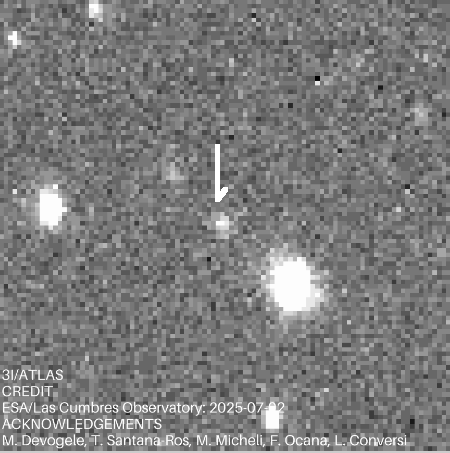
The image to the right is a screen capture of the last image in a movie they created from all the pictures. I have added the arrow to indicate the comet, which underlines the fact that these images really don’t tell us that much about the comet itself. It is hardly more than a few pixels across, with no real detail resolved. However, the data has still been found useful.

Until September, figuring out the location and trajectory of 3I/ATLAS relied on Earth-based telescopes. Then between 1 and 7 October, ESA’s ExoMars TGO turned its eyes towards the interstellar comet from its orbit around Mars. The comet passed relatively close to Mars, approaching to about 29 million km during its closest phase on 3 October.

The Mars probe got about ten times closer to 3I/ATLAS than telescopes on Earth and it observed the comet from a new viewing angle. The triangulation of its data with data from Earth helped to make the comet’s predicted path much more accurate.

While the scientists initially anticipated a modest improvement, the result was an impressive ten-fold leap in accuracy, reducing the uncertainty of the object’s location.

All the data continues to confirm that 3I/Atlas is nothing more than comet, though like all comets unique in its own way. This refined location data will also improve the on-going observations of Europe’s Jupiter probe Juice, presently on its way to Jupiter and in the best position to see 3I/Atlas.

5 comments

Comet C/2025 K1 — NOT interstellar 3I/Atlas — breaks up as it passes closest to the Sun

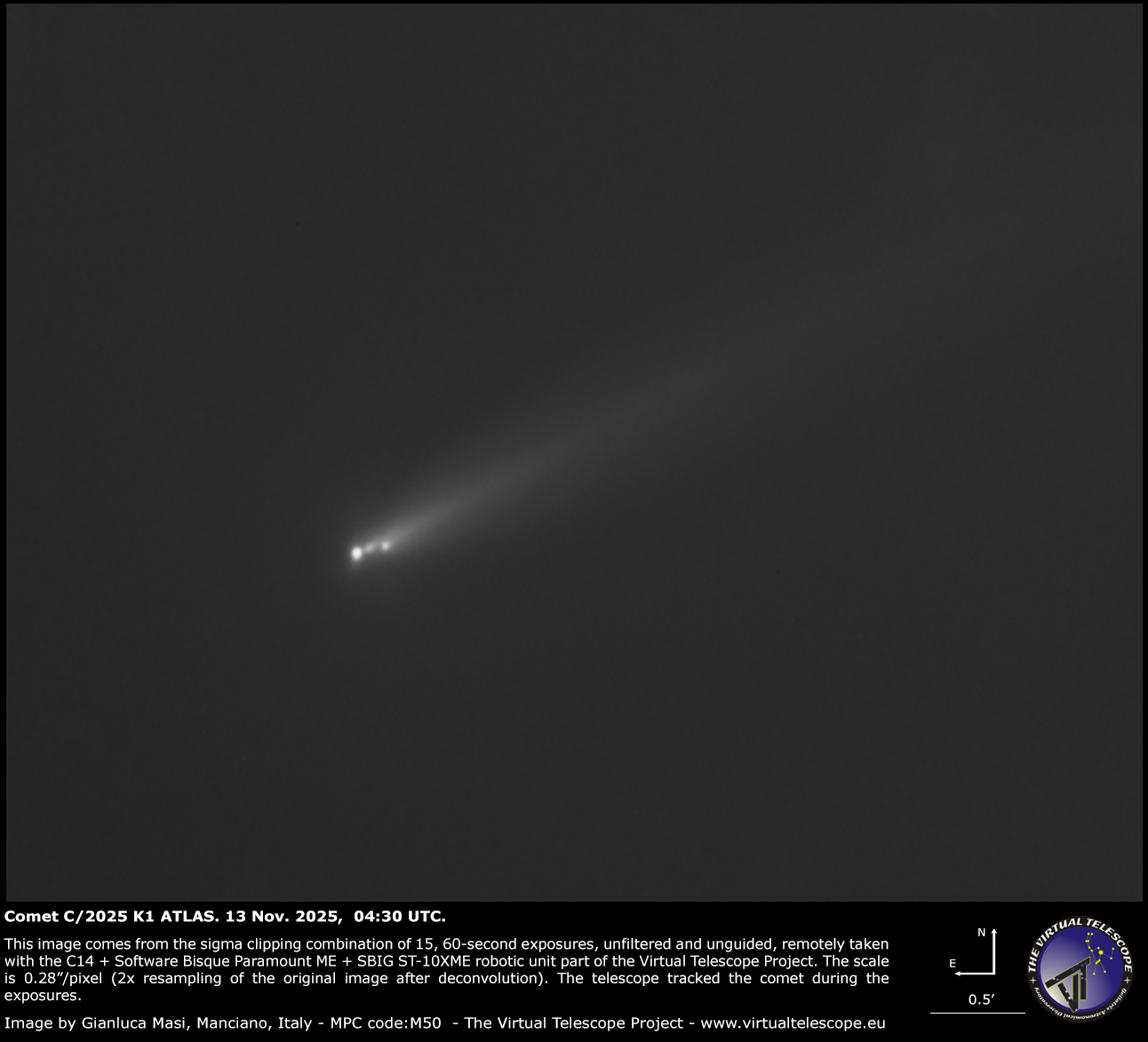
The broken apart nucleus of Comet 3I/Atlas
Click for original image.

CORRECTION: I originally posted this story thinking the comet imaged was the interstellar Comet 3I/Atlas. It is not. It is a different one. I have changed to post below to correct my error.

——————
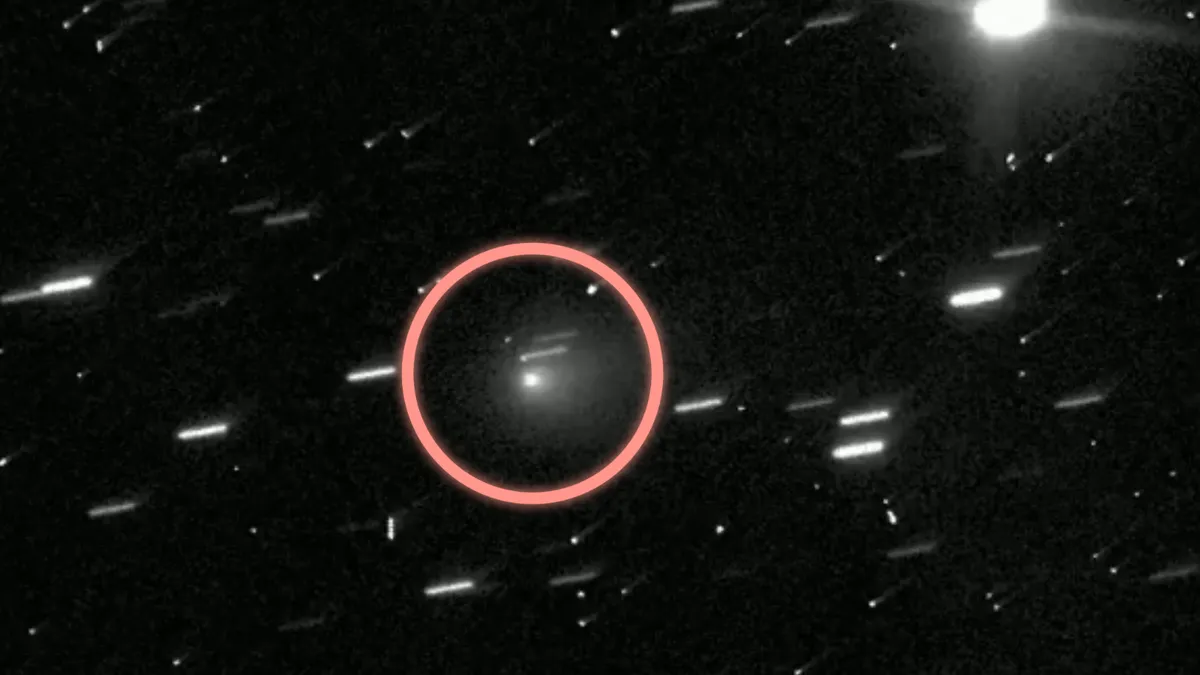
Sometime on November 11, 2025, the nucleus of interstellar C/2025 K1 broke into three pieces as it passed through its closest and hottest point to the Sun.

The image to the right, cropped and reduced to post here, comes from images of the break-up taken by the Virtual Telescope project, which gathers data from many small telescopes remotely.

From the first link, translated by Google from the Italian:

Its trajectory led it, in early October, to pass through a point of minimum distance from the Sun (perihelion) quite close to our star, about 0.33 astronomical units, just outside the orbit of Mercury. Because of this “short” distance from the Sun, it experienced high solar irradiation, which caused a significant increase in the temperature of the surface and internal layers of the nucleus.

These are precisely the conditions under which a “breakup” event is expected: depending on the internal properties of the nucleus—namely, its porosity, its state of cohesion, its composition, and the percentage of ice—it is possible that the increase in temperature could cause significant “outgassing,” a sudden and violent outflow of gaseous and dusty material, and the consequent fragmentation of the nucleus, sometimes into a few pieces of roughly similar size, sometimes into a cloud of fragments and debris that spread along the trajectory of the original comet.

…”From an initial quick analysis of the images, we can confirm that there are certainly two fairly similar pieces, whose brightness maxima are separated by approximately 2,000 km (distance projected on the star field); “Furthermore, we can intuit the presence of a third, smaller and fainter fragment to the left of the pair,” observes Mazzotta Epifani.

It will be interesting to see if the same thing happens to interstellar Comet 3I/Atlas as it makes its own pass close to the Sun.

7 comments

Update on the plans to observe interstellar Comet 3I/Atlas using interplanetary spacecraft

Link here. The key take-away is that nothing is being repurposed to attempt to fly to Comet 3I/Atlas. Instead, as expected the science teams for all the Mars orbiters will turn their instruments to the comet when it is at its closest point to Mars, about 19 million miles away.

Don’t expect any Earth-shattering revelations:

The cameras on these spacecraft were designed to photograph the surface of Mars from Mars orbit, and won’t be able to pick out much detail on such a relatively small comet 30 million km away. But the cameras may be able to capture images of its long tail and also gather data that scientists can use to find out more about what 3I/ATLAS is made of.

Some spectroscopic data will be obtained, but it likely will not be much better than what Webb and other Earth-based telescopes have gotten already.

Similarly, the science team for Europe’s Juice mission, on its way to Jupiter, will take a look, but the distances and orbital positioning will likely limit what it can detect as well.

3 comments

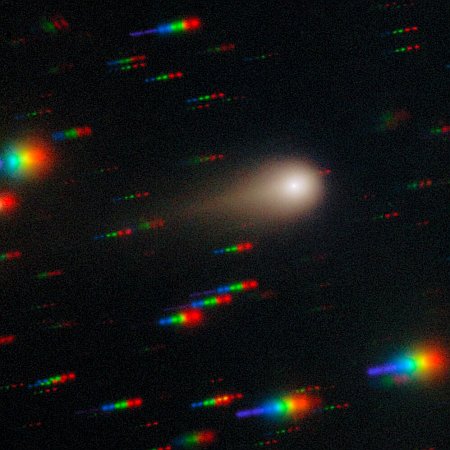
Gemini South telescope captures Comet 3I/Atlas’s growing tail

Comet 3I/Atlas
Click for original image.

Using the Gemini South telescope in Chile, astronomers have taken new images of interstellar Comet 3I/Atlas as it moves through the solar system, this time capturing the slow growth of its tail.

The picture to the right, cropped, reduced, and sharpened to post here, shows that tail trailing off to the left. The stars are streaks because it required four exposures in different wavelengths to produce the image. The comet was held steady while the stars shifted after each exposure.

In the images captured during the session, the comet displays a broad coma — a cloud of gas and dust that forms around the comet’s icy nucleus as it gets closer to the Sun — and a tail spanning about 1/120th of a degree in the sky (where one degree is about the width of a pinky finger on an outstretched arm) and pointing away from the Sun. These features are significantly more extended than they appeared in earlier images of the comet, showing that 3I/ATLAS has become more active as it travels through the inner Solar System.

So far, all the evidence continues to show that though 3I/Atlas has an interstellar origin, it is a relatively ordinary comet, simply unique in the manner all objects of a category are unique. As the scientists pour over the comet’s spectroscopy we might find its make-up is somewhat different than comets from our own solar system, but the data so far suggests that the differences are not likely to be that startling.

3 comments

First Hubble images of interstellar comet 3I/Atlas released

Comet 3I/Atlas, taken by Hubble
Click for original.

An undergraduate student has just released the first pictures taken by the Hubble Space Telescope of the interstellar object 3I/Atlas, confirming that it is a comet as indicated by the earlier image taken by the Gemini North telescope.

One of those images, taken only hours ago, is the inset on the map showing the comet’s route through the solar system to the right. The streaks on the image are either stars or cosmic rays. Though this image is of significantly lower quality than the Gemini North picture, it once again shows both the comet’s nucleus and developing coma.

A preprint [pdf] of a new research paper based on data from both telescopes further confirms this conclusion:

[T]hese results suggest that 3I/ATLAS hosts a coma containing large water ice grains, and that its dust continuum is stable over at least week-long timescales. The spectral characteristics further distinguish 3I from known ultrared trans-Neptunian objects and align it more closely with active Jupiter-family comets.

The last conclusion is very significant. Though the path and speed of this interstellar object says it must come from beyond the solar system, its cometary make-up more resembles comets that reside in the inner solar system. These facts strongly imply that there is at least one other solar systems not very different from our own.

0 comments

Viewing Comet Tsuchinshan-ATLAS when it enters the evening sky

Link here. For those living in the northern hemisphere, Comet Tsuchinshan-ATLAS will be bright and visible to the naked eye just after sunset beginning tomorrow.

“As soon as October 11th, ambitious comet spotters may pick up the comet during twilight just above the western horizon,” says Sky & Telescope Contributing Editor Bob King. “Binoculars will help you see the comet throughout its appearance.”

About 40 minutes after sunset on Friday, find a spot with a good view down to the western horizon. The first thing that will catch your eye will be the bright planet Venus, the Evening Star — that’s your starting point. Hold your fist out at arm’s length; the comet is about 2½ fists to Venus’s right. The comet will still look tiny in Friday’s twilight — like a hazy star with a small tail — and will set while twilight is still in progress.

Comet Tsuchinshan-ATLAS (pronounced choo-cheen-SHAHN) will remain visible for the next ten days, with the best viewing likely from October 13th to October 16th.

5 comments

Viewing Comet Tsuchinshan-ATLAS

While the newly discovered Comet Tsuchinshan-ATLAS in the past week reached naked eye visibility in the dawn sky, in the next few weeks it will shift into the evening sky on October 11, 2024 while brightening to peak levels.

Although Comet Tsuchinshan-ATLAS will be visible in both hemispheres, the northern one is favored because the comet tracks north. Also, sunsets are getting earlier and twilights shorter, while the opposite is happening in southern latitudes.

Observers should be aware that the Moon will interfere for several nights, from about Oct. 15-20 (full Moon is on Oct. 17th), around the same time the comet climbs out of twilight.

As it begins to fade, the comet will be visible at an increasing height above the horizon each night through the end of October. At its brightest it is expected to be one of the brightest objects in the sky.

1 comment

Eruption on comet results in its tail splitting as it brightens by 100x

On July 20, 2023 the Comet 12P/Pons-Brooks suddenly erupted for the first time in almost seven decades, making it a hundred times brighter than normal while splitting its tail in two.

As of July 26, the comet’s coma had grown to around 143,000 miles (230,000 kilometers) across, or more than 7,000 times wider than its nucleus, which has an estimated diameter of around 18.6 miles (30 km), Richard Miles, an astronomer with the British Astronomical Association who studies cryovolcanic comets, told Live Science in an email.

But interestingly, an irregularity in the shape of the expanded coma makes the comet look as though it has sprouted horns. Other experts have also likened the deformed comet to the Millennium Falcon, one of the iconic spaceships from Star Wars, Spaceweather.com reported.

It is believed the tail’s shape is the result of the shape of the comet’s nucleus, which probably had a solid ridge acting as a barrier to material at that point.

The comet, which orbits the Sun every 71 years, will make its closest approach to Earth in the spring of 2024, when it will likely be visible to the naked eye.

3 comments
1 2 3 15