SpaceX, xAI, and Tesla to build large-scale computer chip factory in Texas

At an event this weekend in Austin Elon Musk announced that SpaceX, xAI, and Tesla will a build large-scale computer chip factory in Texas, dubbed Terafab, designed to produce the chips needed by all three companies.

The “TERAFAB” project is a joint effort involving Tesla, SpaceX and xAI. Musk said the chips will be used in vehicles, Tesla’s humanoid AI robots and for projects in space, including solar-powered AI satellites.

…In a Sunday post on X, Musk clarified that the Austin-area facility is one part of the larger project and will focus on chip design. The main TERAFAB facility, he said, would require thousands of acres, and multiple locations are being considered. Musk said the chip production was necessary to fuel his companies’ growth. On Saturday, he shared an ambitious vision for the future powered by TERAFAB, including billions of robots and interplanetary travel. “We want to be a civilization that expands to the galaxy with spaceships, that anyone can go anywhere they want at any time,” he said. “And have a city on the moon, cities on Mars, populate the solar system and send spaceships to other star systems.”

Essentially, Musk has realized that to build his data centers in orbit and on the Moon, he will a lot of computer chips. Early in the history of SpaceX Musk learned that being dependent on outside contractors was crippling. Too often those contractors saw SpaceX has a competitor and acted to sabotage it. He soon decided his companies must be vertically integrated, doing as much work as possible in-house.

He is now applying that policy in chip production as well.

Blue Origin files FCC application for its own 51,600 data center satellite constellation

Blue Origin yesterday filed with the Federal Communications Commission (FCC) an application to launch 51,600 satellites, dubbed Project Sunrise, aimed at creating its own data center constellation in orbit.

The proposed constellation includes up to 51,600 satellites operating in sun-synchronous orbits at altitudes ranging from 500 to 1,800 kilometers. To manage data traffic, the system will primarily use optical links and mesh backhaul networks, supplemented by Ka-band spectrum for telemetry, tracking, and command operations. The spacecraft will utilize multiple antenna variations to maintain efficient coverage across various orbital planes.

You can read the full application here [pdf].
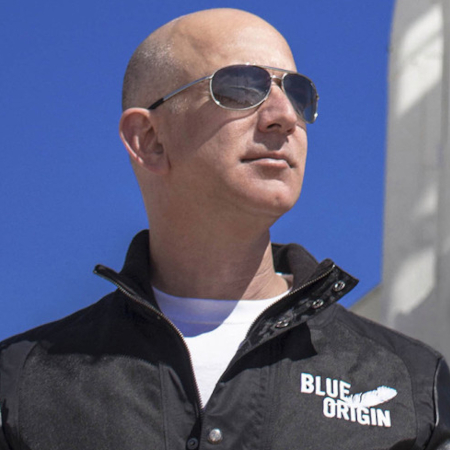
Jeff Bezos
Jeff Bezos, maybe the world’s leader in chutzpah.

Blue Origin also requests several waivers from the FCC’s normal new satellite license requirements, including what I think is a request to waive the FCC’s normal requirement that the applicant launch half its constellation within six years of license approval and complete the constellation three years later. Failure to do so results in financial penalties. The rules were created to prevent companies from getting licenses to grab spectrum from competitors with no intent to launch.

That this Jeff Bezos company is requesting this waiver is what in Yiddish is called chutzpah! Bezos’ other company, Amazon, is clearly going to fail to meet its own license timetable in launching its Leo internet constellation, and was recently lambasted by FCC chairman Brenden Carr for doing so. For Blue Origin to now request this waiver truly is an example of unbelievable gall. I can’t imagine the FCC will do so.

Either way, the competition to put up a lot of satellites continues to grow, with SpaceX and Blue Origin in the best position to make their constellations profitable, because both have their own launch vehicles.

SpaceX submits proposal to FCC for new constellation of one million satellites

SpaceX yesterday submitted a proposal to Federal Communications Commission to build new satellite constellation made up of one million satellites designed as an orbiting data center.

In one 8-page document, SpaceX describes its proposed Orbital Data Center system. “To deliver the compute capacity required for large scale AI inference and data center applications serving billions of users globally, SpaceX aims to deploy a system of up to one million satellites to operate within narrow orbital shells spanning up to 50 km each (leaving sufficient room to deconflict against other systems with comparable ambitions),” the company says.

The same satellites would harness the sun’s energy, orbiting at “between 500 km and 2,000 km altitude and 30 degrees and sun-synchronous orbit inclinations,” the company adds. The orbiting data centers would also use “optical links,” or lasers, to connect with Starlink, using the existing satellite internet system to route traffic to users below.

“Orbital data centers are the most efficient way to meet the accelerating demand for AI computing power,” the filing adds in bold, pointing to the growing energy costs of AI data centers on Earth. The company is also betting it can launch the space-based data centers at a rapid clip using SpaceX’s more powerful Starship vehicle, which is also crucial to upgrading Starlink with next-generation satellites.

The FCC is likely not going to okay this submission, as written. It is clearly very preliminary, but appears to be consistent with SpaceX’s way of doing business. It sees an opportunity, and jumps in with full force. While others are working up their plans, SpaceX submits its first license proposal outlining the plan in very broad terms, thus getting there first.

And SpaceX is very well positioned to launch this constellation as promised. It has the rockets, and has proven itself capable of running a satellite constellation of vast size.