Next Falcon 9 first stage to touch down on land?

The competition heats up: SpaceX is considering an attempt to land its Falcon 9 first stage on land in its next launch in two weeks.

Carol Scott, who works technical integration for SpaceX within NASA’s Commercial Crew Program, told reporters here at the Cape Canaveral Air Force Station today that SpaceX’s first attempt at a land-based rocket landing may be coming sooner than the public expects. “You know how they want to fly the stage back, right? Their plan is to land it out here on the Cape [Canaveral] side,” Scott told reporters.

The company declined to comment on Scott’s remarks, which are vague enough to leave them plenty of wiggle room. Not that it matters. Even if they attempt the next first stage landing on a barge, a landing on land will soon follow. It is only a matter of time.

The first Ceres atlas

Ceres's first atlas

Using data during Dawn’s first orbit of Ceres German scientists have compiled a global atlas of the dwarf planet.

The images used for this are the wide angle survey images, which won’t show the smallest objects because they were taken from about 2,700 miles above the surface. Nonetheless, this atlas gives scientists a baseline for studying the giant asteroid.

Scientists begin another attempt to drill through the Earth’s crust

An expedition to the Indian Ocean is about to begin an effort to drill a core down through the Earth’s crust and into its mantle.

Geologists have been trying to drill through the contact between the crust and the mantle, called the Moho, since the 1960s, with no success. Either the projects have gone way over budget and been shut down, have failed due to engineering problems, or were stopped by the geology itself. This last issue is maybe the most interesting.

Expeditions have come close before. Between 2002 and 2011, four holes at a site in the eastern Pacific managed to reach fine-grained, brittle rock that geologists believe to be cooled magma sitting just above the Moho. But the drill could not punch through those tenacious layers. And in 2013, drillers at the nearby Hess Deep found themselves similarly limited by tough deep-crustal rocks

This new project hopes to learn from these past problems to obtain the first rock samples from below the Earth’s crust.

Turning planes into trucks

The competition heats up: Airbus has patented a concept for having the cargo/passenger section of an airplane modular and removable.

Instead of a single hull, aeroplanes would essentially be built with a hole in their fuselage between the nose cone and the tail section, into which modular compartments could be fitted and removed. The compartments, which could take on the purpose of a passenger, luxury passenger or freight unit, would be transferred between the aircraft and airport via a docking module, which according to Airbus would (ideally) be integrated into airport terminal buildings.

For passenger planes this idea really doesn’t work. However, for cargo it is brilliant. Like trucks, it allows cargo to be loaded without using the expensive flight infrastructure.

Deposed XCOR founders form new company

The competition heats up? The founders of XCOR, who only weeks ago were pushed out in a management reorganization, have teamed up again to form a new company.

Forgive me if I am as skeptical of this new company as I am of XCOR. I’ve looked at all the news articles describing this new company, and see little there that excites me. Lots of talk about new management ideas and agile production efforts, but in the end nothing that suggests anything revolutionary.

These guys had more than a decade at XCOR to produce something and essentially never did. Why should I think they will do it now, just because they are hanging a different company name on their sign?

Don’t get me wrong. I will be the first to celebrate if they make something happen. I just remain exceedingly skeptical.

Russia describes its planned first manned Moon mission

To accomplish its first manned lunar landing, tentatively set for 2029, Russia will have to launch six Angara rockets.

According to the source, the launches are planned to be carried out in pairs from the Vostochny cosmodrome (the Amur region in Russia’s Far East) and the Plesetsk cosmodrome (Archangelsk region in the northwest) with small intervals between the blast-offs. Under the proposed scheme, after the orbit placement, the complex with a total weight up to 70 tonnes will be docked with the manned spacecraft, after which it will fly to the Moon. A payload of 18-20 tonnes will be delivered to the lunar orbit by the end of the mission.

According to a preliminary plan, Russia’s first manned flight to the Moon is possible in 2029. One year ahead of that it is planned to conduct a flight around the Moon, the testing and qualification of space systems for the future manned landing. However, this project may become a reality only if the work to create a new-generation manned transport spacecraft, the Angara-A5 rocket, lunar boosters and other needed rocket and space technology and infrastructure is included in the draft Federal Space Program for 2016-2025.

The final draft Federal Space Program, however, has not yet been approved. This story is obviously a lobbying effort within Russia to get this lunar mission included in that master plan.

What strikes me most about all this is the timing. The big national space programs, Russia, China, and NASA’s SLS, are all aiming for big lunar missions in the late 2020s. All will spend a lot of money for a very limited number of flights, mostly single stunts that merely demonstrate that they can do it. None of these programs will have much staying power on the Moon.

Private space is likely aiming for the Moon as well, and will likely be capable of getting there about the same time. However, private space will be cheap and designed to go many many times (for profit). Watching this race between nations and private companies is going to be quite fascinating. And unlike the 1960s space race, which was a race between two different top-down government programs, this 2020s space race will be between bottom-up capitalism versus top-down government.

I think in the end the governments will be very embarrassed. They will either lose, or act to squelch their private competition.

John Williams – Flying theme from ET

An evening pause: I have always thought Steven Spielberg’s E.T. The Extra-Terrestrial (1982) to be incredibly over-rated, poorly edited, shallow with a predictable script, and not very interesting. Why the public went mad for it in 1982 always baffled me. Nonetheless, Williams’ score was and is magnificent, and a listen here might explain that madness somewhat.

Hat tip Danae.

The jets of Enceladus

Enceladus's jets

Cool image time! The image above, taken in June by Cassini, shows the night side of Saturn’s moon Enceladus, framed by Saturn’s rings, and faintly showing the jets of water coming from its south pole. To show it here I have cropped it and reduced it somewhat, as well as brightened the jets to make them more visible.

The release notes how the image compares the frozen water of Saturn’s rings and the liquid activity of Enceladus’s jets. I note how the image is simply beautiful. Be sure to click on the link to see the full resolution image.

The launch cost of Japan’s H-IIA rocket

The competition heats up: Yesterday’s launch of Japan’s first commercial payload on its upgraded lower cost H-IIA rocket suggested that they are now a serious player in the competitive launch market. What the earlier articles didn’t tell me was the cost they charge to launch a payload on H-IIA.

This article today states that each launch costs 10 billion yen, which translates to about $80 million. That is about $10 million more than SpaceX charges for its Falcon 9, but is certainly cheaper than many other rocket companies. At this price they have a chance of grabbing some of the launch market, but to really compete they need to cut that cost even more, which the article suggests their next rocket will succeed in doing: “The government is developing a new core rocket named the H3, whose launches are expected to cost only about a half of the H2A.”

They do not say whether H3 will be reusable, but at $40 million per launch it will be the cheapest rocket on Earth. That it is government developed however makes me skeptical they will succeed. We shall see. What is clear, however, is that the competition is certainly encouraging the lowering of cost.

Blue Origin lands first stage rocket vertically

The competition heats up: Yesterday Jeff Bezos’s company Blue Origin did its second test flight of its New Shepard suborbital rocket and capsule, and successfully recovered the rocket’s first stage, landing the stage vertically using its rockets.

As Jeff Bezos wrote at the link:

Rockets have always been expendable. Not anymore. Now safely tucked away at our launch site in West Texas is the rarest of beasts, a used rocket.

This flight validates our vehicle architecture and design. Our unique ring fin shifted the center of pressure aft to help control reentry and descent; eight large drag brakes deployed and reduced the vehicle’s terminal speed to 387 mph; hydraulically actuated fins steered the vehicle through 119-mph high-altitude crosswinds to a location precisely aligned with and 5,000 feet above the landing pad; then the highly-throttleable BE-3 engine re-ignited to slow the booster as the landing gear deployed and the vehicle descended the last 100 feet at 4.4 mph to touchdown on the pad.

When you watch the video you’ll see that we took the liberty of engineering all the drama out of the landing.

I have posted video of the flight below the fold.

SpaceX has been attempting this with its orbital Falcon 9 rocket for the last two years. They have come very close, hitting their target and almost landing. They plan to try again in December. Blue Origin however has beaten them to it, even if they have done it with a suborbital rocket.This demonstrates unequivocally that the concept is sound and that a rocket’s first stage can be recovered. It also demonstrates that of all the rocket companies in the world, SpaceX and Blue Origin are in position to dominate for at least the next decade. I am very confident that SpaceX will succeed in its efforts to recover its first stage. I am also very confident that Blue Origin’s plans to upgrade New Shepard into an orbital rocket/capsule will proceed quickly.

In both cases, the companies will then move forward, capable of recovering and reusing significant parts of their rockets, thus making it possible to significantly lower the launch cost and thus charge their customers less. No one else is in this position, or even close to it. The launch market will belong to them.
» Read more

NASA contracts Aeroject Rocketdyne to build shuttle engines for SLS

The competition heats up? NASA has awarded Aerojet Rocketdyne a $1.4 billion contract to restart production on the space shuttle engines, with the intent to use those engines for its hoped-for missions beyond Earth orbit using the Space Launch System (SLS).

Normally I am thrilled when an American company gets a contract to build rocket engines, but here I have my doubts. This contract will only produce deep space engines if Congress gives NASA the money to fly SLS on deep space missions. Right now, Congress has only given NASA just enough money to fly one, maybe two SLS missions, with the second not coming until 2024 at the earliest. My impression of this contract award thus is that it is not to produce engines, but to keep Aerojet Rocketdyne from going bust, since no one else has been interested recently in buying their engines. In other words, it is pork, government money handed out in order to keep the people who work for Aerojet employed.

This is not the way to become a space-faring society. Better Aerojet Rocketdyne goes bust and the good engineers that work for it find jobs with companies making products that people want. Then, the government money can be spent wisely on things that we will eventually want and use, instead of make-work projects that accomplish nothing.

NASA contracting development of new ion/nuclear engines

The competition heats up: NASA has awarded three different companies contracts to develop advanced ion and nuclear propulsion systems for future interplanetary missions, both manned and unmanned.

These are development contacts, all below $10 million. However, they all appeared structured like NASA’s cargo and crew contracts for ISS, where the contractor does all of the development and design, with NASA only supplying some support and periodic payments when the contractor achieves agreed-upon milestones. Because of this, the contractors will own the engines their develop, and will be able to sell them to other customers after development, thereby increasing the competition and innovation in the field.

Dawn’s first close look at Ceres’s poles

Ceres's poles

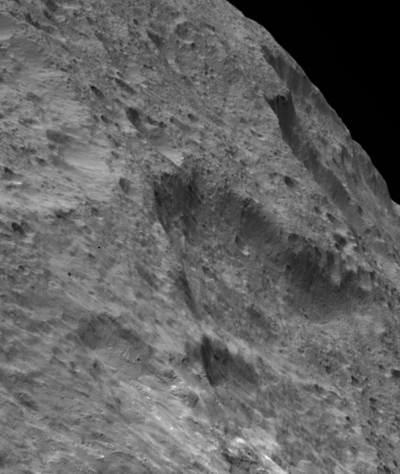
The Dawn science team have released their first images of the north and south poles of Ceres.

The region around the south pole appears black in this view because this area has been in shade ever since Dawn’s arrival on March 6, 2015, and is therefore not visible. At the north polar region, craters Jarovit, Ghanan and Asari are visible, as well as the mountain Ysolo Mons. Near the south pole, craters Attis and Zadeni can be seen.

Another company enters the orbital remote sensing field

The competition heats up: A California company, Hera Systems, has announced plans to launch 9 cubesats late in 2016 to provide commercial imagery of the Earth.

Hera Systems of San Jose, California, is planning to launch nine cubesat-class spacecraft in late 2016 that will be able to provide images at resolutions of up to one meter over several spectral bands, as well as video. That initial constellation could grow in time to up to 48 satellites, allowing the company to take images of the same location several times a day.

This field is becoming very crowded. Either there will be a significant shake-out, or we will see a burst of profits that will invigorate it even more. The companies all seem to think there is enough business to justify their existence.

Bezos gives museum recovered Saturn V engines

Jeff Bezos today personally delivered to the Seattle Musuem of Flight the restored remains of two Apollo Saturn V engines that his company recovered from the ocean floor in 2013.

Over the course of two and a half years, the experts at the museum worked to stabilize the F-1 engine parts, halting the corrosion caused by the salt water. The engines were not restored, however. Rather they were conserved in their “as found” condition to preserve their full history, from the sky to the sea.

In the process, the Cosmosphere was able to reveal and research the parts’ serial numbers and identify the flight history for most of the large parts. The conservators were able to tie the components to the Apollo 11 and Apollo 12 missions in 1969 and to Apollo 16 in 1972.

The Apollo 11 components will be donated to the Smithsonian National Air and Space Museum in Washington.

ULA is adding cubesat capability to its Atlas 5

The competition heats up: ULA has announced that they are adding a cubesat launch capability to their Atlas 5 rocket so that by 2017 they will be able to place in orbit as many as 24 cubesats per launch, as secondary payloads.

In addition, the company will offer universities to compete for six launch slots at no charge.

“ULA will offer universities the chance to compete for at least six CubeSat launch slots on two Atlas V missions, with a goal to eventually add university CubeSat slots to nearly every Atlas and Vulcan launch,” noted Tory Bruno, ULA president and CEO. “There is a growing need for universities to have access and availability to launch their CubeSats and this program will transform the way these universities get to space by making space more affordable and accessible.”

This offer is ULA’s way of trying to capture some of that growing smallsat market that companies like Rocket Labs and Virgin Galactic are trying to grab.

Japan’s Venus probe zeros in on Dec 7 arrival

A Japanese Venus research spacecraft, dubbed Akatsuki, has completed all its preliminary course corrections and is ready for a December 7 orbital insertion attempt, the second since the spacecraft’s main engine failed during the first attempt in 2010.

The space probe accomplished its last targeting maneuver Oct. 11 to aim for its Dec. 7 arrival at Venus, and all systems are go for the encounter, said Takeshi Imamura, Akatsuki’s project scientist at JAXA’s Institute of Space and Astronautical Science. Imamura said the Akatsuki spacecraft, named for the Japanese word for dawn, will zoom 541 kilometers, or 336 miles, above Venus for a 20-minute insertion burn using the probe’s secondary attitude control thrusters. Japanese ground controllers have programmed the probe to use the backup rocket jets after a faulty valve knocked out Akatsuki’s main engine during its first attempt to enter orbit around Venus in December 2010.

Four of the eight attitude control thrusters aboard Akatsuki will fire for 20 minutes and 33 seconds to slow the spacecraft down enough for Venus’ gravity to pull it into an egg-shaped orbit that skims above the planet’s cloud tops on the low end and ranges several hundred thousand miles in altitude at peak altitude. The reaction control thrusters, originally designed to help point the spacecraft, were not rated for such a hefty propulsive maneuver.

To make this second chance possible, they have spent the last five years improvising. First they dumped the fuel from the now-useless main engine to make the spacecraft lighter so that the attitude control thrusters could handle the maneuvers. Then they used those thrusters repeatedly to adjust the course to bring Akatsuki back to Venus after it zipped past in 2010.

If they succeed in getting it in a useful orbit on December 7, it will be real triumph for these Japanese engineers.

Vine to Wine

An evening pause: Making wine, the modern way. It is interesting how many steps here are still done by hand when they clearly could be automated. I suspect that it doesn’t pay for this winery to upgrade to more sophisticated equipment because their overall output is relatively small and it is more efficient for these steps to still be done by hand.

Hat tip Phill Oltmann, who tells me he is thinking of planting his own grape vines this year.

ULA concedes GPS competition to SpaceX

The competition cools down: ULA has decided against bidding on a military GPS launch contract, leaving the field clear for SpaceX.

ULA, which for the past decade has launched nearly every U.S. national security satellite, said Nov. 16 it did not submit a bid to launch a GPS 3 satellite for the Air Force in 2018 in part because it does not expect to have an Atlas 5 rocket available for the mission. ULA has been pushing for relief from legislation Congress passed roughly a year ago requiring the Air Force to phase out its use of the Russian-made RD-180 engine that powers ULA’s workhorse Atlas 5 rocket.

This decision might be a lobbying effort by ULA to force Congress to give them additional waivers on using the Atlas 5 engine. Or it could be that they realize that they wouldn’t be able to match SpaceX’s price, and decided it was pointless wasting time and money putting together a bid. Either way, the decision suggests that ULA is definitely challenged in its competition with SpaceX, and until it gets a new lower cost rocket that is not dependent on Russian engines, its ability to compete in the launch market will be seriously hampered.

Short circuit on ISS

An electrical failure on ISS has deprived ISS of one of its main circuits.

They have alternative wiring and are using that, so that all equipment is presently functioning. However, a similar failure in 2014 required a spacewalk to fix. Moreover, they don’t have the necessary spare parts on board to fix the problem. They will have to be shipped up, and it is too late to put them on the Cygnus freighter now packed and ready for launch on December 3.

Curiosity heads for the dunes

Bagnold Dunes

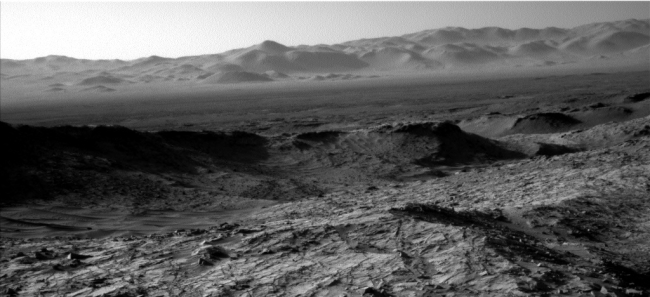
The Curiosity science team has decided to send the rover towards some large active dunes, visible in its journey ahead up Mt. Sharp.

On its way to higher layers of the mountain where it is investigating how Mars’ environment changed billions of years ago, NASA’s Curiosity Mars rover will take advantage of a chance to study some modern Martian activity at mobile sand dunes.

In the next few days, the rover will get its first close-up look at these dark dunes, called the “Bagnold Dunes,” which skirt the northwestern flank of Mount Sharp. No Mars rover has previously visited a sand dune, as opposed to smaller sand ripples or drifts. One dune Curiosity will investigate is as tall as a two-story building and as broad as a football field. The Bagnold Dunes are active: Images from orbit indicate some of them are migrating as much as about 3 feet (1 meter) per Earth year. No active dunes have been visited anywhere in the solar system besides Earth.

In the image on the right the target dune is in the center beyond the dark ridge line in the foreground. It looks kind of like a pointed mesa. the dark sandy area on the center right just below the dark ridge line in the center of the image. (Newer images released today gave me a more correct idea of the dunes as shown in this image.) Click here to see the full image. The rover is presently about 200 yards from the first dune, and should reach it in the next few days.

Enceladus rises over Dione

Enceladus rising behind Dione

Cool image time! The image on the right was taken by Cassini in September 2015, and shows two Saturn moons, bright Enceladus partly blocked by darker and nearer Dione.

Although Dione (near) and Enceladus (far) are composed of nearly the same materials, Enceladus has a considerably higher reflectivity than Dione. As a result, it appears brighter against the dark night sky.

The surface of Enceladus (313 miles or 504 kilometers across) endures a constant rain of ice grains from its south polar jets. As a result, its surface is more like fresh, bright, snow than Dione’s (698 miles or 1123 kilometers across) older, weathered surface. As clean, fresh surfaces are left exposed in space, they slowly gather dust and radiation damage and darken in a process known as “space weathering.”

The image doesn’t contain any earth-shattering discoveries. It is simply beautiful. And in these dark times, seeing beauty is sometimes the most important thing one can do.

Mysterious piece of space junk burns up over Indian Ocean

Though scientists have not yet identified it, the piece of space junk discovered last month in an unusual orbit with a predictable moment of decay has burned up over the Indian Ocean,

Estimated to measure 1–2 metres across, WT1190F had circled the Earth–Moon system since at least 2009, says independent astronomy-software developer Bill Gray, who has been working with NASA to track the debris. It most likely came off a recent lunar spacecraft, but it is not out of the question that it could have dated to the Apollo era.

In at least one case, scientists were able to image the object as it burned up. The data from this will allow them to determine its chemical composition, which in turn might help them identify it.

Next Blue Origin test flight before end of year

The competition heats up: Blue Origin not only intends to launch another test flight of its suborbital New Shepard rocket/capsule before the end of 2015, they hope to begin commercial unmanned flights by the second quarter of 2016.

Manned flights will follow, though they don’t say when. Based on this schedule, however, it appears that Blue Origin, which had hardly been on anyone’s radar for most of the last decade, is going to beat Virgin Galactic and XCOR in flying their first commercial flight.

Dubai to use jetpacks to fight fires

Buck Rogers lives! In order to better fight fires among its many high skyscrapers, Dubai officials have purchased 20 jetpacks for use by its firefighters.

Martin Jetpacks have been developed with first responder use in mind. They can be flown by a pilot or via remote control, take off and land vertically, operate in confined spaces (such as close to or between buildings or near trees) and carry commercial payloads of up to 120 kg (265 lb). This functionality means the Jetpacks can provide a variety of first response services. For example, they can be used for surveillance or observation (such as to determine the focus of a fire), transporting equipment to where it is required, rescuing individuals or deploying specialist teams.

Though it sounds cool, remotely controlled drones would make more sense for most of these tasks. The jetpacks might be useful for getting crews in and out of difficult high locations, as well as possibly rescuing trapped victims, but to make this practical will require significant training, something that I don’t see as realistic.

1 388 389 390 391 392 528