
Axiom’s fourth commercial passenger flight to ISS delayed another two days

NASA, Axiom, and SpaceX yesterday announced that the launch of Axiom’s fourth commercial passenger flight to ISS, dubbed Ax-4, has been delayed two days to June 10, 2025.

NASA, Axiom Space, and SpaceX are targeting no earlier than 8:22 a.m. EDT on Tuesday, June 10, for launch of the fourth private astronaut mission to the International Space Station, Axiom Mission 4. This shift allows teams to account for predicted inclement weather during the SpaceX Falcon 9 rocket and Dragon spacecraft transport in addition to completing final processing of the spacecraft ahead of launch.

The Dragon capsule for this mission is new, and there had been delays in getting it built. Though weather is likely the biggest reason for this delay, it also sounds as if SpaceX has needed just a little bit of extra time to finalize the capsule’s construction.

The mission will fly one Axiom astronaut plus three passengers, each a government astronaut from India, Poland, and Hungary. It will spend about a week docked at ISS.
0 comments

Third stage of India’s PSLV rocket fails during launch

India’s PSLV rocket today (May 18 in India) experienced a launch failure in attempting to place an Earth observation satellite into orbit, with the failure occurring during the engine firing of the rocket’s third stage.

The link is cued to just before the tracking screen began showing the third stage drop from its planned trajectory. The suddenness of the loss of data as well as the drop in the trajectory suggests the engine exploded during firing, but that is pure speculation. Regardless, the launch, only the second India has attempted in 2025, was a failure.

Moreover, the first launch this year was a failure also, though the GSLV rocket in that launch performed as expected and deployed the satellite in its planned transfer orbit. At that point however the Indian-built satellite’s thrusters failed to operate, stranding the satellite in the wrong orbit , which soon decayed. UPDATE: According to a more recent report, it has remained in orbit but provides little service.

Thus 2025, which ISRO had predicted to be India’s most active year ever, is so far not turning out so well. ISRO hopes to begin launching its first unmanned test flights of its Gaganyaan capsule later this year, using its Heavy Lift Vehicle Mark 3 rocket (HLV-M3), an upgraded version of its GSLV rocket. One wonders if these issues will impact that schedule.

These failures by the space agency could however help the Modi government shift the balance of power away from ISRO and to its emerging private rocket sector. If the agency can’t get it done, maybe the private sector should be given the chance to do it. For example, the government has been pushing to have the ownership and management of the PSLV rocket transferred from ISRO to a private rocket company since in 2016. In the nine year since, there however has been little sign of this shift happening.

Part of the problem has been that none of India’s private rocket startups are really ready to take over these operations. The transfer is further made less likely by the strong resistance to change within ISRO’s bureaucracy. These failures provide political ammunition to push back against that resistance.

1 comment

Europe and India sign agreement to work together on manned space flight

The European Space Agency (ESA) yesterday announced that it has signed an agreement with the Indian government that will lay the groundwork for them to work together on manned space exploration, first in connection with their future space station plans and later on lunar exploration.

ESA and ISRO declared their intent to work together on the interoperability of rendezvous and docking systems to allow their respective spacecraft to work together in low Earth orbit. They will also examine further activities related to astronaut training, analogue space missions – where teams test aspects of space missions in ground-based simulations – and parabolic flight activities.

…Future cooperation possibilities include ESA astronaut flight opportunities to the planned Bharatiya Antariksh Station (BAS) and early scientific utilisation, as well as developing infrastructure in low Earth orbit. The two space agencies are also discussing alignment on payloads and robotic scientific missions to the Moon.

Faced with the decommissioning of ISS in 2030, as well as the likely end to several major Artemis components (Orion and Lunar Gateway) that ESA has had a major part, it appears Europe has quickly begun looking for other alternatives. It already has partnered with the American consortium building the Starlab space station, but this new agreement with India gives it more options.

India meanwhile gets aid and support from Europe. It could even be that both are negotiating transferring some of Europe’s Lunar Gateway modules to India’s space station.

4 comments

SpaceX gets approval to sell Starlink in India

Almost immediately after India’s government issued this week new tightened regulations for allowing private satellite constellations to sell their services in India, it also apparently completed negotiations with SpaceX to allow it to sell Starlink in India based on these rules.

According to sources, the DoT [Department of Transportation] granted the LoI [Letter of Intent] after Starlink accepted 29 strict security conditions, including requirements for real-time terminal tracking, mandatory local data processing, legal interception capabilities, and localisation of at least 20% of its ground segment infrastructure within the first few years of operation.

Starlink’s nod came amid heightened national security sensitivities, coinciding with India’s pre-dawn Operation Sindoor strikes on terror camps across the border in response to the Pahalgam massacre. However, DoT officials clarified that the decision to approve Starlink was independent of these military developments.

At the moment SpaceX’s chief competitors, OneWeb and Amazon’s Kuiper constellation, have not yet obtained the same permissions. This allows SpaceX to grab a large portion of the market share in India before either of these other companies.

2 comments

India tightens its satellite regulations for foreign companies

In what is a likely response to the increased military conflict with Pakistan, India’s government has announced new satellite regulations for foreign companies that will likely impact the operations of both Starlink and OneWeb.

The country’s Department of Telecommunications (DoT) announced 29 additional regulations May 5, citing national security interests, which also apply to companies that already hold licenses for providing space-based communication services directly to users.

The rules include a requirement for call logs and other user data to be stored in India, and new obligations for interception and monitoring under national law. Satellite operators must also show how they plan to source at least 20% of their ground infrastructure equipment from India within five years of commercial launch.

The article at the link suggests that these new regulations will have a greater impact on OneWeb than Starlink. Yet, OneWeb already has approval to sell its services in India, while Starlink has not.

The article also included one interesting tidbit from a Starlink official, noting that the company expects to have 6.5 million subscribers by the end of this year. Based on the company’s subscriber fees, that translates into many billions in revenue. Very clearly SpaceX no longer needs NASA to develop Starship.

1 comment

Update on launch schedule for India’s manned space program

According to the head of India’s space agency ISRO, V Narayanan, the first unmanned Gaganyaan orbital mission is now targeting a launch in the last quarter of this year, followed by two more unmanned test flights in 2026 and the manned mission of one to three days flying in the first quarter of 2027.

This schedule appears more firm than any previously announced. When first proposed back in 2018, ISRO’s goal was to launch the first manned mission in 2022. And like all government projects, the launch date kept getting pushed back again and again. ISRO officials will blame the COVID panic for these delays, but that’s hogwash. While ISRO shut down for almost two years out of fear of a only slightly more potent illness than the flu, others did not, and ended up stealing almost all of ISRO’s commercial business as a result.

The delays in Gaganyaan also stem from the unrealistic goals first put forth by ISRO. For example, initially the program did not include these unmanned test flights, a lack that was foolish and later corrected.

Based on all reports in the past year, however, it appears that this newest schedule probably reflects reality, and will take place more or less as described.

1 comment

India’s Spadex mission completes second autonomous docking

According to one government official, India’s space agency ISRO has now successfully completed a second autonomous docking in orbit using the target and chase spacecraft of its Spadex mission, launched in December 2024.

Between the undocking on March 13 and the second docking operation, Isro had carried out a “rolling” or “rotating” experiment — in late March. … At the time, Narayanan [ISRO chairman], while confirming the success of the operation, had said that more experiments were in store. … “…The satellites have a lot of propellant… I have only told [the teams] one thing, please do everything [on] simulation on ground [first]. Let us be very careful. Let us not make any mistakes as a wealth of data can be generated [through various experiments].”

The rolling experiment, which was likened to the Chandrayaan-3 “hop” experiment the space agency conducted on Moon in terms of learning it provides for future missions, helped Isro validate multiple softwares, ground station control and more.

This second docking further confirms the technology and the ability of ISRO’s engineers to perform it. Originally the plan had been to do only one docking. The two spacecraft were to then undock and go their separate ways, doing other orbital research. Narayanan changed that plan, since this technology is essential for India’s planned space station. The focus is now on multiple test dockings, in a variety of configurations, with more to come.

0 comments

Two different states in India announce space policies

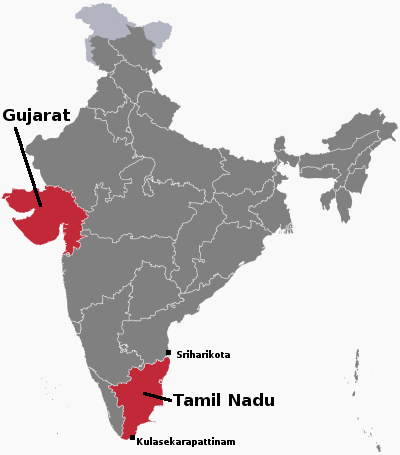
Map of India

Capitalism in space: In another indication that India’s governments are going full bore for private enterprise in space, two different Indian states this week announced new space policies designed to attract private investment and space startups.

Those two states, Tamil Nadu and Gujarat, are shown on the map to the right. Tamil Nadu announced its new space industrial policy hopes to attract more than a billion dollars in space companies to the state. Gujaret in turn announced its own space policy aimed at attracting $5 billion in investment and 25,000 jobs over the next five years.

It is not surprising that Tamil Nadu has issued this policy, considering that it is the state where India’s new second spaceport, Kulasekarapattinam, is located, and is being built as a launch site for commerical operations. Gujaret is at first glance less obvious, but it houses a major facility of India’s space agency ISRO. It is also one of India’s most industrialized states.

Both however illustrate the impact of the Modi government because of its policy to encourage private enterprise and de-emphasize government control. Not only is the federal government pushing capitalism, the country’s individual states are joining in.

4 comments

Indian satellite thruster manufacturer opens American factory

Capitalism in space: The Indian satellite company Bellatrix, which up-to-now has manufactured electrical attitude thrusters for satellites built by India’s space agency, has now opened a factory in Delaware in order to attract business from American satellite companies.

Bellatrix hired Chris MacDonald, a former business development director at rocket developer Astra and satellite provider Terran Orbital, to lead its recently created U.S. subsidiary, headquartered in Delaware. The manufacturing facility would support localized production, testing and delivery of propulsion systems to enable faster turnaround times and closer collaboration with U.S.-based customers, MacDonald said via email.

Founded in 2015, Bellatrix’s electric hall effect thruster has been used in a handful of missions for India’s space agency in recent years.

Bellatrix is not the only foreign space company to open offices in the U.S. for similar reasons. The Japanese startups Astroscale and Ispace have done the same, as well as several other companies listed in the article at the link. It appears the new American launch industry, which has significantly lowered the cost to orbit, is attracting orbital business from across the world.

3 comments

Indian engineers successfully undock its two Spadex robot satellites

After a delay of several months following the first autonomous robotic docking of its two-satellite Spadex mission, engineers from India’s space agency ISRO have now successfully undocked the chase satellite from its target satellite.

According to ISRO, the in-orbit performance of the docked satellites was extensively analysed, with a viable operational window identified from March 10 to March 25. Isro plans to conduct further experiments with the satellites in the coming days.

…Now that the undocking is complete, more docking attempts are expected to evaluate: How precisely ISRO can execute multiple docking maneuvers, how well the algorithms perform under various conditions, how the integrated inertial systems function and how the propulsion system performs during repeated operations.

These rendezvous and docking capabilities are essential for India to achieve its goal of building a manned space station and resupplying it on a regular basis.

0 comments

SpaceX inks Starlink deals with India’s two largest telecom operators

In a sign that suggests OneWeb is losing the competition to begin satellite internet access to India, SpaceX this week has signed two Starlink deals with India’s two largest telecom operators.

Jio Platforms, the subsidiary of India’s conglomerate Reliance Industries and the country’s largest telecom operator, Wednesday announced a partnership with Elon Musk’s SpaceX to offer Starlink’s satellite broadband internet services to its customers in India. Under the agreement, which is subject to regulatory approvals, Jio and SpaceX will explore using Starlink to extend the telco’s offerings, while Jio will sell Starlink equipment through its retail outlets and online storefronts, the telco said in a press statement.

…Earlier Wednesday, Airtel, India’s second-biggest telco, announced a similar partnership with SpaceX to offer Starlink through its channels. The Airtel partnership is also subject to SpaceX’s regulatory approvals in the country, which are in process with IN-SPACe and the Department of Telecommunications.

SpaceX had previously tried to bring Starlink to India by selling subscriptions directly to customers but was forced to pull back when the government denied it regulatory approval. These two deals suggest that the government wanted SpaceX to partner with Indian companies, keeping some of its profits in-country.

These deals also suggest that OneWeb is failing to provide good service to the Indian market, even though it is half owned by a major Indian investor and got regulatory approval several years ago. The design of OneWeb’s system requires the construction of ground stations to link its satellite constellation with the ground operations, and it appears this added step is causing delays that is forcing the telecom industry to look elsewhere. For example, the same thing has happened in the Falkland Islands, which signed first with OneWeb (which is also half owned by the UK government) but has now approved Starlink because OneWeb wasn’t able to provide its service on time.

4 comments

India’s Vikram lunar lander: Data suggests there could be more water impregnated in more places on the Moon

According to scientists analyzing the data sent back from India’s Vikram lunar lander, it appears that water could be impregnated in the upper lunar soil in more places than previously predicted.

You can read their paper here [pdf]. One instrument on the lander measured the temperature of the soil down about four inches, and found the temperature to be 25 degrees Celsius warmer than expected. That location was on a sunward-facing slope, so it was expected to be warmer but not by that amount. From the paper’s abstract:

This demonstrates that local topography at metre scales can alter temperature at high latitudes, unlike equatorial regions. Numerical model calculations using ChaSTE measurements, suggest that larger poleward facing slopes(>14°) at high latitudes can harbour water-ice, making them promising and technically less challenging sites for future lunar exploration and habitation.

In other words, slopes that get much less sunlight near the poles but are not permanently shadowed could still be cold enough only a few inches below the surface to harbor water molecules.

Sounds good, but I am beginning to sense a bit of blarney in these stories, over-pushing the possible existence of water to encourage more government space funding. It might be true that there is more water molecules in more places than predicted, but rarely do these reports say how much, which I expect will be very very little, in the parts per billion range. Nor do these stories ever consider the processing necessary to extract that water. Based on other data obtained from the Shadowcam instrument on South Korea’s Danuri lunar orbiter, it increasingly seems to me that any water found in polar regions of the Moon could be very slight, or even if in large amounts much more difficult to access than anyone ever mentions.

4 comments

India’s space agency ISRO begins construction of second spaceport

India's spaceports
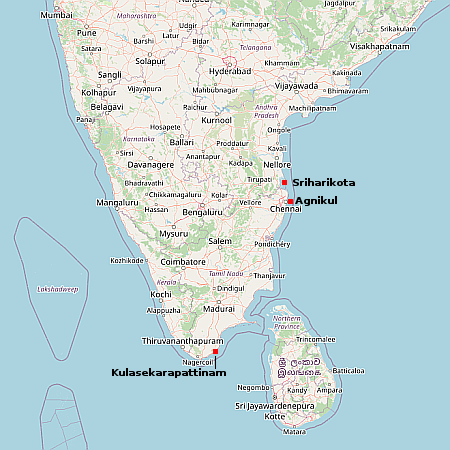
India’s spaceports

After several years getting the real estate as well as the necessary regulatory approvals, India’s space agency, Indian Space Research Organization (ISRO), has now begun construction of it second spaceport, dubbed Kulasekaranpattinam, near the southern tip of India.

The map to the right shows the location. The Sriharikota spaceport has been used by the agency for decades. The Agnikul site was used once by one of India’s rocket startups for a suborbital launch, but it is unclear if it will be upgraded to a full launch site in the future.

Kulasekarapattinam was one of the areas recommended for the launchpad even before the rocket launchpad was set up in Sriharikota due to its strategic geographical location near the equator. It is located on the east coast and there is no land to the south of it, allowing for direct southward launches over the Indian Ocean. This will minimize fuel consumption and maximize payload capacity for small satellite launch vehicles (SSLVs), particularly beneficial for cost-effective commercial satellite launches.

The site also avoids the need for complex “dogleg” manoeuvres around Sri Lanka. The manoeuvre involves a sharp turn or bend in a launch trajectory to avoid collisions or falling debris into populated areas, which would require additional fuel.

As part of the breaking ground ceremonies, ISRO scientists also completed a small suborbital rocket launch from this new site, reaching an altitude of 46 miles before falling back into the Indian Ocean.

0 comments

ISRO’s head touts private construction of PSLV rocket

In comments published in the Times of India today, the head of India’s space agency ISRO, V Narayanan, enthusiastically touted the fact that a private consortium is presently manufacturing its first PSLV rocket under a five-rocket contract.

Isro chairman V Narayanan revealed this in an exclusive interview to TOI and said the launch, scheduled for the third quarter of this year, will mark a milestone as the first PSLV manufactured by the private sector under a contract for five rockets. The vehicle is in “advanced stages of realisation” with Isro providing technical guidance to the industrial partners.

Sounds good, eh? Actually, this instead appears to be an attempt by ISRO to thwart the Modi government’s desire to transfer ownership of ISRO’s rockets, starting with the long established PSLV rocket, from ISRO to the private sector. This five-rocket deal, first signed in 2022, doesn’t transfer anything. All it does is have private companies build the rocket, something that ISRO has had private companies do for decades. The one difference is that ISRO is no longer listed as the prime contractor, and appears to be somewhat less involved in management.

Well, it is at least a start. Getting government bureaucracies to give up power can sometimes be a struggle that lasts years, unless you are Donald Trump arriving for a second term disgusted with that same struggle during his first term.

The launch, targeting the third quarter of this year, will place a collection of tecnology test payloads into orbit.

0 comments

ISRO considering doing more docking tests with Spadex satellites

India’s space agency ISRO has delayed the undocking of its two Spadex satellites as it considers a plan to do more docking tests.

The original plan was to have the chase satellite complete only one docking with the target vehicle, after which the two satellites would separate and spend the next two years doing different work. That plan is being reconsidered.

[Isro chairman V.] Narayanan said in Sriharikota that they have to think of the money involved in such projects and utilise it to the maximum. “Now we are in the process of reviewing when to do the undocking, the power connections and when to totally separate them again and dock again. All these processes are going on. We do not want to undock and leave it,” the Isro chairman said.

“We have loaded five kg of propellant on both the satellites. The propellant is needed for docking and undocking exercises. Currently we have 60 to 70 per cent of the propellant (as of January 29) remaining in the spacecraft. There are going to be a lot of experiments in the docking, undocking, power connection exercises and it is not a one time exercise,” he said.

Sources at ISRO also suggest there may be issues with the docking that still need analysis.

0 comments

Indian navigation satellite stranded in wrong orbit

Though the GSLV launch rocket worked as planned, putting India’s new navigation satellite in the proper transfer orbit on January 29, 2025, the satellite’s own engines have failed to fire.

Subsequent to the launch, the solar panels on board the satellite were successfully deployed and power generation is nominal. Communication with the ground station has been established. But the orbit raising operations towards positioning the satellite to the designated orbital slot could not be carried out as the valves for admitting the oxidizer to fire the thrusters for orbit raising did not open.

The satellite systems are healthy and the satellite is currently in elliptical orbit. Alternate mission strategies for utilising the satellite for navigation in an elliptical orbit is being worked out. [emphasis mine]

The highlighted sentence suggest India’s space agency ISRO has determined there is no way to raise the orbit to its proper height. With the solar panels deployed and the spacecraft’s orbit having low point that dips into the Earth’s atmosphere, the satellite’s orbit will likely decay relatively quickly. If so, the satellite’s mission will be a failure, not a good way to start what ISRO’s hopes to be its busiest year.

0 comments

Spadex’s unmanned docking faces possible two month delay

India’s Spadex mission, launched to test autonomous unmanned docking procedures necessary for many of that country’s future space plans, now faces a possible two month delay in orbit before the final docking can take place.

On January 11, 2025 the chase vehicle completed its closest proximity maneuver, getting within three meters of the target vehicle, after which it backed away as planned. ISRO engineers are presently analyzing the data before proceeding with the actual docking.

The problem is that this docking must occur by January 20, 2025. After that the lighting conditions will not allow another attempt until March.

It seems ISRO is not concerned about this situation, and would rather get things right, even if it means that delay.

0 comments

ISRO moving ahead with Spadex docking

India’s space agency ISRO has announced that it now moving ahead with the autonomous docking of its two Spadex spacecraft presently in orbit, but it will wait until after the docking to post when it had occurred.

With the Indian Space Research Organisation’s (Isro) SpaDeX space docking experiment missing two publicly announced schedules on January 7 and January 9, the space agency has decided to complete docking before making a public announcement.

Isro had earlier announced that the docking would be a public event but after two consecutive postponements, a senior Isro official said that the docking “is on track” but the space agency will now “dock and inform” the public about the exercise.

I suspect they realized the uncertainty of the real docking schedule made making the schedule public too difficult. This remains a test, and so many things can occur along the way to slow things down.

0 comments

India appoints a new leader for its space agency ISRO

After two-plus very successful years under the leadership of S. Somnath, the Indian government has now appointed a new chairman for its space agency ISRO, V. Narayanan.

Narayanan’s journey with ISRO began in 1984, and he has functioned in various capacities before becoming Director of the Liquid Propulsion Systems Centre (LPSC), which Narayanan heads, is engaged in the development of liquid, semi-cryogenic and cryogenic propulsion stages for launch vehicles, chemical and electric propulsion systems for satellites, control systems for launch vehicles, and transducers development for space systems health monitoring.

The term for this job in India is never more than three years, which explains this change at what seems a somewhat inappropriate moment, with ISRO gearing up to fly its first manned mission while preparing more missions to the Moon. It means that Narayanan will be in charge during that manned mission in 2026, should it fly on time.

0 comments
1 2 3 4 5 26