Japan and India successfully complete launches

Japan and India today completed launches of different rockets, one on its first successful test launch.

First, early this morning Japan’s new H3 rocket successfully reached orbit for the first time, on its second attempt. The first attempt had problems, first with a launch abort at T-0 when the solid-fueled strap-on boosters failed to ignite. On the launch attempt the upper stage failed. Today’s launch was a complete success, placing a dummy payload into orbit.

Japan’s space agency JAXA however needs to learn how to run a launch in a professional manner. Minutes prior to launch an announcer began a second-by-second countdown, and continued this for minutes after the launch. Not only was this unnecessary and annoying, it made the real updates impossible to hear. India used to do this in its first few live streams, but quickly recognized the stupidity of it. In addition, the person translating the updates clearly knew nothing about rocket launches, so her translations were tentative and often completely misunderstood what had just happened.

All of this makes JAXA look like a second rate organization, which might also help explain its numerous technical failures in recent years.

About twelve hours later, at mid-day in India, India’s space agency ISRO successfully launched its GSLV rocket, placing a commercial radar environmental satellite into orbit.

The leaders in the 2024 launch race:

15 SpaceX
8 China
2 Iran
2 Russia
2 Japan
2 India

American private enterprise still leads the entire world combined in successful launches 17 to 16, with SpaceX trailing the entire world combined (excluding American companies) 15 to 16.

6 comments

India deorbits a defunct satellite early, in a controlled manner

India’s space agency ISRO yesterday successfully deorbited its defunct Cartosat-2 satellite, using the satellite’s leftover fuel to bring it down in a controlled manner, about three decades sooner than its orbit would have decayed naturally.

The satellite was launched in 2007 to provide detailed ground images of India, and completed its mission in 2019. As noted in ISRO’S press release:

ISRO opted to lower its perigee using leftover fuel to comply with international guidelines on space debris mitigation. This involved reducing collision risks and ensuring safe end-of-life disposal, following recommendations from organizations like the United Nations Committee on the Peaceful Uses of Outer Space (UN-COPOUS) and the Inter-Agency Space Debris Coordination Committee (IADC).

While such actions are a good thing, that governments in India and Europe are suddenly making a big deal about it now — after almost 3/4s of a century of inaction — is not for those reasons, but to lay the political groundwork for allowing the international community, led by the UN, to impose new regulations on all space efforts, both government and private.

Be warned. They are the government, and they are here to help you.

0 comments

India’s proposed space station now has a name: Bharatiya Antariksh Station

Though no money has yet been allocated to build it, and India’s space agency ISRO has only begun design work, it has now apparently decided to name the space station the Bharatiya Antariksh Station.

They tentatively hope to launch a test module in 2028 to do unmanned rendezvous and docking tests, with assembly beginning in 2028 and completed by 2035.

None of this schedule is certain of course. ISRO has been proposing this space station since 2017. Nothing has ever come of those plans.

Only now does this seem more likely, with India’s effort to shift its space effort from a government-owned and run program to a competitive commercial industry.

3 comments

India to do 19 launches through March 2025

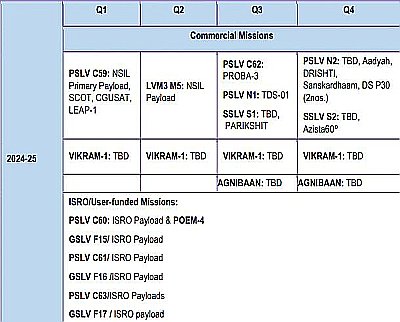
India's planned launches through March 2025

According to India’s space bureaucracy IN-SPACe, that nation has planned as many as 19 launches through March 2025.

The image to the right shows the manifest that IN-SPACe released. That agency is tasked with encouraging India’s private and independnt space industry, and it claims that 30 missions in total are planned, with half by commercial companies. This number however includes payloads and suborbital test missions, not just orbital launches. Based on the manifest to the right it appears that 19 of these missions are launches, with six being entirely private launches. One of those private launches, the first of Agnikul’s commercial Agnibaan rocket, will be suborbital.

It thus appears that in 2024 India hopes to complete 14 orbital launches. If so, this would double that nation’s previous record of seven launches in a single year. This schedule is very aspirational, with those six entirely commercial launches likely not all happening as planned.

0 comments

Japan and India team up for unmanned lunar lander mission

Japan and India are now partnering to put a lander/rover on the Moon in 2025, dubbed LUPEX.

Set tentatively for 2025, LUPEX will be launched on JAXA’s H3 launcher, with a 350-kg rover developed by the Japanese agency. ISRO is developing the lander. The instruments will be on the lander and the rover. Initial feasibility studies and the lander’s configuration have been completed. The rover will sample the soil with a driller and the samples will be analysed using equipment on the rover,

Unlike the previously successful lunar landers from both countries (India’s Chandrayaan-3 and Japan’s SLIM), LUPEX is being designed to survive the 14-day-long lunar night, with a mission that is aiming to last three to six months.

0 comments

Private company in India aims to build its own manned capsule and astronaut training facility

A private company in India, Astroborne Aerospace, is now developing its own commercial manned capsule as well as a commercial astronaut training facility, targeting as customers Earth-based tourists as well as those hoping to fly in space.

The capsule, dubbed Airawat, will seat six, and will be designed for suborbital flights, similar to Blue Origin’s New Shepard capsule. The training facility will be on a four-acre site the company is presently negotiating either a lease or purchase from the local government.

The company says it has obtained investment capital, but also says that money will arrive next month.

Whether this deal is real or not is actually irrelevant. Its existence illustrates the underlying enthusiasm in India for private commercial space, now that the Modi government has ended the monopoly on all space activities by its space agency ISRO.

1 comment

India and France sign deal to partner selling flights on their rockets

India and France have apparently signed a deal to not compete in selling flights on their biggest rockets, but instead work together to keep prices under their control.

Under the terms of the MoU [memorandum of understanding], NSIL’s [the commercial space division of India’s government] heavy-lift launch vehicle, LVM-3, and Arianespace’s Ariane-6 will be at the forefront of this joint endeavor.

The article at the link provides no information at all about the specifics of this deal. I am simply guessing that is it designed to control prices, especially because France by itself does not own the Ariane-6 and thus can not award launch contracts for it. All it can do is convince India to not charge less for its comparable LVM rocket (a variation of its GSLV rocket). If so, it is a bad deal for India, which can easily undercut any price that Arianespace can charge for the expensive Ariane-6. It will drive business from India, since other companies (such as SpaceX, ULA, and hopefully Blue Origin in the near future) will be under no obligation to match Ariane-6’s high cost.

It is also possible that the deal is simply an empty political gesture, timed during the visit to India by France’s President Emmanuel Macron. Its vague language suggests this. It gives Macron a photo op, but as an MOU it leaves India under no long term obligation.

1 comment

Indian satellite startup opens new satellite factory

Capitalism in space: The Indian satellite startup Pixxel has opened a new factory in Bengaluru in southern India, where it expects to ramp up satellite production in the coming years.

Bengaluru-based space data company Pixxel inaugurated its first spacecraft manufacturing facility in Bengaluru on Monday. The new facility holds significance as it targets to launch six satellites this year and 18 more by 2025, further advancing its mission of building a “health monitor” for the planet.
Spread across 30,000 square feet, the facility, at its full capacity, is equipped to handle more than 20 satellites simultaneously that can be turned around within a timeframe of six months, making possible a total of 40 large satellites per year.

The company says that its “…total customer base is divided into three divisions as of now – 40 per cent agriculture, 30 per cent resource companies, and 30 per cent government. Pixxel expects 85 per cent of the revenue to be generated from its commercial side and the rest from the government’s side by 2025.”

For India’s government and its space agency ISRO, Pixxel’s existence signals the sea-change in its policies, similar to what has been happening in the U.S. with NASA. In the past ISRO would have built the satellites. Now it is buying them from the private sector in India. That shift bodes well for India’s space industry, and will likely make it a major player in space in the coming years.

0 comments

India completes first launch of 2024

India’s space agency ISRO early today completed the first launch of 2024, its PSLV rocket placing an X-ray telescope into orbit along with ten payloads on its fourth stage, which is functioning as an orbital tug. Most appear [pdf] to be experiments that will remain on board, but one is an amateur radio smallsat that might be released.

As this is the only launch so far in 2024, India leads the race. It will certainly not remain the leader.

My annual global launch report for 2023 will be published tomorrow, after the holiday.

4 comments

NASA to fly Indian astronaut to ISS next year

During meetings in India between NASA and ISRO officials, instigated by administrator Bill Nelson’s visit this week, the mission details for the flight of an Indian astronaut to ISS in 2024 are now being worked out.

A Nasa delegation led by Nelson held a meeting with minister of state for science & technology Jitendra Singh on Tuesday. “I had a discussion with the minister on what the Indian astronaut would do on the space station. And the two of us talked about the fact that things that are important to India in scientific research, the Indian astronaut ought to have that as a choice to do. If there is a particular part of research that he or she would be interested in, then I want to encourage that,” Nelson later said at a media interaction. “Nasa will help train the Indian astronaut to fly to ISS by end of 2024. Those details are being worked out. Indian Space Research Organisation (Isro) will announce that,” Nelson said.

Though this plan for NASA to fly Indian astronaut to ISS next year was first announced in June, it was overshadowed by India’s decision at that time to sign the Artemis Accords.

It is also important to recognize that the real arrangements are all being done by others, that Nelson and the India government officials are merely there to get their faces on television.

If this flight happens as planned, next year could be very exciting for India’s manned space program, since it also hopes to fly its own manned mission at that time.

1 comment

Eutelsat-OneWeb gets license approval in India

Less than two weeks after SpaceX obtained regulatory approval to offer its Starlink system in India, Eutelsat-OneWeb (newly merged) has now gotten its own approval.

Eutelsat-OneWeb is half owned by an Indian investment firm, so it is no surprise it obtained this approval soon after SpaceX. The two companies will now be competing aggressively for business in this giant country, whose technological capabilities has been renewed in recent years by the abandonment of a socialist/communist government for a leadership focused on encouraging freedom, capitalism, and competition.

0 comments

India now plans robotic lunar sample return mission

Following the successful landing of Vikram on the Moon, officials of India’s space agency ISRO have announced it is considering a much more ambitious follow-up, Chandrayaan-4, that will not only land on the lunar surface with a much larger rover, it will also dig up some samples and return them to Earth.

The spacecraft will travel to the moon, land, collect samples, and then connect to another module in space. The module will then return to Earth orbit. As the two modules approach Earth, they will separate, with one part returning to Earth and the other will keep orbiting the planet. Desai described the mission as ambitious, stating, “Hopefully, in the next five to seven years, we will meet the challenge of bringing samples from the moon.”

For return to Earth, Desai said that the mission would need two launch vehicles containing four modules (Transfer module, Lander Module, Ascender Module and Re-entry module). RM and TM would be Parked in the lunar orbit and two will go down from which Ascender Module will get separated from lander module and would collect the sample.

If India does this mission, while also completing its first manned mission during that time frame, it will place itself in direct competition with China and the U.S., and in fact will be getting close to matching both in capabilities.

1 comment

November 16, 2023 Quick space links

Courtesy of BtB’s stringer Jay, who notes it has been “a slow news day. I guess everyone is waiting to see SpaceX launch.” For me this has been good, as the day has mostly been tied up with doctors (nothing serious).


1 comment

India releases on-board camera views during its Gaganyaan launch abort test

India’s space agency ISRO today released the on-board camera views taken during its Gaganyaan launch abort test on October 21, 2023.

The test was a complete success, and the footage shows each step clearly, from launch to stage separation to deployment of parachutes.

ISRO is still targeting 2024 for the first manned Gaganyaan mission, which will carry two to three astronauts into orbit for three to seven days. To meet that target however will require a lot of fast work, as the agency intends to fly three separate unmanned orbital missions of the Gaganyaan capsule prior to putting humans in it. More likely the manned mission will happen in 2025.

1 comment

Gaganyaan abort test flight flies successfully after short delay

When I went to bed last night India’s Gaganyaan abort test flight had been cancelled due to a launch abort at T-0, with the live stream ending and an expectation that engineers would need at least another day to fly.

When I woke up it turned out that ISRO behaved more like SpaceX than a government agency. It quickly figured out what was wrong, recycled the countdown, and two hours later successfully flew the test of its launch abort rescue system for its manned Gaganyaan capsule.

Indian Space Research Organisation (ISRO) successfully executed the Test Flight Abort Mission, for the Gaganyaan mission on Saturday after the first test flight was aborted at 8:45 am due to a problem in the engine ignition. ISRO Chief S Somanth said the planned lift off the TV-D1 rocket could not happen following an anomaly that will be analysed. He said that the engine ignition of the TV-D1 rocket did not happen over time.

The space agency then said that the errors have been identified and corrected and the second launch was scheduled for 10:00 Hrs today.

And at 10 am, ISRO successfully launched the test vehicle from Sriharikota today. Chairman Somanath expressed happiness and said, “I am very happy to announce the successful accomplishment of Gaganyaan TV-D1 mission”.

The test rocket launched, the abort system separated from the rocket as planned, the capsule was released from the abort system, its parachutes then opened, and the capsule then safely splashed down in the Bay of Bengal about ten miles off the coast, where it was recovered successfully.

ISRO plans a second launch abort test prior to flying the actual manned mission, but at this moment it appears very close to being ready for a manned mission in 2024, its present goal.

2 comments

India’s Gaganyaan launch abort test aborts at T-0

India’s attempt today to test the launch abort system to be used to safely propel its manned Gaganyaan capsule away from a failing rocket aborted at T-0.

They need to take the spacecraft back to the assembly building in order to figure out what went wrong, so the next attempt will likely be delayed at mininum several weeks. UPDATE: That’s what the head of ISRO said at the end of this live stream, but that is not what happened. See new post above.

2 comments

India rocket startup Agnikul raises $26.7 million in new private investment capital

The new colonial movement: The Indian rocket startup Agnikul has now raised an additional $26.7 million in private investment capital, bringing its total cash on hand now to about $40 million.

The company hopes to complete the first suborbital launch of its Vikram-S rocket in mid-November. If successful, it will be the second private rocket startup in India to do it, joining Skyroot, which did its first suborbital test flight last year. Both companies plan orbital versions of these rockets, and are also likely bidding to take over the SSLV (Small Satellite Launch Vehicle) rocket from India’s space agency ISRO. The Modi government is offering to literally give it to a private company to operate for profit.

0 comments

India schedules Gaganyaan launch abort test for October 21st

India’s space agency ISRO has now scheduled the first unmanned launch abort test of its Gaganyaan manned capsule for October 21, 2023.

The test Crew Module (CM), according to the statement, will be akin to the pressurized module that’ll hold crew members during their ascent to space — this version, however, will be unpressurized. It will be launched via a single-stage liquid rocket specifically developed for this mission that will simulate an abort scenario; the true CM, by contrast, will ride atop a 143-foot-tall (43.5-meter) Launch Vehicle Mark-3 (LVM3) rocket with a solid stage, liquid stage and cryogenic stage. The latter recently received human safety certifications, R. Hutton, project director of the Gaganyaan mission, said during a conference last month.

At present ISRO is targeting 2024 for the first manned mission, but that target date remains very uncertain.

2 comments

India’s government confirms its policy to transition to private enterprise in space

Capitalism in space: In a presentation at the International Astronautical Congress in Baku yesterday, one high official from India confirmed the Modi’s government’s new policy to shift is space industry from government-controlled to privately-run.

“A transition is happening in India. We are moving from ISRO [India’s space agency] being the sole player in the space sector to the private sector taking on a more meaningful role,” Pawan Goenka, chairman of the Indian National Space Promotion Authorization Center (IN-SPACe), said at a forum at the 74th International Astronautical Congress in Baku, Oct. 5.

The Indian government approved the Indian Space Policy 2023 in April this year, which follows a number of developments in recent years. “What the Indian Space Policy did was take everything to do with space — satellite communication, remote sensing, space operations, transportation, navigation, everything — and put it into one comprehensive document only 12 pages long,” Goenka said. [emphasis mine]

The highlighted words will sound very familiar to regular readers of this webpage. It describes what NASA has been doing for the past decade, and sums up precisely the recommendations put forth in my 2017 policy paper, Capitalism in Space.

IN-SPACe, the agency Goenka heads, has been tasked with fulfilling this task, and is thus in a direct turf war with ISRO, the space agency that has controlled all of India’s space effort for a half century. How that turf war will play out remains uncertain, though at present IN-SPACe and the Modi government appear to be winning.

It would likely help India’s private industry if the Modi government would make public that 12-page policy statement. So far it has either not released the text, or if it has it has made it impossible for me to find it.

2 comments

India successfully tests upgraded upper stage engine for manned mission

India’s space agency ISRO has now successfully completed full power static fire engine tests of a more power version of the upper stage engine used by the most powerful version of its GSLV rocket, the LVM3, thus preparing it to launch that nation’s first manned mission, dubbed Gaganyaan.

On September 22, 2023, this test was conducted at the state-of-the-art test facility located at IPRC, Mahendragiri. During this test, the CE20 engine operated at the coveted 22-tonne thrust level for a duration of 670 seconds. Both the engine and the testing facility performed flawlessly, meeting all the performance parameters.

ISRO is still targeting 2024 for the first manned mission, but that target remains somewhat uncertain, though less so as one-by-one the agency completes these performance tests successfully.

1 comment
1 3 4 5 6 7 26