India launches AST SpaceMobile’s sixth Bluebird satellite

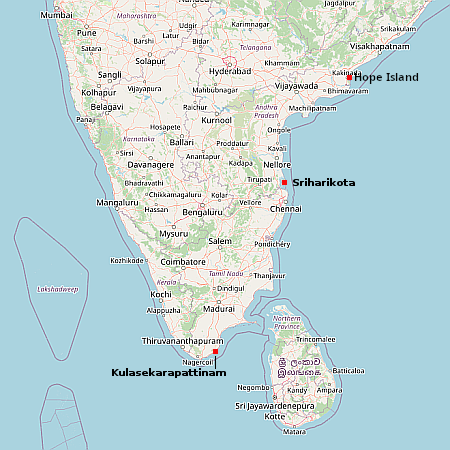
India’s space agency ISRO today (December 24 in India) successfully launched AST SpaceMobile’s sixth Bluebird satellite into orbit, its Bahubali rocket (LVM3) lifting off from its Sriharikota spaceport on India’s eastern coast.

This Bluebird is an upgrade from the first five satellites, providing ten times the bandwidth. The constellation acts as satellite cell towers for smart phones. These Bluebird satellites have been the largest in size ever launched, and this satellite will break their previous records. It is also the heaviest satellite India’s Bahubali rocket has ever put in orbit, on its sixth launch.

For India, this is its fourth launch in 2025. The leaders in the 2025 launch race:

168 SpaceX
86 China
18 Rocket Lab
15 Russia

SpaceX still leads the rest of the world in successful launches, 168 to 144.

2 comments

More delays expected in India’s first manned Gaganyaan orbital mission

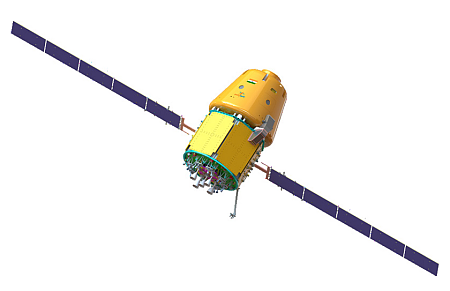
Artist rendering of India's Gaganyaan capsule
Artist rendering of India’s Gaganyaan capsule

It appears that India’s space agency ISRO is now hinting that the first manned orbital flight of India’s Gaganyaan capsule will not occur in 2027 as planned, but could be delayed until 2028.

ISRO had hoped to fly the first unmanned orbital test flight, Gaganyaan G1, before the end of this year, followed by several more unmanned flights in 2026, with the manned flight in 2027. G1 however has slipped to early 2026, though it appears the mission is finally coming together.

In a response to a question posed at the Lok Sabha, the State Minister for Space, Jitendra Singh noted that the first Gaganyaan mission is nearly ready to fly, “Major infrastructure such as the Orbital Module Preparation Facility, Gaganyaan Control Centre, Crew training facility have been established. Second launch pad modifications have been incorporated. Precursor missions such as TV-D1 and IADT-01 have been successfully accomplished. Ground tracking networks, terrestrial links and IDRSS-1 feeder stations have been established. Crew Module Recovery plan as well as assets to be deployed have been finalized. For the first uncrewed mission (G1), all HLVM3 stages and CES motors are ready. Crew and Service Module systems have been realized. Assembly and integration activities are nearing completion.”

…The Gaganyaan G1 flight is the first of eight planned missions as part of an expanded programme cleared by the Union Cabinet last year with a total budget of Rs 20,193 crore. Initially, the programme was envisioned with two developmental flights followed by a crewed flight, with a budget of Rs 9,023 crore. There are now two crewed flights in the revised campaign, with ISRO aiming for the first crewed flight in 2027-28. [emphasis mine]

The highlighted dates are the first time ISRO has suggested the first manned flight might slip to 2028.

When the Gaganyaan program was first announced in 2018, the first manned flight was scheduled for 2022. Since then that schedule has been repeatedly delayed. I suspect ISRO’s schedule will only become more reliable after it finally completes that first G1 orbital test flight.

The endless incremental delays however are reminiscent of NASA’s Artemis program, designed to hide a sluggish program with problems.

2 comments

Russia and India agree to orbit their space stations in the same inclination, the same as ISS

India's Bharatiya Antariksh Station as outlined in 2024
India’s Bharatiya Antariksh Station as outlined in 2024.
Click for original image.

According to statements made by Roscosmos head Dmitry Bakanov at a conference in New Delhi this week, Russia and India have agreed to orbit their planned new space stations in the same inclination as ISS, 51.6 degrees, and coordinate their operations at both stations.

By choosing the same orbital geometry for ROS [Russian Orbital Station] and BAS [Bharatiya Antariksh Station], Moscow and New Delhi are effectively planning a continuous “replacement belt” in low Earth orbit. After the ISS is retired, crewed spacecraft launched from Russia and India would still be able to reach a major laboratory complex without radically changing launch trajectories or infrastructure, and—crucially—could, in principle, travel between the two stations with relatively modest maneuvers compared with a full plane-change.

Bakanov’s New Delhi comments build on a broader Roscosmos–ISRO understanding that the two stations should be able to support cross-visits, resource sharing and coordinated operations once both are flying.

This high inclination is required because spacecraft launching from Russia’s high latitudes can’t reach lower inclinations practically. India could put its station at a lower inclination (being at a lower latitude), but if this story is true, it apparently has decided there are advantages using an orbit that will allow cross-missions with Russia, including launches from Russia.

India plans to launch the first module of its station in 2028, and have the entire station operational by 2035. Russia says it will launch is station’s first module by 2027, with full operations beginning by 2030. While both schedules are likely to see delays, we should expect India to get its station built, while Russia will likely struggle to launch even one module.

In fact, I suspect this deal is Russia’s effort to find some partner that can carry it in the future, when its own station gets delayed.
» Read more

4 comments

India tests new and better restart method for upper stage of its biggest rocket

India’s space agency ISRO has successfully tested new restart method for the engine it uses on the upper stage of its LVM rocket, its biggest rocket that it also intends to use for its manned and interplanetary missions.

For future missions, multiple in-flight restarts of the CE20 engine will be required for mission flexibility towards multi-orbit missions. However, with the present configuration, each restart demands an additional start-up gas bottle and associated systems, leading to a reduction in vehicle payload capability. Hence, achieving boot-strap mode start – where the engine builds up to steady operation without external start-up assistance – is essential.

In this regard, a boot-strap mode start test on the CE20 Cryogenic engine was successfully conducted under vacuum conditions in the High-Altitude Test (HAT) facility at ISRO Propulsion Complex, Mahendragiri on 7th November 2025, for a duration of 10 seconds. A multi-element igniter was employed in both the thrust chamber and gas generator to facilitate boot-strap starting. In this test, following the ignition of the thrust chamber, the gas generator was ignited under tank head conditions, and the turbopumps were started without the use of the start-up system. Subsequently, boot-strap mode build-up and steady-state operation of the engine were successfully demonstrated.

In other words, the engine now be restarted numerous times, giving any payload attached much greater flexibility in positioning and orbital maneuvers. For manned missions this means it can be used to reposition the modules for India’s planned space station, maneuver its manned capsule Gaganyaan, and send interplanetary missions to the Moon and beyond.

0 comments

The orbital propulsion module for India’s Chandrayaan-3 lunar lander drifts back into lunar orbit

When India’s Chandrayaan-3 spacecraft arrived in lunar orbit in August 2023, it separated into three units, the lander, a lunar orbiter, and a propulsion unit used to get everything to the Moon.

While the Vikram lander successfully touched down several hundred miles from the Moon’s south pole and the Chandrayaan-3 orbiter continues to make observations of the Moon, in October 2023 engineers had the propulsion module do a burn that sent it out of lunar orbit and into an Earth orbit that was close to one of the Lagrange points where the gravity of the Earth and Moon are balanced.

Now, three years later, that module has drifted back into lunar orbit, where it has since done two close fly-bys of the surface.

This intricate orbital dance culminated when the module once again entered the Moon’s SOI [sphere of influence] on November 4, 2025, an event marking the transition where lunar gravity dominates its motion.

The first recorded lunar flyby occurred on November 6, 2025, at a distance of 3,740 km from the lunar surface, though it was outside the Indian Deep Space Network’s (IDSN) visibility range. A second, closely monitored flyby took place on November 11, 2025, bringing the module within 4,537 km of the Moon and well within observation capabilities.

These events noticeably altered the satellite’s orbital parameters, expanding its orbit size from 100,000 x 300,000 km to a massive 409,000 x 727,000 km and shifting its inclination from 34° to 22°.

It is not clear what happens next. Having this module in lunar orbit could be an issue for present and later orbiters, as no orbit around the Moon can ever be stable. At some point India’s space agency ISRO needs to properly dispose of this unit, either by sending into the Moon or out of the Moon-Earth system entirely. I am of course assuming it has the fuel to do so.

2 comments

India tests Gaganyaan parachutes again

Artist rendering of India's Gaganyaan capsule
Artist rendering of India’s Gaganyaan capsule

India’s space agency ISRO on November 3, 2025 successfully completed another drop test of the parachutes it will use on its Gaganyaan manned orbital capsule, this time testing the chutes in extreme conditions.

Explaining the November 3 test, the Isro statement said the GCM parachute system comprises 10 parachutes of four types. “The descent sequence begins with two apex cover separation parachutes that remove the protective cover of the parachute compartment, followed by two drogue parachutes that stabilize and decelerate the module. Upon release of the drogues, three pilot parachutes are deployed to extract three main parachutes, which further slow down the Crew Module to ensure a safe touchdown,” said Isro. “The system is designed with redundancy—two of the three main parachutes are sufficient to achieve a safe landing.”

Using a pyro device, the main parachutes open partially, a process known as reefing, and then open fully after a predetermined period of time, referred to as disreefing. This step-by-step process is known as reefed inflation. An important aspect of the test was the successful validation of the main parachutes under possible extreme scenarios of delay in the disreefing between the two main parachutes.

The August drop tests were from a helicopter at about 3 kilometers. The November drop tests took place from an airplane at about 2.5 kilometers.

The agency has indicated the first unmanned orbital test flight of Gaganyaan has been delayed from this year to early next, possibly as early as January. It plans to do at least three unmanned flights in 2026 before putting humans on board in early 2027.

0 comments

Ispace signs deals with companies in India and Japan

The Japanese lunar lander startup Ispace today announced it has signed partnership deals with two different companies, OrbitAid in India and Toyota in Japan.

The startup OrbitAid is India’s first “on-orbit refueling company”. It will provide Ispace’s landers with standardized docking ports as well as refueling capabilities.

The two companies aim to demonstrate the critical capabilities required for mission extension in the cislunar environment, enabling long-duration lunar operations and paving the way for a sustainable lunar economy. The integration of OrbitAID’s SIDRP interface is expected to not only optimize refueling, recharging, and data transmission capabilities but also support ispace’s efforts to enhance the performance and reliability of its landers. By enabling lunar refueling, both companies plan to facilitate deep-space exploration beyond Earth’s orbit.

Toyota meanwhile will provide technical support to Ispace as it develops its own second generation lunar rover, dubbed Lunar Cruiser. Ispace is already prepping a smaller rover that will fly on its next lunar landing mission.

Ispace has been signing on a range of customers and commercial partners in recent months, even though its only two attempts to land on the Moon both failed just before touch down. It has contracts with NASA, ESA, and JAXA for future missions. These new deals appear designed to strengthen and extend its capabilities beyond simply landing on the Moon, but also to provide interplanetary spacecraft as well.

0 comments

Indian rocket startup Skyroot hires Exolaunch to handle satellite integration and deployment

The Indian rocket startup Skyroot yesterday signed a partnership agreement with the company Exolaunch to handle the integration and deployment of satellites once its Vikram smallsat rocket begins launching.

Through this agreement, Exolaunch will integrate and deploy customer satellites on Skyroot’s Vikram series of launch vehicles, beginning with the Vikram-1 orbital missions. Exolaunch will provide its flight-proven deployment technologies for Skyroot customers across dedicated and rideshare launches. The partnership also includes the use of Exolaunch’s EXOtube payload stacks, designed to optimize multi-payload rideshare configurations, streamline constellation launches, increase mission flexibility, and enhance vehicle utilization.

While Skyroot has not yet launched, Exolaunch is very well established, having “a decade of flight heritage and 582 satellites launched across 39 missions to date.” Since Skyroot has no experience yet in these matters, having Exolaunch do it makes satellite companies more likely to buy space on its rocket.

Until recently Skyroot had been targeting a first launch before the end of this year. That schedule has now changed. According to the company’s webpage, that first launch is now scheduled sometime in 2026.

0 comments

India’s government finalizes deal to transfer operation of its SSLV rocket to a private company

India’s government and its various space agencies yesterday finalized its deal with the Indian company Hindustan Aeronautics Limited (HAL) to take over the manufacture and operation of its government-designed SSLV rocket (Small Satellite Launch Vehicle) for the next decade.

Under the technology transfer contract that HAL signed with ISRO, Indian National Space Promotion and Authorisation Centre (IN-SPACe) and NewSpace India Limited (NSIL), the aviation major will absorb the technology in the first two years, which will be followed by a 10-year production phase. The agreement grants HAL a non-exclusive, non-transferable license to the SSLV technology, which includes comprehensive design, manufacturing, quality control, integration, launch operations, and post-flight analysis documentation, as well as training and support. HAL will be responsible for the mass production of SSLV to meet Indian and global demands,” the company says in a statement.

Initially the Modi government had implied the transfer would involve ownership of the rocket by the private company, so that it could market the rocket for profit. The actual deal does not do this. Instead, it gives HAL the responsibility to manufacture and operate the rocket, but it appears sales and ownership will still be under the control of India’s space agency ISRO. If this is correct, the deal accomplishes less than nothing, and in fact simply adds another player in the game, making the SSLV rocket less competitive in the international market.

Then again, the Modi government might see this deal as just a first step in the transition from a government-run space program to a competitive independent space industry. It needs to wrest control from ISRO, and this can’t be done politically in one fell swoop.

To me however this deal for HAL is a bad one. It now has the responsibility for making and launching the rocket, but none of the benefits.

1 comment

India now targeting December for first unmanned test flight of Gaganyaan

Artist rendering of India's Gaganyaan capsule
Artist rendering of India’s Gaganyaan capsule

According to the head of India’s space agency ISRO, it is now targeting December 2025 for first unmanned test flight of its Gaganyaan manned capsule.

That flight will put the capsule into orbit for several days carrying a humanoid robot dubbed Vyomitra, designed to simulate what a human would experience in the capsule in space. It will be the first of three similar unmanned orbital test flights, leading up to a planned manned orbital mission in 2027.

Though this program has experienced numerous delays and program changes since it was first proposed in 2006, all the pieces have begun to fall into place in the past four years. It now appears that the above schedule is very solid. As long as there are no major test failures, India could launch its first astronauts by 2027.

0 comments

Indian rocket startup Skyroot tests solid-fueled motor

The Indian rocket startup Skyroot has successfully tested the solid-fueled motor it plans to use in its three-stage solid-fueled Vikram-1 rocket. From the press release issued by India’s space agency ISRO:

First Static Test of the KALAM 1200 Motor – the first stage of Vikram – 1 Launch Vehicle of M/s Skyroot Aerospace Pvt. Ltd. (SAPL), Hyderabad is accomplished successfully at Static Test complex of Satish Dhawan Space Centre, Sriharikota, ISRO, Department of Space at 09:05 hrs on 08.08.2025. This is a major milestone in the configuration and realization of the systems for Vikram – 1 Launch Vehicle. The motor is a 11 m long, 1.7 m dia monolithic composite motor with a Propellant Mass of 30t. Based on the design inputs, this longest monolithic motor is prepared at the Solid Propellant Plant, Sriharikota. Similarly, ISRO team has provided the design for the Test Stand, which is used for the static test of the motor.

This is in line with the Government of India initiative on Space Policy, 2023 for providing the necessary technical infrastructure and managerial guidance for the Private Sector players to contribute for the space economic growth. The performance of the test bed and the associated systems is normal as predicted.

The last paragraph is the most important. The Modi government has tasked its space agency to provide its facilities and expertise to help rocket startups like Skyroot. It appears from this test and press release the resistance within ISRO to this policy — which cuts into ISRO’s turf — is fading.

Skyroot had said it wants to do the first orbital test flight of Vikram-1 before the end of 2025. It remains unclear whether it will meet that schedule.

Hat tip BtB’s stringer Jay.

2 comments

India’s Chandrayaan-2 lunar orbiter photographs Intuitive Machines’ Athena lander

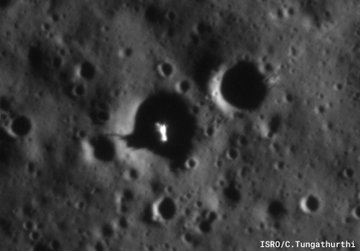
Athena as seen by Chandrayaan-2
Click for source.

India’s Chandrayaan-2 lunar orbiter has now produced a new high resolution image of Intuitive Machines’ Athena lander, sitting on its side inside a small crater near the Moon’s south pole.

The IM-2 ‘Athena’ lander attempted a soft touchdown near the Moon’s South Pole on 6 March, 2025. Although the lander remained intact, it failed to reach its intended landing spot and ended up tipping over on its side inside a crater.

In the … images taken by the OHRC instrument on board the Chandrayaan-2 Orbiter, the Athena lander can be clearly seen lying on its side inside a crater.

This image, posted to the right, compares very favorably with the photos taken by Lunar Reconnaissance Orbiter (LRO) in March 2025. The lander’s legs can clearly be seen sticking out toward the top of the picture.

Hat tip BtB’s stringer Jay.

1 comment

India and China complete launches

Two more launches today. First, India’s space agency ISRO successfully placed a joint NASA-ISRO radar satellite into orbit, its GSLV rocket lifting off from its Sriharikota spaceport on the eastern coast of India.

This was India’s first fully successful launch in 2025. On the first launch in January, the GSLV rocket performed as planned, but the satellite’s own engines failed to put it into the right orbit. Then in May the third stage of its PSLV rocket failed during launch.

Next China placed the sixth group of nine satellites for one of its mega-constellations designed to compete with Starlink, its Long March 8A rocket lifting off from its Wenchang coastal spaceport.

The leaders in the 2025 launch race:

94 SpaceX
40 China
10 Rocket Lab
9 Russia

SpaceX still leads the rest of the world in successful launches, 94 to 70.

0 comments

Axiom’s ticket price for India’s astronaut on Ax-4 mission: $59 million

According to reports today in the India press, the price Axiom charged India’s space agency ISRO for training and then flying its astronaut on the just completed Ax-4 two-week mission to ISS was $59 million.

The expenditure by ISRO includes cost of [Shubhanshu] Shukla’s training for the mission as well as that of a seat on SpaceX’s Dragon spacecraft for the 20-day trip that launched Shukla, and three others — Peggy Whitson from the US, Slawosz Uznanski-Wisniewski of Poland and Tibor Kapu of Hungary — to space.

Earlier reports had suggested Axiom was charging $70 million per ticket. If the $59 million is accurate and applies to the charges Poland and Hungary paid, then Axiom’s revenue for the flight was $177 million. From that it would have to pay SpaceX (for the launch and the use of its Grace capsule) and NASA (for the use of ISS). Based on past history, SpaceX likely charged around $70 million for the launch. The cost for using Grace is unknown. NASA’s fees for a two-week visit to ISS were probably around $10 million plus.

My guess, based on this very limited information, is that Axiom made some profit from the flight, ranging from $20 to $50 million.

1 comment

Third Indian state announces a space policy to encourage private enterprise

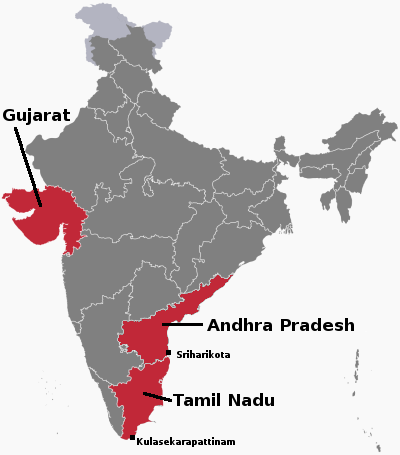
India map

A third state in India, Andhra Pradesh, has now released its own space policy, designed to create what it calls “manufacturing clusters”, centered around India’s main spaceport at Sriharikota.

The A.P. Space Policy (4.0) 2025-30 is valid for five years from the date of issue (July 13, 2025), or till a new policy is announced. A technical committee will be constituted under the Commissioner of Industries to vet and process applications for land allotment in the Space Cities proposed to be developed along the Hyderabad-Bengaluru Industrial Corridor in Sri Sathya Sai district and in Tirupati (Routhasuramala).

The government will form an SPV, ‘AP Space City Corporation’, which will drive all initiatives related to the development of the above Space Cities, and serve as the central agency to coordinate infrastructure development, raise start-up funds, attract investments, facilitate industry partnerships, build partnerships to attract global demand, and liaise with all GoI [Government of India] entities for tapping the domestic demand.

The previous two state space policies in Tamil Nadu and Gujarat, announced in April, had similar goals aimed at promoting the establishment of private aerospace companies within their regions.

Whether Andhra Pradesh’s policy will work carries uncertainties. Its advantage is that it is linked to India’s primary spaceport. Its disadvantage lies in the complex bureaucracy the state is creating in conjunction with these “Space Cities.” Such bureaucracies are rarely helpful for new businesses.

0 comments

SpaceX finally passes final regulatory hurdle to sell Starlink in India

You might get deja-vu from this story, since I have reported repeatedly in the past that SpaceX has finally gotten regulatory approval to sell Starlink in India.

However, India’s complex regulatory framework — leftover from the days of British rule and strengthened for decades after independence when the strongly socialist Congress Party ruled — ended up requiring SpaceX to leap multiple regulatory hurdles to get the Starlink approved. According to news reports today, that last licensing hurdle has now finally been leaped.

The final approval marks a crucial milestone that will pave the way for the Musk-led company to launch its commercial satellite operations in the country. The Elon Musk-led company has been waiting for regulatory approvals since 2022 to operate legally in India. With this approval, Starlink has become the third company to enter the satellite space in India after Reliance Jio and Eutelsat’s OneWeb, in which Bharti Airtel, led by Sunil Mittal, is a shareholder.

Does this mean SpaceX can now sell Starlink in India? Of course not:

The next step for Starlink is to secure spectrum from the government, which will likely be assigned in the coming months. It also needs to set up infrastructure on the ground. One of the most critical aspects of Starlink’s India foray will be its compliance with the country’s security rules.

Since Starlink doesn’t need a complex ground infrastructure, selling terminals directly to customers, the infrastructure mentioned in the quote likely involves partnering Starlink operations with the Indian telecommunications companies Airtell and Jio, so that they get a piece of the action.

0 comments

ISRO successfully tests thrusters to be used on its manned Gaganyaan capsule

India’s space agency ISRO last week successfully completed two tests of the attitude control thrusters that will be used on its manned Gaganyaan capsule.

In a statement issued on Wednesday, ISRO said that the short-duration tests, lasting 30 seconds and 100 seconds respectively, were aimed at validating the test article configuration. The space agency stated that the overall performance of the propulsion system during the hot tests had been normal and aligned with pre-test predictions.

It was also noted that during the 100-second test, the simultaneous operation of all Reaction Control System (RCS) thrusters in various modes—both steady state and pulsed—along with all Liquid Apogee Motor (LAM) engines had been successfully demonstrated.

The first unmanned test flight of Gaganyaan is presently targeting a launch in the last quarter of 2025, with two more unmanned test flights in 2026. The manned mission of one to three days would follow in 2027.

0 comments

India transfers ownership of SSLV rocket from space agency to government-owned private aerospace company

Capitalism in space: As part of the Modi government’s effort to switch its space industry from something owned and run entirely by its space agency ISRO, it has now awarded the ownership and control of ISRO’s newest and smallest rocket, the SSLV, to the aerospace company Hindustan Aeronautics Limited (HAL).

The company paid about $60 million for the purchase, and the right to build, market and launch it. It hopes to build between 6 to 10 rockets per year, depending on launch demand.

This transfer is not as radical as it appears. Though HAL operates mostly as an independent aerospace company, it is still owned by the government with its board of directors appointed by the president of India. The rocket will thus still be owned and controlled by the government, not a private company.

At the same time, this deal acts to shift power away from the space agency ISRO, which I suspect is the plan: Divvy up ISRO’s assets, which will eventually make it harder for it to block independent operations by private companies. As part of that program, the government has also transferred construction of the larger PSLV rocket from ISRO to a consortium of companies.

Whether this shift can create an independent and competitive rocket industry in India is very unclear. In many ways the country’s strategy so far mimics more China’s pseudo-company approach (where the companies raise investment capital, compete for government and commercial contracts, but are always under the full control and supervision of the government) then it does America’s free enterprise system (where ownership and control resides entirely with the companies, and the government only buys the services it needs from them).

The American model is by far the most successful in encouraging innovation and competition for the least cost. The Chinese model produces some results for less cost, but relatively little innovation. Instead, it copies what Americans do.

1 comment

Starlink begins or expands service in three more countries

Starlink this week officially began service in both India and the African country of Guinea-Bissau, while expanding its service in the Ukraine to include phone-to-satellite texting.

In India the final licensing approval came through, and the service is now available to customers through two different Indian telecommunication platforms.

The deals consists of selling Starlink’s equipment through Jio and Airtel’s retail networks, while Jio will also offer customer service, installation, and activation support. It will emphasise on providing high-speed internet to businesses, healthcare centres, schools and remote communities across India, according to reports.

SpaceX also begain to offer its services in Guinea-Bissau, a former Portuguese colony located on Africa’s northwestern coast and the seventh African country to approve Starlink. Its license had been approved in April, but the service wasn’t available apparently until now.

Finally, regulators in the Ukraine have now approved the use of Starlink’s phone-to-satellite service by the Ukrainian telecommunications company Kyivstar. The program will at present be limited to texting and emergency alerts. This expands Starlink’s already extensive internet availability there.

In every case, Starlink will act to decentralize control of communications aware from the government, as its sells terminals to ordinary citizens.

3 comments

Starlink approved for India

After several regulatory issues that blocked the company during the past few years, SpaceX has finally gotten approval to sell Starlink to customers in India.

The company hopes to initiate service within the next year. There still remain some required license approvals:

Although the licence from the Ministry of Telecommunications clears a major hurdle, the service’s final launch in India will depend on further regulatory clearances, including the Telecom Regulatory Authority of India’s (TRAI) recommendations on spectrum allocation, which are still pending approval from the Department of Telecommunications (DoT).

These should be pro forma at this point, since it was the ministry of telecommunications that issued this most recent license. Why would it issue one permit but then block another?

2 comments
1 2 3 4 26