India’s space agency: In ’25 it did 20 maneuvers to avoid collisions in space

India's space agency ISRO, as transparent as mud
India’s space agency ISRO.

India’s space agency ISRO today released its annual Space Situational Report, describing the collision possibilities that now exist due to the large increase in orbiting objects. According to this report, in 2025 ISRO did 20 maneuvers to avoid collisions in space.

More than 150,000 alerts issued by the Combined Space Operations Center (CSpOC) of USSPACECOM for ISRO’s Earth orbiting satellites were analysed using more accurate orbital data from operational flight dynamics. There were 4 collision avoidance maneuvers (CAM) for GEO [geosynchronous orbits], while 14 CAMs, including one for NISAR [A NASA/ISRO radar telescope], which is designated as Risk Mitigation Maneuver in NASA terminology, were performed for LEO [low Earth orbiting] satellites. Wherever feasible, collision avoidance requirements were met by adjusting orbit maintenance maneuvers to avoid exclusive CAMs.

In addition, ISRO had to twice shift the orbit of its Chandayaan-2 lunar orbiter because of an orbital conflict with NASA’s Lunar Reconnaissance Orbiter (LRO).

The report has a lot more interesting details, as ISRO is also trying to increase its ability to track everything in orbit, rather than rely on data from the American military or American commercial tracking companies, which has been the policy in the past.

A review of India’s government space program suggests it is behind schedule

India's space agency ISRO, as transparent as mud
India’s space agency ISRO.

Link here. The main take-away of the article is that the investigation into the two launch failures of ISRO’s PSLV rocket has stalled everything, including the planned two unmanned orbital test missions of its Gaganyaan capsule, needed before the actual manned mission can fly in early 2027. The first was originally supposed to fly in March, but has been delayed pending completion of the investigation of the PSLV failures.

That investigation however has stalled far more than just Gaganyaan:

The Indian Space Research Organisation (Isro), which had announced an aggressive manifest of 18 launches for 2026, has so far completed only one in the first four months of the year, and that mission [PSLV] ended in failure.

The article also notes a decline in ISRO’S transparency in recent months, a decline that bodes ill for the agency and its programs. I have noted this as well. When ISRO in February 2026 announced the next PSLV launch for this coming June, it released no information from its investigation of the previous two launch failures. If ISRO knows what went wrong, it wasn’t saying. All it has told us so far is that the cause of the two launch failures was for different reasons.

India conducts another parachute drop test for its Gaganyaan manned capsule

Gaganyaan drop test
Click to watch video of drop test.

India’s space agency ISRO today successfully completed its second helicopter drop test of a dummy capsule, testing the parachute release system that its Gaganyaan manned capsule will use on return to Earth.

In this test, a simulated Crew Module, weighing about 5.7 tonnes, that is equivalent to the mass of the Crew Module in the first uncrewed Gaganyaan mission (G1), was lifted by an Indian Air Force Chinook helicopter to an altitude of about 3km and released over a designated drop zone in sea, near to Sriharikota coast.

Ten parachutes of four types were deployed in a precise sequence during the descent of the Crew Module, gradually reducing the velocity for safe touchdown. Subsequently, the simulated Crew Module was successfully recovered in coordination with Indian Navy. The IADT-02 test validated the parachute-based deceleration systems in the Crew Module.

The manned mission is presently scheduled for early next year, after a series of unmanned orbital test flights are completed in ’26. This schedule is significantly later than ISRO’s original schedule. When the program was first proposed in 2018, ISRO said the manned mission would happen in 2022.

India’s space agency requests proposals for building landing legs for its next new rocket

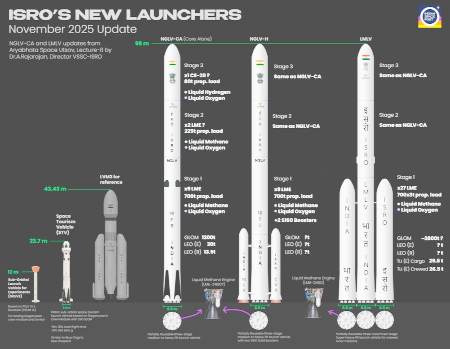
NGLV as proposed in November 2025
NGLV (the two rockets in the middle) as proposed
in November 2025. Click for bigger image.

India’s space agency ISRO has issued a request for bids from the country’s commercial aerospace sector to build landing legs for its next new rocket, dubbed the Next Generation Launch Vehicle (NGLV).

The tender, titled “Fabrication of Landing Leg Hardware with materials for Advanced Development Module for In-situ Reusable Technologies (Admire) VTVL (10 units)”, seeks industry participation in developing critical components for a vertical take-off, vertical landing (VTVL) test vehicle under the ADMIRE programme.

…According to ISRO’s tender documents, the selected vendor will be responsible for end-to-end development, including procurement of raw materials, manufacturing, quality control planning, and final delivery of landing leg hardware. The project has been structured into three distinct phases spanning approximately 12 months.

The NGLV rocket was first approved by the India government in September 2024. Since then ISRO has completed the preliminary design of its methane engine, but has also revised the rocket’s design twice, in October 2024 and again in November 2025. This new landing leg contract suggests the agency hopes to do some test hops of a first stage prototype a year from now.

India’s second spaceport to be completed next year

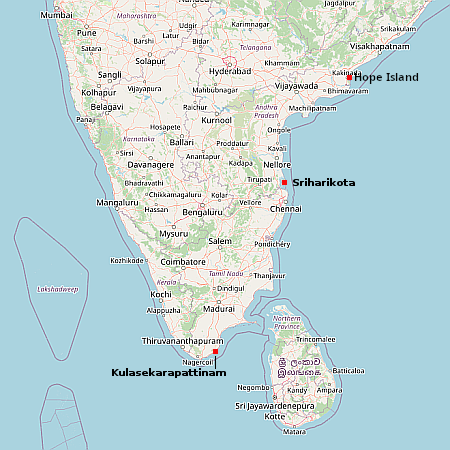
The existing and proposed spaceports in India

According to officials in India, the nation’s second spaceport at Kulasekarapattinam is on schedule to be completed by next year, when it will become available for polar launches of the SSLV rocket as well as other commercial rocket launches.

India is moving ahead with plans to operationalise a new launch facility at Kulasekarapattinam in Tamil Nadu. It is expected to be commissioned during the 2026–27 financial year, according to information shared in the Lok Sabha by Jitendra Singh.

The new facility, officially called the Small Satellite Launch Vehicle (SSLV) Launch Complex, is being developed as the country’s second space launch site. The Kulasekarapattinam complex will primarily handle launches of SSLV missions to Sun-synchronous Polar Orbit, a trajectory widely used for Earth observation satellites.

The SSLV rocket is at present controlled by India’s space agency ISRO, though there has been an effort by the Modi government to transfer it to the private sector. It is not clear whether that effort has been successful. ISRO and India’s large space bureaucracy has been resistant. There have also been indications that this new spaceport will be made available to the handful of Indian rocket startups that are developing their own rockets.

The Sriharikota spaceport is ISRO’s main launch site. The Hope Island site is a proposed commercial and private spaceport, whose future remains very uncertain.

Indian rocket startup Agnikul completes static fire test of three-engine cluster

The Indian rocket startup Agnikul has now released a video of a 40-second static fire test of three-engine cluster it hopes to use on its Agnibaan orbital rocket.

The engines, powered by electric motor-driven pumps, were designed and manufactured in-house at Agnikul’s Rocket Factory-1. All three were fully 3D-printed as single-piece hardware units, reflecting the startup’s focus on advanced manufacturing and indigenous engineering.

Co-founder and chief executive Srinath Ravichandran said that increasing the number of engines improves rocket performance and that a three-engine system is required for commercial missions. The clustered test involved calibrating six pumps and six motors and fine-tuning six independent speed control algorithms to function in synchronisation. The goal was to achieve uniform startup, steady-state operation and shutdown performance across all three engines, a technically complex process given the precision required in semi-cryogenic propulsion systems.

The company has completed one suborbital test launch in May 2024, and in September 2025 said its orbital rocket’s first stage will land vertically and be reused.

Agnikul however has not released any schedule for launch, and based on this static fire test appears years from a first launch. It is making progress, but slowly. At the same time, it says it has raised $500 million in private investment capital, giving it the resources to build the rocket.

Based on testing and published progress, Agnikul appears to be trailing India’s other rocket startup Skyroot, though this could change in the coming year.

India negotiating a possible Gaganyaan docking at ISS

India's Bharatiya Antariksh Station as outlined in 2024
India’s Bharatiya Antariksh Station as outlined in 2024.
Click for original image.

The head of India’s space agency ISRO, it is negotiating with NASA about doing a variety of manned space operations in conjunction with NASA, including a possible Gaganyaan docking to ISS.

According to a presentation by Isro chairman V Narayanan reviewed by TOI [Times of India], the future cooperation areas span three key areas of collaboration between the two nations’ space agencies.

The first involves comprehensive training of ISRO personnel, including astronauts, at NASA facilities across multiple domains, including robotics systems, extravehicular activity (EVA), extravehicular mobility unit (EMU) systems, resource management, space medicine and spaceflight operations, LEO and lunar mission control operations, rendezvous and docking procedures, and payload and science operations.

An important initiative outlined is the uncrewed docking demonstration of India’s Gaganyaan Orbital Module with the US Orbital Segment of the ISS — this would mark a significant technological milestone for India’s human spaceflight programme.

The third area focuses on cooperation in docking, berthing, and inter-operability systems.

It is clear ISRO wishes to get training from NASA for its manned missions. It also makes sense for it to make sure its Gaganyaan’s docking systems are compatible with ISS, Dragon, Starliner, Soyuz, and even China’s station.

Doing a test unmanned docking at ISS would also provide ISRO valuable experience in preparation for its own Bharatiya Antariksh Station (BAS). Its first module is presently scheduled for launch in 2028, with the entire station assembled by 2035.

None of this however has been finalized. If India were to do a docking at ISS, it would like have to wait until 2029, after the two tourist missions assigned to Axiom and Vast. ISS has a limited number of available ports, and I suspect a port really won’t be available until after those missions.

First unmanned Gaganyaan mission facing delay

Artist rendering of India's Gaganyaan capsule
Artist rendering of India’s Gaganyaan capsule

Though this is not yet confirmed, sources inside India’s space agency ISRO are saying that the first unmanned Gaganyaan orbital test mission, presently targeting a March launch, is likely to be delayed in order to do additional safety checks, following the two consecutive launch failures of the agency’s PSLV rocket.

After the dual PSLV setbacks, there is zero appetite for risk at Isro. Every component, fitting, system, and subsystem of Gaganyaan is being re-examined in minute detail to ensure mission success.

The PSLV, traditionally regarded as Isro’s workhorse launcher, suffered rare back-to-back failures over the past two years, prompting a comprehensive review of quality assurance and mission readiness protocols across launch vehicles. While Gaganyaan is slated to fly aboard the Human-Rated Launch Vehicle Mark-3 (HLVM3), an upgraded version of the GSLV Mk-III, the recent setbacks have cast a shadow over the broader launch ecosystem.

The actual manned mission is presently scheduled for early next year, after a series of unmanned orbital test flights are completed in ’26. This schedule is significantly later than ISRO’s original schedule. When the program was first proposed in 2018, ISRO said the manned mission would happen in 2022.

Fairing from India’s Bahubali rocket launched in December found in Maldives

A man fishing off an uninhabited island in the Maldives discovered what appears to be pieces from the fairing used by India’s LVM3 rocket, also dubbed Bahubali, when it launched AST SpaceMobile’s sixth Bluebird satellite in December.

A similar discovery was made on December 28, 2025 in Sri Lanka. In both cases it is theorized that the material came from the fairings of the December Bahubali launch.

I am unable to determine the flight path of the Bluebird launch, but the location of this debris suggests it headed strongly south from India’s east coast spaceport. The fairing pieces then drifted south and west to reach the Maldives after two months.

SpaceX routinely recovers its fairing and resuses them, which due to the fairing’s basic shape has turned out to be relatively straightforward. They have the shape of a boat’s hull, and after parachuting softly down can simply float on the surface until they can be picked up. It is absurd no one else does this.

FAKE Chandrayaan-2 images of the Apollo 11 and 12 landing sites

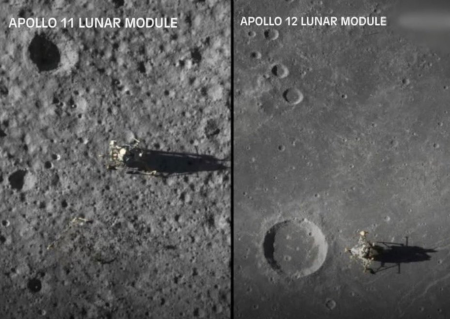
Chandrayaan-2 images of Apollo 11 and Apollo 12 landing sites

The pictures to the right are fake, as are the two stories I had linked to in the now crossed-out post below. Both stories included pictures of the Apollo 11 and Apollo 12 landing sites that were fake and did not match the actual pictures taken earlier by Lunar Reconnaissance Orbiter.

I seem to remember that Chandrayaan-2 had taken pictures of these Apollo landing sites, but I have not been able to find those originals. Either way, the stories below as well as the pictures to the right are fake, and for that reason I have deleted the links to both.

For reasons I don’t understand, two different news outlets in the past two days decided to highlight the 2021 images taken by India’s Chandrayaan-2 lunar orbiter of the Apollo 11 and 12 landing sites, with both outlets claiming these pictures provided third-party verification that those manned lunar landings actually happened.

Those pictures are to the right. They aren’t new, but they are so good I decided they were cool enough to post again.

As for proving the lunar landing happened, that is pure anti-American silliness, sadly too often pushed by ignorant Americans. They should be ashamed. The Apollo landings were possibly the greatest single achievement Americans have ever accomplished. And if not the greatest, the landings rank near the top, and above all they certainly were among our noblest achievement.

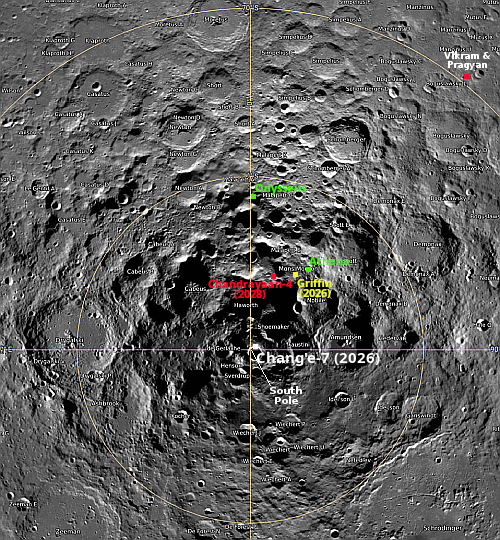
India picks landing site for its Chandrayaan-4 lunar sample return mission

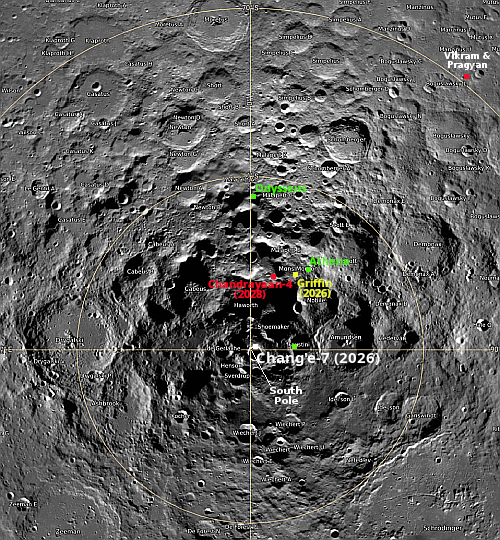
Landing sites at the Moon's South Pole

Scientists at India’s space agency ISRO have now picked [pdf] a preliminary landing site for its planned Chandrayaan-4 lunar sample return mission, scheduled to launch in 2028.

[Four] sites of Mons Mouton area was fully characterised with respect to terrain characteristics using high resolution OHRC multiview image datasets and it was found that 1km x 1km area around MM-4 (-84.289, 32.808) contains the less hazard percentage, mean slope of 5°, Mean height of 5334m and most number of hazard free grids of size 24m x 24m. Hence MM-4 can be considered for the potential site of Chandrayaan-4 mission.

The study area of all four sites is indicated on the map to the right by the red dot labeled “Chandrayaan-4”. This mountain, Mons Mouton, is essentially a flat plateau between the numerous craters in the south pole region (many with permanently shadowed craters). Intuitive Machines second lander, Athena, attempted a landing there last year, and tipped over, as did that company’s first lander, Odysseus, both indicated in green. Astrobotic’s Griffin lander (yellow) is targeting this mountain also, hopefully to launch later this year.

India schedules next PSLV launch for June, claims it knows cause of January launch failure

India's space agency ISRO, as transparent as mud
India’s space agency ISRO,
as transparent as mud

According to a statement by a government minister yesterday, India’s space agency ISRO now knows what caused the January launch failure of its PSLV rocket, and has thus scheduled its next launch for June 2026.

This had been the second PSLV launch failure in a row, both of which occurred with the rocket’s third stage at almost the exact same time. With the first failure, ISRO never outlined publicly the cause, though it claimed it had solved the issue. According to the minister’s statement, the failure of the second launch was unrelated to the first.

The minister also said that the two PSLV missions that had failed—PSLV-C61 in May 2025 and PSLV-C62 in January this year—were unrelated. “It wasn’t the same problem. When the first mission failed, there was a detailed assessment, and the problem was fixed. Both the issues were different,” Singh said.

He also added that separate internal and external failure assessment committees have been set up to analyse what went wrong in each of the missions.

No word however as to the cause of the failure has yet been released. Though he also claimed the PSLV has not lost its customers due to these issues, ISRO’s lack of transparency says otherwise. If it claims the two failures came from different causes, it should provide the details in order to reassure potential customers.

New spaceport proposed in India independent of its space agency ISRO

The existing and proposed spaceports in India

According to the chief minister of the Andhra Pradesh province of India, his government is presently in discussions with the private Indian energy company Greenko Group about establishing a partnership to build a commercial spaceport at Hope Island off the coast near the city of Kakinada.

Addressing the gathering of foreign investors in renewable energies and officials of the State government after performing ‘bhumi puja’ [ground-breaking] for the Green Hydrogen and Green Ammonia Production Complex in Kakinada, Mr. Naidu said, “Soon, we (Andhra Pradesh) will launch satellites from the Hope Island. It will come soon, and Kakinada will have a lot of advantages in the field of technology and innovation.”

“The Greenko Group is evincing interest in being a part of the State government’s Space City project that includes developing satellite launching facility. In a recent interaction, Greenko Founder and Group CEO Anil Kumar Chalamalsetty has shown interest in the Space City project on the Hope Island,” said Mr. Naidu.

The location has advantages over the Sriharikota spaceport, run by India’s space agency ISRO, which on polar orbital launches needs to use extra fuel to avoid flying over Sri Lanka to the south. This issue is one of the reasons ISRO is presently building that second spaceport to the south for its SSLV rocket.

If privately run, this new spaceport will have other advantages. It will possibly attract some of India’s new rocket startups, who will avoid some of the bureaucracy that accompanies any dealings with ISRO. ISRO launches always involve a gigantic number of government personnel, a cost these startups can’t afford. This new Hope Island spaceport might avoid these costs with low overhead and efficient operations.

Nothing is firm yet. From the statement above, it appears the negotiation is in a very preliminary stage, and might never bear fruit.

Hat tip BtB’s stringer Jay.

Indian startup raises seed money to build robotic satellite servicing “jetpacks”

An Indian startup, Aule Space, has now raised $2 million in seed money to begin development of a robot servicing spacecraft it intends to call “jetpacks”, designed to attach to satellites and provide them fuel and power.

The seed funding will allow Aule Space to being work on a demonstration mission planned for launch next year to test its docking capabilities. That will involve two satellites, each weighing about 30 kilograms, but Panchal said one option is to instead use an orbital transfer vehicle as the client for the docking demonstration.

The 11-person company, which plans to grow to 20 people by the end of the quarter, is working on ground tests of its rendezvous and docking technology. It has access to facilities used by the Indian space agency ISRO for testing SPADEX, a docking demonstration mission flown a year ago.

This “jetpack” concept is very similar to Northrop Grumman’s Mission Extension Vehicles (MEV), several of which have already flown and extended the life of several satellites.

Aule is exactly the type of Indian satellite startup that India’s rocket startups, Agnikul and Skyroot, are being built to serve. The problem is that all of these startups, both satellite and rocket, are literally all startups. None has flown. India’s private space sector won’t really take off until its private rocket companies get off the ground, as its government space agency, ISRO, has done a very poor job launching its PSLV and SSLV rockets (both designed for smallsats). The PSLV has failed on its last two launches, and the SSLV has been in limbo now for years.

A small European prototype re-entry capsule survived PSLV launch failure

A small prototype re-entry demonstration capsule, built by the Spanish startup Orbital Paradigm and dubbed the Kestrel Initial Demonstrator (KID), apparently survived for a short period the failure of the third stage of India’s PSLV rocket early this week.

According to an Orbital Paradigm press release, the survival of its little demonstrator came as a surprise. “When we understood that the launch was non-nominal it was a bit of a hit for us,” explained Orbital Paradigm CEO Francesco Cacciatore. … “I think the launch livestream was still ongoing when the team saw that we had 190 seconds of flight data transmitted and received. We needed a few minutes to realize it was real data and not a glitch.”

…“KID was tested beyond its design envelope, and it worked. Separation, power-on, and data transmission, even after reentry, all performed well despite degraded conditions,” explained the company in a 13 January update. “Based on initial analysis, it seems that we achieved 4 out of 5 launch milestones, albeit through an off-nominal profile. The failure to deliver customers’ data prevents us from declaring the mission a success.”

The company considers the mission a failure because it did not get the re-entry data back that it really needed. It says however it is moving forward on a more advanced demonstrator it hopes to launch in 2027. I suspect it will not hire India’s space agency ISRO to launch it.

India’s PSLV rocket experiences the second launch failure in a row

India’s space agency ISRO tonight attempted its first launch in 2026 and the first launch of its PSLV rocket since the rocket’s third stage failed during a May 2025 launch.

Unfortunately the rocket’s third stage failed again, near the end of its engine burn. The animation on the mission control displays, based on actual telemetry, showed the stage suddenly tumbling, its engines no longer firing. It appears something catastrophic occurred the end of that burn.

The rocket’s primary payload (a satellite for India’s military) as well as 18 smallsats for a variety of other customers were all lost.

While ISRO last year was able to complete five successful launches of its larger GSLV and LVM rockets, the PSLV was grounded due to that May 2025 failure. Today’s launch was intended to show the third stage problem had been fixed. Instead, it showed that the modifications hadn’t fixed the problem. In fact. it occurred at almost the same time as in the May launch. The link above is cued to just before the stage began tumbling. In May the failure took place 374 seconds into the flight. Today it occurred at 377 seconds into the flight.

India’s space agency: At least six launches in 2026

According to remarks by the head of India’s space agency ISRO last week, the agency is planning at least six launches in 2026, including two unmanned test flights of its Gaganyaan manned capsule.

Also planned will be the first launch of its PSLV rocket that was manufactured entirely by commercial vendors, rather than ISRO itself. The goal by the Modi government had been to transfer ownership of the rocket to private companies, but ISRO revised that to retain control and ownership while giving manufacture to the private companies HAL & L&T, thus defeating the essential goal of shifting power to the private sector.

The total does not include possible orbital attempts by two rocket startups, Skyroot and Agnikul.

India launches AST SpaceMobile’s sixth Bluebird satellite

India’s space agency ISRO today (December 24 in India) successfully launched AST SpaceMobile’s sixth Bluebird satellite into orbit, its Bahubali rocket (LVM3) lifting off from its Sriharikota spaceport on India’s eastern coast.

This Bluebird is an upgrade from the first five satellites, providing ten times the bandwidth. The constellation acts as satellite cell towers for smart phones. These Bluebird satellites have been the largest in size ever launched, and this satellite will break their previous records. It is also the heaviest satellite India’s Bahubali rocket has ever put in orbit, on its sixth launch.

For India, this is its fourth launch in 2025. The leaders in the 2025 launch race:

168 SpaceX
86 China
18 Rocket Lab
15 Russia

SpaceX still leads the rest of the world in successful launches, 168 to 144.

More delays expected in India’s first manned Gaganyaan orbital mission

Artist rendering of India's Gaganyaan capsule
Artist rendering of India’s Gaganyaan capsule

It appears that India’s space agency ISRO is now hinting that the first manned orbital flight of India’s Gaganyaan capsule will not occur in 2027 as planned, but could be delayed until 2028.

ISRO had hoped to fly the first unmanned orbital test flight, Gaganyaan G1, before the end of this year, followed by several more unmanned flights in 2026, with the manned flight in 2027. G1 however has slipped to early 2026, though it appears the mission is finally coming together.

In a response to a question posed at the Lok Sabha, the State Minister for Space, Jitendra Singh noted that the first Gaganyaan mission is nearly ready to fly, “Major infrastructure such as the Orbital Module Preparation Facility, Gaganyaan Control Centre, Crew training facility have been established. Second launch pad modifications have been incorporated. Precursor missions such as TV-D1 and IADT-01 have been successfully accomplished. Ground tracking networks, terrestrial links and IDRSS-1 feeder stations have been established. Crew Module Recovery plan as well as assets to be deployed have been finalized. For the first uncrewed mission (G1), all HLVM3 stages and CES motors are ready. Crew and Service Module systems have been realized. Assembly and integration activities are nearing completion.”

…The Gaganyaan G1 flight is the first of eight planned missions as part of an expanded programme cleared by the Union Cabinet last year with a total budget of Rs 20,193 crore. Initially, the programme was envisioned with two developmental flights followed by a crewed flight, with a budget of Rs 9,023 crore. There are now two crewed flights in the revised campaign, with ISRO aiming for the first crewed flight in 2027-28. [emphasis mine]

The highlighted dates are the first time ISRO has suggested the first manned flight might slip to 2028.

When the Gaganyaan program was first announced in 2018, the first manned flight was scheduled for 2022. Since then that schedule has been repeatedly delayed. I suspect ISRO’s schedule will only become more reliable after it finally completes that first G1 orbital test flight.

The endless incremental delays however are reminiscent of NASA’s Artemis program, designed to hide a sluggish program with problems.

Russia and India agree to orbit their space stations in the same inclination, the same as ISS

India's Bharatiya Antariksh Station as outlined in 2024
India’s Bharatiya Antariksh Station as outlined in 2024.
Click for original image.

According to statements made by Roscosmos head Dmitry Bakanov at a conference in New Delhi this week, Russia and India have agreed to orbit their planned new space stations in the same inclination as ISS, 51.6 degrees, and coordinate their operations at both stations.

By choosing the same orbital geometry for ROS [Russian Orbital Station] and BAS [Bharatiya Antariksh Station], Moscow and New Delhi are effectively planning a continuous “replacement belt” in low Earth orbit. After the ISS is retired, crewed spacecraft launched from Russia and India would still be able to reach a major laboratory complex without radically changing launch trajectories or infrastructure, and—crucially—could, in principle, travel between the two stations with relatively modest maneuvers compared with a full plane-change.

Bakanov’s New Delhi comments build on a broader Roscosmos–ISRO understanding that the two stations should be able to support cross-visits, resource sharing and coordinated operations once both are flying.

This high inclination is required because spacecraft launching from Russia’s high latitudes can’t reach lower inclinations practically. India could put its station at a lower inclination (being at a lower latitude), but if this story is true, it apparently has decided there are advantages using an orbit that will allow cross-missions with Russia, including launches from Russia.

India plans to launch the first module of its station in 2028, and have the entire station operational by 2035. Russia says it will launch is station’s first module by 2027, with full operations beginning by 2030. While both schedules are likely to see delays, we should expect India to get its station built, while Russia will likely struggle to launch even one module.

In fact, I suspect this deal is Russia’s effort to find some partner that can carry it in the future, when its own station gets delayed.
» Read more

India tests new and better restart method for upper stage of its biggest rocket

India’s space agency ISRO has successfully tested new restart method for the engine it uses on the upper stage of its LVM rocket, its biggest rocket that it also intends to use for its manned and interplanetary missions.

For future missions, multiple in-flight restarts of the CE20 engine will be required for mission flexibility towards multi-orbit missions. However, with the present configuration, each restart demands an additional start-up gas bottle and associated systems, leading to a reduction in vehicle payload capability. Hence, achieving boot-strap mode start – where the engine builds up to steady operation without external start-up assistance – is essential.

In this regard, a boot-strap mode start test on the CE20 Cryogenic engine was successfully conducted under vacuum conditions in the High-Altitude Test (HAT) facility at ISRO Propulsion Complex, Mahendragiri on 7th November 2025, for a duration of 10 seconds. A multi-element igniter was employed in both the thrust chamber and gas generator to facilitate boot-strap starting. In this test, following the ignition of the thrust chamber, the gas generator was ignited under tank head conditions, and the turbopumps were started without the use of the start-up system. Subsequently, boot-strap mode build-up and steady-state operation of the engine were successfully demonstrated.

In other words, the engine now be restarted numerous times, giving any payload attached much greater flexibility in positioning and orbital maneuvers. For manned missions this means it can be used to reposition the modules for India’s planned space station, maneuver its manned capsule Gaganyaan, and send interplanetary missions to the Moon and beyond.

The orbital propulsion module for India’s Chandrayaan-3 lunar lander drifts back into lunar orbit

When India’s Chandrayaan-3 spacecraft arrived in lunar orbit in August 2023, it separated into three units, the lander, a lunar orbiter, and a propulsion unit used to get everything to the Moon.

While the Vikram lander successfully touched down several hundred miles from the Moon’s south pole and the Chandrayaan-3 orbiter continues to make observations of the Moon, in October 2023 engineers had the propulsion module do a burn that sent it out of lunar orbit and into an Earth orbit that was close to one of the Lagrange points where the gravity of the Earth and Moon are balanced.

Now, three years later, that module has drifted back into lunar orbit, where it has since done two close fly-bys of the surface.

This intricate orbital dance culminated when the module once again entered the Moon’s SOI [sphere of influence] on November 4, 2025, an event marking the transition where lunar gravity dominates its motion.

The first recorded lunar flyby occurred on November 6, 2025, at a distance of 3,740 km from the lunar surface, though it was outside the Indian Deep Space Network’s (IDSN) visibility range. A second, closely monitored flyby took place on November 11, 2025, bringing the module within 4,537 km of the Moon and well within observation capabilities.

These events noticeably altered the satellite’s orbital parameters, expanding its orbit size from 100,000 x 300,000 km to a massive 409,000 x 727,000 km and shifting its inclination from 34° to 22°.

It is not clear what happens next. Having this module in lunar orbit could be an issue for present and later orbiters, as no orbit around the Moon can ever be stable. At some point India’s space agency ISRO needs to properly dispose of this unit, either by sending into the Moon or out of the Moon-Earth system entirely. I am of course assuming it has the fuel to do so.

India tests Gaganyaan parachutes again

Artist rendering of India's Gaganyaan capsule
Artist rendering of India’s Gaganyaan capsule

India’s space agency ISRO on November 3, 2025 successfully completed another drop test of the parachutes it will use on its Gaganyaan manned orbital capsule, this time testing the chutes in extreme conditions.

Explaining the November 3 test, the Isro statement said the GCM parachute system comprises 10 parachutes of four types. “The descent sequence begins with two apex cover separation parachutes that remove the protective cover of the parachute compartment, followed by two drogue parachutes that stabilize and decelerate the module. Upon release of the drogues, three pilot parachutes are deployed to extract three main parachutes, which further slow down the Crew Module to ensure a safe touchdown,” said Isro. “The system is designed with redundancy—two of the three main parachutes are sufficient to achieve a safe landing.”

Using a pyro device, the main parachutes open partially, a process known as reefing, and then open fully after a predetermined period of time, referred to as disreefing. This step-by-step process is known as reefed inflation. An important aspect of the test was the successful validation of the main parachutes under possible extreme scenarios of delay in the disreefing between the two main parachutes.

The August drop tests were from a helicopter at about 3 kilometers. The November drop tests took place from an airplane at about 2.5 kilometers.

The agency has indicated the first unmanned orbital test flight of Gaganyaan has been delayed from this year to early next, possibly as early as January. It plans to do at least three unmanned flights in 2026 before putting humans on board in early 2027.

Ispace signs deals with companies in India and Japan

The Japanese lunar lander startup Ispace today announced it has signed partnership deals with two different companies, OrbitAid in India and Toyota in Japan.

The startup OrbitAid is India’s first “on-orbit refueling company”. It will provide Ispace’s landers with standardized docking ports as well as refueling capabilities.

The two companies aim to demonstrate the critical capabilities required for mission extension in the cislunar environment, enabling long-duration lunar operations and paving the way for a sustainable lunar economy. The integration of OrbitAID’s SIDRP interface is expected to not only optimize refueling, recharging, and data transmission capabilities but also support ispace’s efforts to enhance the performance and reliability of its landers. By enabling lunar refueling, both companies plan to facilitate deep-space exploration beyond Earth’s orbit.

Toyota meanwhile will provide technical support to Ispace as it develops its own second generation lunar rover, dubbed Lunar Cruiser. Ispace is already prepping a smaller rover that will fly on its next lunar landing mission.

Ispace has been signing on a range of customers and commercial partners in recent months, even though its only two attempts to land on the Moon both failed just before touch down. It has contracts with NASA, ESA, and JAXA for future missions. These new deals appear designed to strengthen and extend its capabilities beyond simply landing on the Moon, but also to provide interplanetary spacecraft as well.

Indian rocket startup Skyroot hires Exolaunch to handle satellite integration and deployment

The Indian rocket startup Skyroot yesterday signed a partnership agreement with the company Exolaunch to handle the integration and deployment of satellites once its Vikram smallsat rocket begins launching.

Through this agreement, Exolaunch will integrate and deploy customer satellites on Skyroot’s Vikram series of launch vehicles, beginning with the Vikram-1 orbital missions. Exolaunch will provide its flight-proven deployment technologies for Skyroot customers across dedicated and rideshare launches. The partnership also includes the use of Exolaunch’s EXOtube payload stacks, designed to optimize multi-payload rideshare configurations, streamline constellation launches, increase mission flexibility, and enhance vehicle utilization.

While Skyroot has not yet launched, Exolaunch is very well established, having “a decade of flight heritage and 582 satellites launched across 39 missions to date.” Since Skyroot has no experience yet in these matters, having Exolaunch do it makes satellite companies more likely to buy space on its rocket.

Until recently Skyroot had been targeting a first launch before the end of this year. That schedule has now changed. According to the company’s webpage, that first launch is now scheduled sometime in 2026.

India’s government finalizes deal to transfer operation of its SSLV rocket to a private company

India’s government and its various space agencies yesterday finalized its deal with the Indian company Hindustan Aeronautics Limited (HAL) to take over the manufacture and operation of its government-designed SSLV rocket (Small Satellite Launch Vehicle) for the next decade.

Under the technology transfer contract that HAL signed with ISRO, Indian National Space Promotion and Authorisation Centre (IN-SPACe) and NewSpace India Limited (NSIL), the aviation major will absorb the technology in the first two years, which will be followed by a 10-year production phase. The agreement grants HAL a non-exclusive, non-transferable license to the SSLV technology, which includes comprehensive design, manufacturing, quality control, integration, launch operations, and post-flight analysis documentation, as well as training and support. HAL will be responsible for the mass production of SSLV to meet Indian and global demands,” the company says in a statement.

Initially the Modi government had implied the transfer would involve ownership of the rocket by the private company, so that it could market the rocket for profit. The actual deal does not do this. Instead, it gives HAL the responsibility to manufacture and operate the rocket, but it appears sales and ownership will still be under the control of India’s space agency ISRO. If this is correct, the deal accomplishes less than nothing, and in fact simply adds another player in the game, making the SSLV rocket less competitive in the international market.

Then again, the Modi government might see this deal as just a first step in the transition from a government-run space program to a competitive independent space industry. It needs to wrest control from ISRO, and this can’t be done politically in one fell swoop.

To me however this deal for HAL is a bad one. It now has the responsibility for making and launching the rocket, but none of the benefits.

India now targeting December for first unmanned test flight of Gaganyaan

Artist rendering of India's Gaganyaan capsule
Artist rendering of India’s Gaganyaan capsule

According to the head of India’s space agency ISRO, it is now targeting December 2025 for first unmanned test flight of its Gaganyaan manned capsule.

That flight will put the capsule into orbit for several days carrying a humanoid robot dubbed Vyomitra, designed to simulate what a human would experience in the capsule in space. It will be the first of three similar unmanned orbital test flights, leading up to a planned manned orbital mission in 2027.

Though this program has experienced numerous delays and program changes since it was first proposed in 2006, all the pieces have begun to fall into place in the past four years. It now appears that the above schedule is very solid. As long as there are no major test failures, India could launch its first astronauts by 2027.

Indian rocket startup Skyroot tests solid-fueled motor

The Indian rocket startup Skyroot has successfully tested the solid-fueled motor it plans to use in its three-stage solid-fueled Vikram-1 rocket. From the press release issued by India’s space agency ISRO:

First Static Test of the KALAM 1200 Motor – the first stage of Vikram – 1 Launch Vehicle of M/s Skyroot Aerospace Pvt. Ltd. (SAPL), Hyderabad is accomplished successfully at Static Test complex of Satish Dhawan Space Centre, Sriharikota, ISRO, Department of Space at 09:05 hrs on 08.08.2025. This is a major milestone in the configuration and realization of the systems for Vikram – 1 Launch Vehicle. The motor is a 11 m long, 1.7 m dia monolithic composite motor with a Propellant Mass of 30t. Based on the design inputs, this longest monolithic motor is prepared at the Solid Propellant Plant, Sriharikota. Similarly, ISRO team has provided the design for the Test Stand, which is used for the static test of the motor.

This is in line with the Government of India initiative on Space Policy, 2023 for providing the necessary technical infrastructure and managerial guidance for the Private Sector players to contribute for the space economic growth. The performance of the test bed and the associated systems is normal as predicted.

The last paragraph is the most important. The Modi government has tasked its space agency to provide its facilities and expertise to help rocket startups like Skyroot. It appears from this test and press release the resistance within ISRO to this policy — which cuts into ISRO’s turf — is fading.

Skyroot had said it wants to do the first orbital test flight of Vikram-1 before the end of 2025. It remains unclear whether it will meet that schedule.

Hat tip BtB’s stringer Jay.

India’s Chandrayaan-2 lunar orbiter photographs Intuitive Machines’ Athena lander

Athena as seen by Chandrayaan-2
Click for source.

India’s Chandrayaan-2 lunar orbiter has now produced a new high resolution image of Intuitive Machines’ Athena lander, sitting on its side inside a small crater near the Moon’s south pole.

The IM-2 ‘Athena’ lander attempted a soft touchdown near the Moon’s South Pole on 6 March, 2025. Although the lander remained intact, it failed to reach its intended landing spot and ended up tipping over on its side inside a crater.

In the … images taken by the OHRC instrument on board the Chandrayaan-2 Orbiter, the Athena lander can be clearly seen lying on its side inside a crater.

This image, posted to the right, compares very favorably with the photos taken by Lunar Reconnaissance Orbiter (LRO) in March 2025. The lander’s legs can clearly be seen sticking out toward the top of the picture.

Hat tip BtB’s stringer Jay.

India and China complete launches

Two more launches today. First, India’s space agency ISRO successfully placed a joint NASA-ISRO radar satellite into orbit, its GSLV rocket lifting off from its Sriharikota spaceport on the eastern coast of India.

This was India’s first fully successful launch in 2025. On the first launch in January, the GSLV rocket performed as planned, but the satellite’s own engines failed to put it into the right orbit. Then in May the third stage of its PSLV rocket failed during launch.

Next China placed the sixth group of nine satellites for one of its mega-constellations designed to compete with Starlink, its Long March 8A rocket lifting off from its Wenchang coastal spaceport.

The leaders in the 2025 launch race:

94 SpaceX
40 China
10 Rocket Lab
9 Russia

SpaceX still leads the rest of the world in successful launches, 94 to 70.

1 2 3 17