ISRO moving ahead with Spadex docking

India’s space agency ISRO has announced that it now moving ahead with the autonomous docking of its two Spadex spacecraft presently in orbit, but it will wait until after the docking to post when it had occurred.

With the Indian Space Research Organisation’s (Isro) SpaDeX space docking experiment missing two publicly announced schedules on January 7 and January 9, the space agency has decided to complete docking before making a public announcement.

Isro had earlier announced that the docking would be a public event but after two consecutive postponements, a senior Isro official said that the docking “is on track” but the space agency will now “dock and inform” the public about the exercise.

I suspect they realized the uncertainty of the real docking schedule made making the schedule public too difficult. This remains a test, and so many things can occur along the way to slow things down.

India appoints a new leader for its space agency ISRO

After two-plus very successful years under the leadership of S. Somnath, the Indian government has now appointed a new chairman for its space agency ISRO, V. Narayanan.

Narayanan’s journey with ISRO began in 1984, and he has functioned in various capacities before becoming Director of the Liquid Propulsion Systems Centre (LPSC), which Narayanan heads, is engaged in the development of liquid, semi-cryogenic and cryogenic propulsion stages for launch vehicles, chemical and electric propulsion systems for satellites, control systems for launch vehicles, and transducers development for space systems health monitoring.

The term for this job in India is never more than three years, which explains this change at what seems a somewhat inappropriate moment, with ISRO gearing up to fly its first manned mission while preparing more missions to the Moon. It means that Narayanan will be in charge during that manned mission in 2026, should it fly on time.

ISRO delays its unmanned docking in orbit two days

India’s space agency ISRO today announced that it has decided to delay the attempted unmanned autonomous docking of its two orbiting Spadex spacecraft two days, from January 7 to January 9.

“The docking process requires further validation through ground simulations based on an abort scenario identified today (Jan 6),” Isro said Monday. Multiple sources told TOI that “there was nothing concerning” with the Space Docking Experiment (SpaDeX) satellites and that the additional simulations are being carried out to validate the docking process.

This follows the pattern at ISRO since its present head, S. Somanath, took over in 2022. He pushes hard to get missions launched, but simultaneous demands caution and testing along the way to make sure the mission is a success. For example, when he took over he quickly added a number of unmanned test flights for India’s Gaganyaan manned capsule, to take place before the manned mission.

India and SpaceX announce their planned launch goals for 2025

We now have predictions from both India and SpaceX on the number of times each will attempt orbital launches in 2025.

In a tweet from India’s space agency ISRO today, the agency announced it plans ten launches in 2025. This count includes one launch of its man-rated Heavy Lift Vehicle-Mark 3 (HLVM3) rocket in March, testing its unmanned Gaganyaan manned capsule, one launch of its slightly smaller LVM3 rocket, four launches of its older GSLV rocket, three of its even smaller PSLV rocket, and one of its smallest new rocket, the SSLV. The last two the Indian government hopes to transfer to the private sector. (Note: The tweet says nine launches, but the graphic shows ten.)

This prediction does not include any additional orbital launches that India’s two private rocket startups, Agnikul and Skyroot, might attempt. Both have said they hope to do their first launches in 2025.

SpaceX meanwhile is hoping to smash its own record in 2024. According to comments made by the company’s CEO Gywnne Shotwell in mid-December (comments that I missed at the time), the company is planning 175 to 180 launches in 2025. This increase will likely come from two sources. First, it is my understanding that the company is adding another drone ship to its recovery fleet, allowing for more Falcon 9 launches. Second, it is probably going to be able to conduct Starship/Superheavy launches much more frequently, because the Trump administration is almost certainly going to eliminate much of the FAA regulatory red tape that has stymied the entire American rocket industry these last four years.

In the coming weeks I expect more nations and companies will announce their intended launch targets for 2025.

India gets nine bids involving 30 companies on proposal to build satellite constellation

Capitalism in space: India’s space agency in charge of promoting commercial space, In-Space, has received nine different bids involving 30 Indian companies on its proposal that an Earth observation satellite constellation be built by a private company, not by the country’s space agency ISRO.

The regulator had sought “expressions of interest” (EoI) in July to build home-grown satellite constellations as part of a broader strategy to monetize the sector and ensure data sovereignty.

India is doubling down on its small satellite and data services market to carve out a leading role in the global commercialization of space. The market for such services, increasingly key for industries ranging from telecoms to climate monitoring, is projected to reach $45 billion by 2030.

The applicants for IN-SPACe’s latest effort in this regard include startups such as Google-backed Pixxel and Baring Private Equity-backed SatSure, as well as larger entities like Tata Group’s Tata Advanced Systems. The companies did not immediately respond to requests for comment.

This is all part of the Modi government’s effort to shift from a government-run space program, controlled by ISRO, to the capitalist model where private companies compete for business and there is no “program” at all, at least not one that controls everything. The government becomes nothing more than one of many customers, buying services and products from the private sector to achieve its “program”. The companies in that sector then follow their own goals, and profit and innovation dictate who succeeds best. The result under this freedom model is always more development faster for less cost.

Hat tip to BtB’s stringer Jay.

Another record-setting launch day worldwide

In what might be a record for the global launch industry, yesterday saw a total of four launches at four different spaceports worldwide.

That record might very well be matched today. Already three launches have already taken place, with one more scheduled.

First, India’s space agency ISRO successfully launched European Space Agency’s PROBA-XL solar telescope, its PSLV rocket lifting off from its Sriharikota spaceport on India’s eastern coast. This was India’s fourth launch in 2024.

Next, China launched what its state-run press merely described as a “group of satellites,” its Long March 6 rocket taking off from its Taiyuan spaceport in northern China. That state-run press also said nothing about where the rocket’s lower stages and four strap-on boosters crashed inside China. (UPDATE: More information about the payload can be found here. It appears to have been the third set of 18 satellites launched as part of China’s attempt to compete with Starlink.)

Then, SpaceX launched SXM-9, a new satellite for the constellation of the radio company Siruis-XM, its Falcon 9 lifting off from Kennedy in Florida. The first stage completed its nineteenth flight, landing on a drone ship in the Atlantic. As of posting the satellite had not yet been deployed.

If all goes as planned, the fourth flight today will be the first launch in more than two years of Avio’s Vega-C rocket, which has been grounded while the company redesigned and then redesigned again the engine nozzle of its upper stage. The launch is also one of the last that will be managed by Arianespace, which is giving up control to Avio over the next year. The live stream is here.

If successful, it will be the eighth launch worldwide in only two days, something that I am fairly certain has never been done before. In the past there simply weren’t enough independent entities and spaceports available to allow this number of launches in such a short period of time. What makes this record even more striking is that three of the eight launches were launched by one private American company, SpaceX.

The leaders in the 2024 launch race:

127 SpaceX
59 China
16 Russia
13 Rocket Lab

American private enterprise still leads the rest of the world combined in successful launches 146 to 89, while SpaceX by itself leads the entire world, including American companies, 127 to 108.

The space agencies of India and Australia agree to cooperate in recovering Gaganyaan

India’s space agency ISRO yesterday announced that it has signed an agreement with the Australian Space Agency (ASA) to work together in doing ocean recovery of India’s Gagayaan manned capsule.

The IA [Implementation Agreement] enables the Australian authorities to work with Indian authorities to ensure support for search and rescue of crew and recovery of crew module as part of contingency planning for ascent phase aborts near Australian waters.

Apparently ISRO anticipates the possible need for capsule ocean recovery near Australia should there be a launch abort shortly after liftoff.

SpaceX successfully completes two launches today

SpaceX successfully completed two launches today, one from each coast.

First in the early morning the company sent 20 Starlink satellites into orbit, its Falcon 9 rocket lifting off from Vandenberg in California. The first stage completed its 20th flight, landing on a drone ship in the Pacific. Of the 20 satellites, 13 were configured for direct-to-cell service.

Next, SpaceX launched GSAT-20, a geosynchronous communications satellite for India’s space agency ISRO, which hired SpaceX because the satellite was too heavy for its own rockets. The Falcon 9 rocket lifted off from Cape Canaveral, with the first stage completing its 19th flight, successfully landing on a drone ship in the Atlantic. Of the two fairings, one completed its fifth flight while the second completed its first flight.

If we include the afternoon launch yesterday by SpaceX from Kennedy, the company did three launches from three locations in less than 24 hours. And it hopes to launch again tomorrow, this time flying Starship/Superheavy on its sixth test orbital flight, launching from the company’s launchpad in Boca Chica. I have embedded the live steam here.

The leaders in the 2024 launch race:

117 SpaceX
53 China
13 Russia
12 Rocket Lab

American private enterprise now leads the rest of the world combined in successful launches 135 to 79, while SpaceX by itself leads the entire world, including American companies, 117 to 97.

With these two launches today, the all-time global record for successful orbital launches in a year, set only last year at 213, has been broken, and there are still about five weeks left in 2024.

ISRO head unveils new timeline for major missions

The head of India’s space agency ISRO, S. Somanath, yesterday unveiled a new timeline for several of that nation’s major missions, both manned and unmanned.

The new timeline is as follows:

  • 2025: NISAR: a joint Indian-American radar orbiter, long delayed
  • 2026: Gaganyaan-1, India’s first manned orbital mission
  • 2028: Chandrayaan-4, an unmanned sample return mission to the Moon
  • 2028: Chandrayaan-5, a joint lander-rover to the Moon

The last project will be done in partnership with Japan, with India building the lander and Japan the rover.

2028 will be a very busy year for India in space. The Indian government had previously announced that ISRO would launch in 2028 the first module of its space station as well as a Venus orbiter.

ISRO reveals design of its Chandrayaan-4 lunar sample return mission

India’s space agency ISRO yesterday unveiled its design concept for its Chandrayaan-4 lunar sample return mission, requiring two launches and five modules that will dock in Earth orbit before traveling to the Moon.

“After two launches, the stacks will be docked together in elliptical Earth orbit to form an integrated stack. Subsequent to docking, the Integrated Stack will perform the first set of Earth-bound manoeuvres with the PM propulsion system. Once the PM is depleted, it gets jettisoned from the Integrated stack,” Isro said Tuesday.

The integrated stack then performs all the manoeuvres to achieve the lunar orbit, such that the orbit plane has the pre-determined landing site. In the final lunar orbit, the descender module and ascender module get separated from the transfer module and re-entry module. The descender and ascender modules then undergo powered descent to achieve a soft landing on the lunar surface.

Both a robot arm and a drill will then grab samples, deposit them separately in the ascender, which will then launch and redock with the stack. It will then take the re-entry module back toward Earth, where it will be released prior to its return.

This plan is essentially the same as the first proposal last year, but with many more added details.

A landing site has apparently not yet been chosen.

India completes third and last test launch of its SSLV rocket

India today successfully completed the third and last test launch of its Small Satellite Launch Vehicle (SSLV), lifting off from its Sriharikota spaceport and carrying an experimental satellite designed to test a number of new technologies.

This launch is three-plus years late. It was originally to take place no later than 2021, but India’s space agency ISRO shut down entirely during the COVID panic, putting a halt on the rocket’s development. This delay also badly damaged ISRO’s attempt to grab the smallsat launch market. While it hid in basements in fear of a virus comparable to the flu, companies on the U.S. pushed to grab that market. Whether it can now grab its own market share is unclear, but the increased regulatory burdens that have appeared in the U.S. in the last three years gives it an opportunity.

This was India’s third launch in 2024, so the leader board in the 2024 launch race remains unchanged:

81 SpaceX
33 China
10 Rocket Lab
9 Russia

American private enterprise still leads the rest of the world combined in successful launches 96 to 51, while SpaceX by itself still leads the entire world combined, including American companies, 81 to 66.

Antenna for joint NASA-ISRO radar satellite needs fix, delaying launch

The large deployable antenna for a joint NASA-ISRO radar satellite, dubbed NISAR, that was targeting a spring launch will require an extra coat of reflective material, thus delaying the satellite’s launch until the second half of this year.

In a March 22 statement, NASA said a new launch date for the NASA-ISRO Synthetic Aperture Radar (NISAR) mission will be set at the end of April because of work to protect the spacecraft’s reflector, an antenna that is 12 meters across when fully deployed, from temperatures when in its stowed configuration. “Testing and analysis identified a potential for the reflector to experience higher-than-previously-anticipated temperatures in its stowed configuration in flight,” NASA said in the statement. To prevent those increased temperatures, a “special coating” will be applied to the antenna so that it reflects more sunlight.

That work, NASA said, requires shipping the antenna, currently with the rest of the NISAR spacecraft in India, to a facility in California that can apply the coating. NASA did not state how long the process of applying the coating, as well as shipping the antenna to California and then back to India, will take.

It appears that the need for this additional coat was discovered during environmental testing by ISRO engineers in India as part of its preparation for launch on India’s GSLV rocket. Based on the JPL website for this mission, it appears this antenna system was built by JPL.

NASA is providing the mission’s L-band synthetic aperture radar, a high-rate communication subsystem for science data, GPS receivers, a solid-state recorder and payload data subsystem. ISRO is providing the spacecraft bus, the S-band radar, the launch vehicle and associated launch services.

Though the purpose of the final environmental testing prior to launch is specifically to find such issues and correct them, the question remains why this issue occurred. One can’t help wondering if the many management problems detailed at JPL in several reports (here, herej, here) might have contributed, including the organization’s total commitment since 2022 to Diversity, Equity, and Inclusion quotas, making skin color and sex the primary qualifications for hiring, rather than skill, education, or talent.

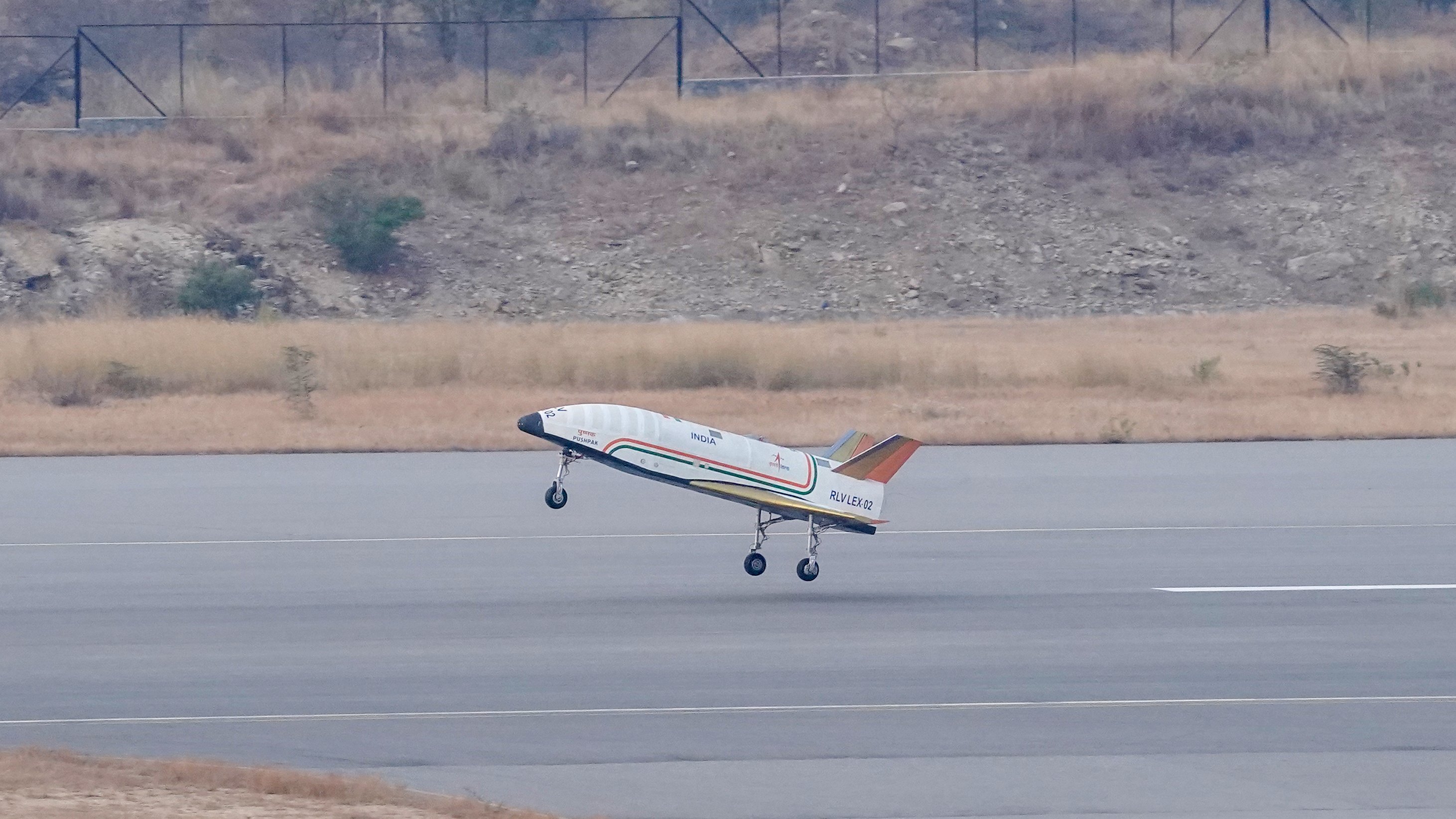
ISRO completes second drop test runway landing of its own mini-reusable shuttle

Pushpak about to land
Click for original image

India’s space agency ISRO yesterday successfully completed the second runway landing of its own mini-reusable shuttle, dubbed Pushpak, after the vehicle was dropped from a helicopter at an altitude of 2.8 miles.

This mission successfully simulated the approach and high-speed landing conditions of RLV returning from space. With this second mission, ISRO has re-validated the indigenously developed technologies in the areas of navigation, control systems, landing gear and deceleration systems essential for performing a high-speed autonomous landing of a space-returning vehicle. The winged body and all flight systems used in RLV-LEX-01 were reused in the RLV-LEX-02 mission after due certification/clearances. Hence reuse capability of flight hardware and flight systems is also demonstrated in this mission. Based on the observations from RLV-LEX-01, the airframe structure and landing gear were strengthened to tolerate higher landing loads. [emphasis mine]

The highlighted sentences I think are the most significant. ISRO is pushing hard for reusability.

The concept of this spacecraft is somewhat comparable to the X-37B, though all the engineering can be applied to larger shuttles that can carry cargo and humans in and out of orbit. At the moment however Pushpak is simply an engineering test prototype, not yet ready for orbital flights. For example, the landing gears are too large and cannot be retracted, something unacceptable for orbital flights.

India’s Vikram lander disturbed the lunar surface the least of all landers

According to an analysis of images taking before and after landing, engineers have concluded that India’s Vikram lander disturbed the lunar surface the least of all landers, due to its use of multiple smaller landing engines.

Presenting the new findings at LPSC on Monday, [ISRO scientist Suresh K] attributed the intriguingly short dust plume to the lack of a central engine on the spacecraft, which resulted in a lower engine thrust during descent. Starting its “rough braking phase” at an orbit of 18.6 miles (30 kilometers) above the lunar surface, when the spacecraft reached 0.4 miles (0.8 kilometers) above its targeted landing area, it switched off two of its four 800-newton engines such that two diagonal engines remained operational all the way until touchdown. The mission used the “least powerful engine till date,” [Suresh] K said. “We’ve observed very less disturbance on the surface.”

You can read their paper here [pdf].

Finding ways to reduce the dust kicked up during landings will be critical for the early missions to the Moon, before landing pads can be constructed. This research suggests that when Starship lands, it should use only its outer engines, and gimbal them sideways, in order to reduce the dust thrown up around it.

India names four astronauts, three of whom will fly on its first manned mission

Prime Minister Narendra Modi of India today revealed the four astronauts training for its first manned mission, dubbed Gaganyaan and targeting a launch next year.

Prime Minister Narendra Modi on Tuesday announced the names of four pilots who are undergoing training for the country’s maiden human space flight mission ‘Gaganyaan’. The pilots are – Group Captain P Balakrishnan Nair, Group Captain Ajit Krishnan, Group Captain Angad Pratap, and Wing Commander S Shukla.

Though all four are training for the mission, only three will fly. The mission itself will orbit the Earth for three days. More information about each man can be found here. All have already received astronaut training in Russia.

ISRO: Upper stage engine of largest rocket now approved for Gaganyaan manned mission

India’s space agency ISRO today announced that it has completed engine tests of the upper stage engine of its LVM rocket, a variation of its GSLV rocket and its most powerful, that will be used on its Gaganyaan manned orbital mission presently scheduled for launch in 2025.

In order to qualify the CE20 engine for human rating standards, four engines have undergone 39 hot firing tests under different operating conditions for a cumulative duration of 8810 seconds against the minimum human rating qualification standard requirement of 6350 seconds.

Before the 2025 manned mission, ISRO plans four more launch abort tests (one has already taken place) and three unmanned Gaganyann orbital demo missions. Two of those unmanned demo flights are scheduled for this year.

India proposes to send its own helicopter to Mars

India has now considering adding its own helicopter to its next Mars mission, dubbed the Martian Boundary Layer Explorer (Marble).

While ISRO’s rotorcraft is still in the conceptual stage, the agency envisions a drone that can fly as high as 100 meters in the thin Martian air. Along with the Marble instrument suite, the drone is expected to carry various sensors, including temperature, humidity, pressure, wind speed, electric field, trace species, and dust sensors.

Whether this mission will include a lander, rover, or orbiter as well is very unclear, which suggests strongly the entire mission profile is presently very much undecided as yet.

Japan and India successfully complete launches

Japan and India today completed launches of different rockets, one on its first successful test launch.

First, early this morning Japan’s new H3 rocket successfully reached orbit for the first time, on its second attempt. The first attempt had problems, first with a launch abort at T-0 when the solid-fueled strap-on boosters failed to ignite. On the launch attempt the upper stage failed. Today’s launch was a complete success, placing a dummy payload into orbit.

Japan’s space agency JAXA however needs to learn how to run a launch in a professional manner. Minutes prior to launch an announcer began a second-by-second countdown, and continued this for minutes after the launch. Not only was this unnecessary and annoying, it made the real updates impossible to hear. India used to do this in its first few live streams, but quickly recognized the stupidity of it. In addition, the person translating the updates clearly knew nothing about rocket launches, so her translations were tentative and often completely misunderstood what had just happened.

All of this makes JAXA look like a second rate organization, which might also help explain its numerous technical failures in recent years.

About twelve hours later, at mid-day in India, India’s space agency ISRO successfully launched its GSLV rocket, placing a commercial radar environmental satellite into orbit.

The leaders in the 2024 launch race:

15 SpaceX
8 China
2 Iran
2 Russia
2 Japan
2 India

American private enterprise still leads the entire world combined in successful launches 17 to 16, with SpaceX trailing the entire world combined (excluding American companies) 15 to 16.

India deorbits a defunct satellite early, in a controlled manner

India’s space agency ISRO yesterday successfully deorbited its defunct Cartosat-2 satellite, using the satellite’s leftover fuel to bring it down in a controlled manner, about three decades sooner than its orbit would have decayed naturally.

The satellite was launched in 2007 to provide detailed ground images of India, and completed its mission in 2019. As noted in ISRO’S press release:

ISRO opted to lower its perigee using leftover fuel to comply with international guidelines on space debris mitigation. This involved reducing collision risks and ensuring safe end-of-life disposal, following recommendations from organizations like the United Nations Committee on the Peaceful Uses of Outer Space (UN-COPOUS) and the Inter-Agency Space Debris Coordination Committee (IADC).

While such actions are a good thing, that governments in India and Europe are suddenly making a big deal about it now — after almost 3/4s of a century of inaction — is not for those reasons, but to lay the political groundwork for allowing the international community, led by the UN, to impose new regulations on all space efforts, both government and private.

Be warned. They are the government, and they are here to help you.

India’s proposed space station now has a name: Bharatiya Antariksh Station

Though no money has yet been allocated to build it, and India’s space agency ISRO has only begun design work, it has now apparently decided to name the space station the Bharatiya Antariksh Station.

They tentatively hope to launch a test module in 2028 to do unmanned rendezvous and docking tests, with assembly beginning in 2028 and completed by 2035.

None of this schedule is certain of course. ISRO has been proposing this space station since 2017. Nothing has ever come of those plans.

Only now does this seem more likely, with India’s effort to shift its space effort from a government-owned and run program to a competitive commercial industry.

Japan and India team up for unmanned lunar lander mission

Japan and India are now partnering to put a lander/rover on the Moon in 2025, dubbed LUPEX.

Set tentatively for 2025, LUPEX will be launched on JAXA’s H3 launcher, with a 350-kg rover developed by the Japanese agency. ISRO is developing the lander. The instruments will be on the lander and the rover. Initial feasibility studies and the lander’s configuration have been completed. The rover will sample the soil with a driller and the samples will be analysed using equipment on the rover,

Unlike the previously successful lunar landers from both countries (India’s Chandrayaan-3 and Japan’s SLIM), LUPEX is being designed to survive the 14-day-long lunar night, with a mission that is aiming to last three to six months.

Indian satellite startup opens new satellite factory

Capitalism in space: The Indian satellite startup Pixxel has opened a new factory in Bengaluru in southern India, where it expects to ramp up satellite production in the coming years.

Bengaluru-based space data company Pixxel inaugurated its first spacecraft manufacturing facility in Bengaluru on Monday. The new facility holds significance as it targets to launch six satellites this year and 18 more by 2025, further advancing its mission of building a “health monitor” for the planet.
Spread across 30,000 square feet, the facility, at its full capacity, is equipped to handle more than 20 satellites simultaneously that can be turned around within a timeframe of six months, making possible a total of 40 large satellites per year.

The company says that its “…total customer base is divided into three divisions as of now – 40 per cent agriculture, 30 per cent resource companies, and 30 per cent government. Pixxel expects 85 per cent of the revenue to be generated from its commercial side and the rest from the government’s side by 2025.”

For India’s government and its space agency ISRO, Pixxel’s existence signals the sea-change in its policies, similar to what has been happening in the U.S. with NASA. In the past ISRO would have built the satellites. Now it is buying them from the private sector in India. That shift bodes well for India’s space industry, and will likely make it a major player in space in the coming years.

India completes first launch of 2024

India’s space agency ISRO early today completed the first launch of 2024, its PSLV rocket placing an X-ray telescope into orbit along with ten payloads on its fourth stage, which is functioning as an orbital tug. Most appear [pdf] to be experiments that will remain on board, but one is an amateur radio smallsat that might be released.

As this is the only launch so far in 2024, India leads the race. It will certainly not remain the leader.

My annual global launch report for 2023 will be published tomorrow, after the holiday.

NASA to fly Indian astronaut to ISS next year

During meetings in India between NASA and ISRO officials, instigated by administrator Bill Nelson’s visit this week, the mission details for the flight of an Indian astronaut to ISS in 2024 are now being worked out.

A Nasa delegation led by Nelson held a meeting with minister of state for science & technology Jitendra Singh on Tuesday. “I had a discussion with the minister on what the Indian astronaut would do on the space station. And the two of us talked about the fact that things that are important to India in scientific research, the Indian astronaut ought to have that as a choice to do. If there is a particular part of research that he or she would be interested in, then I want to encourage that,” Nelson later said at a media interaction. “Nasa will help train the Indian astronaut to fly to ISS by end of 2024. Those details are being worked out. Indian Space Research Organisation (Isro) will announce that,” Nelson said.

Though this plan for NASA to fly Indian astronaut to ISS next year was first announced in June, it was overshadowed by India’s decision at that time to sign the Artemis Accords.

It is also important to recognize that the real arrangements are all being done by others, that Nelson and the India government officials are merely there to get their faces on television.

If this flight happens as planned, next year could be very exciting for India’s manned space program, since it also hopes to fly its own manned mission at that time.

India now plans robotic lunar sample return mission

Following the successful landing of Vikram on the Moon, officials of India’s space agency ISRO have announced it is considering a much more ambitious follow-up, Chandrayaan-4, that will not only land on the lunar surface with a much larger rover, it will also dig up some samples and return them to Earth.

The spacecraft will travel to the moon, land, collect samples, and then connect to another module in space. The module will then return to Earth orbit. As the two modules approach Earth, they will separate, with one part returning to Earth and the other will keep orbiting the planet. Desai described the mission as ambitious, stating, “Hopefully, in the next five to seven years, we will meet the challenge of bringing samples from the moon.”

For return to Earth, Desai said that the mission would need two launch vehicles containing four modules (Transfer module, Lander Module, Ascender Module and Re-entry module). RM and TM would be Parked in the lunar orbit and two will go down from which Ascender Module will get separated from lander module and would collect the sample.

If India does this mission, while also completing its first manned mission during that time frame, it will place itself in direct competition with China and the U.S., and in fact will be getting close to matching both in capabilities.

India releases on-board camera views during its Gaganyaan launch abort test

India’s space agency ISRO today released the on-board camera views taken during its Gaganyaan launch abort test on October 21, 2023.

The test was a complete success, and the footage shows each step clearly, from launch to stage separation to deployment of parachutes.

ISRO is still targeting 2024 for the first manned Gaganyaan mission, which will carry two to three astronauts into orbit for three to seven days. To meet that target however will require a lot of fast work, as the agency intends to fly three separate unmanned orbital missions of the Gaganyaan capsule prior to putting humans in it. More likely the manned mission will happen in 2025.

Gaganyaan abort test flight flies successfully after short delay

When I went to bed last night India’s Gaganyaan abort test flight had been cancelled due to a launch abort at T-0, with the live stream ending and an expectation that engineers would need at least another day to fly.

When I woke up it turned out that ISRO behaved more like SpaceX than a government agency. It quickly figured out what was wrong, recycled the countdown, and two hours later successfully flew the test of its launch abort rescue system for its manned Gaganyaan capsule.

Indian Space Research Organisation (ISRO) successfully executed the Test Flight Abort Mission, for the Gaganyaan mission on Saturday after the first test flight was aborted at 8:45 am due to a problem in the engine ignition. ISRO Chief S Somanth said the planned lift off the TV-D1 rocket could not happen following an anomaly that will be analysed. He said that the engine ignition of the TV-D1 rocket did not happen over time.

The space agency then said that the errors have been identified and corrected and the second launch was scheduled for 10:00 Hrs today.

And at 10 am, ISRO successfully launched the test vehicle from Sriharikota today. Chairman Somanath expressed happiness and said, “I am very happy to announce the successful accomplishment of Gaganyaan TV-D1 mission”.

The test rocket launched, the abort system separated from the rocket as planned, the capsule was released from the abort system, its parachutes then opened, and the capsule then safely splashed down in the Bay of Bengal about ten miles off the coast, where it was recovered successfully.

ISRO plans a second launch abort test prior to flying the actual manned mission, but at this moment it appears very close to being ready for a manned mission in 2024, its present goal.

India’s Gaganyaan launch abort test aborts at T-0

India’s attempt today to test the launch abort system to be used to safely propel its manned Gaganyaan capsule away from a failing rocket aborted at T-0.

They need to take the spacecraft back to the assembly building in order to figure out what went wrong, so the next attempt will likely be delayed at mininum several weeks. UPDATE: That’s what the head of ISRO said at the end of this live stream, but that is not what happened. See new post above.

India rocket startup Agnikul raises $26.7 million in new private investment capital

The new colonial movement: The Indian rocket startup Agnikul has now raised an additional $26.7 million in private investment capital, bringing its total cash on hand now to about $40 million.

The company hopes to complete the first suborbital launch of its Vikram-S rocket in mid-November. If successful, it will be the second private rocket startup in India to do it, joining Skyroot, which did its first suborbital test flight last year. Both companies plan orbital versions of these rockets, and are also likely bidding to take over the SSLV (Small Satellite Launch Vehicle) rocket from India’s space agency ISRO. The Modi government is offering to literally give it to a private company to operate for profit.

1 2 3 4 10