Chang’e-6 to attempt landing on Moon’s far side on June 1st

Chang'e-6 landing zone

After spending almost a month in lunar orbit, the lander on China’s Chang’e-6 sample return mission will attempt a soft touchdown on Moon’s far side on June 1, 2024 at 8:00 pm (Eastern).

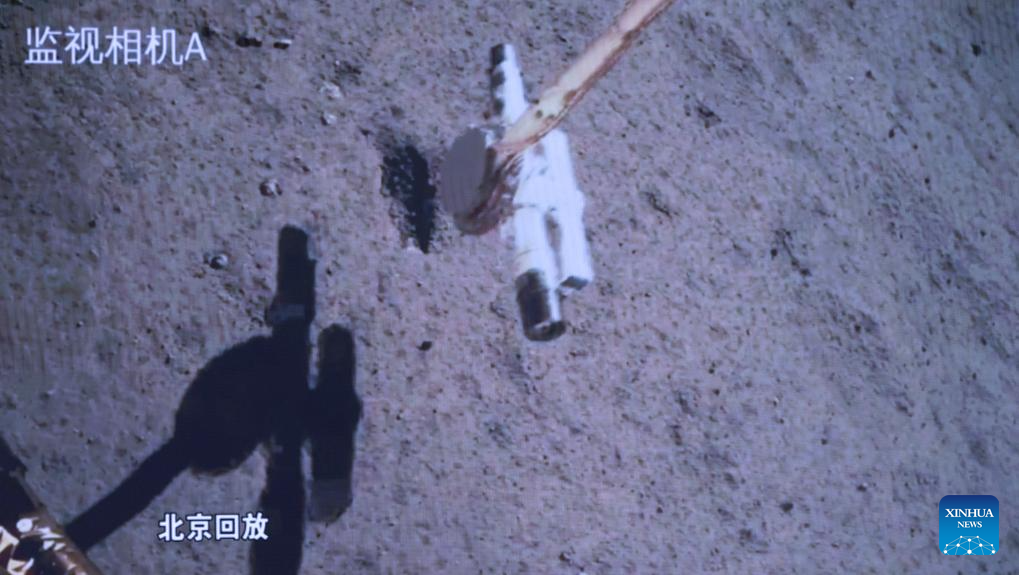
If successful, the lander will go through initial checks and setup. It will then begin drilling and scooping up materials from the surface. These samples, expected to weigh up to 2,000 grams, will be loaded into an ascent vehicle. The ascender will then launch the precious cargo back into lunar orbit for rendezvous and docking with the orbiter. Surface operations will last about 48 hours.

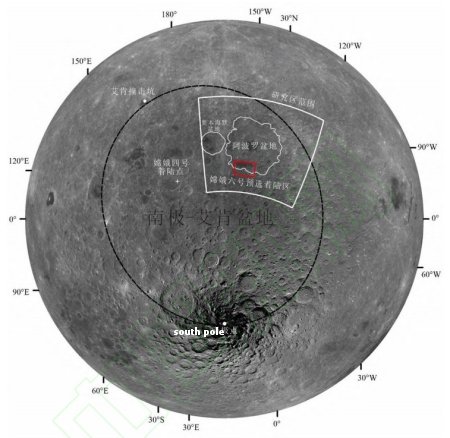
The map to the right indicates the landing zone by the red box, on the southern edge of Apollo Crater, indicated by the wavy white circle. The black circle marks the perimeter of South Aitken Basin, the largest impact basin on the Moon.

Once the ascender docks with the orbiter, the sample will be transferred into the sample return capsule, which will bring that sample back to Earth in late June.

1 comment

SLIM goes dark

SLIM's landing zone
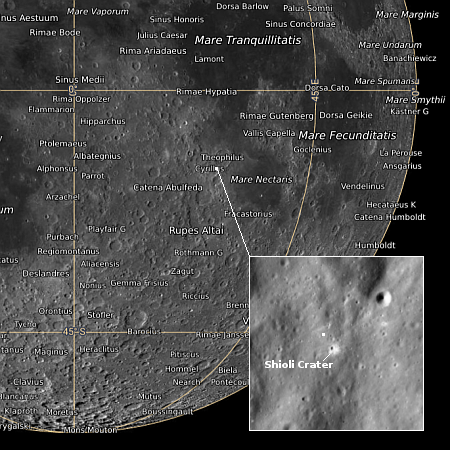
Map showing SLIM landing zone on the Moon.
Click for interactive map.

The Japanese lunar lander SLIM has failed to respond to ground commands sent soon after dawn, ending the lander’s fourth night on the Moon.

SLIM was never expected to survive the harsh conditions of even a single 14-day-long lunar night after landing on the Moon in January 2024. Its primary mission had been to test precision autonomous landings, which it did successfully (though it landed on its side when one nozzle fell off just before touchdown). Yet, it then survived three lunar nights, resuming communications at dawn.

Its failure now is therefore no surprise, and actually marks a magnificent engineering success. The spacecraft’s hardware was proven robust enough to survive the very cold temperatures during lunar night, and suggests that future Japanese lunar landers using SLIM designs will function as well.

1 comment

Ispace gets a new payload for its first NASA lunar landing mission

Capitalism in space: The Japanese company Ispace has won a contract with the European company Control Data Systems (CDS) to place CDS’s precise localization instrument on Ispace’s APEX lunar lander, its first NASA mission.

CDS’s technology, which combines precision localization with telecommunications, uses Ultra-Wideband for determining precise positions and was developed specifically for space applications with support from the European Space Agency. The lack of a GPS-like system on the Moon, makes the technology ground-breaking for future applications related to lunar exploration.

The agreement … also represents the first Romanian payload to be delivered to the lunar surface. The technology will be integrated into the APEX 1.0 lunar lander as part of ispace technologies U.S. (ispace-U.S.) Mission 3, currently scheduled for 2026. A lunar rover will transport the CDS equipment on the surface to test the localization technology using an antenna that will remain on the APEX 1.0 lander.

Though Ispace is based in Japan, it has divisions in both the U.S. and Europe, which is allowing it to sign contracts with NASA and companies in both locations.

0 comments

ISRO to land its Chandayaan-4 lunar sample return mission near where Chandrayaan-3 landed


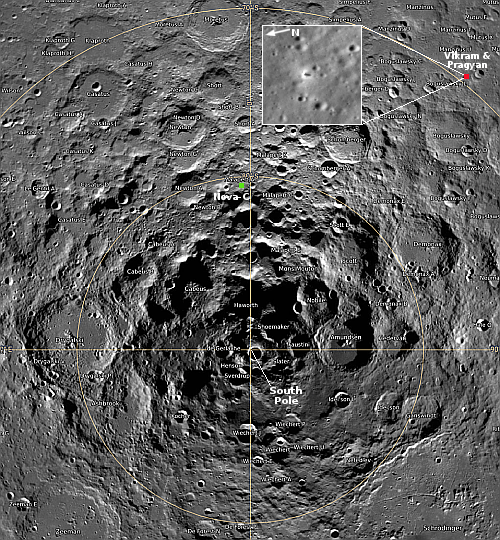
Click for interactive map. To see the original
image, go here.

India’s space agency ISRO announced on May 11, 2024 that the landing site for its Chandayaan-4 lunar sample return mission will be in the same area where its Chandrayaan-3’s Vikram lander touched down, carrying the Pragyan rover.

The map to the right shows that location, at about 69 degrees south latitude. The mission will require two launches, and will have five components, a propulsion module, a transfer module, a lander module, an ascender module and a re-entry module. The two rockets will use India’s LVM-3 and PSLV rockets.

The actual mission concept, including which modules will be launched with which rocket as well as whether they will dock in Earth or lunar orbit, has not yet been released. This most recent tweet however mentioned that the lander will only operate for one lunar day, which means it will land, grab its samples quickly, and send the ascender capsule up, all within an Earth week.

A launch timeline for the mission also remains unclear.

0 comments

Significant water found in samples from China’s Chang’e-5 Moon mission

According to a new paper published in late April, scientists analyzing the samples returned from the Moon by China’s Chang’e-5 Moon mission in 2021 have found more water embedded in the topsoil than expected. From the paper’s conclusions:

[O]ur results indicate that a considerable [solar wind]-derived water is stored within at least the uppermost meter (down to 0.8 meters) of the regolith beneath the lunar surface. This type of water represents a valuable potential resource for future in situ exploration of the Moon, as it not only has higher contents than indigenous water (up to several wt.% vs. <50 ppm) but could also be extracted by heating.

We are still not talking about a lot of water, but this result suggests there is more than earlier reports from Chang’e-5’s samples. This result also could explain the hydrogen signature across much of the Moon’s surface by Chandrayaan-1.

7 comments

Serbia joins China’s lunar base project

Serbia this week signed an agreement with China to become the eleventh nation to join its International Lunar Research Station (ILRS) lunar base project.

China’s project now has eleven partner nations (Azerbaijan, Belarus, Egypt, Nicaragua, Pakistan, Russia, Serbia, South Africa, Thailand, Turkey, and Venezuela) and eleven academic or governmental bureaucracies.

Except for China and Russia, the other partners are very minor players in space, and will likely contribute relatively little to the lunar base other than providing China some shallow positive PR.

Nonetheless, the two competing alliances in settling the solar system are becoming clear. On one side you have the alliance led by the U.S. under the Artemis Accords, while on the other you have an alliance led by China, under its lunar base project. Both right now appear only interested in establishing government power in space.

In the middle will be ordinary people, dreaming of building new societies to live in on other worlds. Sadly it increasingly appears they will be crushed between these two big government alliances. Though the U.S. alliance was initially established to foster private property and ownership so that those settlers could have as free and as prosperous a life as the Americans who settled the United States, it no longer seems interested in that goal.

4 comments

Chang’e-6 enters lunar orbit

Chang'e-6 landing zone

China’s Chang’e-6 sample return spacecraft successfully entered lunar orbit today, in preparation for its mission to land and bring back material from the the far side of the Moon. The landing zone is indicated by the red box on the map to the right, on the southern rim of Apollo Crater in the southern hemisphere. That crater is inside South Aitkin Basin, one the Moon’s largest impact basins.

The spacecraft will next adjust its orbit to prepare for sending its lander-ascender sections down to the surface. If the landing goes well, it will drill into the surface, place some material into the ascender section, which will then lift-off and dock with the orbiter-return section in orbit. The material will be transferred into the return section, which will separate and bring the material back to Earth, sometime in late June.

0 comments

China launches Chang’e-6 sample return mission to the far side of the Moon

Chang'e-6 landing zone

The new colonial movement: China today successfully launched its Chang’e-6 sample return mission to the far side of the Moon, its Long March 5 rocket lifting off from its coastal Wenchang spaceport. Unlike the Long March 5B, whose core stage reaches an unstable orbit and later crashes uncontrolled somewhere on Earth, the core stage of Long March 5 does not, and thus returns to Earth immediately, over the ocean.

The graphic from the right, released by China’s state-run press, shows the landing zone in red on the far side. The target is the southern rim area of Apollo Crater, marked by the uneven white outline. Apollo sits inside the South Aitken Basin, one of the Moon’s largest impact basins, 1,600 miles across, and roughly indicated by the black circle. The circle to the left of Apollo indicates Van Karman crater, where Chang’e-4 landed in 2019 with the Yutu-2 rover, both still operating.

The mission includes a lunar orbiter, a lander, an ascent vehicle, and an Earth sample return capsule. If all goes as planned, the samples will return to Earth in 53 days.

The leaders in the 2024 launch race:

45 SpaceX
18 China
6 Russia
5 Rocket Lab

American private enterprise still leads the world combined in successful launches, 52 to 30. SpaceX by itself still leads the rest of the world, including other American companies, 45 to 37.

6 comments

NASA IG: Major technical problems with Orion remain unsolved

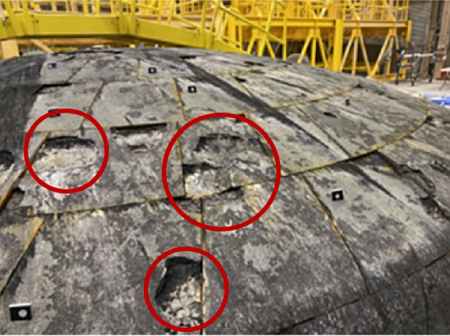
Orion's damage heat shield
Damage to Orion heat shield caused during re-entry,
including “cavities resulting from the loss of large chunks”

A just released report [pdf] by NASA’s inspector general has found the major technical problems discovered after the first unmanned Artemis mission of Orion around the Moon remain unsolved, and threaten the safety of the astronauts that NASA plans to send around the Moon on the second Artemis mission.

The problems with Orion are threefold and are quite serious, involving its heat shield, separation bolts, and power distribution.

Specifically, NASA identified more than 100 locations where ablative thermal protective material from Orion’s heat shield wore away differently than expected during reentry into Earth’s atmosphere. Engineers are concurrently investigating ways to mitigate the char loss by modifying the heat shield’s design or altering Orion’s reentry trajectory.

In addition, post-flight inspections of the Crew Module/Service Module separation bolts revealed unexpected melting and erosion that created a gap leading to increased heating inside the bolt. To mitigate the issue for Artemis II, the Orion Program made minor modifications to the separation bolt design and added additional thermal protective barrier material in the bolt gaps.

NASA also recorded 24 instances of power distribution anomalies in Orion’s Electrical PowerSystem. While NASA has determined that radiation was the root cause and is making software changes and developing operational workarounds for Artemis II, without a permanent hardware fix, there is increased risk that further power distribution anomalies could lead to a loss of redundancy, inadequate power, and potential loss of vehicle propulsion and pressurization.

Moreover, like with any engineering system, without understanding the residual effects of introducing design and operational changes, it will be difficult for the Agency to ensure that the mitigations or hardware changes adopted will effectively reduce the risks to astronaut safety.

This is not all.
» Read more

21 comments

Scientists: computer modeling suggests one lunar crater is the origin of a nearby asteroid

The uncertainty of science: Using computer modeling some scientists now suggest that the nearby asteroid 2016 HO3, also known as Kamo’oalewa, that has a solar orbit that periodically flips around the Earth, came from an impact a million years ago that created the Giordano Bruno crater on the moon’s far side.

According to the simulations, it would have required an impactor of at least 1 kilometer (0.6 mile) in diameter to launch a large fragment like Kamo’oalewa beyond the moon’s gravitational pull. According to the group’s model, the impact would have dug up Kamo’oalewa from deep beneath the moon’s surface, leaving behind an impact crater larger than 10 to 20 kilometers (6-12 miles) in diameter. Additionally, the crater would have to be younger than the average lifetime for near-Earth objects, which spans about 10 million to 100 million years, a very short and recent period in the history of the solar system.

While the lunar surface is riddled with thousands of craters from impacts spanning the moon’s 4.5 billion year-history, only Giordano Bruno with its 14-mile diameter and estimated 4 million years of age fits the bill in terms of size and age, making it the most probable source of Kamo’oalewa’s origin. The team also showed that this scenario is feasible from an impact dynamics perspective.

To say that this conclusion is uncertain is an understatement of monumental proportions. However, the possibility is real. A Chinese asteroid mission, dubbed Tianwen-2, will likely found out, as it is planning to bring samples back from this asteroid by 2027.

1 comment

China reveals its rough plans for building its manned moon base.

At a conference in China this week, the chief designer of China’s lunar exploration program, Wu Weiren, outlined roughly the plans for building China’s International Lunar Research Station (ILRS) on the Moon.

According to Wu, the first phase of the ILRS construction project will see a basic station built by 2035 in the lunar south pole region. This basic station will have comprehensive scientific facilities with complete basic functions and supporting elements to carry out regular scientific experiments, and develop and utilize resources on a limited scale.

The second phase will see expansion of the station, set for completion by 2045, with a moon-orbiting space station as the hub and facilities featuring complete functions, considerable scale and stable operation. It will carry out comprehensive lunar-based scientific research and resource development and utilization, and conduct technical verification as well as scientific experiments and research for a manned landing on Mars.

This schedule contradicts other recent government statements that suggested the first phrase would be completed by 2030. Either way, we now have a rough timeline which, based on China’s past announcements, should be a reasonably accurate measure of what it now plans to do.

The timeline however is very long, and many other events outside of this program, such as war with Taiwan or sudden changes in the leadership of the ruling communist party, could change it drastically.

4 comments

China releases new geological atlas of the Moon

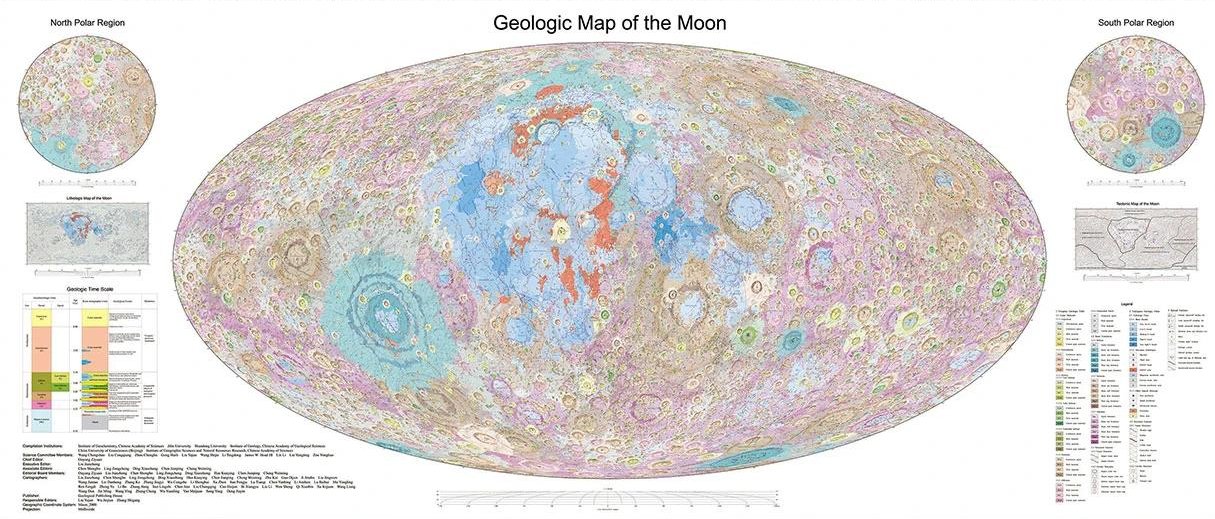
China's geologic map of the Moon

The map above is one low resolution example of a new detailed geological atlas that Chinese scientists have created and just released, using data obtained from all of China’s recent lunar missions, both orbiters and landers.

More information here.

The Chinese Academy of Sciences (CAS) has released the highest-resolution geological maps of the Moon yet. The Geologic Atlas of the Lunar Globe, which took more than 100 researchers over a decade to compile, reveals a total of 12,341 craters, 81 basins and 17 rock types, along with other basic geological information about the lunar surface. The maps were made at the unprecedented scale of 1:2,500,000.

…The CAS also released a book called Map Quadrangles of the Geologic Atlas of the Moon, comprising 30 sector diagrams which together form a visualization of the whole Moon.

The map has been released in both Chinese and English.

3 comments

More partners join China’s International Lunar Research Station

China today announced the addition of three more international partners in its project to build a permanent base on the Moon, dubbed the International Lunar Research Station (ILRS).

The new partners of the ILRS include Nicaragua, the Asia-Pacific Space Cooperation Organization and the Arab Union for Astronomy and Space Sciences. China will collaborate with these three parties on various issues concerning the ILRS, including its demonstration, engineering implementation, operation and application, according to the CNSA.

China’s project now has ten partner nations (Azerbaijan, Belarus, Egypt, Nicaragua, Pakistan, Russia, South Africa, Thailand, Turkey, and Venezuela) and eleven academic or governmental bureaucracies.

If all goes as planned, China hopes to have the basic station established by 2030, which it will periodcially and intermittently send astronauts.

2 comments

SLIM survives its third lunar night

Though it was primarily designed to prove its landing system and was never expected to resume operations after enduring the long 14-day-long lunar night, Japan’s SLIM lunar lander has successfully survived its third lunar night, resuming contact with Earth yesterday.

JAXA said on the social media platform X that SLIM’s key functions are still working despite repeated harsh cycles of temperature changes. The agency said it plans to closely monitor the lander’s deterioration.

While the newly downloaded data and photos have some scientific value, the important data is the spacecraft’s engineering status. Finding out what continues to work and what fails after each lunar night will inform engineers on what to do best to build future lunar landers and rovers.

2 comments

Boeing to reduce staffing for SLS due to overall delays in Artemis

Boeing announced yesterday that it is going to reduce the staffing for its SLS rocket, caused by delays in other parts of the program that force it to stretch out operations.

When Boeing cites “external factors,” it is referring to the slipping timelines for NASA’s Artemis Program. In January officials with the space agency announced approximately one-year delays for both the Artemis II mission, a crewed lunar flyby, to September 2025; and Artemis III, a lunar landing, to September 2026. Neither of these schedules are set in stone, either. Further delays are possible for Artemis II, and likely for Artemis III if NASA sticks to the current mission plans.

Although the SLS rocket will be ready for the current schedule, barring a catastrophe, the other elements are in doubt. For Artemis II, NASA still has not cleared a heat shield issue with the Orion spacecraft. That must be resolved before the mission gets a green light to proceed next year. The challenges are even greater for Artemis III. For that mission NASA needs to have a lunar lander—which is being provided by SpaceX with its Starship vehicle—in addition to spacesuits provided by Axiom Space for the lunar surface. Both of these elements remain solidly in the development phase.

What Boeing is telling us indirectly is that, though NASA has not yet announced any further delays in those launch dates for Artemis-2 and Artemis-3, those dates are going to be delayed, quite possibly by one or more years.

None of this is a surprise. I have long been predicting that the first manned lunar landing in the Artemis program will not take place before 2030. In fact, that date was obvious the moment NASA announced its plan to make the Lunar Gateway space station an integral part of the program, back in 2018, when it was called LOP-G.

Now that SLS development is complete and NASA considers it “operational”, Boeing is merely reducing the staffing to maintain its assembly line, reducing it accordingly because of expected delays when additional rockets will be needed.

3 comments

China: Quequiao-2 is successfully operating in lunar orbit

China’s state-run press today announced that its Quequiao-2 communications relay satellite in lunar orbit has successfully completed its initial in-orbit tests, and is functioning as planned.

The satellite successfully completed a communication test on April 6 with Chang’e-4, which is now carrying out an exploration mission on the far side of the moon. From April 8 to 9, it conducted communication tests with the Chang’e-6 probe, which is yet to be launched. Queqiao-2 was launched on March 20 and entered its target highly elliptical orbit on April 2 after midway correction, near-moon braking and orbital maneuver around the moon.

Two communication and navigation technology test satellites, Tiandu-1 and Tiandu-2, were sent into space together with Queqiao-2. They entered their target circumlunar orbits on March 29 and separated with each other on April 3. They are now conducting a series of tests on communication and navigation technology.

According to the article, Quequiao-2’s orbit is relatively stable for a lunar orbit and requires less fuel to maintain. The spacecraft thus should be able to operate for a very long time. The orbit “has also significantly improved its communication coverage on the south pole region of the moon.” It will be used for all of China’s future unmanned and manned lunar missions, and will provide China the ability to do farside missions routinely.

0 comments

Japan and NASA ink lunar deal

After several years of discussion, Japan and NASA have finally signed an lunar exploration agreement whereby Japan will build a pressurized rover that astronauts can use to travel large distances in exchange for NASA launching two Japanese astronauts to the Moon.

An enclosed and pressurized rover will enable astronauts to travel farther and conduct science in geographically diverse areas by serving as a mobile habitat and laboratory for the astronauts to live and work for extended periods of time. It will be able to accommodate two astronauts for up to 30 days as they traverse the area near the lunar South Pole. NASA currently plans to use the pressurized rover on Artemis VII and subsequent missions over an approximate 10-year lifespan.

This rover is being built in a deal between Japan’s space agency JAXA and Toyota. It will be very heavy, which meanst NASA is now planning its lunar exploration with Starship as a fundamental part. No other planned lunar lander could bring this kind of mass to the surface.

The two Japanese astronauts will likely fly on two different Artemis missions over that time-span. When these missions will occur will largely depend on how long NASA stubbornly sticks with is SLS/Orion/Lunar Gateway framework for getting astronauts to the Moon. These assets are not yet ready. They are also very cumbersome and expensive and slow. Missions using SLS expecially cannot occur faster than every two years, if that. If NASA depends on them, serious lunar exploration will likely not occur before 2030, at the earliest.

If however SpaceX’s Starship/Superheavy becomes operational in the next two years, and NASA switches operations to it instead, the pace will pick up, exponentially. Launches could likely occur multiple times per year, and it will be possible to put large amounts of mass on the Moon quickly. That lunar base will be built fast.

The decision to switch however will require a political decision, one that it appears many in Washington are reluctant to make. First, the Democrats now see Elon Musk as an enemy. Why award his company? Secondly, SLS/Orion/Gateway are great jobs programs. Abandoning them will eliminate a lot of wasteful pork, a sin to the politicos who operate our government for their interests, not the interests of the country.

0 comments

China successfully tests new propulsion system for satellites

The state-run Chinese press today touted the successful use of a new “cold-propulsion system” on the Tiandu-2 test satellite launched into lunar orbit with its Queqiao-2 relay communications satellite.

The cold propulsion system recently provided high-precision orbital attitude control for the satellite during lunar orbit, marking the first successful application of the liquid ammonia cold air micro-propulsion system in the field of deep-space exploration.

The storage tank is an important component of satellite propulsion systems. As a pressure component, it requires not only high precision of forming and no leakage, but also good anti-fatigue performance, allowing for repeated fuel filling and discharge.

The article touts the tank so much because it was 3D-printed, making it the first such tank sent into space by China.

0 comments

Japan to sign deal with NASA to fly two Japanese astronauts to Moon

According to story in the Japanese press yesterday, a deal between Japan and NASA will be signed next week whereby Japan will have two astronauts go on Moon missions in exchange for providing cargo to the Lunar Gateway station as well as a manned lunar rover.

The report today is unclear whether those Japanese astronauts will land on the Moon, but I expect they will. The rover project is being led by Toyota. It will include a airtight cabin where spacesuits will not be necessary and passengers can also sleep, allowing for very long exploratory traverses from the landing site.

Reports of this deal have been appearing in the press since 2022, when NASA said it would involve flying one Japanese astronaut to the Moon. In December 2023 it was reported that the deal would be signed within a month. It is now April. It appears the extended negotiations have gotten Japan a second astronaut Moon walker.

NASA’s Artemis program is beginning to shape up as an international program for getting almost everyone to the Moon but Americans. I am exaggerating, but I think in the future Americans will find it easier to go on a private mission to the Moon than depend on NASA, especially because of all the international deals NASA will have to honor.

0 comments

Lunar Reconnaissance Orbiter snaps a smeared image of South Korea’s Danuri lunar obiter

Danuri as seen by LRO
Click for original image.

Cool image time! On March 5 to March 6, 2024, the orbits of NASA’s Lunar Reconnaissance Orbiter (LRO) and South Korea’s Danuri orbiter had three close approaches, during which LRO had a chance to snap pictures of Danuri as it zipped by in the opposite direction.

The first image is to the right, cropped but expanded to post here.

The flight paths of the two vehicles were nearly parallel but in opposite directions, resulting in extreme relative velocity. The LROC NAC exposure time was very short, only 0.338 milliseconds. But still, Danuri was smeared by a factor greater than 10x in the downtrack direction.

…On the first opportunity, LRO was slewed 43 degrees to capture Danuri from a distance of 5.0 kilometers

Of the three pictures taken, this one appears the best. In all three cases, the fast relative speed was too fast for the camera shutter, so that Danuri’s image was smeared as you see.

2 comments
1 9 10 11 12 13 57