European Union proposes new space law to supersede national space rules

The European Union

The European Union (EU) has now released its proposed Space Act that would impose European-wide regulations on the space industries of all its partnering nations, superseding their own regulations and policies.

The press release claims, at the start, that this space act would “cut red tape, protect space assets, and create a fair, predictable playing field for businesses,” but in reading the act itself [pdf], it appears to do the exact opposite. It imposes new environmental, safety, and cybersecurity regulations on the design of satellites and spacecraft in a manner that will likely slow development and competition in Europe significantly. And it applies these regulations not only to European companies but to the rest of the world’s space industry, should it do any operations at all in Europe.

This European Union space law was initially supposed to be released last year, but was delayed because it appeared there was strong opposition to it from many of the union’s member nations.

The proposed law appears to have been reshaped to limit the areas the EU can regulate space, but my appraisal of these regulations is that they are designed to quickly expand to cover everything, while adding an unneeded layer of red tape across Europe’s space industry that will only cause it to founder.

It must also be noted once again that there is no one in the bureaucracy of the EU qualified to impose these regulations on the space industry. The EU launches nothing. Its bureaucracy knows nothing about space technology. All it can do is say no to anyone that wants to achieve anything, just because it thinks it knows better.

It will be interesting to see if this space law passes. It still must be approved by European Parliament and the European Commission. I expect there to be significant opposition from several different member states, most especially Germany, Spain, and Italy, each of which have a newly emerging space industry. We should also expect opposition from the member nations formerly part of the Soviet bloc, as their past totalitarian experience makes them very skeptical of this kind of bureaucratic power play.

At the same time, the political structure of the European Union is designed to encourage the passage of such laws, which is one reason there is a rising movement in many member nations to leave the union. If the law passes, expect it to cause more fragmentation within Europe, rather than unifying the continent as it claims it will do.


4 comments

French startup Latitude to spend $9.3 million on building its French Guiana launch facility

French Guiana spaceport
The French Guiana spaceport. The Diamant launchsite is labeled “B.”
Click for full resolution image. (Note: The Ariane-5 pad is now the
Ariane-6 pad.)

The French rocket startup Latitude has announced it will spend $9.3 million to build its own launchpad at the spaceport in French Guiana, where hopes to launch its Zephyr rocket in 2026.

In a 23 June update, Latitude confirmed the Guiana Space Centre as the launch site for the inaugural flight of its 19-metre-tall, two-stage Zephyr rocket, which is designed to deliver payloads of up to 200 kilograms to low Earth orbit. The site was one of two under consideration, with the company also having committed to developing launch infrastructure at SaxaVord Spaceport in Scotland. When that partnership was announced in March 2022, Latitude, then known as Venture Orbital Systems, aimed to carry out its first launch from SaxaVord in 2024.

Construction of the ELM-Diamant shared launch facility began in 2025 and is expected to be completed by 2026. According to Latitude’s 23 June update, the company will work with CNES and the European Space Agency in the coming months to implement its dedicated launch infrastructure at the site. This will be followed by the inaugural launch of its Zephyr rocket in 2026.

It is not clear exactly how that ELM-Diamant launch site will be shared. France’s space agency CNES (which operates French Guiana) had previously said it wanted all the new European rocket startups that wanted to launch from there to use a common launch infrastructure, thus requiring them to share technology as well as redesign their rockets to fit CNES’s requirements. The rocket startups objected, but it now appears two startups, Latitude and PLD, and come to an agreement of some sort.

This deal also suggests that Latitude is shifting away from using the Saxavord spaceport in the United Kingdom, possibly because it has seen the difficult regulatory hurdles required there and has decided French Guiana is a better option.

2 comments

Mexican president threatens action against SpaceX at Boca Chica

The president of Mexico, Claudia Sheinbaum, yesterday indicated that her government was considering taking legal action against SpaceX because of the debris from its Superheavy rocket that was found washed up on its beaches after a test launch.

Mexico’s government was studying which international laws were being violated in order to file “the necessary lawsuits” because “there is indeed contamination”, Sheinbaum told her morning news conference on Wednesday.

…Mexican officials are carrying out a “comprehensive review” of the environmental impacts of the rocket launches for the neighboring state of Tamaulipas, Sheinbaum said.

Other than this one quote, the article at the link is largely junk, focusing on the test stand explosion last week of Starship, an event that has nothing to do with the material found on Mexico’s beaches. Moreover, that debris was apparently so harmless Mexicans were able to quickly gather it for souvenirs, with some immediately making money from it by selling it on social media.

In other words, this “investigation” and this “reporting” is nothing more than anti-Musk rhetoric because Musk has aligned himself with Trump.

22 comments

France’s space agency awards ArianeGroup contract to build methane-fueled engine

France’s space agency CNES this week awarded ArianeGroup, the rocket partnership between Airbus and Safran that builds the Ariane-6 rocket a contract to develop a more powerful methane-fueled rocket engine.

Aiming to reach between 200 and 300 tons of thrust, the new engine will be twice as powerful as the current Vulcain 2.1 main stage engine that propels Ariane 6.

No details about cost or time schedule were released.

The significance of this deal isn’t the engine, but that it was issued directly to ArianeGroup by France’s space agency, instead of through the European Space Agency’s (ESA) Arianespace commercial arm, as has been routine for the past three decades. The deal illustrates how the ESA is essentially beginning to break up. Rather than go through it, its individual nations are now going it alone, each providing support and funding to their own commercial private space startups. Germany began this process, encouraging the development of three new rocket companies (Rocket Factory Augsburg, Isar, and Hyimpulse). Spain and Italy soon followed with their own new rocket companies, (PLD and Avio respectively). France, which until recently lobbied to keep the old government model alive in ESA, has in the past year shifted strongly to the capitalism model.

This contract only underscores this shift.

1 comment

Why should anyone listen to people who behave like infantile toddlers?

A modern Democrat protester
The modern face of the Democratic Party.
Click for video.

For decades the Democratic Party and the left (I repeat myself) have used public demonstrations to garner support for their agenda. A bunch of protesters would gather in some public place, holding preprinted signs and demanding “action” for some leftist cause or another. The propaganda press would then give the protest loving coverage, advocating the cause nationwide as something that “must be done.”

For decades these protests have had some success. They forced the public debate to move in the direction the protesters wanted, and almost routinely resulted in legislative or executive actions that they supported.

All this has changed. The recent protests against the Trump administration’s effort to deport illegal immigrants, often devolving into violence, rioting, and looting, have done nothing to shift Trump’s policies. More important, they have done nothing to convince the public to their cause. If anything, all polls indicate these protests have been counter-productive, that the public has shifted even more strongly in its support of Trump.

The picture to the right, a screen capture from the video below, I think illustrates beautifully why these protests have failed so spectacularly. It shows a woman insanely trying to stop an ICE vehicle carrying captured illegals by grabbing the bus’ front grill. As she does this she starts screams madly, first by shrieking “Let my people go!” and then “Don’t kill me!” as the vehicle begins to accelerate. Eventually ICE officers pull her away, but then she tries to grab the side of this bus as well as two others that follow, all the while continuing her mindless screeching.
» Read more

27 comments

A blacklisted American wins in court

Bruce Gilley of Portland State University, willing to fight
Bruce Gilley, formerly of Portland State University

Back in 2017 political science professor Bruce Gilley wrote a quite reasonable historical paper in the academic journal Third World Quarterly that took a look at the colonialism of the western nations in 1800s and concluded that this colonialism had not been all bad, and in fact had brought “significant social, economic and political gains” to the nations colonized.

For this sin of honest academic analysis (certainly open to debate), the academic community put together a coordinated international campaign to get his paper withdrawn and his reputation ruined. He received death threats, and later in response to these threats and this campaign — including the resignation of fifteen of its board members — the journal withdrew Gilley’s paper. It didn’t do so because of any academic flaws in the work, only because it dared state conclusions that today’s leftist, Marxist, and very bigoted academic community cannot tolerate.

Soon thereafter Gilley found himself blacklisted and censored at his university, Portland State University in Oregon. The communication manager for its Division of Equity and Inclusion, Tova Stabin, blocked him from a college X discussion group because Gilley had had the nerve in one email to quote Thomas Jefferson, noting that “all men are created equal.”
» Read more

5 comments

Europe’s old aerospace industry struggles with the concept of competition

Made in European Union

Two stories today from Europe’s aerospace industry suggest that its older big space companies are having real difficulties dealing with the new space landscape of competition and freedom.

First, Arianespace and Avio issued a statement demanding that Europe require that all European launches occur on European rockets.

The statement warned that without “sustained support,” European rocket builders were at risk of losing out to institutionally backed competitors from the US. “Major space powers support their industries through stable and guaranteed institutional markets, enabling long-term investments, innovation, and the preservation of leadership,” explained the statement.

…The pair argue that Europe risks falling behind not due to a lack of technical capability, but because of structural market weaknesses. While Ariane 6 and Vega-C have demonstrated competitiveness and reliability, they caution that this progress is fragile in the absence of guaranteed long-term demand.

While a preference for European launch providers is clearly in the best interest of both Avio and Arianespace, the pair did reserve a slice for new entrants to the market. “Enshrining European preference as an untouchable principle would support not only Ariane and Vega, but also foster the development of emerging projects in the small launcher sector.” [emphasis mine]

The highlighted sentence reveals the true reasons behind this call against competition. » Read more

5 comments

Under Trump FCC shifts from regulating satellite construction and de-orbit to streamlining red tape

FCC seal

According to a Space News article yesterday, the FCC’s regulatory focus since January and the advent of the Trump administration has shifted significantly from its focus during the Biden administration.

The article describes in detail the present focus to streamline regulations and speed license approvals.

One early result of this push is a reduction in the FCC’s licensing backlog. Schwarz said the space bureau has reduced pending applications by 35 percent since January, including those for new space stations and ground infrastructure.

Modernizing regulations for non-geostationary satellite systems is another priority. The FCC is considering revising so-called “power limit” rules aimed at preventing interference between low-orbit constellations and traditional geostationary satellites and earth stations. Schwarz said these reforms could help pave the way for higher-throughput services that rival terrestrial broadband.

This focus appears correctly centered on the FCC’s actual legal statutory authority to regulate the limited bandwidth of the electromagnetic spectrum to avoid conflicts in its use.

Under Biden, the FCC instead focused on expanding its power beyond that statutory authority, claiming it had the right to determine how satellites were built, when they would be de-orbited, and in what manner. None of those activities have anything to do with bandwidth and the FCC’s legal responsibilities.

There was some legislative push back from Congress during the Biden administration, but it was slow and relatively weak. Now that push back has become unnecessary, because the FCC under Trump is back to doing its actual job instead of trying to build empires of regulation.

The agency also appears, for the moment, to have ended its partisan abuse of red tape for political reasons. Under Biden it used its regulatory power against SpaceX in retaliation to Elon Musk’s decision to publicly support Biden’s political opponents. It appears the present effort to speed license approvals for everyone has ended this practice.

0 comments

Cruz’s pork/budget bill also adds new taxes to rocket launches

Ted Cruz, a typical
Ted Cruz, a typical “tax-and-spend” Republican

It appears the Senate appropriations bill that was put forth last week by senator Ted Cruz (R-Texas), head of the Senate’s commerce committee, was not simply filled with pork, it also establishes a new tax structure for rocket launches, with the money supposedly allocated to pay for the increased red tape required by the FAA.

Cruz’s section of the Senate reconciliation bill calls for the FAA to charge commercial space companies per pound of payload mass, beginning with 25 cents per pound in 2026 and increasing to $1.50 per pound in 2033. Subsequent fee rates would change based on inflation. The overall fee per launch or entry would be capped at $30,000 in 2026, increasing to $200,000 in 2033, and then adjusted to keep pace with inflation.

You can read the bill here [pdf].

In a statement by Cruz during a senate hearing last week, he justified these new taxes as follows:
» Read more

13 comments

Kazakhstan moves west

Two stories today suggest that Kazakhstan is shifting its politics away from Russia and towards the west, albeit carefully and with an eye to avoid poking the bear that lives so close by.

First, the government’s tourism agency announced plans to develop tourism at its Baikonur spaceport.

Participants discussed infrastructure upgrades, the creation of new travel routes, brand strengthening, investment attraction and partnerships to support long-term development.

According to Kazakh Tourism Сhairman Kairat Sadvakasov, the concept focuses on building a sustainable tourism ecosystem during the periods between rocket launches. The goal is to integrate Baikonur into Kazakhstan’s cultural, educational and scientific agenda.

Both the Soviet and Russian governments have always treated Baikonur as a classified military installation, and forbid such visitation, including vetoing public viewing areas areas. Kazakhstan has likely seen the cash earned by India and U.S. by allowing such spaceport tourism, and wants some for itself. Evidently it now thinks the Russians no longer have the clout to stop it from doing so.

Next, Kazakhstan’s government announced it has signed a deal with SpaceX to introduce Starlink into the country.

The agreement ensures that Starlink will comply with Kazakhstan’s legal and regulatory requirements, including those related to information security and communications. Until now, Starlink operated in the country only on a pilot basis, providing internet access exclusively to schools.

The upcoming launch will allow citizens to legally purchase, register, and use Starlink terminals. The service aims to improve high-speed internet access in remote and hard-to-reach regions, supporting rural schools, healthcare centers, mobile units, and infrastructure sites – particularly in areas where laying fiber-optic networks is not feasible.

This deal also suggests a change in Kazakhstan’s relationship with Russia. Starlink is blocked from Russia due to its invasion on the Ukraine. Yet the service is now available to both Kazakhstan and the Ukraine, formerly part of the Soviet Union and directly adjacent to Russia. That Kazakhstan is publicly permitting Starlink in is a clear statement that it wants the same technology as the Ukraine to better protect it from a Russian invasion.

It also suggests a decline in Russia’s influence inside Kazakhstan. Previously if the Russians said jump, the Kazakhstan government would ask, “How high?” Now it appears it is willing to act more independently, and in ways that are not necessarily in Russia’s interests.

One wonders if this shift could go as far as Kazakhstan trying to sell Baikonur as a launch site for other commercial entities, such as from India, China, and Europe. I doubt many would buy the service (Baikonur is not well located compared to other spaceports), but the very offer would signal a major political shift in this part of the world.

5 comments

Why Kennedy’s decision to fire everyone at the CDC advisory panel was only a start

Sudden collapse
One of many sudden public collapses from jab-induced heart failure.
Click for full video.

On June 9, 2025 the head of the Health and Human Services at the federal government Robert Kennedy fired all seventeen members of the Centers for Disease Control and Prevention’s (CDC) Advisory Committee for Immunization Practices (ACIP).

According to Kennedy, each member was appointed by the Biden administration as part of a “concerted effort to lock in public health ideology” and to limit the Trump administration from taking “the proper actions to restore public trust in vaccines.” ACIP members usually serve four-year terms. Because 13 appointees took their seats in 2024, without the complete ouster, the committee would not have had a Kennedy-selected majority until 2028.

“A clean sweep is necessary to reestablish public confidence in vaccine science,” Kennedy said in the HHS release. He will be responsible for appointing the new committee members, which are scheduled to meet from June 25 to June 27 to discuss a slate of vaccines, including those for anthrax, chikungunya, COVID-19, cytomegalovirus, influenza and HPV.

All the usual suspects on the left, including members of Congress and in the propaganda press, immediately went into a hissy-fit, claiming Kennedy’s action was “politicizing the ACIP,” even though it is blatantly obvious that Biden had made his 2024 appointments, just before the election, for his own political reasons.

Politics aside, however, the real reason to dump these Biden-era appointees is that they were also part of the “intellectual” cabal that foisted jab mandates, mask mandates, six-foot social distancing, and lockdowns on everyone. None of these policies were based on any proven science research, and in fact they violated decades of infectious disease policy that recommended doing the exact opposite, across the board.

Worse, there is now clear evidence [pdf] that these same people demanded the imposition of jab mandates, even though they were well aware at the time that the jab caused serious side effects that killed. As noted in this June 11, 2025 report:
» Read more

14 comments

House committee moves to eliminate Trump budget cuts to Space Force

Useless: In its first review of Trump’s proposed budget cuts for the Space Force, the House Appropriations Committee, under Republican leadership, immediately moved to not only eliminate those cuts, but to increase the Space Force budget another $300 million.

And these turkeys are adding this money even though they admit, due to Congress’s incompetent budget process, they really have no way to determine exactly how the money will be spent.

The House Appropriations committee took the first step in crafting a FY2026 bill to fund the Department of Defense today, albeit reluctantly. Appropriators from both parties lamented the paucity of data they have about what the money will be used for, but decided to move ahead and mark up their bill at subcommittee level this afternoon. Full committee markup is scheduled for Thursday. President Trump’s request would cut about $2.5 billion from the U.S. Space Force’s budget, but the committee would restore it and add a little more.

According to the new budget put forth by this committee, the Space Force will have a budget of $29 billion, more than even the highest budget figure proposed for NASA.

This is what we can expect now from the Republican leadership in Congress. They will cut nothing, but instead restore all the spending that Trump attempts to eliminate, even money that is expressly designed to help leftist causes. They are worse than useless.

What these idiots don’t realize that if the country goes bankrupt, it will become impossible to accomplish anything. A smart person would realize it is better to only get part of what you want now (so you can maybe get the rest later) than to try to get it all immediately and instead end up with nothing at all.

But then, these are Congressmen. The word “smart” is the last word I would use to describe them.

12 comments

Mexican officials demand investigation into Starship/Superheavy debris on its beaches

Mexican officials of the border state adjacent to Texas are now demanding an investigation into Starship/Superheavy debris that has been found recent on its coast, claiming SpaceX is “polluting Mexican beaches.”

Karina Lizeth Saldivar, the head of the Tamaulipas Secretariat for Urban Development and Environment, recently announced that they would be requesting that federal authorities in Mexico investigate the damages and potential damages that rocket fragments could cause.

According to Saldivar, the rocket pieces could pose a potential danger to locals and claimed that her agency would request a formal investigation by Mexican federal environmental agencies. It remains unclear if Mexico’s government could do anything about the issue.

Saldivar is a typical government apparachik. Rather than try to develop the beach area in Mexico that is close to Boca Chica and thus provides a great tourist spot for viewing launches, she instead can only whine and demand the government shut things down.

Meanwhile, the article notes that ordinary Mexicans aren’t complaining. Instead, they have been collecting the rocket pieces enthusiastically, with some making money by selling them as collector’s iten on social media.

4 comments

Trump eliminates restrictions against supersonic flights over the U.S.

In an executive order released on June 6, 2025, President Trump eliminated the half-century-old regulations that forbid supersonic airplanes to fly over the land mass of the United States.

The Administrator of the Federal Aviation Administration (FAA) shall take the necessary steps, including through rulemaking, to repeal the prohibition on overland supersonic flight in 14 CFR 91.817 within 180 days of the date of this order and establish an interim noise-based certification standard, making any modifications to 14 CFR 91.818 as necessary, as consistent with applicable law. The Administrator of the FAA shall also take immediate steps to repeal 14 CFR 91.819 and 91.821, which will remove additional regulatory barriers that hinder the advancement of supersonic aviation technology in the United States.

This order makes sense for several reasons. First, the restrictions were always absurd. The sonic boom concern was always over-rated. Second, the concern increasingly doesn’t exist due to improvements in technology. In a flight test in January, the commercial supersonic airplane startup Boom Aerospace confirmed that its test plane broke the sound barrier three times and each time with “no audible sonic boom.”

Though Boom isn’t the only supersonic startup, it is far ahead of the others. It already has orders from United and Japan airlines for its Overture 80-passenger supersonic jet. This new Trump order will certainly help it attract investment capital, as well as more airlines willing to buy its planes.

4 comments

White House issues new orders to streamline federal broadband regulations

As part of its effort to eliminate the red tape imposed by Biden during his term as president, the White House last week issued new orders to streamline the federal broadband regulations as well as cancel those Biden restrictions.

This Trump executive order cancels a number of Biden executive orders that imposed net neutrality, DEI, climate change, and other requirements that added paperwork and cost money and time. Most important of all for rocket companies, this new order aims to streamline the environmental review process on new projects, a process that was expanded exponentially during Biden but had been growing out-of-control for decades, and appeared during Biden to destroy many rocket startups.

Of course, because this executive order was issued by Trump, it will likely be blocked by a federal judge, because only Democratic Party presidential executive orders are allowed in America now.

1 comment

Starlink approved for India

After several regulatory issues that blocked the company during the past few years, SpaceX has finally gotten approval to sell Starlink to customers in India.

The company hopes to initiate service within the next year. There still remain some required license approvals:

Although the licence from the Ministry of Telecommunications clears a major hurdle, the service’s final launch in India will depend on further regulatory clearances, including the Telecom Regulatory Authority of India’s (TRAI) recommendations on spectrum allocation, which are still pending approval from the Department of Telecommunications (DoT).

These should be pro forma at this point, since it was the ministry of telecommunications that issued this most recent license. Why would it issue one permit but then block another?

2 comments

Air Force issues impact statement for SpaceX’s proposed Cape Canaveral Starship/Superheavy launch site

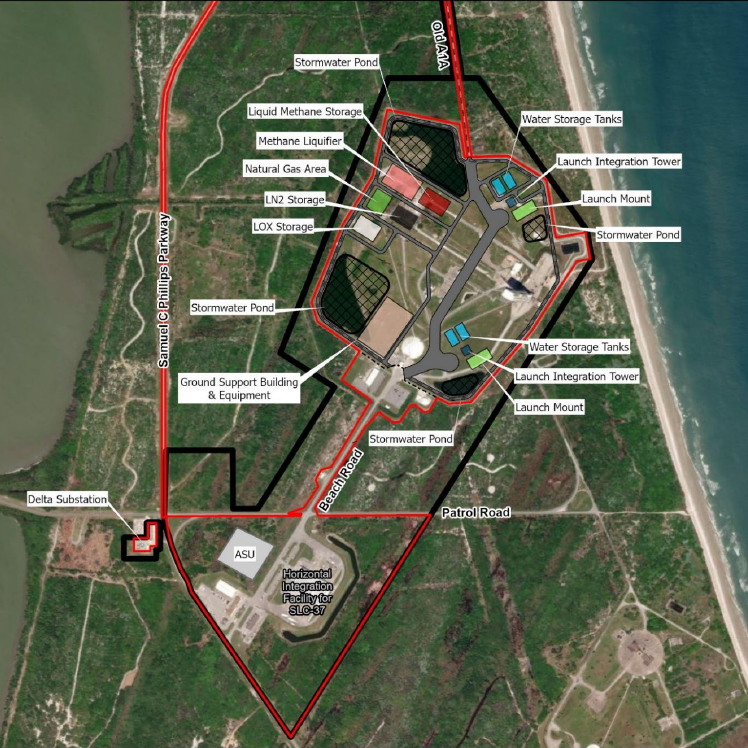
Map of proposed Cape Canaveral Starship/Superheavy launch facilities
Click for higher resolution version.

The Air Force today released its environmental impact statement for SpaceX’s proposed Starship/Superheavy launch site at Cape Canaveral, generally approving a launch rate of 76 launches per year, noting that this would cause “no significant impact” on the environment while providing “beneficial impact” on the local economy.

You can read the impact statement here [pdf]. It lists 69 areas where these new operations could impact something, and found in almost all no significant impact. The beneficial impact was found in the areas where the operations would boost the local economy.

The single area where these additional launches might have an impact is the issue of noise, noting that “community annoyance may increase” due to the launches. Considering the wealth that the local community will gain from jobs, industry, and tourism due to those launches, I suspect the only whining about this noise will come from fake environmental groups opposed to anyone doing anything.

None of this is any surprise. Launches have been occurring at Cape Canaveral and the Kennedy Space Center for more than three quarters of a century, and the only significant impact to the ecology has been beneficial, reserving large areas from development where wildlife has prospered. If anything, the obviousness of this proves the utter waste of money we now spend on such reports.

The statement notes that it still will require FAA input on coordinating the closure of air space during launches, but it also appears to consider this part of normal routine actions, not a requirement the FAA can use to block operations or approval.

The number of proposed launches however is quite impressive. SpaceX’s plan would close to match the annual number of global launches by everyone for most of the space era. Nor is it impossible considering the design of the rocket and the plans the company has for getting to Mars. The site plan includes two launch mounts for Starship/Superheavy (as shown in the map above). This is in addition to the two Starship/Superheavy launch facilities the company wants to build at Kennedy.

The statement is now open to public comment through July 28, 2025. The Air Force also plans three public meetings in the Cape Canaveral area on July 8, 9, and 10. It will also make a fourth virtual public meeting available from July 15 to July 28.

4 comments

The Senate, led by Ted Cruz, endorses NASA’s failed SLS, Orion, and Lunar Gateway

Let’s all go bankrupt! A bill introduced today by Ted Cruz (R-Texas), chairman of the Senate Commerce Committee, rejects the Trump budget plan to phase out NASA’s failed SLS, Orion, and Lunar Gateway programs that have cost so far tens of billions for decades without accomplishing anything, and instead expands funding over the next decade to these and many other projects and agencies at NASA.

The bill would allocate $2.6 billion to Lunar Gateway, $4.1 billion to build two more SLS rockets, $20 million to build one more Orion capsule, $1.25 billion more for ISS to continue its operations as is, and $1 billion to upgrade or expand facilities at five NASA centers in Florida, Texas, Mississippi, Alabama, and Louisiana.

This pork-laden bill would also fund a Mars Telecommunications Orbiter for $700 million and add $325 million to the $843 million contract NASA has with SpaceX to build the de-orbit vehicle for bringing ISS down in a controlled manner once it is retired.

What this bill tells us is that these Senators, led by “lying” Ted Cruz (to use the nickname Trump pinned on him during the 2016 presidential election campaign), are still unwilling to face the realities of the national debt, and want to spend money we don’t have in order to make believe they are grand explorers sending Americans into space. Instead, these idiots are simply funneling cash to their states in order to bribe voters to vote for them.

As Elon Musk so correctly noted, there is an election coming in 2026. Maybe it is time to throw them all out.

What this bill also tells us is that Trump is going to find it very difficult to get the budget under control. The Senate doesn’t care if the country goes bankrupt. They intend to spend our money like it grows on trees, to hell with the future. Shame on them.

Sadly, these senators know they have the backing of almost the entire press corp, which is why they are doing this. They figure they will get great press for “saving” NASA, even if it bankrupts the country. Worse, it appears the press is all for helping them do so.

R.I.P. America.

40 comments

Texas legislature gives Starbase power to close Boca Chica beaches

The Texas legislature this week approved language that now gives the new government of Starbase the power to close the road to Boca Chica’s beaches, taking that power from the local county.

House Bill 5246 revises the power and duties of the Texas Space Commission and the Texas Aerospace Research and Space Economy Consortium. A conference committee report of the bill added a section that allows the Space Commission to coordinate with a city to temporarily close a highway or venue for public safety purposes.

In South Texas, that will give the Starbase city commissioners the authority to approve those closures which would affect State Highway 4, a road that runs through Starbase and leads to the beach, as well as the beach itself.

As is usual for the particular news outlet at the link, it magnifies the opposition to SpaceX, amplifying the size of the several tiny leftist activist organizations that have been trying to shut down SpaceX at Boca Chica since the day Elon Musk announced he was now voting Republican. In reality, that opposition is nil. The region is thrilled by the wealth and jobs that SpaceX is bringing to the area, and is willing do help it grow in all ways. This action by the state legislature only reflects that support.

I must also note that the opposition in the legislature came entirely from the Democratic Party, once again taking the 20% side of an 80-20 issue.

Hat tip to radio host Robert Pratt of Pratt on Texas.

5 comments

Trump’s NASA budget cuts and rejection of Jared Isaacman for NASA administrator signal a very bright future for American space

To most Americans interested in space exploration, my headline above must seem extremely counter-intuitive. For decades Americans have seen NASA as our space program, with any cuts at NASA seen as hindering that effort. Similarly, Isaacman, a businessman and private astronaut who has personally paid for two flights in space, had initially been nominated by Trump to become NASA administrator expressly because of that commercial space background. For Trump to reject such a person now seems at the surface incredibly damaging to NASA’s recent effort to work with the private sector.

All of that seems true, but it really is not. Both of these actions by Trump are simply what may be the last acts in the major change that has been engulfing the American space industry now for the past decade.

Jared Isaacman

Jared Isaacman during his spacewalk
Jared Isaacman during his spacewalk in September 2024

First, let’s consider Isaacman. Before Trump had nominated him for NASA administrator, he had been a free American doing exactly what he wanted to do. As a very wealthy and successful businessman, he had decided to use that wealth to not only fly in space — fulfilling a personal dream — but to also use those flights to raise money for St. Jude’s Children’s hospital, whose work he considered priceless and wanted supported. He ended up flying two space missions, becoming the first private citizen to do a spacewalk, while also raising more than $200 million for St. Jude’s.

Isaacman’s second flight was also the first in what he hoped would be his own long term manned space program, which he dubbed Polaris. The first mission did this spacewalk from a SpaceX capsule. The second would hopefully do a repair mission to Hubble, or if rejected by NASA some other work in orbit. And the third would fly in SpaceX’s Starship around the Moon.

As this program was funded entirely by Isaacman and used no government funds, it was generally free from criticism. If anything, Americans hailed it as ambitious and courageous. He was following his own American dream, and doing it on his own dime.

This history however made him appear on the surface to be a perfect choice for NASA administrator under Trump, especially in a time where America’s space effort is shifting more and more to the private sector.

Everything changed however once Trump nominated him. He had to suspend his private Polaris program. He had to kow-tow to politicians, telling them what they wanted to hear. And he was no longer his own boss.
» Read more

21 comments
1 9 10 11 12 13 388