Thailand studying feasibility of establishing its own commercial spaceport

Thailand
Click for source.

Thailand’s government has begun a study to find out whether it makes financial and technical sense to establish its own commercial spaceport in that country.

The Geo-Informatics and Space Technology Development Agency (Public Organisation), or GISTDA, organised a seminar titled “Thailand’s Future Opportunities for Spaceport Development” on October 15 at iConsiam. The seminar aimed to establish a platform for exchanging views and gathering suggestions from all sectors regarding the future of a “Spaceport” in Thailand, underscoring a critical juncture for the country to elevate its presence on the global space stage fully.

Pakorn Apaphant, GISTDA Director, revealed that GISTDA is currently conducting a feasibility study for establishing a Spaceport in Thailand, in collaboration with the business consulting firm KPMG Phoomchai Business Advisory Ltd. The comprehensive study covers economic aspects, business strategy, environmental and social impacts, as well as a nationwide survey of potential sites to evaluate the most suitable location for future development.

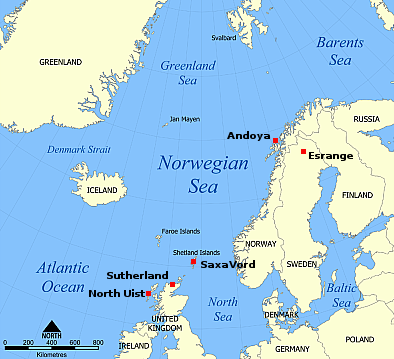
As the map to the right shows, Thailand’s geography is not perfect. It has plenty of coast, in the country’s south, but at any location the trajectory of most launches would almost have to cross land of Thailand or other countries. Nonetheless, with the advent of reusable lower stages, such considerations will eventually become less of a concern.

1 comment

Three launches since yesterday

The beat goes on. Since yesterday there were three launches, one by China and two by SpaceX.

First, China’s Long March 8A rocket placed the twelfth set of satellites in the Guowang internet constellation, eventually aiming to be 13,000 satellites strong. China’s state-run press did not specify the exact number of satellites. Based on previous launches using the Long March 8A, the number was likely nine, bringing the number of this constellation’s satellites now in orbit to 96.

The launch was from China’s coastal Wenchang spaceport, and had a flight path that dumped the lower stages of the rocket near islands in the Philippines.

Next, SpaceX placed 21 satellites into orbit for the Pentagon, its Falcon 9 rocket lifting off from Vandenberg in California. This was the second launched by SpaceX for this military communication constellation, dubbed Tranche-1, intended to be 158 satellites total. The first stage completed its seventh flight, landing on a drone ship in the Pacific. The fairing halves completed their third and fourth flights respectively.

Finally, SpaceX launched another 28 Starlink satellites, its Falcon 9 rocket lifting off from Cape Canaveral in Florida. The first stage completed its third flight, landing on a drone ship in the Atlantic.

The leaders in the 2025 launch race:

133 SpaceX
61 China
13 Russia
13 Rocket Lab

SpaceX now leads the rest of the world in successful launches, 133 to 102.

0 comments

Orbital tug startup Impulse Space to develop its own unmanned lunar lander

Impulse's tug and proposed lunar lander
Click for original image.

The orbital tug startup Impulse Space, founded by Tom Mueller (one of SpaceX’s first engineers), is now proposing to build its own unmanned lunar lander, with a target for delivering six tons of cargo on two missions, starting in 2028.

Our proposed architecture combines our existing Helios kick stage and a new lunar lander, to be developed by our team in-house. Helios would launch on a standard medium- or heavy-lift rocket. Our lunar lander would ride as a payload on Helios. Once Helios and the lander are deployed in Low Earth Orbit (LEO), Helios serves as a cruise stage, transporting the lander to low lunar orbit within one week. The lunar lander then separates from Helios and descends to the surface of the Moon. By taking advantage of Helios’s high delta-v capabilities, this mission architecture doesn’t require in-space refueling.

This solution can bridge the existing cargo delivery gap by offering direct transportation of the necessary mass to kickstart infrastructure, resource utilization, and economic activities on the Moon. We’ve already begun engine development for our lunar lander solution, and we stand ready to execute as dictated by industry demand and interest.

With this Helios and Impulse-made lander combination, we estimate delivering up to 6 tons of payload mass to the Moon (across two missions) per year starting in 2028 at a cost-effective price point. Each Helios + lander combo would take approximately 3 tons of cargo to the Moon.

It appears the company has identified a need (transporting cargo to the Moon cheaply and quickly) that no one (including NASA) is presently considering. SpaceX will be able to do it with Starship. Blue Origin is also proposing to do it with various versions of its Blue Moon manned lander. Impulse has decided however that both of those spacecraft are too large and tied to SLS and Lunar Gateway, with Starship requiring refueling, that makes their cargo missions more costly than a direct mission. Impulse proposes a simpler option.

This decision is also another indication that the demand for low orbital tugs is not developing as expected. It appears satellite companies and the available rocket companies have worked out ways to get most of their satellites to the orbits they require without tugs.

It will be interesting to watch if this proposal gains traction. If it does, than it will likely encourage other orbital tug as well as the other lunar lander companies to propose their own alternatives.

0 comments

Space Force approves Vandenberg environmental assessment, allowing SpaceX’s to launch as much as 100 times annually

Map of Vandenberg Space Force Base, showing SpaceX's two launchpads
Figure 2.1-1 of the final environmental assessment report

The Space Force on October 10, 2025 announced it has now finalized and approved the environmental assessment that will permit SpaceX’s to increase its launch rate at Vandenberg to as much as 100 times per year.

The DAF [Air Force] has decided to increase the annual Falcon launch cadence at VSFB [Vandenberg] through launch and landing operations at SLC-4 and SLC-6 [the two SpaceX launchpads], including modification of SLC-6 for Falcon 9 and Falcon Heavy launch vehicles to support future U.S. Government and commercial launch service needs. The overall launch cadence will increase from 50 Falcon 9 launches per year at SLC-4 to up to 100 launches per year for Falcon 9 and Falcon Heavy at both SLCs combined. Falcon Heavy, which has not previously launched from VSFB, would launch and land up to five times per year from and at SLC-6. The DAF will authorize SpaceX to construct a new hangar south of the HIF [SpaceX’s horizontal integration facility] and north of SLC-6 to support Falcon 9 and Falcon Heavy integration and processing.

You can read the full environmental assessment here [pdf]. The map to the right, from the assessment, shows the location at Vandenberg of the two SpaceX launch sites. SLC-4 (pronounced “slick-four”) is the pad SpaceX has been using for years to launch Falcon 9s. SLC-6 was originally built for the space shuttle but never used for that purpose. Subsequently ULA leased it to launch its Delta family of rockets. When that rocket was retired SpaceX won the lease to reconfigure the site for both Falcon 9 and Falcon Heavy launches.

The Space Force apparently decided to ignore the objections of the California Coastal Commission as well as a number of anti-Musk leftwing activist groups. And its decision is well grounded in facts. The report documents at length the lack of any consequential environmental impacts from the increase of launches, which is further supported by almost three quarters of a century of actual use.

The decision is also well founded in basic American culture and law. The Space Force as a government agency must act as a servant of the American people, in this case represented by the private company SpaceX. It must therefore do whatever it can to aid and support that company, not put up roadblocks because it doesn’t like what the company proposes.

At least under Trump, this is the approach the Space Force is taking. I fear what will happen if a Democrat regains the presidency, based on the radical and enthused communist make-up of that party today.

4 comments

The hurricane season in 2024 confounded the predictions again

The trail of bad global warming predictions

The uncertainty of science: Though the climate science community had predicted that last year’s hurricane season was going to be one of the most active ever, a new study published two weeks ago in Geophysical Research Letters of the American Geophysical Union (AGU) found that the 2024 season did not behave as predicted. It ended up producing about the predicted number of hurricanes, but did so only because of a sudden rise in activity near the end of the season, after a long lull with almost no activity. From the study’s conclusion:

As has been noted throughout this study, the lull was immediately followed by one of the busiest ends to an Atlantic hurricane season on record, including two major hurricane landfalls in Florida (Helene and Milton), resulting in more than 250 fatalities and $100 billion in damage (National Centers for Environmental Information, 2025). Though the final overall number of hurricanes and major hurricanes were aligned with the seasonal forecasts, the extremely busy beginning and end to the season and marked lull in the middle highlight just how unusual the season was.

Last year’s prediction was not the first to be incorrect, though this time the error was in how the season unfolded instead of the total numbers. In the past two decades — since Al Gore prophesied that global warming would cause a gigantic increase in violent storms — NOAA has repeatedly called for very active hurricane seasons, and repeatedly those predictions have turned out wrong. In fact, from 2006 until 2018 there were almost no major hurricanes at all, the exact opposite to what Gore had foretold. Since then the seasons have returned to more normal numbers, but the predictions of the scientists have continued to be no better than throwing a dart at a wall while wearing a blindfold.

The ongoing 2025 hurricane season is following this same pattern. In May 2025 NOAA predicted this year would be a very active hurricane season. Instead, this season has matched those from 2006 to 2016, in which no hurricanes made landfall in the U.S. and the number of strong hurricanes was almost nil.

The season of course is not yet over. We could see a burst of activity in the next few months, similar to what happened in 2024. Nonetheless, the important takeaway from this story is that the scientists who claim to know what is going to happen simply don’t know anything. They are guessing, because as the paper above admits, the Earth’s weather and climate are incredibly complex, and our understanding of it is still in its infancy.

Remember this when you read the next “We’re all gonna die!” prediction touted in the propaganda press.

20 comments

Three launches in the past day

Even as all eyes focused on SpaceX’s 11th test launch of Starship/Superheavy yesterday, there were three other launches in the past fourteen hours taking place on three different continents by China and two different American companies.

First, China placed a technology test satellite into orbit, its Long March 2D rocket lifting off from its Jiuquan spaceport in northwest China. The only information about the satellite is that it will test “new optical imaging.” No information at all was released on where the rocket’s lower stages, using very toxic hypergolic fuels, crashed inside China.

Next, SpaceX placed 24 of Amazon’s Kuiper satellites into orbit, its Falcon 9 rocket lifting off from Cape Canaveral in Florida. The first stage completed its second flight, landing on a drone ship in the Atlantic.

With this launch, Amazon now has 154 satellites in orbit, out of a planned constellation of about 3,200. Its FCC license requires it to have about 1,600 in orbit by July of ’26, but that goal seems increasingly unlikely to be met. With this launch SpaceX completed its three-launch contract for Amazon. It has contracts with ULA for 46 launches (having so far completed three in 2025), and that company appears ready to launch regularly in the coming months. Amazon’s other launch contracts with Blue Origin’s New Glenn (27 launches) and ArianeGroup’s Ariane-6 (18 launches) however are more uncertain. Neither company has achieved any launches on their contracts, and it is not clear when either company, especially Blue Origin, will ever begin regular launches.

Finally, this morning Rocket Lab placed the seventh radar satellite into orbit for the company Synspective, its Electron rocket lifting off from one of its two launchpads in New Zealand. Rocket Lab has a contract for another twenty Synspective launches over the next few years. The launch also featured a larger fairing that will give the company the ability to launch bigger-sized satellites with Electron.

The leaders in the 2025 launch race, now including yesterday’s Starship/Superheavy launch:

131 SpaceX
60 China
13 Russia
13 Rocket Lab

SpaceX now leads the rest of the world in successful launches, 131 to 101.

0 comments

Another round of layoffs at JPL

The management at the Jet Propulsion Lab (JPL) in California today announced it will be laying off 550 people this week, about 11% of its work force.

As part of this effort, JPL is undergoing a realignment of its workforce, including a reduction in staff. This reduction — part of a reorganization that began in July and not related to the current government shutdown — will affect approximately 550 of our colleagues across technical, business, and support areas. Employees will be notified of their status on Tuesday, Oct. 14.

As the statement makes clear, this reduction is unrelated to the government shutdown, and is also mostly unrelated directly to the 24% budget cut the Trump administration wishes to impose on NASA. JPL has had major management issues in the last few years, including two previous rounds of layoffs of similar amounts. Much of these budget issues stem from the cancellation by NASA of the Mars sample return mission, which JPL was to play a major part. That money is gone, and even if the mission is resurrected, JPL is almost certainly not going to play a major part.

5 comments

Michael Knowles – Celebrating Columbus

A mid-day pause: I posted twice in the past, but think it should be seen again. As I wrote in 2021,

On this day when all should be celebrating Christopher Columbus and his willingness “sail beyond the sunset,” to use a phrase from Tennyson, this short video give us an accurate picture of the man, his times, and his achievements. It also puts the lie to the bigoted, hateful, leftist slanders that have been used in recent years to poison his legacy.

8 comments

Faced with loss of the federal gravy train, Lowell Observatory makes major changes

According to a press release last week, the Lowell Observatory in Arizona is now making major changes to it management and operations due to “declines in federal research funding.”

The new framework centers on two defining pursuits: Planetary Defense, safeguarding our world from cosmic hazards, and Exoplanetary Research, seeking to understand distant worlds and the potential for life beyond Earth.

Declines in federal research funding, coupled with uncertainty about future national priorities, have impacted research institutions across the country. At the same time, Lowell’s historic reliance on internal funding to sustain research is no longer a viable long-term model. To ensure stability and growth, the Observatory will focus its efforts on key scientific areas while building new endowments to support the scientists and technology that drive discovery.

Essentially, it can no longer depend on easy federal cash (thank you Donald Trump!), and thus needs to actually do real research work in fields that others consider important. It will also abandon its “traditional academic tenure system.” Scientists who use the facility will now have to earn that right, in a case-by-case basis. And such researchers will have to be funded by “private, endowed support.”

In other words, Lowell is returning to the model that had been used by American researchers for most of the nation’s history, until World War II, getting their funding from private sources rather than the federal teat.

We should expect therefore the work at Lowell to become more effective and focused, something it has not been for decades.

4 comments

Germany’s space agency DLR delivers one prototype leg for Europe’s Callisto grasshopper

Callisto's basic design
Callisto’s basic design

Government in-action: After a decade of work, the German space agency DLR this week finally delivered for testing a prototype leg of the Callisto grasshopper-type demo rocket, intended by the European Space Agency (ESA) to demonstrate vertical take-off and landing.

On 9 October, the Institute of Structures and Design announced that it had delivered a qualification model of the demonstrator’s landing leg to the Institute of Space Systems in Bremen. According to a 3 December 2024 update, the leg will now undergo a series of tests at the Institute’s Landing and Mobility Facility, including deployment, touchdown, and vibration testing.

Once the qualification test campaign is complete and the landing leg design has been validated, the Institute of Structures and Design will proceed with the construction of the four flight-ready legs.

Note again that Callisto, as shown to the right, was proposed as a joint ESA and JAXA project in 2015. Only now, a decade later, as DLR delivered one prototype leg. The first test hop has been repeatedly delayed, so that now it is now not expected to happen until 2027, and that rocket will not even be an operational version, it will simply be a small scale prototype.

Meanwhile, SpaceX has landed its Falcon 9 first stage hundreds of times, and reused them dozens of times. Other companies are flying or building their own reusable rockets, and hope to fly operational versions next year.

The contrast between this government project and the private sector is quite embarrassing. What makes it even more embarrassing is that it is par for the course, and yet so many people still look to the government as the god who can get things done. When will people learn?

2 comments

Rocket Lab gets two-launch contract from Japan’s space agency JAXA

In what appears to be a significant slap at its own rockets (especially its delayed Epsilon-S rocket), Japan’s space agency JAXA this week signed a two-launch deal with the American rocket company Rocket Lab.

Launching from Rocket Lab Launch Complex 1 in New Zealand, the two Electron missions will deploy satellites for JAXA’s Innovative Satellite Technology Demonstration Program. The first launch, scheduled from December 2025, will deploy the agency’s RApid Innovative payload demonstration SatellitE-4 (RAISE-4) spacecraft, a single satellite that will demonstrate eight technologies developed by private companies, universities, and research institutions throughout Japan.

The second launch, scheduled for 2026, is a JAXA-manifested rideshare of eight separate spacecraft that includes educational small sats, an ocean monitoring satellite, a demonstration satellite for ultra-small multispectral cameras, and a deployable antenna that can be packed tightly using origami folding techniques and unfurled to 25 times its size.

Rocket Lab has previously won contracts from several private Japanese satellite companies (Q-Shu, Astroscale, ALE), but this I think is the first JAXA contract it has won. What makes it significant is that JAXA has always focused on using its own rockets, the large retired H2A and the new H3 as well as the smaller Epsilon-S. To go to an American company is somewhat unprecedented.

Though larger than Rocket Lab’s Electron rocket, Epsilon-S was being developed to compete for the same market. That development however has been plagued by failure, including explosions of engines during tests of both its upper and first stages in ’23 and ’24 respectively. After the second explosion JAXA announced in December 2024 the rocket’s first launch would not occur in the spring of 2025 as planned, but provided no additional information. Since then there have been no updates.

This Rocket Lab deal suggests the Epsilon program is in big trouble. In the long run however this might be a very good thing for both JAXA and Japan’s own nascent rocket industry. JAXA might finally be recognizing that building and owning its own rockets is not the best plan, that it would be better to use the capitalism model and simply be a customer buying the services from the private sector. At the moment Japan doesn’t yet have a viable commercial rocket sector, with only Mitsubishi having an operational commercial rocket, the H3 (mostly controlled by JAXA). There are a number of new startups however, including Interstellar, Honda, Space One, and Tispace, all of which have done tests of one kind or another. If JAXA is ready to abandon its own government rockets and buy the service from the private sector, those Japanese startups will start to prosper.

6 comments

China launches three satellites from ocean platform

The Chinese pseudo-company Orienspace yesterday successfully placed three satellites into orbit, its solid-fueled Gravity-1 rocket lifting off from an ocean platform off the country’s northeast coast.

This was Orienspace’s second launch, both using its Gravity-1 rocket from the ocean. Of the three satellites, one was an Earth observation satellite, and the other two were part of the pseudo-company Geespace’s Geely constellation of satellites, though it is not clear if these are for its Internet-of-Things (IoT) constellation or for general communications. The IoT constellation already has 64 satellites in orbit out of a planned 240.

Another launch of China’s Long March 8A rocket was supposed to happen yesterday, but there is no indication in China’s state-run that it took place, nor any information about a rescheduled launch date. That state-run press also illustrated the pseudo nature of these Chinese companies by only mentioning Orienspace as an afterthought at the end of the article.

The leaders in the 2025 launch race:

129 SpaceX
59 China
13 Russia
12 Rocket Lab

SpaceX still leads the rest of the world in successful launches, 129 to 99. The company will try again this evening to launch its third mission for Amazon, placing a set of Kuiper satellites into orbit. Weather has scrubbed the past two attempts in the previous few days.

0 comments
1 36 37 38 39 40 988