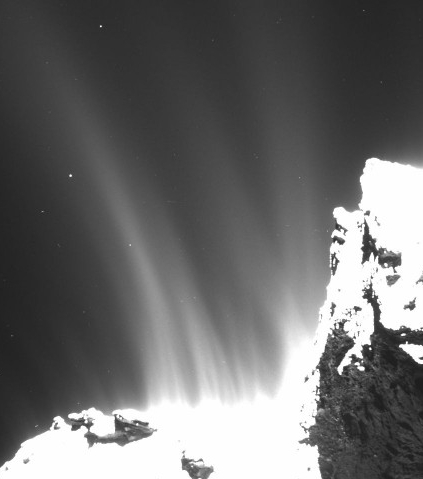
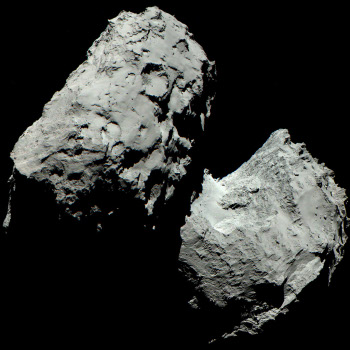
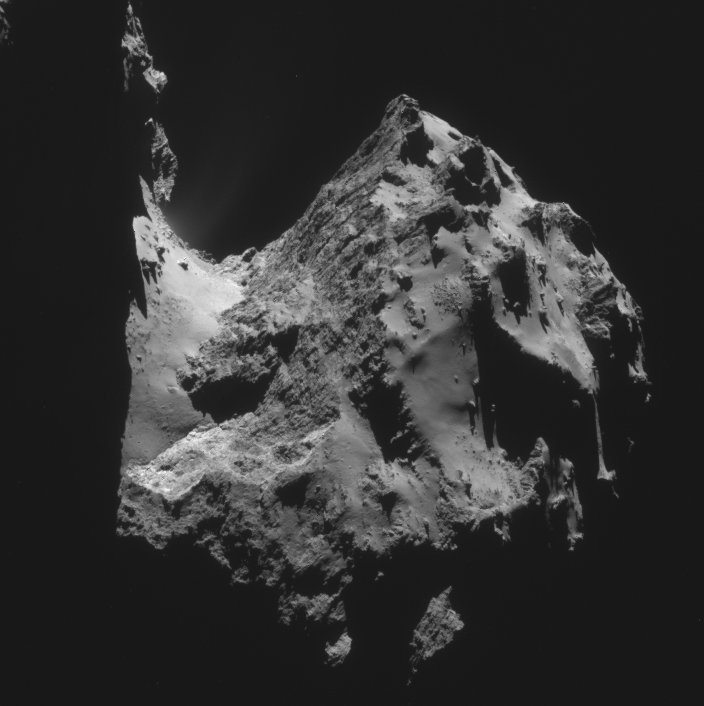
Plumes and dust surrounding Comet 67P/C-G

Plumes and dust

Cool image time! A new navigation camera mosaic from Rosetta shows both a clear plume rising out of Comet 67P/C-G as well as a “large number of small white blobs and streaks in the image are likely specks of dust or other small objects in the vicinity of the comet.”

The fact that, unlike previously, they did not have to significantly overexpose the image to bring out the plume and dust illustrates the increasing activity at the comet.

0 comments

Update on Philae on Comet 67P/C-G

The Rosetta team has provided a detailed update describing their so far unsuccessful search for Philae on the surface of Comet 67P/C-G.

In addition, the update also looks into the possibility that Philae might wake up in the late spring when the comet’s orbit and rotation changes enough so its solar panels are more exposed to the Sun.

Bottom line: Don’t expect them to find the lander from images. Right now it is a mere three pixels in size. And whether it will come back to life as well also remains unknown.

0 comments

The surprisingly dark and organic surface of Comet 67P/C-G

Link here.

The first surprising result emerging from VIRTISโ€™s study of Comet 67P/Churyumov-Gerasimenko is the measurement of its albedo, or how much sunlight is reflected by the surface of the nucleus. With an albedo of only 6%, about half as much as the Moon’s, 67P/C-G is one of the darkest objects in the Solar System. Such a low reflecting power indicates that the surface of the comet contains minerals such as, for example, iron sulfides, but also carbon-based compounds. The low albedo also indicates that there is little or no water ice on the outermost layers of the surface of the nucleus.

โ€œThis clearly doesn’t mean that the comet is not rich in water, but only that there is no water ice in the outermost shell, just over one millimetre thick,โ€ explains Fabrizio Capaccioni, VIRTIS Principal Investigator from INAF-IAPS in Rome, Italy. โ€œThe reason for this is rooted in the recent history of the comet’s evolution, since repeated passes in the vicinity of the Sun cause surface ice to sublimate.โ€

This result, combined with other Rosetta data, also suggests that during each pass the dust that did not escape along the comet’s tail settled back down to coat the surface and hide the lower layers of water ice.

0 comments

Comet 67P/C-G’s water output has increased

Data from a U.S. instrument on Rosetta has shown that the water venting off of Comet 67P has increased significantly since the spacecraft arrived.

“In observations over a period of three months [June through August, 2014], the amount of water in vapor form that the comet was dumping into space grew about tenfold,” said Sam Gulkis, principal investigator of the MIRO instrument at NASA’s Jet Propulsion Laboratory in Pasadena, California, and lead author of a paper appearing in the special issue [of Science].

The amount of water at the maximum level averages about 40 ounces every second.

In related Rosetta news today, data from the comet is showing that the dust leaving its surface is dust that had settled back down after the comet’s last close pass to the Sun.

0 comments

Ten astonishing images from Rosetta

Link here. These images are from Rosetta’s high resolution camera OSIRIS, the results from which have been kept very closely secret by the Rosetta science team. Today however they published a bunch of papers in the journal Science, so we are finally beginning to see some of their amazing images.

Take a look. Each one illustrates how alien a place Comet 67/C-G is.

More info on these papers can be found here and here.

Even more here, from the Rosetta team.

2 comments

Comet 67P/C-G’s coma fluctuates widely

Climate change: Data from Rosetta has shown that the coma surrounding Comet 67P/C-G’s nucleus varies far more than had been expected by Earth-based observations.

โ€œFrom a telescope, images of a cometโ€™s atmosphere suggest that the coma is uniform and does not vary over short periods of hours or days. Thatโ€™s what we were expecting as we approached the comet,โ€ said Dr. Stephen Fuselier, a director in the SwRI Space Science and Engineering Division and the lead U.S. co-investigator for the Rosetta Orbiter Spectrometer for Ion and Neutral Analysis Double Focusing Mass Spectrometer (ROSINA DFMS) instrument. โ€œIt was certainly a surprise when we saw time variations from 200 km away. More surprising was that the composition of the coma was also varying by very large amounts. Weโ€™re taught that comets are made mostly of water ice. For this comet, the coma sometimes contains much more carbon dioxide than water vapor.โ€

The variations might be seasonal, or even reflect a variation from day to night.

Expect more news stories about Comet 67P/C-G from Rosetta. The journal Science is today publishing a special section on results from Rosetta.

0 comments

Comet 67P/C-G’s plumes

plumes from Comet 67P/C-G

The science team running Rosetta has released an image (cropped by me on the right) from the probe’s high resolution camera showing the fine structure of Comet 67P/C-G’s plumes.

I call them plumes rather than jets, which is the word the scientists use as well as everyone else, because it appears to me that they really aren’t jets, tightly confined flows of material coming from a nozzle-like opening. Instead, the image makes me think of very fast-rising plumes of smoke rising from an extinguished fire.

This image was taken in November, and is one of only a very tiny handful of images released from the high resolution camera. Rosetta’s science team has been very possessive of images from this camera, holding them back for their own research papers to follow in the future. Even here, the image is not very detailed. I wonder what cool stuff this camera has snapped close in that they have not yet shown us.

0 comments

Comet 67P/C-G in color

Comet 67P/C-G in color

You might not believe it, but the image on the right is the first color image taken by Rosetta of Comet 67P/C-G. (Click on the link to see a full image.)

To create an image revealing 67Pโ€™s โ€œtrueโ€ colours, the scientists superposed images taken sequentially through filters centred on red, green, and blue wavelengths. However, as the comet rotated and Rosetta moved during this sequence, the three images are slightly shifted with respect to each other, and are taken from slightly different observing perspectives. Painstaking work is needed to superimpose the images accurately, which is one reason it has taken so long to come up with the first meaningful colour image of 67P/C-G.

As you can see, there really isn’t much color there. Moreover, the comet is so coal-dark that they had to brighten the images to bring out any detail.

0 comments

Comet 67P/C-G unveils a scientific surprise

Data from Rosetta of Comet 67P/C-G strongly suggests that the origin of the comets of its class come from a wide range of locations within the early solar system, and that many of these comets might not have delivered the water to Earth as previously believed.

The data also suggests that the Earth’s water came more from asteroids, not comets, something that scientists had not expected.

0 comments

Philae’s bouncing, tumbling landing sequence

Scientists and engineers have pieced together the bouncing and tumbling land sequence that Philae went through before it came to rest on Comet 67P/C-G, including the possibility that the second touch down was actually the spacecraft grazing a crater rim.

After the first touchdown, the spin rate started increasing. As the lander bounced off the surface, the control electronics of the flywheel were turned off and during the following 40 minutes of flight, the flywheel transferred its angular momentum to Philae. After this time, the lander was now spinning at a rate of about 1 rotation per 13 seconds;

At 16:20 GMT spacecraft time the lander is thought to have collided with a surface feature, a crater rim, for example. “It was not a touchdown like the first one, because there was no signature of a vertical deceleration due to a slight dipping of our magnetometer boom as measured during the first and also the final touchdown,” says Hans-Ulrich. โ€œWe think that Philae probably touched a surface with one leg only โ€“ perhaps grazing a crater rim โ€“ and after that the lander was tumbling. We did not see a simple rotation about the landerโ€™s z-axis anymore, it was a much more complex motion with a strong signal in the magnetic field measurement.โ€

Following this event, the main rotation period had decreased slightly to 1 rotation per 24 seconds. At 17:25:26 GMT Philae touched the surface again, initially with just one foot but then all three, giving the characteristic touchdown signal. At 17:31:17 GMT, after travelling probably a few more metres, Philae found its final parking position on three feet.

The search for the spacecraft itself, sitting on the surface, continues.

3 comments

Looking down a comet’s neck

Looking down Comet 67P/C-G's neck

Because all the focus in past two weeks has been on the attempt to land Philae on the surface of Comet 67P/C-G, no one has been paying much attention to the images that Rosetta has continued to produce. On the right however is a humdinger, released on November 17. The image looks into the neck or saddle of the comet, from the side. The giant boulder Cheops can be seen in the saddle, with a jet visible against the black sky above it.

What I like about this image is that I can imagine hiking up the sandy slope to this narrow saddle, where I could stand next to Cheops and look out at that jet. For the explorer in all of us this sure wets the appetite for the future. If only people could go and do that now!

1 comment

Philae’s landing site dust-covered ice

Based on the data that Philae beamed down prior to going into hibernation, scientists believe the landing site on Comet 67P/C-G is made of a layer of dust 4 to 8 inches thick covering solid ice.

At Philaeโ€™s final landing spot, the MUPUS probe recorded a temperature of โ€“153ยฐC close to the floor of the landerโ€™s balcony before it was deployed. Then, after deployment, the sensors near the tip cooled by about 10ยฐC over a period of roughly half an hour. โ€œWe think this is either due to radiative transfer of heat to the cold nearby wall seen in the CIVA images or because the probe had been pushed into a cold dust pile,โ€ says Jรถrg Knollenberg, instrument scientist for MUPUS at DLR.

The probe then started to hammer itself into the subsurface, but was unable to make more than a few millimetres of progress even at the highest power level of the hammer motor. โ€œIf we compare the data with laboratory measurements, we think that the probe encountered a hard surface with strength comparable to that of solid ice,โ€ says Tilman Spohn, principal investigator for MUPUS.

Looking at the results of the thermal mapper and the probe together, the team have made the preliminary assessment that the upper layers of the cometโ€™s surface consist of dust of 10โ€“20 cm thickness, overlaying mechanically strong ice or ice and dust mixtures.

In many ways, this result is a testament to the magnificence of science and the industrial revolution. The methods and technology that made it possible for scientists to predict the make up of comets (dirty snowballs) were developed in the period from the 16th to the 19th centuries, hundreds of years before it was even possible to see Comet 67P, no less land on it and sample its surface. And what do we find when we do land there? The data gathered beforehand from far away is confirmed, as precisely as one can imagine.

Update: Another of Philae’s instruments also detected organics on the surface, though the reports so far are very vague.

0 comments

Philae spotted before and after first bounce

A close review of a series of Rosetta images has identified Philae’s first landing site, as well as the spacecraft itself as it approached and bounced away.

The second link is especially amazing, as it includes a gif animation of the landing site, showing the before situation, the puff of dust just after impact, and then Philae drifting away with its shadow hitting the surface of the comet.

0 comments

Philae has gone to sleep

Despite several attempts to reposition the lander to get more sunlight to its solar panels, Philae went into hibernation on Saturday.

There is still a chance the lander will come back awake, but right now the Rosetta science team considers its mission complete. Meanwhile, Rosetta will continue its flight with Comet 67P/C-G, tracking it closely for the next year as it makes its next close approach to the sun.

6 comments

Drill baby drill!

Faced with a loss of power in Philae’s batteries due to a lack of sunlight, scientists plan to activate the lander’s drill today.

This action might push the lander off the surface again, but it also might move it into daylight. At the least it might get them some geological data.

If the reserve battery runs out of power and the spacecraft shuts down on Saturday, there is still a chance that it could come back to life at a later time, should Comet 67P/C-G’s position change enough to put its solar panels in daylight and it can charge its main battery.

0 comments

Engineers have until Saturday to reposition Philae before its batteries go dead

Sitting in the shade under a cliff and on its side, engineers have until Saturday to nudge it into brighter territory before Philae’s batteries go dead.

One of Philaeโ€™s major scientific goals is to analyse the comet for organic molecules. To do that, the lander must get samples from the comet into several different instruments, named Ptolemy, Cosac and Civa. There are two ways to do this: sniffing and drilling. Sniffing involves opening the instruments to allow molecules from the surface to drift inside. The instruments are already doing this and returning data.

Drilling is much riskier because it could make the lander topple over. Newtonโ€™s third law of motion says that for every action there is an equal and opposite reaction. In the minuscule gravity of the comet, any movement on Philae will cause motion. The drill turning one way will make Philae want to turn the other. Pushing down into the surface will push the lander off again. โ€œWe donโ€™t want to start drilling and end the mission,โ€ said Bibring.

But the team has decided to operate another moving instrument, named Mupus, on Thursday evening. This could cause Philae to shift, but calculations show that it would be in a direction that could improve the amount of sunlight falling on the probe. A change in angle of only a few degrees could help. A new panoramic image will be taken after the Mupus deployment to see if there has been any movement.

2 comments

Philae’s status on the surface

European engineers have released an overall status update on Philae’s generally good condition after its landing on Comet 67P/C-G.

Later on 12 November, after analysing lander telemetry, the Lander Control Centre (in Cologne) and Philae Science, Operations and Navigation Centre (SONC, Toulouse) reported;There were three touchdowns at 15:34, 17:25 and 17:32 UTC; in other words, the lander bounced. The firing of the harpoons did not occur. The primary battery is working properly. The mass memory is working fine (all data acquired until lander loss of signal at 17:59 UTC were transmitted to the orbiter). Systems on board the lander recorded a rotation of the lander after the first touchdown. This is confirmed by ROMAP instrument data, which recorded a rotation around the Z-axis (vertical).

The lander did receive some power from the solar panels on Wall No. 2 (technical description of the lander’s solar walls here), but it appears that parts of the lander were in shadow during the time that last night’s surface telemetry were being transmitted.

An additional update here.

Philae is between a rock and a hard place. More specifically, it’s on its side, one leg sticking up in the air — and in the shadows of a looming crater wall a few meters away. Solar panels are receiving only about 1.5 hours of light a day, when the goal was for 6 or 7 hours per day to recharge the lander’s batteries. Drilling into the subsurface would have to wait until the very end of Philae’s 60 hours of battery life — for fear that it could upset the lander. Yet mission leaders were largely upbeat about being alive and doing science. Most of the lander’s 10 instruments were taking data, and engineers were exploring options to use the spring of the lander legs or other ground-poking instruments to jostle the lander into a more favorable position.

Even more here, including the first image from the surface.

1 comment
1 4 5 6 7 8 10