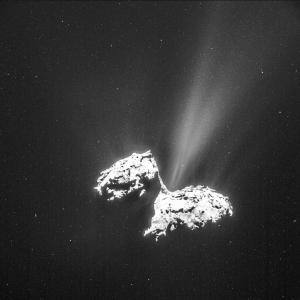
Is this Philae?

Philae?

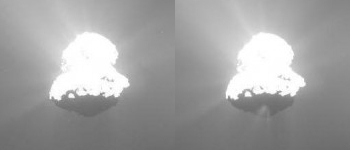
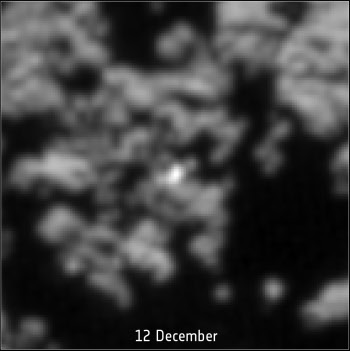
Cool image time! The Rosetta science team has spent much effort trying to locate Philae, which attempted to land on Comet 67P/C-G in November. The image on the right shows what they think is their best candidate, the bright feature in the center. It was not there prior to Philae’s landing attempt.

Because there are many uncertainties, however, this might not be Philae.

Ultimately, a definitive identification of this or any other candidate as being Philae will require higher-resolution imaging, in turn meaning closer flybys. This may not be possible in the near-term, as issues encountered in navigating close to the comet mean that the opportunity to make flybys at significantly less than 20 km from the surface may be on hold until later in the mission. But after the comet’s activity has subsided, Rosetta should be able to safely operate in close proximity to the comet nucleus again.

The other possibility of further refining Philae’s location would come if the lander were to receive enough power to wake-up from its hibernation and resume its scientific study of 67P/C-G. Then, CONSERT could be used to perform additional ranging measurements and significantly reduce the uncertainties on the lander’s location. At the moment, Philae is still in hibernation, but the mission team remain hopeful that, as the comet moves closer to the Sun along its orbit, the lander will receive enough power in the coming weeks or months to wake up and transmit a signal to Rosetta.
0 comments

Jets on Comet 67P/C-G now persist into the night

jets from Comet 67P/C-G

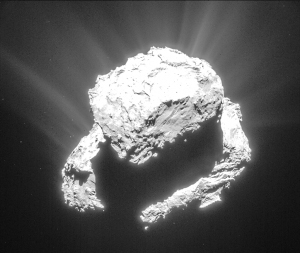
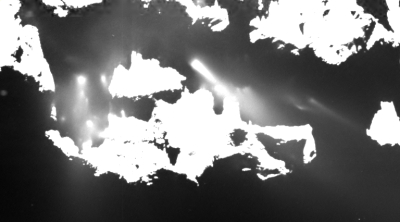
Cool image time! Rosetta’s high resolution camera is now finding that, due to increased activity as Comet 67P/C-G approaches the sun, jets of material now continue to evaporate off the surface even after sunset.

“Only recently have we begun to observe dust jets persisting even after sunset”, says OSIRIS Principal Investigator Holger Sierks from the Max Planck Institute for Solar System Research (MPS) in Germany. In the past months, the comet’s activity originated from illuminated areas on the day side. As soon as the Sun set, these jets subsided and did not re-awake until after the next sunrise. (An exception poses an image from 12 March, 2015 showing the onset of a dust jet on the brink of dawn.)

According to OSIRIS scientists, the jets now occurring even after sunset are another sign of the comet’s increasing activity. “Currently, 67P is rapidly approaching perihelion in mid-August”, says Sierks. At the time the image was taken, comet and Sun were only 270 million kilometers apart. “The solar irradiation is getting more and more intense, the illuminated surface warmer and warmer”, Sierks adds.

Because the jets are now remaining active into the night, it is allowing us to see more precisely their points of origin on the surface, which can then be studied more closely in daylight. Previously it was difficult in daylight to pinpoint the exact spot where the jets began.

0 comments

Rosetta team proposes landing on comet to finish mission

Rather than simply turn off the spacecraft when its funding runs out at the end of 2015, Rosetta’s science team have proposed that the mission get a nine month extension, during which they will slowly spiral into the comet and gently land.

Their proposal is similar to what American scientists did with their NEAR spacecraft, which hadn’t been designed to land on an asteroid but was successfully eased onto the surface of Eros, where it operated for a very short time.

0 comments

Another major image release from Rosetta

Time for many cool images! The Rosetta science team has just released to the public another batch of images from its navigational camera.

The 1776 images cover the period between 23 September and 21 November 2014, corresponding to Rosetta’s close study of the comet down to distances of just 10 km from the comet centre – 8 km from the surface – and the images taken during and immediately following the landing of Philae on the comet.

You can browse through them at your leisure, making your own discoveries if you have a sharp eye and know something about planetary geology.

1 comment

Balanced rock on Comet 67P/C-G

balanced rock on Comet 67P/C-G

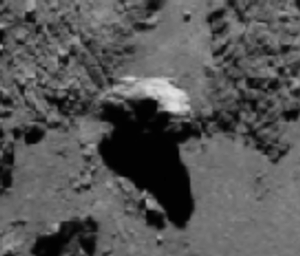
Cool image time! Rosetta’s high resolution camera has discovered a group of balancing rocks on the surface of Comet 67P/C-G.

The image on the right, cropped and brightened by me, shows the most dramatic of these rocks. The scientists are as yet uncertain on how these rocks got to where they are.

“How this apparent balancing rock on Comet 67P/C-G was formed is not clear at this point,” says OSIRIS Principal Investigator Holger Sierks from the Max Planck Institute for Solar System Research (MPS) in Germany. One possibility is that transport processes related to cometary activity played a role, causing such boulders to move from their original site and reach a new location.

It is also possible that the rocks were sitting on a base of ice that simply evaporated away over time.

0 comments

Rosetta team releases almost 1300 images of Comet 67P/C-G

The science team for Rosetta’s navigation camera have released to the public 1297 images taken of Comet 67P/C-G as the spacecraft began its approach on August 1, 2014 through September 23, 2014.

The release also included a video assembled from these images, showing the comet nucleus as Rosetta approached from August 1 to August 22. I have embedded that video below. As you watch, you will think, “How does this thing stay together?” Though the video shows the nucleus’ rotation at a highly accelerated rate, which exaggerates the stresses on the object, the question is a good one, and in fact, is actually predicting the future. Eventually, this nucleus will break up.

0 comments

Rosetta records the appearance of a new jet on Comet 67P/C-G

jet appears on comet

Cool image time! Images taken two minutes apart by Rosetta have captured the emergence of a new jet on Comet 67P/C-G.

The two images released today show the remarkable onset of such a jet for the first time. They were taken on 12 March from a distance of 75 kilometres. In the first image, obtained at 07:13 CET, several rays of dust jets frame the upper, illuminated side of the comet. The dark underside shows no such features. Two minutes later, the picture has changed: a spectacular new jet has emerged on the dark side, hurtling dust into space and displaying a clearly discernable fine structure.

This was the first jet observed in a shadowed area, and the scientists think this jet might have started because it was just before dawn there.

0 comments

Rosetta team adopts new approach strategy

Because of the problems Rosetta experienced during its last close fly-by of Comet 67P/C-G the engineering team has worked out a new approach strategy for future observations.

Essentially, they are postponing any close fly-bys for the near future. Instead, they will observe from farther away, while reassessing the situation and planing for later opportunities.

Meanwhile, on April 12 the next opportunity to listen for Philae begins.

0 comments

Rosetta team asks for help from amateur astronomers

Want to help the Rosetta science team study Comet 67P/C-G? If you are an amateur astronomer, you can!

They are asking amateurs with larger telescopes to observe the comet as it makes its close approach to the Sun and report their observations. The science team will compare their observations with the amateurs. This will teach us how to interpret future comet events when seen from afar.

0 comments

Problems for Rosetta during its most recent fly-by of Comet 67P/C-G

During its most recent close fly-by of Comet 67P/C-G Rosetta had a number of issues that caused the spacecraft to go into safe mode.

During the most recent flyby, a number of issues were reported, starting with the primary star tracker encountering difficulties in locking on to stars on the way in towards closest approach. Attempts were made to regain tracking capabilities, but there was too much background noise due to activity close to the comet nucleus: hundreds of ‘false stars’ [from comet debris] were registered and it took almost 24 hours before tracking was properly re-established.

In the meantime, a spacecraft attitude error had built up, resulting in the high gain antenna off-pointing from the Earth. Indeed, a significant drop in the radio signal received by ground stations on Earth was registered. Following recovery of the star tracker system, the off-pointing was immediately automatically corrected and the operations team subsequently saw a return to a full strength signal from the spacecraft.

However, issues with false stars were still occurring. Cross comparisons with other navigation mechanisms showed inconsistencies with the star trackers and some on board reconfigurations occurred. While attempting to reconfigure those, the same error occurred again leading this time to an automatic safe mode on Sunday afternoon. Safe modes occur when certain spacecraft parameters fall out of their normal operating ranges and the spacecraft automatically takes measures to preserve its safety. This also includes switching off the science instruments to protect them.

Rosetta is operating nominally now, but these issues are going to get more serious in the coming months, as the comet gets more active. Rosetta’s engineering team is going to have to come up with a method for the spacecraft’s star trackers to distinguish between stars and the debris in the comet’s coma. If they don’t it is likely that they will have to reduce the close fly-bys significantly.

2 comments

Rosetta makes the first detection of nitrogen at a comet

Rosetta has made the first detection of molecular nitrogen in the coma of Comet 67P/C-G.

The in situ detection of molecular nitrogen has long been sought at a comet. Nitrogen had only previously been detected bound up in other compounds, including hydrogen cyanide and ammonia, for example. Its detection is particularly important since molecular nitrogen is thought to have been the most common type of nitrogen available when the Solar System was forming. In the colder outer regions, it likely provided the main source of nitrogen that was incorporated into the gas planets. It also dominates the dense atmosphere of Saturn’s moon, Titan, and is present in the atmospheres and surface ices on Pluto and Neptune’s moon Triton.

It is in these cold outer reaches of our Solar System in which the family of comets that includes Rosetta’s comet is believed to have formed.

0 comments

Rosetta’s first attempt to contact Philae ends with no contact

After eight days of sending signals, listening for Philae, and getting no response, Rosetta has ceased its effort.

“It was a very early attempt; we will repeat this process until we receive a response from Philae,” says DLR Project Manager Stephan Ulamec. “We have to be patient.” On 20 March 2015 at 05:00 CET, the communication unit on the Rosetta orbiter was switched off. Now, the DLR team is calculating when the next favourable alignment between the orbiter and the lander will occur, and will then listen again for a signal from Philae. The next chance to receive a signal from the lander is expected to occur during the first half of April.

They always knew that it was unlikely for the lander to come alive this soon, but they tried anyway. The odds improve, however, in the coming months.

0 comments

New areas of Comet 67P/C-G come out of the shadows

Comet 67P/C-G's smaller lobe

Rosetta has snapped a new image of Comet 67P/C-G’s smaller lobe that not only shows the increased activity around the nucleus but captures areas of the comet that had formally been in darkness. The image also includes the region where engineers think Philae landed, which I think is the area just below the brightest flat area in the center of the lobe. That this area is now in daylight is why engineers are hopeful that Philae might soon wake up.

0 comments

The neck of Comet 67P/C-G in color

The neck of Comet 67P/C-G

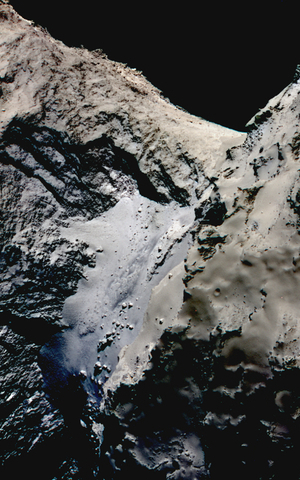
Rosetta’s high resolution camera has taken a color image of Comet 67P/C-G’s narrow neck, the area where the most plume activity has taken place.

When seen with the human eye, comet 67P/Churyumov-Gerasimenko is grey – all over. With its color filters Rosetta’s scientific imaging system OSIRIS, however, can discern tiny differences in reflectivity. To this effect, scientists from the OSIRIS team image the same region on the comet’s surface using different color filters. If, for example, the region appears especially bright in one of these images, it reflects light of this wavelength especially well.

“Even though the color variations on 67P’s surface are minute, they can give us important clues”, says OSIRIS Principal Investigator Holger Sierks from the Max Planck Institute for Solar System Research (MPS) in Germany. In a recent analysis performed by the OSIRIS team, the Hapi region clearly stands out from the rest of the comet: while most parts of 67P display a slightly reddish reflectivity spectrum as is common for cometary nuclei and other primitive bodies, the reflection of red light is somewhat lower in this region.

They as yet do not know exactly why the smooth area at the neck has a very slight blueish tinge, though they suspect it is because of the presence of a higher percentage of frozen water.

0 comments

Monitoring for a signal from Philae to begin this week

Beginning on Thursday Rosetta engineers will start searching for a signal from their lander Philae, hidden somewhere on the surface of Comet 67P/C-G.

The likelihood of getting an answer this soon is not high, but the lander is now getting about twice as much sunlight as it did when it landed in November. There is a chance it will warm up enough and get enough stored power to come to life.

0 comments

Fly-by close-up of Comet 67P/C-G


close-up of Comet 67P/C-G

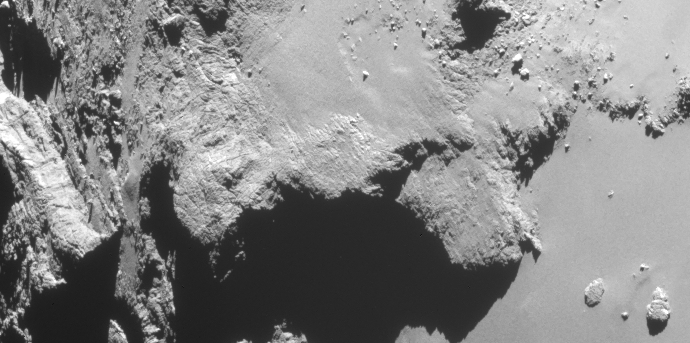
More cool images! Rosetta’s navigation camera has taken another very amazing close-up of Comet 67P/C-G, snapped during the February 14 fly-by.

The cropped section above focuses on the transition between two regions, the generally smooth area called Imhotep on the right and the more mountainous and rugged area called Khepry on the left. Go to the link for the full image, which also includes an interesting description of the engineering problems of doing these close fly-bys.

0 comments

Rosetta preps for close fly-by of Comet 67P/C-G

Single frame image

Cool image time! In preparation for a close fly-by of Comet 67P/C-G on Saturday — where it will zip past the comet less than three miles above its surface — Rosetta has eased away to a distance of about 60 miles, allowing its navigation camera to snap its first single frame image since the spacecraft’s initial close approach last summer.

The image brightness has been adjusted to make the plume more obvious. Also, if you look closely at the full resolution version of the image, it is possible to see the dusty material that forms the coma surrounding the nucleus.

0 comments
1 3 4 5 6 7 10