ROSAT has crashed to Earth, but no one knows where as yet
ROSAT has crashed to Earth, but no one knows where as yet.
UARS has come to Earth, re-entering the atmosphere at 11:23 pm (Eastern) last night over the Pacific Ocean.
Aerospace Corporation has further refined its prediction for the deorbit of UARS. The window now goes from 11 pm to 3 am tonight, with the only land areas at risk being Canada, Africa, and Australia.
NASA now says re-entry will be between 11:45 and 12:45 am (Eastern), putting only Canada and Africa in the satellite’s path.
The most recent prediction now says that the UARS satellite will come down tonight between 9 pm and 3 am Eastern time, during one of four orbits, all of which pass over North America, Europe, and Africa. One orbit also passes over Australia.
The crash time of the UARS climate satellite has now been updated to a window lasting from 6 pm (Eastern) to 4 am (Eastern) tonight.
According to the map at the link, the U.S., Europe, Africa, and Middle East are all potential crash sites.
Even if UARS misses you today, don’t relax! A second large satellite, the 2.4 ton ROSAT X-Ray space telescope, is going to rain debris down late in October or early November.
On its ROSAT website, DLR estimates that “up to 30 individual debris items with a total mass of up to 1.6 tonnes might reach the surface of the Earth. The X-ray optical system, with its mirrors and a mechanical support structure made of carbon-fibre reinforced composite – or at least a part of it – could be the heaviest single component to reach the ground.”
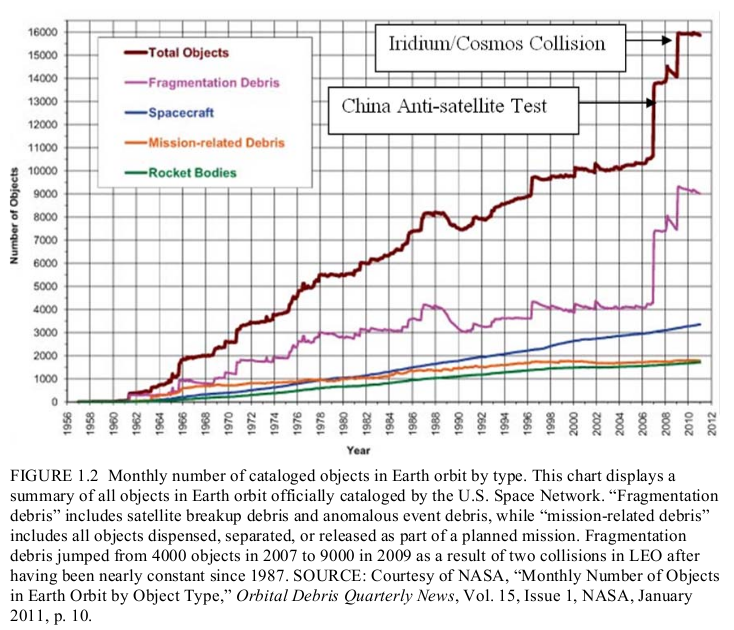
A just released National Research Council report on space junk, Limiting Future Collision Risk to Spacecraft: an assessment of NASA’s meteoroid and orbital debris programs, describes in great and worthwhile detail the increasing problem of orbital debris as well as the technical and budgetary problems that exist for removing it. It is especially worth reading for the stories, such as when a Colorado hiker heard a high-pitched sound and then found a still warm thirty-inch diameter sphere in a foot deep crater. The object turned out to be a titanium tank from a Russian upper stage rocket, launched two months earlier.
What I want to focus on here, however, is one issue the report discusses that, as far as I can tell, has generally been missed. Worse, this issue — somewhat ridiculous when you think about a little — will make removing most of the space junk in Earth orbit far more complicated than ever imagined by engineers.
Simply put, under already agreed-to international treaties, no nation can salvage or collect any debris placed in orbit by another nation. To do so will violate international law, and almost certainly cause an international incident. To quote the report:
» Read more
This ISS status update, dated June 28, explains why the piece of space junk that flew past the station that day was such a surprise. (Hat tip to NASA engineer James Fincannon for pointing this out to me.)
Last night at ~6:00pm EDT, NASA Houston FTC (Flight Control Team) received notification of an upcoming “red threshold” conjunction of the ISS with a piece of orbital debris (Object 82618, UNKNOWN), with a TCA (Time of Closest Approach) this morning at 8:08am EDT, – which was too late to begin planning for a DAM (Debris Avoidance Maneuver). Therefore, FTC and crew made preparations for crew sheltering in Soyuz 26S & 27S. PC (Probability of Collision) at last tracking fix (7:20am) remained in the Red box, at ~0.003, with a miss distance of 0.25 km radial, 0.375 km downtrack, 0.570 m crosstrack. The necessary reconfiguration procedures (USOS hatches closed, etc.) began 1.5 hrs before TCA (6:38am EDT), and the six crewmembers ingressed their Soyuz vehicles. At 8:08am the object cleared the ISS with no impact, and shortly thereafter the crew was given the Go for returning to the ISS. [The late notification occurred because of the high air resistance (drag) of the object (~175 times higher than ISS) which made its trajectory very sensitive to small errors in atmospheric density predictions at the current solar flux. Due to the high drag, there is no chance of a recurrence of Object 82618).] [emphasis mine]
In other words, the piece of junk was probably something like a piece of insulation, very light but with a large area, much like a sail. Thus, as it flies through the thin atmosphere at 200 to 400 miles altitude its velocity and direction can easily change, making it difficult, if not impossible, to predict its future trajectory.
The good news is that these same conditions mean that the orbit of the object will quickly decay (“due to high drag”) so that it poses no future threat to the station.
Unfortunately, there are many other objects like this in orbit, and they all pose a threat, mostly because of the difficulty of reliably predicting their orbits.

Astronauts retreated to their Soyuz lifeboats early today as a piece of space junk zipped less than 1000 feet past the station.
Astronauts in ISS take cover as Chinese space junk flies past.