
Astroscale to fly mission to rendezvous and inspect two different satellites
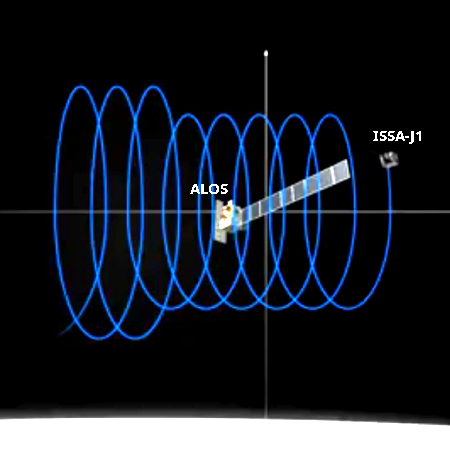
Screen capture of ISSA-J1 operations around ALOS
Click for full animation.

The Japanese orbital tug company Astroscale this week announced a 2027 mission to fly an inspector satellite to rendezvous and inspect closely two different defunct satellites in different orbits.

The ISSA-J1 mission will inspect two retired Japanese satellites launched in the early 2000s. By approaching them in orbit, ISSA-J1 will observe their current condition more than 20 years after launch, including their attitude, rotation behavior and signs of degradation. The mission will conduct close‑range observations of multiple objects, closer than traditional monitoring methods, demonstrating new possibilities for on‑orbit inspection services.

The screen capture graphic to the right shows ISSA-J1’s proximity flight path around the first defunct satellite, ALOS, which was an Earth resource satellite that operated from 2006 to 2011. After completing its inspection of ALOS, it will then move into a higher orbit to inspect ADEOS‑II, another Earth observation satellite that operated in 2003.

Astroscale has already demonstrated it can do these kinds of inspection missions with its ADRAS-J mission, which flew within fifty feet of an abandoned rocket upper stage. Its eventual goal is to do space junk removal missions, grabbing this kind of space junk and de-orbiting it.


0 comments

A 2nd Starlink satellite since December fails catastrophically

According to reports from two different companies (here and here) that monitor objects in orbit, a Starlink satellite broke apart for unknown reasons on March 29, 2026.

SpaceX yesterday confirmed the incident.

On Sunday, March 29, Starlink satellite 34343 experienced an anomaly on-orbit, resulting in loss of communications with the satellite at ~560 km above Earth. Latest analysis shows the event poses no new risk to the Space_Station, its crew, or to the upcoming launch of NASA’s Artemis II mission. We will continue to monitor the satellite along with any trackable debris and coordinate with NASA and the USSpaceForce.

This is the second time in just over three months that a Starlink satellite has failed suddenly. In mid-December a Starlink satellite began to tumble when fuel began venting from a tank. It burned up in the atmosphere a month later.

Considering that SpaceX has approximately ten thousand Starlinks in orbit, any failures should not be a surprise. You launch that many, some are going to fail. That the company has only had two such failures indicates instead SpaceX’s incredible quality control in manufacturing, as almost every satellite works as expected with no such failure.

3 comments

Fourteen-year-old NASA satellite about to burn up uncontrolled in the atmosphere

Chicken LIttle rules again.

Chicken Little rules again! After fourteen years, the orbit of one of NASA’s two Van Allen Probe satellites is about to decay, causing the 1,323 pound satellite to burn up uncontrolled in the atmosphere.

As of March 9, 2026, the U.S. Space Force predicted that the roughly 1,323-pound spacecraft will re-enter the atmosphere at approximately 7:45 p.m. EDT on March 10, 2026, with an uncertainty of +/- 24 hours. NASA expects most of the spacecraft to burn up as it travels through the atmosphere, but some components are expected to survive re-entry. The risk of harm coming to anyone on Earth is low — approximately 1 in 4,200.

As today is a very slow news day in space news, a lot of the mainstream press is highlighting this story, with the usual fear-mongering about how it could hit the Earth and cause terrible damage. And while it is certainly true that this satellite appears large enough for some pieces to reach the ground, the chances of those pieces causing any real harm is quite slim. In fact, I think NASA’s estimate of 1 in 4,200 to be far too high.

Mission engineers had initially estimated the orbit would decay in the 2030s, but that estimate was based on a prediction of a weak solar maximum. The Sun however was more active than predicted in the past decade, and that activity caused the Earth’s atmosphere to puff up, which in turn acted to accelerate the satellite’s orbital decay.

This incident once again shows us that there is money to be made in removing defunct satellites from orbit. NASA and ESA have both made it clear each would pay a company to do it. So have some private companies. Some of the orbital tug and robotic servicing companies have here an opportunity they need to grab.

8 comments

Starfish gets a second satellite servicing contract from Pentagon

The orbital tug startup Starfish has now won a second major satellite servicing contract from the military to use its Otter tug to either service or de-orbit defunct military satellites.

The first contract, announced in late January, was from the Space Force’s Space Development Agency (SDA) for $52.5 million. Under that deal, Starfish would fly an Otter in 2027 to dock with a satellite and then de-orbit it.

The new contract, announced February 7, 2026, is with the Pentagon’s APFIT program, designed to encourage “innovative technologies”. It is for an additional $54.5 million, and calls for Otter to dock with a satellite in 2028 and service it rather than de-orbit it.

The Otter is designed to autonomously dock with and maneuver national security satellites, maximizing their operational capabilities while supporting SSC’s [Space Systems Command] need for sustained space maneuver. The spacecraft leverages autonomous rendezvous, proximity operations, and docking technology, allowing it to service satellites that were not originally designed for servicing.

As I noted in January when the first de-orbit contract was announced, while a number of contracts have been issued in the U.S., Europe, and Japan to demonstrate de-orbit technology, that was the first operational de-orbit contract. As for servicing, Northrop Grumman has already succeeded several times in prolonging the life of defunct commercial geosynchronous satellites with its Mission Extension Vehicle (MEV).

Starfish’s Otter however has only successfully demonstrated rendezvous and proximity capabilities on two missions, with a third a failure. As for docking, its Otter Pup tug has flown two missions, with the first failing in 2023 when both spacecraft began spinning unexpected. The second mission is presently ongoing, and was supposed to achieve a docking by now. After completing rendezvous maneuvers in September Starfish has provided no new updates. As far as we know, the docking never occurred or was a failure.

These contracts however suggest it has succeeded. Why else would the military suddenly issue more than $100 million in contracts to the company?

0 comments

Russian defunct military satellite breaks up in graveyard orbit

A Russian defunct military geosynchronous satellite that was launched in 2014 and spent a decade spying on other geosynchronous satellites only to be moved to a graveyard orbit in 2025 when its fuel ran out apparently broke apart earlier today.

The Swiss company S2A systems, which specializes in tracking orbital objects, captured the moment the spacecraft began disintegrating. I have embedded that footage below, though it really is far less exciting than it sounds.

The debris poses a very small risk to other geosynchronous satellites, which orbit at about 22,000 miles elevation where there is too little atmosphere to decay orbits. The graveyard orbit is several hundred miles higher.
» Read more

11 comments

Orbital tug startup Starfish Space wins $52.5 million Space Force contract to de-orbit its defunct satellites

Remora rendezvous
Images taken by Starfish’s camera during rendezvous
maneuvers.

The orbital tug startup Starfish Space yesterday announced it has been awarded a $52.5 million contract from the Space Force’s Space Development Agency (SDA) to use its Otter tug to de-orbit satellites when they have reached their end-of-life.

Under the contract, Starfish Space will build, launch, and operate an Otter spacecraft in low Earth orbit (LEO) to safely and efficiently dispose of SDA satellites at the end of their operational lives. The mission begins with an initial deorbit, with options for multiple additional deorbits, enabled by Otter’s significant capacity and ability to service several satellites in a single mission. The mission is targeting launch in 2027.

While a number of contracts have been issued in the U.S., Europe, and Japan to demonstrate de-orbit technology, this is the first operational contract ever issued. Moreover, I don’t think any of those other demo missions have actually achieved a de-orbit as of yet. Starfish itself has only successfully demonstrated rendezvous and proximity capabilities on two missions, with a third a failure. In the most recent late last year (as shown by the image on the right), Impulse’s Mira tug used Starfish software and camera to move within 1.2 kilometers of another Mira tug.

As for docking, its Otter Pup tug has flown two missions. The first failed in 2023 when both spacecraft began spinning unexpected. The second was supposed to achieve a docking, but after completing rendezvous maneuvers the company has provided no new updates. As far as we know, the docking never occurred or was a failure.

Nonetheless, it appears Starfish’s overall recent performance convinced the Space Force it could handle this new de-orbit contract.

1 comment

Something caused a Starlink satellite to tumble and its fuel tank to vent

According to an update yesterday by SpaceX on X, one of its many Starlink satellites is now tumbling with its fuel tank venting, and is thus losing altitude.

On December 17, Starlink experienced an anomaly on satellite 35956, resulting in loss of communications with the vehicle at 418 km. The anomaly led to venting of the propulsion tank, a rapid decay in semi-major axis by about 4 km, and the release of a small number of trackable low relative velocity objects. SpaceX is coordinating with the @USSpaceForce and @NASA to monitor the objects.

The satellite is largely intact, tumbling, and will reenter the Earth’s atmosphere and fully demise within weeks. The satellite’s current trajectory will place it below the @Space_Station, posing no risk to the orbiting lab or its crew.

Either the tank burst, or got hit with something causing it to burst.

The media reports I’ve seen have tried to make this event more significant than it is. First, it is remarkable how few of SpaceX’s thousands of Starlink satellites have failed in this manner. These low numbers show how this incident is rare and not very concerning. Second, the spacecraft’s orbit is decaying, and will soon burn up harmlessly in the atmosphere. It will not add any space junk to low Earth orbit.

In fact, that this event illustrates more than anything how well SpaceX manages its Starlink constellation. Thousands of satellites launched, and only a handful have failed like this.

7 comments

Was it a piece of space junk that broke a United plane windshield in flight last week?

While flying at 36,000 feet last week, the right half of the windshield on a United 737-Max airplane was suddenly hit by something hard and dense, shattering it.

The outer glass fractured. One of the pilots was injured. In photos shared online, the captain appeared to have injuries consistent with shattered glass: his forearm bloodied, shards of broken glass strewn across the flight deck. Scorch marks appeared across the impacted section. Whatever hit the aircraft left no debris, no residue, and no clear explanation.

The crew was able to safely bring the plane back so that everyone could be off loaded.

Though we don’t know what the object was, there is now reasonable speculation that it might have been a piece of space junk falling to Earth. The plane was flying high enough to almost completely eliminate a bird as the cause, and the damage showed no sign of feathers, blood, or tissue. Moreover, the captain reported seeing something metallic just before impact.

The National Transportation Safety Board (NTSB) has started an investigation. Though space junk could have caused the incident, NASA estimates the odds of such a thing occurring at a trillion to one. It is far more likely there was some internal flaw in the window itself that caused it to catastrophically fail, though even this theory doesn’t fit all the known facts.

14 comments

Debris from suspected Chinese rocket discovered in western Australia

Though it has not yet been confirmed, a burned tank has been found in western Australia that is thought to come from the fourth stage of China’s solid-fueled Smart Dragon-3 rocket that lifted off from an ocean platform on September 24, 2025.

Suspected space junk that crashed near an iron ore mine in remote WA has been linked to a Chinese rocket launch, as authorities continue to probe the object’s origin. The smoking [sic] piece of debris was found on Saturday about 30 kilometres east of Newman, on a BHP mine access track.

The Australian Transport Safety Bureau and WA Police are investigating, but Flinders University space archaeologist Alice Gorman said she believed the debris was from the fourth stage of a Chinese rocket called Jielong [Smart Dragon].

If that debris is from the September launch, there is no where it was “smoking” when found two days ago. The images of the object simply show it to be well-blackened from its trip. It is also not clear when the object fell to Earth, making pinpointing its source more difficult.

If it is from China’s Smart Dragon-3 rocket, it suggests China has more work to do to keep its rockets’ stages from falling on land. Smart Dragon-3’s launch from an ocean platform just off China’s northeast coast, so one would think the lower stages would all fall in the ocean. In this case it appears the problem is similar to what has happened to some parts of the service module from de-orbiting SpaceX Dragon cargo capsules. The company found that if it allowed the service module to fall on its own, some parts would hit the ground. It has since changed its de-orbit procedures to guarantee this won’t happen any longer.

China needs to do the same. Based on its past record, it is not clear it will make any effort to do so.

3 comments

Astroscale awarded patent for its space junk removal technology

Astroscale's patented design
Astroscale’s patented design. Click for original.

The Japanese orbital tug and space junk removal startup Astroscale was awarded a U.S. patent in late July for its space junk removal technology.

Under this new patented method, the servicer docks with a debris object (the “client”) and transfers it to a reentry shepherd vehicle in a lower orbit. Once the client is docked with the shepherd, the servicer separates and proceeds to engage a new client, while the shepherd safely guides the initial client into Earth’s atmosphere for reentry. This process repeats, allowing the servicer to remove multiple large debris objects over the course of its mission.

Astroscale’s architecture also supports flexible mission profiles: the shepherd can remain docked through reentry, undocked after performing reentry insertion and returned to orbit, or in some cases, missions can proceed without a shepherd vehicle at all. This adaptability is essential in addressing the diverse size and risk profile of objects in orbit.

The company notes that this technology, which the image suggests will use robot arms to grab its targets, will allow its spacecraft to remove not only inactive satellites that were launched with docking equipment already attached but also rocket bodies and older satellites without that docking capability.

2 comments

Crash prediction for Venera failed lander now reduced to four hours

Venera reentry prediction
Click for original image.

UPDATE: According to several reports today such as this one, the spacecraft ended up burning up over the Indian Ocean west of Indonesia at 2:24 am (Eastern) on May 10, 2025. It remains unclear whether it can be salvaged in any way.
————————-

The Aerospace Corporation’s prediction for the final uncontrolled re-entry of the Soviet Union’s 1972 failed Venus lander Venera has now been reduced to four hours, centered above the Indian Ocean near Indonesia, as shown on the map to the right, at around 1:29 pm Eastern.

This prediction however has great uncertainty, and will change in the next few hours. However, based on the orbits depicted, there is a good chance the lander will come down over either Europe or Asia.

As it was designed to survive the very thick and very hot atmosphere of Venus, there is also a good chance it will survive its uncontrolled re-entry through Earth’s atmosphere. Since Russia inherited all the assets of the Soviet Union, it will be responsible for any damage the lander does, as per the Outer Space Treaty.

4 comments

Crash prediction for Soviet-era Venus probe narrows

May 9, 2025 morning prediction
Click for original image.

The prediction for when and where a 1972 Soviet-era failed Venus lander will crash back on Earth has now narrowed to an eight hour period on May 10, 2025, centered at 1:54 pm (Eastern).

The map to the right, from the Aerospace Corporation, shows the orbital path of the lander for the Venera lander, covering its last six orbits. Though the center of the prediction would have the lander come down over the Atlantic, that orbit has it crossing parts of South America, all of Europe, much of Asia and India, and Australia.

The lander failed to leave Earth orbit when it was launched in 1972, and has been circling the Earth since. As it was designed to survive the very thick and hot atmosphere of Venus, it is likely to survive re-entry through Earth’s more benign atmosphere.

This prediction will narrow continuously for the rest of the day. I will post an update this evening.

8 comments

An apparent rocket part falls in Kenya

What appears to have been a rocket stage separation ring fell in Kenya on December 30, 2024, and local officials from Kenya’s space agency are attempting to confirm and identify the source.

The pictures of the ring show a lot of details, so it should not be hard to identify what rocket it came from, assuming the owner is willing to come forward. While most will do so, China might not.

11 comments

Defunct Pentagon weather satellite breaks up

According to the Space Force as well as two commercial space tracking companies, a defunct military weather satellite launched in 1997 has broken up into more than fifty pieces.

The satellite, dubbed DMSP-5D2 F14, was in a sun-synchronous orbit over the poles. What makes the break-up significant is that it is not the first of this design of weather satellites to do so.

DMSP-5D2 F14 is part of a family of spacecraft that have suffered breakups in orbit. The F12 satellite broke up in October 2016, following the breakup of F13 in February 2015. In 2004, the F11 spacecraft broke up, creating 56 pieces of tracked debris. All the satellites had a battery assembly with a design flaw that made them vulnerable to explosion.

A similar spacecraft design was used for a line of civilian polar-orbiting weather satellites operated by the National Oceanic and Atmospheric Administration. The NOAA-16 satellite broke up in November 2015, followed by NOAA-17 in March 2021.

Overall the military launched nine satellites of this design, while NOAA launched three. Of these twelve satellites six have now broken apart. We should expect a large percentage of the remaining six to also break up.

This story explains why in the last ten years a number of companies have appeared attempting to develop the technology to remove space junk. There is a desperate need in the satellite industry for this capability, and those space junk companies are aiming to make profit from this need.

Note I do not expect or want the government to take the lead in this. This issue is mostly a need of the satellite industry, of which the world’s governments are merely just one more participant. This industry should band together to set up a fund to pay for this work, with those governments joining as just one more partner.

11 comments

ExoAnalytic now identifies more than 500 pieces from Intelsat satellite breakup

The private commercial space tracking company ExoAnalytic has now identified more than 500 pieces from Intelsat 33e satellite breakup.

Some of the smaller debris might actually quickly disappear as these pieces are possibly bits of solid fuel that will evaporate.

Much of the press has suddenly decided this failure is all Boeing’s fault, because the satellite was built by that company a decade ago. This seems a bit unfair, since Boeing’s problems now seem far removed from its design and construction of satellites then. At the same time one must wonder. Boeing built four of these type satellites for Intelsat, and the first was lost in 2019 when either it was hit by a meteor or had “a wiring flaw, which led to an electrostatic discharge following heightened solar weather activity.”

That means two of the four satellites have been lost, though the second, 33e, didn’t break-up until twelve years of operation, almost its expected lifespan. Furthermore, the other two satellites are still working fine.

All in all, that suggests to me that though there may be a technical cause that can be traced back to the company, it is more likely we are simply seeing a random expression of the dangers of space to engineering, by anyone.

1 comment

Intelsat satellite breaks up in geosynchronous orbit

An Intelsat communications satellite launched in 2016 has broken up in its high geosynchronous orbit, scattering into as many as 57 pieces of debris.

“U.S. Space Forces-Space (S4S) has confirmed the breakup of Intelsat 33E (#41748, 2016-053B) in GEO on October 19, 2024, at approximately 0430 UTC,” states an alert posted on SpaceTrack, the U.S. Department of Defense’s space-tracking platform. “Currently tracking around 20 associated pieces – analysis ongoing. S4S has observed no immediate threats and is continuing to conduct routine conjunction assessments to support the safety and sustainability of the space domain.”

Douglas Hendrix, CEO of ExoAnalytic Solutions, said the U.S.-based space-tracking company identified 57 pieces of debris Oct. 21 associated with the breakup. “We are warning operators of any spacecraft that we think are at risk of collision,” Hendrix said via email.

This satellite, which served Europe, Africa, and parts of Asia, has had thruster issues since launch, suggesting the breakup might have been caused by similar issues.

At the moment is is unclear whether the debris will threaten other satellites in geosynchronous orbit.

The break-up once again highlights the profit potential for companies capable of removing such space junk. Communications companies like Intelsat as well as others in close orbits would certainly be willing to pay someone to clean things up, for many reasons.

12 comments

Orbital tug startup D-Orbit raises another 150 million euros

The orbital tug company D-Orbit announced today that it was able to extend its more recent round of fund-raising by 50 million euros, and raise a total of 150 million in private investment capital instead.

Japan’s Marubeni Corp. led the Series C round. Marubeni has exclusive rights to distribute D-Orbit’s services in Japan in Southeast Asia, according to the news release.

New and existing investors participating in the round include: Avantgarde, CDP Venture Capital, Iberis Capital, Indaco Venture Partners, the European Innovation Council, Neva, Phaistos Investment Fund, Primo Ventures and Seraphim Space Investment Trust. Also joining the round was a consortium led by United Ventures that included the European Investment Bank and the European Investment Fund.

I call the company a “startup” in the headline, but that probably is now incorrect. It already has flown fourteen orbital tug missions, with seven more scheduled in 2025. At this point it is well established, and could extend this most recent funding round.

0 comments

A space journalist suddenly notices that the FCC has no legal authority to regulate space junk

An article posted yesterday at Space News was unusual in that this mainstream media space news source and its reporter suddenly recognized, more than a year late, that the FCC’s effort to impose regulations on all satellite companies requiring they build satellites a certain way to facilitate their de-orbit at the end of their lifespan, is based on no statutory authority and is thus illegal.

[A] Supreme Court ruling in June struck down a principle widely known as “Chevron deference,” which gave agencies greater latitude in interpreting ambiguities in laws they enforced. The move has raised questions over the FCC’s space sustainability jurisdiction without a federal law that explicitly authorizes it or other agencies to establish and enforce debris mitigation rules.

Still, the FCC is seen as the logical agency to handle the risk of orbital debris. If courts rule that the FCC has not been granted the authority, Congress will likely address this once it gets around to tackling the issue.

My, my! You mean a federal bureaucrat doesn’t have the right to make law out of thin air, just to facilitate what that bureaucrat thinks should be done? Who wudda thought it!

As an old-fashioned American who believes in freedom and limited government (as clearly established by our Constitution) I had recognized this legal fact immediately in January 2023, when the FCC first made its power grab. That our young modern journalists don’t understand this is both tragic and disgraceful.

What makes this even more disgraceful is that the entire article lobbies hard for the FCC, claiming with no real evidence that “the FCC is seen as the logical agency to handle the risk of orbital debris.”

What this reporter should have known and reported is that both the House and the Senate have disgreed, forcefully. In the House one bill was introduced to give the de-orbit regulatory power to the FAA, while later rejecting a second bill that would have given that power to the FCC. The Senate meanwhile introduced its own bill giving this de-orbit regulatory power to the FAA and Commerce, not the FCC.

Sadly it is probably a mistake to give any government agency too much power in this matter, but our Congress will do so regardless. That is how things are done nowadays. Americans are expected to kow-tow to Washington regulators, in everything they do. Freedom is not the default approach. Regulation is.

6 comments

The UK awards space removal contract to Astroscale/Clearspace partnership

The United Kingdom yesterday awarded a new $3 million contract to a partnership of the Japanese company Astroscale and the Swiss company Clearspace to further develop a mission to de-orbit two satellites in 2026.

The British subsidiaries of Japan-based Astroscale and Switzerland’s ClearSpace announced about 2.35 million British pounds ($3 million) each in funding before tax Sept. 11 to continue de-risking their robotic arm capture system and debris de-tumbling capabilities. The grants enable the ventures to continue working on their technologies until March, when the UK Space Agency is expected to decide which will conduct the demonstration mission.

Both consortiums passed preliminary design reviews for their mission earlier this year.

Both companies are positioning themselves as space junk removal operations, with Astroscale having already flown a partly successful mission to demonstrate rendezvous and capture technologies using its own proprietary magnetic capture system.

0 comments

Chinese Long March 6A upper stage breaks up into debris shortly after deploying satellites

Ground and satellite reconnaissance data now indicates that the upper stage of the Chinese Long March 6A rocket that on August 6 launched the 18 satellites in a proposed Chinese 14,000 satellite internet constellation broke up into numerous pieces shortly after deploying the satellites.

The detection was made by the company Slingshot Aerospace, which tracks orbital spacecraft looking for the appearance of this kind of space junk.

This is actually the second time recently that an upper stage of a Long March 6A has broken up shortly after launch. In December 2022 the same thing was detected following a November launch.

All told, this relatively new Chinese rocket has launched seven times, and has had its upper stage break up twice. Apparently, China not only doesn’t care if the lower stages of its many rockets crash on top of its own citizens, it is quite okay with littering near-earth orbital space with debris. It needs to fix the upper stage of this rocket now, so such break-ups no longer occur.

5 comments
1 2 3 9