Second launch attempt by Japanese rocket startup fails about 90 seconds after liftoff

Japanese spaceports
Japanese spaceports

The second orbital launch attempt by Japanese rocket startup Space One of its Kairos rocket failed about 90 seconds after liftoff when the rocket started to spiral out of control and mission controllers were forced to destroy it.

The link above starts just before launch. You can see the rocket begin to fly out of control, and start spiraling. Shortly thereafter it disappears from view.

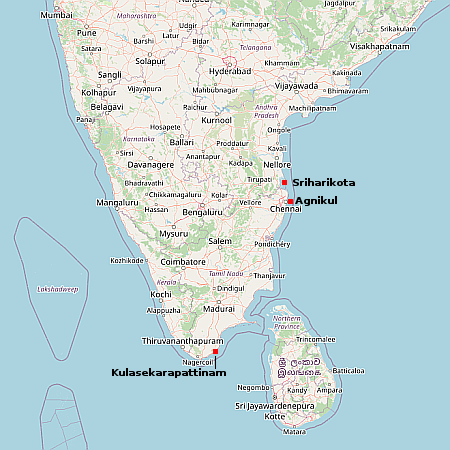
The map to the right shows the location in Japan of its private launch facility, dubbed Spaceport Kii. The spaceport of Japan’s space agency JAXA, where all of the country’s previous launches have taken place, is at Tanegashima on a island in the south of Japan.

Space One’s first orbital attempt failed in March when the rocket blew up mere seconds after lift-off.

The company has some major Japanese investors, including Canon Electronics and Mitsubishi, so I would expect it will have the finances to try again.

1 comment

FAA issues license for SpaceX’s seventh test flight of Starship/Superheavy

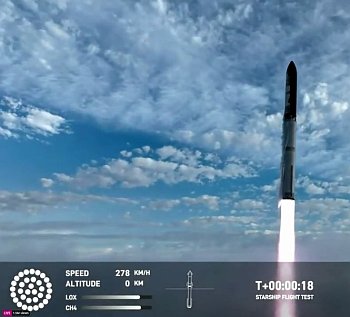
My, what a difference an election makes! FAA today proudly announced that it has issued the launch license for SpaceX’s seventh test flight of Starship/Superheavy at Boca Chica, now tentatively set for mid-January.

I say “proudly” because of this quote in the announcement:

“The FAA continues to increase efficiencies in our licensing determination activities to meet the needs of the commercial space transportation industry,” said the Associate Administrator for Commercial Space Transportation Kelvin B. Coleman. “This license modification that we are issuing is well ahead of the Starship Flight 7 launch date and is another example of the FAA`s commitment to enable safe space transportation.”

For the past three years it was like pulling teeth to get the FAA to issue these licenses for Starship/Superheavy test flights. Every time SpaceX had to wait from one to six months extra, and would only get the license mere hours before launch. During that time the FAA made no effort to “increase efficiencies” in its licensing process. Instead it found more ways to slow things down, not just for SpaceX but for the entire launch industry.

Trump gets elected and now suddenly the agency is interested in reducing red tape? What you are seeing instead a lot of bureaucrats desperately trying to convince the incoming administration that the delays for the past three years were not their fault, that they were really against red tape!

Or to put it more bluntly: “Please don’t fire us!”

I hope Trump doesn’t fall for this. A major house-cleaning in management and regulations is necessary at the FAA, and it must be done fast.

6 comments

Using a new first stage booster, SpaceX launches two communications satellites

In what has become a rare event, SpaceX today used a brand new first stage to successfully place two SES communications satellites into orbit, its Falcon 9 rocket lifting off from Kennedy in Florida.

The first stage landed safely on a drone ship in the Atlantic. The two fairing halves completed their second and twenty-second flights respectively.

The leaders in the 2024 launch race:

131 SpaceX
62 China
16 Russia
13 Rocket Lab

American private enterprise still leads the rest of the world combined in successful launches 150 to 94, while SpaceX by itself leads the entire world, including American companies, 131 to 113.

1 comment

Ranking the four private space stations under construction

the proposed Starlab space station

Yesterday NASA posted an update on the development of Starlab, one of the four private space stations under development or construction, with three getting some development money from NASA. According to that report, the station had successfully completed “four key developmental milestones, marking substantial progress in the station’s design and operational readiness.”

As is usual for NASA press releases, the goal of this announcement was to tout the wonderful progress the Starlab consortium — led by Voyager Space, Airbus, and Northrop Grumman — is making in building the station.

“These milestone achievements are great indicators to reflect Starlab’s commitment to the continued efforts and advancements of their commercial destination,” said Angela Hart, program manager for NASA’s Commercial Low Earth Orbit Development Program. “As we look forward to the future of low Earth orbit, every successful milestone is one step closer to creating a dynamic and robust commercialized low Earth orbit.”

I read this release and came to a completely opposite conclusion. » Read more

14 comments

Starlink revenue in 2025 now projected to be $11.8 billion

Capitalism in space: According to one industry market research firm, SpaceX is expected to earn $11.8 billion in revenue in 2025 from its Starlink satellite constellation, a gigantic increase from its estimate for 2024.

SpaceX’s satellite internet service Starlink is projected to reach $11.8 billion in revenue next year, driven by strong consumer demand and growing U.S. military contracts, according to a new market analysis. The forecast, released by the market research firm Quilty Space, represents a substantial increase from the estimated $7.7 billion in revenue for 2024, highlighting Starlink’s rapid growth trajectory in the satellite communications market.

The rise in revenue has been fueled by two factors, the growth in consumer subscribers to the system, and the addition of Space Force contracts that use SpaceX Starshield version of its Starlink satellites.

These numbers are quite spectacular. In the past seven years SpaceX had raised about $12 billion in private investment capital to build both its Starlink constellation and its Starship/Superheavy rocket. Starlink now produces that amount of money for the company each year.

In other words, SpaceX no longer needs NASA as a customer. It has the resources to complete development of Starship, in all its iterations, without any government help. If it wishes to funnel some of this income back into Starship and Superheavy to launch its own missions to Mars, it can.

0 comments

New computer simulations suggest Saturn’s rings are not young but formed at the same time as the solar system

A bright spot in Saturn's rings
Click for original source.

The uncertainty of science: Scientists doing computer simulations now posit that Saturn’s rings are not young, between 100 to 400 million years old as has been believed for the last few decades, but formed instead when Saturn formed, 4.6 billion years ago.

You can read their paper here [pdf].

The young age had been based on data from the Cassini orbiter, which showed the ring particles to be very bright and clean. If old those particles would have been darker as they accumulated dust over time on their surface. The new computer simulations suggest a process whereby those particles get “cleaned,” thus making it possible for the rings to be very old, possibly as old as Saturn itself.

Must I point out the uncertainties? The paper itself admits in its abstract “uncertainties in our models that assume no porosity, strength, or ring particle granularity.” Seems these assumptions make the conclusions very uncertain indeed.

Then again, the previous young estimates of the age of the rings had many similar assumptions and uncertainties. Essentially, we don’t have enough information to make any definitive determinations.

1 comment

T-Mobile initiates direct-cell-to-satellite texting using Starlink

As expected after the most recent Starlink launch, T-Mobile has now begun offering its customers beta registration for using Starlink satellites for texting in areas where no cell towers exist.

The free beta program is available to all T-Mobile customers with compatible devices and postpaid voice plans, the telco announced Dec. 16, although first responders will receive priority access due to limited initial capacity. The company declined to detail capacity and device restrictions but said the beta program would gradually expand to more devices via software updates. “Spots are limited but the service will be available in most areas and most of the time,” a T-Mobile spokesperson said.

The goal right now is to test the system and get user feedback.

0 comments

Thailand signs the Artemis Accords

Thailand yesterday became the 51st nation to sign the Artemis Accords, joining the American alliance in space.

The full list of nations now part of this American space alliance: Angola, Argentina, Armenia, Australia, Austria, Bahrain, Belgium, Brazil, Bulgaria, Canada, Chile, Colombia, Cyprus, Czech Republic, Denmark, Dominican Republic, Ecuador, Estonia, France, Germany, Greece, Iceland, India, Israel, Italy, Japan, Lithuania, Luxembourg, Mexico, the Netherlands, New Zealand, Nigeria, Panama, Peru, Poland, Romania, Rwanda, Saudi Arabia, Singapore, Slovakia, Slovenia, South Korea, Spain, Sweden, Switzerland, Thailand, the United Kingdom, the United Arab Emirates, the Ukraine, the United States and Uruguay.

Trump created the accords with the goal to create an alliance with enough clout to overcome the Outer Space Treaty’s restrictions on private property. Biden rewrote the goal to accomplish the exact opposite, as NASA states in all recent press releases about new nations joining:

The Artemis Accords are grounded in the Outer Space Treaty and other agreements including the Registration Convention, the Rescue and Return Agreement, as well as best practices and norms of responsible behavior that NASA and its partners have supported, including the public release of scientific data.

I expect there to be a shift back to the original goals in the second Trump administration.

2 comments

China and SpaceX complete launches

Two launches today. First China launched four Earth observation radar satellites, its Long March 2D rocket lifting off from its Taiyuan spaceport in northeast China. No word where the rocket’s lower stages, using very toxic hypergolic fuels, crashed within China.

SpaceX then launched a GPS-type satellite for the Space Force, its Falcon 9 rocket lifting off from Cape Canaveral. Little was released about the payload and what information was released was not very informative. The first stage completed its fourth flight, landing softly on a drone ship in the Atlantic.

The leaders in the 2024 launch race:

130 SpaceX
62 China
16 Russia
13 Rocket Lab

American private enterprise still leads the rest of the world combined in successful launches 149 to 94, while SpaceX by itself leads the entire world, including American companies, 130 to 113.

0 comments

A galactic eye in heaven

A galactic eye in space
Click for original image.

Cool image time! The picture to the right, reduced and sharpened to post here, was taken by the Hubble Space Telescope as part of a project to study the star formation processes over time in this galaxy, located about 76 million light years away.

A prominent bar of stars stretches across the centre of this galaxy, and spiral arms emerge from each end of the bar. Because NGC 2566 appears tilted from our perspective, its disc takes on an almond shape, giving the galaxy the appearance of a cosmic eye.

As NGC 2566 gazes at us, astronomers gaze right back, using Hubble to survey the galaxy’s star clusters and star-forming regions. The Hubble data are especially valuable for studying stars that are just a few million years old; these stars are bright at the ultraviolet and visible wavelengths to which Hubble is sensitive. Using these data, researchers will measure the ages of NGC 2566’s stars, helping to piece together the timeline of the galaxy’s star formation and the exchange of gas between star-forming clouds and stars themselves.

To get the full picture, astronomers have also obtained infrared data from the Webb Space Telescope and millimeter/submillimeter radio wavelength data from the ALMA telescope.

1 comment

The Insight lander on Mars as seen from orbit over six years

Insight as seen by MRO over six years
Click for movie.

Using photos taken by Mars Reconnaissance Orbiter (MRO) from 2018 to 2024, researchers have compiled a short movie showing how the dust around the Mars lander Insight changed over time.

This video shows images taken by HiRISE between Dec. 11, 2018, just a couple weeks after InSight landed on Mars, and Oct. 23, 2024. In the images, InSight often appears as a bright, blue dot due to its reflection of sunlight. A dark halo was scorched into the ground by the spacecraft’s retrorocket thrusters; this halo fades away over time. Dark stripes that can be seen on the surface are tracks left by passing dust devils. [emphasis mine]

You can see the movie here. The image to the right was the first picture taken by MRO only three weeks after landing.

Insight eventually shut down because this dust accumulated on its solar panels, and the lander never was blessed with having a dust devil cross over it to blow that dust away. This video illustrates why. Out of the seven images making up the short movie, only three show dust devil tracks, and in each case only a few tracks are seen. No other tracks are detected.

In other words, over six years this region simply did not get a lot of dust devils. The odds of one crossing over InSight was thus quite low. Ironically, the image to the right shows that a dust devil crossed very close to the lander about the time it landed in 2018, probably just beforehand since the dark scorch created by the lander’s thrusters cover the track. No dust devil ever got that close again.

1 comment

Another American rocket startup gets a multi-launch contract

The American rocket startup Vaya Space announced today that it has been awarded a multi-launch contract to use its proposed Dauntless rocket to place up to 250 small satellites in orbit for the satellite startup Space Telecommunications.

Vaya has been around since 2017, has won contracts with the Air Force in connection with developing its hybrid-solid-fueled rocket, and in 2022 completed a test suborbital launch. It hopes to launch Dauntless for the first time in 2026.

This contract is probably like most launch contracts awarded to rocket startups. It allows the company to claim progress, while giving the satellite company the right to go elsewhere at no cost should the rocket not launch on time.

0 comments
1 163 164 165 166 167 1,327