Spanish rocket startup PLD unveils a proposed family of rockets plus crew capsule

The Spanish rocket startup PLD this week unveiled a proposed family of rockets to follow its Miura-5 rocket, set to launch for the first time in 2025.

The three rockets introduced were the Miura Next, Miura Next Heavy, and Miura Next Super Heavy, all based on a system or modular building blocks. Miura Next will be the base of the modular system will be a single-stick two-stage rocket. Miura Next Heavy will feature two boosters and Miura Next Super Heavy will feature four boosters. The boosters will have a shared architecture with the rocket’s core stage. The first stages and boosters will all feature a propulsive recovery capability.

The smallest of the three rockets will be capable of delivering up to 13,580 kilograms to low Earth orbit, while the most powerful will have the capacity to deliver 53,000 kilograms.

This design concept essentially follows the approach that SpaceX used to develop the Falcon Heavy from the Falcon 9, and saves a great deal of money by using what the company has already developed as part of the larger rocket.

The crew capsule, dubbed Lince, is conceived at this company’s version of Dragon, capable of launching either cargo or 4 to 5 astronauts to any one of the proposed commercial space stations under construction. Capsule drop tests will begin in 2025, with the first launch abort tests in 2028 aiming for the first orbital flight by 2030.

3 comments

SpaceX launches Europe’s Hera asteroid mission

SpaceX today successfully launched the European Space Agency’s (ESA) Hera asteroid mission to the binary asteroid Didymos and Dimorphos, its Falcon 9 rocket lifting off from Cape Canaveral.

The first stage completed its 23rd rocket, but was not recovered in order to maximum the fuel used to send Hera on its proper route. The fairings completed their 13th and 19th flights respectively.

Hera will do a follow-up rendezvous with the binary asteroids to get a close-up look at the consequences of the Dart impact back in 2022 of Dimorphos.

The leaders in the 2024 launch race:

96 SpaceX
44 China
11 Russia
11 Rocket Lab

American private enterprise now leads the rest of the world combined in successful launches 113 to 67, while SpaceX by itself now leads the entire world, including American companies, 96 to 84.

For SpaceX, this launch ties the record the company set last year for the number of launches of a private company in a single year, and it did so in just more than three-quarters of the year. The company’s goal of 144 launches in 2024 remains possible, assuming the federal government stopped blocking its operations. For example, the FAA granted the company permission for this one launch, but maintained its grounding of further launches because an upper stage did not land safely in the ocean in the exact right spot.

0 comments

Frozen Martian eddies at the confluence of two glacier rivers

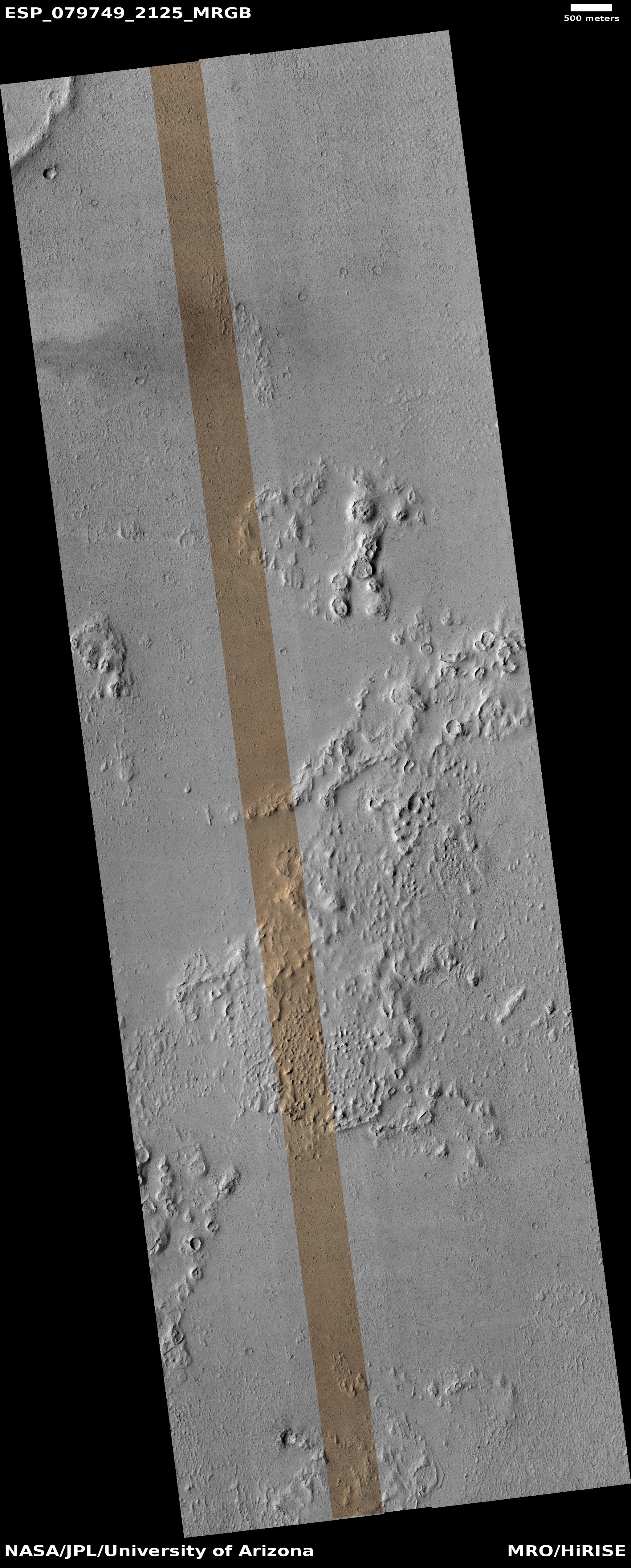
Frozen eddies at the confluence of two glacial rivers
Click for original image.

Cool image time! The picture to the right, rotated, cropped, reduced, and sharpened to post here, was taken on July 3, 2024 by the high resolution camera on Mars Reconnaissance Orbiter (MRO).

The science team labels the photo as capturing a “contact near Reull Vallis,” a 1,000-mile-long Martian canyon that flows down the eastern slopes of Hellas Basin, the death valley of Mars.

What I see isn’t a geological contact but a complex jumble of odd-shaped depressions and mesas, surrounded by an eroded surface that seems squashed and deformed by some process. If this is all we had to go on, I would simply label this as another “What the heck?” image on Mars and move on. However, the larger context of the overview map helps explain it all, at least as best as we can explain using orbital data.
» Read more

0 comments

Sierra Space wins Air Force contract to develop orbital cargo delivery system

The Air Force has now awarded Sierra Space a contract to develop its proposed “Space Ghost” satellite spacecraft, designed to be launched into a stand-by orbit carrying needed cargo, where it can upon command deliver that cargo within 90 minutes anywhere on Earth.

Sierra Space won a contract of undisclosed value as part of the AFRL’s Rocket Experimentation for Global Agile Logistics (REGAL) program. The Air Force is exploring the potential of space vehicles to rapidly transport critical supplies from orbital warehouses back to Earth. This could include reusable reentry vehicles capable of delivering payloads from prepositioned stocks in orbit.

Sierra Space, based in Louisville, Colorado, said its defense technology team designed the Ghost system to be capable of remaining in orbit for up to five years, storing and delivering essential supplies on-demand. Once fully developed, the spacecraft could be used for missions such as delivering rescue kits for downed pilots, medical supplies for disaster relief or logistical support for military operations.

The company began doing drop tests of a Space Ghost prototype heat shield in March, and apparently the data satisfied the Air Force enough to issue this development contract. Whether such a system however makes sense remains unknown. To be able to deliver cargo anywhere on Earth will require putting up a large constellation of Space Ghost satellites, in many different orbits. Moreover, it is unclear how much cargo each satellite would carry.

14 comments

Avio completes testing of new redesigned nozzle for its Vega-C second stage

The Italian rocket company Avio yesterday successfully completed the second of two static fire engine tests of the newly redesigned nozzle for the second stage of its Vega-C rocket, paving the way for the company to resume launches after the nozzle design failed both during a launch in 2022 and then again during a static fire test in 2023 after its first redesign.

A launch date has tentatively been scheduled for November, but this date is not yet confirmed. For this and the next several launches in 2025, the rocket will still be managed by the European Space Agency’s (ESA) commercial arm, Arianespace. Beginning late next year however Avio will regain complete control of its rocket and will be able to market it internationally, no longer required to deal with this unneeded government middleman. The launch price will then certainly go down, making Vega-C more competitive.

1 comment

Engineers set new laser communications record to asteroid probe Psyche

Psyche-Earth laser communications record
Click for original graphic.

As part of a continuing test program, engineers have set a new long distance laser communications record, exceeding 290 million miles, by successfully using a laser to send communicate with the asteroid probe Psyche from Earth.

The graph to the right, not to scale, shows the orbital configuation of the laser record. It appears however that little actual data was sent in this last test. It merely demonstrated that a link could be established. An actual data transfer record by laser occurred in June.

On June 24, when Psyche was about 240 million miles (390 million kilometers) from Earth — more than 2½ times the distance between our planet and the Sun — the project achieved a sustained downlink data rate of 6.25 megabits per second, with a maximum rate of 8.3 megabits per second. While this rate is significantly lower than the experiment’s maximum, it is far higher than what a radio frequency communications system using comparable power can achieve over that distance.

The high data rates promised by laser communications will significantly improve deep space operations. Most especially, the ability to get data back in much larger packets more quickly will reduce the antenna bottleneck on Earth that limits the number of missions as well as the data can be returned daily. More missions will be able to fly, and scientists and engineers will get their results faster.

2 comments

FAA: No Starship/Superheavy launch before late November

In response to speculation that the fifth Starship/Superheavy test launch could happen in mid-October — based on a recent notice to mariners from the Coast Guard, the FAA on Wednesday made it clear that its stonewalling of SpaceX will continue.

“We are not issuing launch authorization for a launch to occur in the next two weeks — it’s not happening,” an FAA spokesman said Wednesday afternoon. “Late November is still our target date.”

The report comes from the San-Antonio Express-News, and as is typical of the reporting in the propaganda press, the article only gives the FAA’s side of this story, making absolutely no mention of SpaceX’s detailed and very public objections. As far as this news outlet is concerned, the FAA is god, whatever it says must be true. So much for a skeptical free press whose goal is supposed to be to hold government accountable.

16 comments

ULA successfully completes second test launch of its new Vulcan rocket

ULA this morning successfully completed the second test launch of its new Vulcan rocket, lifting off from Cape Canaveral from Florida.

It placed a dummy test payload into orbit in order to obtain from the Space Force certification that will allow the company to begin operational military launches and actually make money from the rocket. ULA hopes to launch two such Vulcan launches before the end of the year, and then hopes to do ten more Vulcan launches in 2025, along with ten Atlas-5 launches as it closes out that rocket’s inventory before retiring it.

UPDATE: An explosion on of Vulcun’s two solid-fueled strap-on boosters during the launch today might prevent a quick certification from the military. Though the rocket successfully put the payload into its correct orbit, it appears the nozzle failed on that booster, throwing it out sideways, fortunately away from the rocket. The video here shows this clearly. I was startled by this explosion during the launch, but then forgot about it (until my readers reminded me) when the payload reached orbit as planned.

The strap-on boosters are manufactured by Northrop Grumman. Before using them again ULA needs to get clarity on this issue. We also must wonder if the FAA will step in as it has for SpaceX to ground ULA. At the moment it has decided not to do so.

This was ULA’s fifth launch in 2024, so there is no change in the 2024 launch race leader board.

95 SpaceX
44 China
11 Russia
11 Rocket Lab

American private enterprise now leads the rest of the world combined in successful launches 112 to 67, while SpaceX by itself now leads the entire world, including American companies, 95 to 84.

15 comments

ULA’s big plans for 2025

As ULA prepares for the second launch of its new Vulcan rocket, presently scheduled for launch tomorrow at 6 am (Eastern), it held a press briefing on October 2, 2024 to provide an update on the rocket’s present and future status.

The key takeaways, assuming this launch succeeds as planned, as noted in a tweet by reporter Jeff Foust from Space News:

  • ULA still plans on completing two national security Vulcan flights before the end of the year
  • It is targeting 20 launches in 2025, half with Vulcan and half with Atlas-5
  • The first Atlas-5 launch of Amazon’s Kuiper satellites won’t happen until 2025
  • When Sierra Space says Dream Chaser is ready, ULA will launch it

Completing three Vulcan launches in the next three months will almost match the four launches the company has so far completed in the first nine months of the year. Furthermore, considering that ULA’s previous record for launches in a single year is 16, set in 2009, and that the company has not completed more than ten launches in a year since 2016, these plans are very ambitious indeed.

If it succeeds however in just getting close to these numbers, ULA will be doing very well indeed.

1 comment

A new map of the magnetosphere of Mercury

Map of Mercury's magnetosphere
Click for original.

Using data obtained during the June 2023 fly-by by the European-Japanese probe BepiColombo, scientists have now published a new detailed map of the magnetic field that surrounds Mercury.

That map is to the right. From the caption:

A textured sphere representing Mercury is shown with magnetic field lines compressed on the sunward side and streaming out into a tail on the nightside. The BepiColombo spacecraft’s trajectory is drawn passing through the magnetosphere from dawn to dusk, close to the planet’s surface. Various features in the magnetosphere are depicted and labelled with text. Following the order in which they were detected by the spacecraft, this includes the bow shock, magnetopause, low-latitude boundary layer, cold ion cloud, plasma sheet horn and ring current.

You can read the peer-reviewed paper here [pdf]. Note that this research does not include data obtained during BepiColumbo’s fourth fly-by of Mercury in September. Furthermore, the spacecraft will do two more fly-bys before arriving in orbit in 2026, where it will then separate into two separate orbiters in complementary orbits. Thus, this magnetic map of Mercury is merely a rough draft, and will be significantly refined by the end of the mission.

0 comments

Scientists confirm theory that thunderstorms on Earth also produce gamma ray bursts

Prior to the 1990s, the origin of gamma ray bursts (GRBs) was uttlerly known. First detected by satellites in the early 1970s, astronomers has no idea what caused them because without a parallel detection in optical light they had no way to determine their distance. Theories suggested the bursts could be coming from billions of light years away, from within the Milky Way, from inside the solar system, and from even the Earth’s upper atmosphere.

In the 1990s it was finally proven that GRBs almost all come from very distant cosmic events, billions of light years away, each signaling the formation of a black hole.

Now researchers have confirmed the theory that GRBs are also occuring within the Earth’s atmosphere, though these GRBs have no resemblance to the astronomical ones.

During thunderclouds, two different hard radiation phenomena have so far been known to originate: Terrestrial Gamma-ray Flashes (TGFs) and gamma-ray glows. This third phenomenon, observed and named FGFs by Østgaard et al. [2024] resembles the other two, while at the same time revealing certain characteristics separating FGFs from the others. Most noteworthy may be that FGFs are pulses of gamma-rays not associated with any detectable optical or radio signals.

“We think that FGFs could be the missing link between TGFs and gamma-ray glows, whose absence has been puzzling the atmospheric electricity community for two decades”, says lead author and Professor Nikolai Østgaard at the University of Bergen.

More information on this research can be found here. The research not only confirms the early theories as well as later detections, it adds significant nuance to the data. As noted at this second link:

“The dynamics of gamma-glowing thunderclouds starkly contradicts the former quasi-stationary picture of glows, and rather resembles that of a huge gamma-glowing boiling pot both in pattern and behavior,” said Martino Marisaldi, professor of physics and technology at the University of Bergen.

Given the size of a typical thunderstorm in the tropics, which get much larger than storms at other latitudes, this suggests that more than half of all thunderstorms in the tropics are radioactive. The researchers postulate that this low-level production of gamma radiation acts like steam boiling off a pot of water and limits how much energy can be built up inside.

This data will help refined the computer models that attempt to predict weather patterns, as it appears the phenomenon impacts the formation of thunderstorms.

5 comments

European phone companies demand the FCC stop SpaceX’s cell-to-satellite Starlink plans

Several European phone companies have now submitted a request to the Federal Communications Commission (FCC) to block a waiver that would allow SpaceX to operate its new cell-to-satellite Starlink satellites at radio frequencies normally not permitted.

This request follows similar requests by Verizon and AT&T to the FCC. The fear is that the use of these frequencies in the low orbit of Starlink satellites will interfere with satellites in the much higher geosynchronous orbits that these phone companies presently use.

While those concerns might be valid (SpaceX says no), these companies also fear the competition of Starlink itself, as its low orbit means it can provide better service, and are clearly hoping the FCC will act to protect them from that competition.

In a more sane world, the FCC would decide this issue on purely technical grounds. It was formed expressly to police the frequencies so that users would not interfere or pirate each others licenses, and had done that job quite well for decades.

Sadly, the FCC no longer confines itself to this one job. For the past four years the FCC has arbitrarily decided its job should include many other things not listed in its statutory authority, such as policing the de-orbiting of satellites and determining the acceptable lifespans of orbiting spacecraft, while also making many decisions based entirely on political factors, sometimes even favoring some companies over others for partisan reasons.

Thus we should have no confidence that the FCC will make this decision on purely technical grounds, especially since it has shown a clear hostility to SpaceX in its recent decisions.

3 comments
1 187 188 189 190 191 1,327