Pentagon getting serious of hauling cargo with Starship

Capitalism in space: In the budget proposal submitted by the Biden administration the Pentagon included a request for $47.9 million to help develop the infrastructure it will need to use SpaceX’s Starship rocket as a method for transporting cargo point-to-point on Earth.

“The Department of the Air Force seeks to leverage the current multi-billion dollar commercial investment to develop the largest rockets ever, and with full reusability to develop and test the capability to leverage a commercial rocket to deliver AF cargo anywhere on the Earth in less than one hour, with a 100-ton capacity,” the document states.

Although this does not refer to Starship by name, this is the only vehicle under development in the world with this kind of capability. The Air Force does not intend to invest directly into the vehicle’s development, the document says. However, it proposes to fund science and technology needed to interface with the Starship vehicle so that the Air Force might leverage its capabilities.

Clearly, some Air Force officials are intrigued by the possibility of launching 100 tons of cargo from the United States and having the ability to land it anywhere in the world about an hour later.

The proposal is calling for a fourfold increase in funding for this work, as the Air Force is already spending slightly less than $10 million this year on this work.

The bottom line is that it appears SpaceX already has at least one real customer for its giant rocket. And if the military is that interested now, it likely means many more private customers are beginning to line up.

12 comments

SpaceX barrelling like a juggernaut toward first Starship/Superheavy orbital flight this year

Starship #15 about to land
Starship prototype #15 about to land, May 5, 2021

A series of articles at Teslarati in the past two days suggest strongly that the next Starship flight will be on top of a Superheavy first stage, and will likely be the first near orbital flight from Texas around the globe to splashdown softly in the Pacific Ocean northeast of Hawaii.

And it will likely happen this year!

First there was the report from locals in the McGregor, Texas, area indicating that SpaceX has completed a full duration launch burn of a Raptor engine.

A local resident and unofficial SpaceX observer has reported hearing a test of one of Starship’s Raptor engines that lasted more than five minutes at the company’s McGregor, Texas development facilities.

If accurate, it could be the longest static fire of a Starship engine that SpaceX has ever completed in the two years since full-scale Raptor testing first began. Whether it was successful or not, a five or six-minute static fire would also confirm that SpaceX is well into the process of qualifying Raptor for Starship’s first orbital launch attempts.

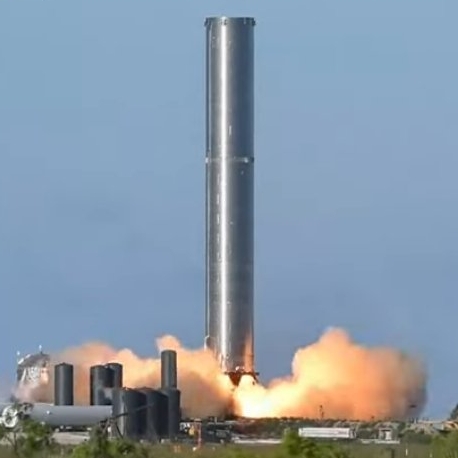
This burn is somewhat longer than the engine burns during the Starship test hops, and approaches the burn time required for Superheavy during a launch.

Next there was the report describing the newest known engine configurations SpaceX is planning for Superheavy itself, with the first version possibly having 29 engines and a future more powerful version sporting 32.
» Read more

15 comments

China creates company to build mega-satellite constellation

The new colonial movement: Late last month China officially created a company to build its own mega-satellite constellation, consisting of 13,000 satellites to provide internet access globally, to compete with the commercial constellations being built by SpaceX, OneWeb, and (someday) Amazon.

Spectrum allocation filings submitted to the International Telecommunication Union (ITU) by China in September last year revealed plans to construct two similarly named “GW” [Guowang] low Earth orbit constellations totaling 12,992 satellites. The filings indicate plans for GW to consist of sub-constellations ranging from 500-1,145 kilometers in altitude with inclinations between 30-85 degrees. The satellites would operate across a range of frequency bands.

Currently no details have been released on the contractors to be involved in the constellation. Notably the China Satellite Network Group will exist independent from and parallel to China’s main space contractors, the China Aerospace Science and Technology Corp. (CASC), and the China Aerospace Science and Industry Corporation (CASIC).

The apparent independence of China Satellite Network Group from CASC and CASIC indicates that other actors, such as other state-owned enterprises and commercial sector space companies could be involved in the construction of the constellation.

Not only does the creation of this company suggest a power-struggle within China’s government, it illustrates the intensifying competition internationally over space. While commercial satellite constellations like SpaceX and OneWeb will be able to provide their services to China, they will also be outside the control of that nation’s dictatorship. If their citizens use them they will have free access to information, something that China’s leaders refuse to allow.

Thus, the political decision in China to build their own constellation. It will also give China the ability to exert its influence worldwide by offering an alternative to the commercial western constellations, one that other dictators can control as well.

Expect more whining from astronomers about how this constellation of satellites will add to their woes. Instead of whining, might they finally decide to at last consider building in-space telescopes, where there is no atmosphere to fog their view and no satellites blocking their vision?

1 comment

Starship prototype #15 removed from launchpad; likely not to fly again

Capitalism in space: SpaceX engineers have removed Starship prototype #15, the first to successfully land after a test flight, from the launchpad and rolled back towards their assembly building.

They had already removed its three Raptor engines and landing legs for inspection, but taking the ship off the launchpad strongly suggests the company has decided to not fly it again.

The immediate assumption is that they will now fly prototype #16, built and ready for launch. The article however speculates something far more intriguing:

There’s a limited possibility that Starship SN16 – all but finished – could be sent to the launch site instead of heading straight to the scrapyard, but any testing would necessarily delay orbital pad construction and any flight activity would likely have to expend SN16 in the ocean rather than risk a land landing.

Ultimately, it’s looking more and more likely that SpaceX would rather go all-in on Starship’s inaugural orbital launch attempt, even if that means little to no ground or flight test availability for a few months.

Prototype #20 had been assigned that for that first near-orbital flight. Does this mean SpaceX has decided abandon #16 through #19 and to go straight to that orbital flight? To do this would also mean they have decided to forego any separate testing of Superheavy, and will instead fly it the first time with a Starship upper stage attached. It would also be the only possible way they could meet their July target date for that orbital flight.

If #16 does not move immediately to the launchpad and there are no Starship test flights for the next month or so, it will tell us that this is likely their plan.

7 comments

SpaceX successfully launches another 60 Starlink satellites

Capitalism in space: SpaceX today successfully used its Falcon 9 rocket to place another sixty Starlink satellites in orbit, bringing that constellation to over 1,700 in orbit.

The first stage was making its second flight, and landed successfully on the drone ship in the Atlantic. Both fairings were reused, with one making a record fifth flight. Though the rocket has not yet deployed the satellites as I write this, it is expected in about a half hour and based on past history, should proceed with no problems. If there is an issue I will report it immediately.

The leaders in the 2021 launch race:

16 SpaceX
13 China
7 Russia
2 Rocket Lab
2 ULA

The U.S. now leads China 22 to 13 in the national rankings.

7 comments

Viasat asks FCC to block further launches of SpaceX’s Starlink satellites

Capitalism in space? The geosynchronous communications satellite company Viasat has demanded the FCC freeze any further launches of SpaceX’s quickly growing constellation of Starlink satellites.

The company claims a recent modification of SpaceX’s FCC license should not have been granted without a new environmental review of the 4,000+ satellite constellation’s impact.

Viasat is asking the FCC to hit pause on further launches until federal courts can review the legality of the license modification.

Carlsbad, California-based Viasat, which provides broadband services from geostationary orbit (GEO), had petitioned the FCC to conduct an environmental review before granting the license modification as part of the National Environmental Policy Act (NEPA), which currently categorically exempts satellite systems, but says this did not happen despite megaconstellations bringing new considerations for regulators.

Some astronomers had also requested an environmental assessment, worried about how the constellation’s reflectivity affects ground-based telescope observations.

What is really happening here is that Viasat, having discovered its market share is seriously threatened by a competitor, is trying to use the government to squelch that competition. Viasat doesn’t really give a twit about the environmental issues. It is launching its own new three-satellite geosynchronous constellation next year to provide broadband services globally, and Starlink’s success threatens to cut into its profits.

The article also reveals one interesting tidbit about former NASA administrator Jim Bridenstine. During his short three-year tenure heading NASA he aggressively moved to encourage provide competition and private enterprise by transferring the design, construction, and ownership of rockets and spaceships from NASA to the commercial sector.

Now that he is out of the government however he — like most Washington swamp creatures — has discovered his true calling: using his influence to squelch private competition:

In April, former NASA administrator Jim Bridenstine joined Viasat’s board of directors. Bridenstine told SpaceNews in an interview at the time that the threat of megaconstellations to space safety, and the overall space access environment, were among issues on his radar.

Like a ventriloquist’s dummy, Bridenstine upon leaving NASA immediately began mouthing the manufactured concerns of his new patrons at Viasat. To hell with allowing real competition and freedom. It is much more important to manipulate the power of the government to prevent Viasat’s competitors from succeeding. And earn a nice big salary at the same time.

6 comments

Axiom announces astronaut to command its second commercial manned flight

Capitalism in space: Axiom has announced that retired NASA astronaut Peggy Whitson will command its second commercial manned flight.

Whitson was the first woman to command the International Space Station and the oldest woman to fly in space (57, in 2017). She holds the U.S. record for most cumulative time in space (665 days) as well as the world record for most spacewalks by a woman (10).

Joining her will be 65-year-old John Shoffner, an airplane pilot and a champion car racer.

No word yet on when this flight will take place, but expect them to aim for next year, as soon as possible after Axiom’s first ISS commercial flight in January. Scheduling will also depend on NASA, which is presently working out an ISS scheduling policy to manage the increasing number of private missions being offered.

The flight will likely use a SpaceX Dragon capsule, which means there is room for two more passengers. It is possible that those seats will be filled with the winners of Discovery Channel’s proposed reality show, but they also might be filled by actor Tom Cruise and a movie director, both of whom have expressed interest in filming scenes of a movie on ISS.

2 comments

Delays force ULA to replace Vulcan rocket with Atlas 5 on military launch

Because the development of ULA’s new Vulcan rocket is behind schedule, the Space Force has agreed to allow the company to replace it with an Atlas 5 rocket on a ’22 launch.

That mission, known as USSF-51, was awarded to ULA in August 2020 and is scheduled to launch in late 2022. The company had bid its newly developed Vulcan to fly that mission but the vehicle is not going to be ready on time. As a result, the Space Force agreed to allow ULA to launch USSF-51 on the company’s legacy vehicle the Atlas 5.

…Switching vehicles financially penalizes ULA. According to the company, the Atlas 5 is more expensive than Vulcan. Phase 2 provisions allow ULA to change vehicles but at no cost penalty to the government.

This story however is important because of what it tells us about the state of Blue Origin’s BE-4 rocket engine, required by both Vulcan and Blue Origin’s New Glenn rocket.

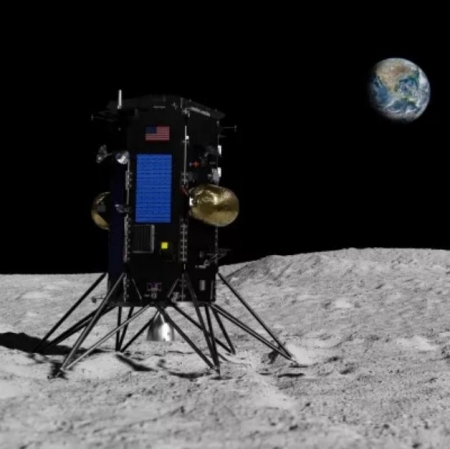
At this moment ULA is saying that the first launch of Vulcan is still scheduled for late this year, launching Astrobotic’s Peregrine lander to the Moon. However, for that launch to happen the rocket requires working BE-4 rocket engines for its first stage. In January Blue Origin announced it had finally completed a full throttle test of that engine after problems lasting several years, and would soon be delivering flight-worthy engines to ULA.

It is now late May, and the article at the link revealed this very significant and somewhat shocking detail buried in the text:

Blue Origin in 2020 delivered pathfinder engines for ground tests but has yet to provide a flight-qualified engine for Vulcan’s first flight. A spokeswoman for Blue Origin said May 20 the company is “on track to deliver BE-4 engines this year.” [emphasis mine]

It seems completely impossible for ULA to launch that lunar lander on Vulcan this year if it does not yet have any flight-worthy engines on hand to incorporate and test in the rocket. Worse, it appears that Blue Origin might not deliver those engines for months yet.

This story thus suggests that we will not see launches of either ULA’s new Vulcan rocket or Blue Origin’s New Glenn rocket for a considerable time.

6 comments

SpaceX grabbing 90% of the launch contracts to the Moon

Capitalism in space: The announcement yesterday by Firefly that it has awarded SpaceX the launch contract for its Blue Ghost lunar lander mission (scheduled for launch in ’23) is significant because it continues a remarkable pattern of dominance by SpaceX of the lunar launch market.

Right now, of the seven scheduled robot missions to the Moon, SpaceX will launch all but one. The full list, in no particular order:

In addition, SpaceX launched Israel’s Beresheet lander in 2019 on a Falcon 9.

Furthermore, SpaceX has won the contract from NASA for the agency’s first manned lunar lander, using Starship. It has also won the contract to launch the initial components of NASA’s Lunar Gateway space station on a Falcon Heavy.

There are other lunar missions in the works (by Russia, China, and others), but these are all the launches awarded as commercial contracts to private rocket companies in recent years. Thus, of these ten lunar missions, SpaceX has launched or is launching nine. That’s a 90% market share!
» Read more

11 comments

SpaceX begins stacking Superheavy prototype for flight

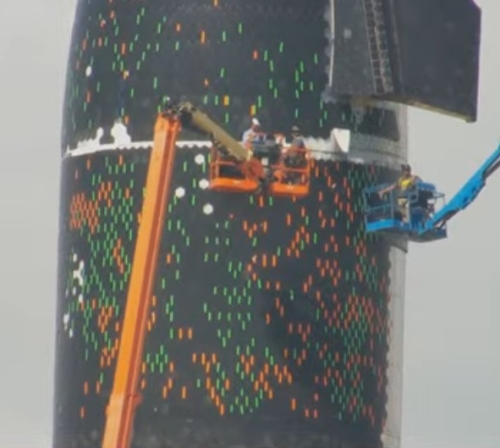
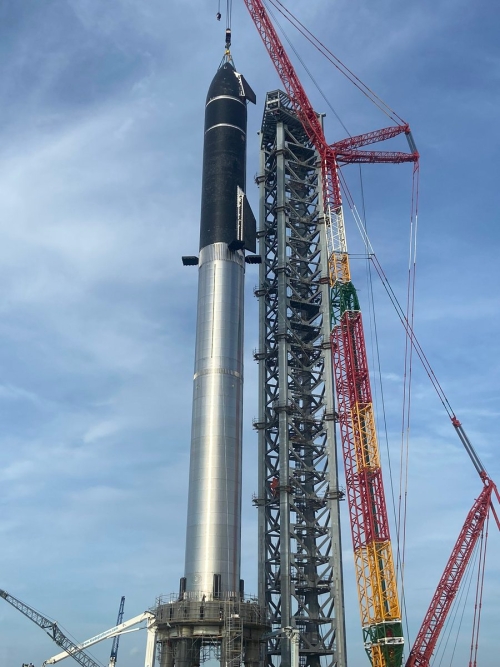
Capitalism in space: It appears that the third Superheavy prototype, BN3 (Booster #3), is now being stacked and prepared for the first near-orbital flight of Starship, which SpaceX is still hoping to launch before the end of this year.

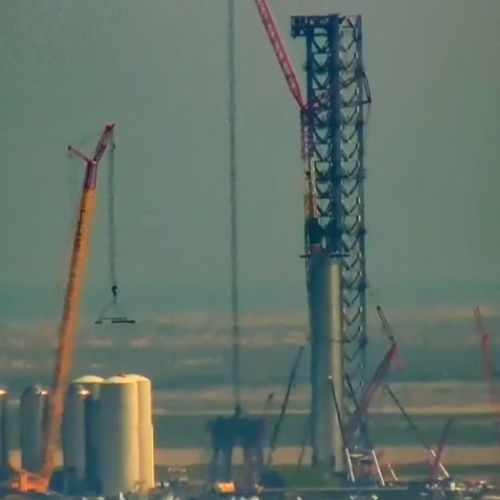
SpaceX has at least six BN3 sections – amounting to 22 rings and two of three tank domes – either completed or awaiting integration. The process of stacking BN3 began sometime in the last 7-10 days when SpaceX joined two four-ring sections – including the booster’s common dome, likely pictured above.

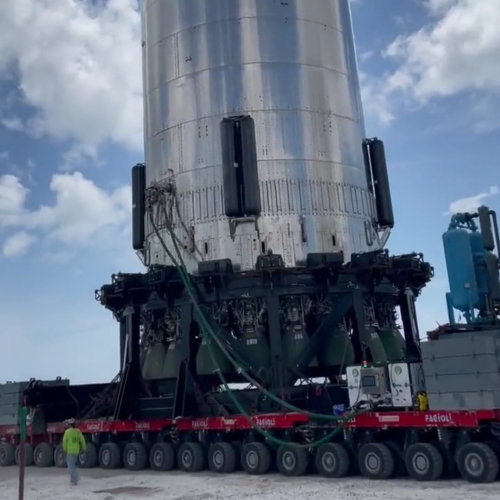
SpaceX has mostly completed BN3’s engine section, including a thrust dome with plumbing cutouts for a full 28 Raptor engines. Most recently, what looks like a Super Heavy fuel manifold appeared in Boca Chica. That manifold will attach to the end of a supersized Super Heavy transfer tube – also spotted in work – used to route methane through the liquid oxygen tank to fuel its Raptor engines. Fueling 28 large, high-performance Raptors is no mean feat and requires a rat’s nest of plumbing to feed them more than 15 metric tons (~30,000 lb) of propellant every second at full throttle.

Put simply, a majority of Super Heavy booster BN3’s hardware appears to be ready or almost ready for integration. The eight rings now stacked represent approximately 20% of the rocket’s full height, leaving another 30 or so rings – 54m (~180 ft) – to go.

That flight, the flight plan of which has already been submitted to the FCC, would take off from Boca Chica, circle about three-quarters of the globe, and land in the Pacific to the northwest of Hawaii. While not a full orbit, this flight would demonstrate an orbital capability while allowing for a controlled safe re-entry at a planned location, a wise approach for that first orbital attempt.

4 comments

Senate revises NASA authorization to protect lunar lander award to SpaceX’s Starship

Even as the full Senate today begins its review of NASA’s newest authorization, the bill has been modified to grandfather in the contract award that NASA gave to SpaceX to build its manned lunar lander using Starship.

An earlier version of the bill had included language inserted by Senator Maria Cantwell (D-Washington) demanding NASA award within 30 days a contract for a second lunar lander. The modified bill extends that timeline to 60 days, but also specifically protects SpaceX’s contract award:

The Administrator shall not, in order to comply with the obligations referred to in paragraph (1), modify, terminate or rescind any selection decisions or awards made under the human landing system program that were announced prior to the date of enactment of this division.

The revised bill still puts NASA in a ridiculous position. Combined with Cantwell’s amendment, the agency will now be forced to name a second lunar lander contract within sixty days. Though it recommends doubling the money for this program ($10 billion over five years instead of ten), it does not actually appropriate it. Moreover, that new budget recommendation is still about one half of what NASA had originally requested in order to fund the construction of two lunar landers.

Not surprisingly, the entire bill [pdf] has become a pork-laden collection of spending put together without any concern for the needs for the nation. Instead, ithe 1,445-page long bill “is the proverbial ‘Christmas tree’ with a Table of Contents that alone is 15 pages” that different senators keep adding items to, making it a hodge-podge of incoherence.

The bill itself however still has to be approved by both the Senate and the House. While this should act as a corrective to make it more sane, don’t expect that. Instead, the more likely result will be that the two houses of Congress will combine together their own personal earmarks into one humongous bill.

3 comments

NASA gives an American the seat on Dragon flight that it had been holding for Russian

NASA yesterday announced that it has added an American astronaut to the next manned mission to ISS, set for October.

NASA said that Kayla Barron will join the Crew-3 mission, launching on a SpaceX Crew Dragon spacecraft scheduled for launch no earlier than Oct. 23. Barron joins NASA astronauts Raja Chari and Tom Marshburn, and European Space Agency astronaut Matthias Maurer, who had been assigned to Crew-3 last December.

The Crew-3 mission will relieve the Crew-2 astronauts who arrived at the station on another Crew Dragon spacecraft April 24. The four Crew-3 astronauts will remain on the station for a six-month stay.

The space agency had been holding that seat open for a Russian, as part of its long term barter arrangement whereby in exchange for flying Americans on Soyuz capsules, Russia flies Russians on American spacecraft. That arrangement had been used repeatedly when the shuttle was flying, but since its retirement the U.S. has been forced to buy its seats on Soyuz as it had nothing to offer in exchange.

With the arrival of SpaceX’s Dragon capsule however NASA has been trying to get the Russians to renew that arrangement. And though an American, Mark Vande Hei, flew for free on a Soyuz last month, the Russians have as yet refused to assign their own astronaut to this upcoming October flight, despite months of negotiations. It appears NASA decided it could wait no longer, and filled the seat with its own astronaut.

In fact, the announcement by Roscosmos on May 13th that the next two Soyuz launches to ISS will carry two commercial passengers each means that Vande Hei cannot return on a Soyuz until next year. The seat he would have used to come home now must be used by these tourists, meaning his mission will now be extended to last for as much as a full year or more.

Unless of course NASA decides to bring him home on a Dragon capsule instead.

6 comments

Flash! SpaceX to use a NEW Falcon 9 1st stage!

Both side boosters landing during the 1st Falcon Heavy launch
Both side boosters landing during
the 1st Falcon Heavy launch

Capitalism in space: For the first time in since September 2020, SpaceX has delivered a new Falcon 9 1st stage to its Florida launch site in preparation for launch.

This new stage will be used on the June 3rd launch of a cargo Dragon freighter to ISS.

What is remarkable about this story is that it is news that SpaceX is using a new first stage. Not only have all of their fifteen launches in 2021 lifted off with used boosters, since November 2020 they have completed nineteen launches using only used boosters.

That’s 19 launches in only six months, all with previously flown boosters!

During that time the company’s Falcon rocket division has apparently dedicated its time in upgrading and building new Falcon Heavy 1st stage boosters, in preparation for the first Falcon Heavy launches since June 2019, set for July and October later this year. I suspect the focus has been an effort to upgrade the core booster so that it will be successfully recovered this time, something that did not occur on two of the first three Falcon Heavy launches in 2018 and 2019..
» Read more

18 comments

SpaceX launches 52 Starlink + 2 customer satellites

Capitalism in space: SpaceX today successfully launched another 52 Starlink satellites along with two smallsat satellites.

They have put just under 1,700 Starlink satellites into orbit. The first stage completed its 8th launch, and the fourth in 2021, according to the SpaceX announcer. Let me repeat that: That’s four launches of the first stage in less than five months. The fairing halves were also flying on their second flight.

The leaders in the 2021 launch race:

15 SpaceX
12 China
7 Russia
2 Rocket Lab

The U.S. now leads China 20 to 12 in the national rankings.

18 comments

SpaceX in FCC filing outlines first orbital flight plan for Starship

The flight plan for Starship's first orbital flight
Click for full images.

Capitalism in space: This week SpaceX filed the flight plan for the first orbital flight of its Starship/Superheavy rocket, taking off from Boca Chica and landing in the Pacific Ocean near Hawaii.

The images to the right are from the filing, which also states:

The Starship Orbital test flight will originate from Starbase, TX. The Booster stage will separate
approximately 170 seconds into flight. The Booster will then perform a partial return and land in the Gulf of Mexico approximately 20 miles from the shore. The Orbital Starship will continue on flying between the Florida Straits. It will achieve orbit until performing a powered, targeted landing approximately 100km (~62 miles) off the northwest coast of Kauai in a soft ocean landing.

No date is listed as yet, though the filing suggests they are aiming for a launch before the end of the year. It also appears that though both Starship and Superheavy will make controlled vertical landings, both will target locations in the ocean. It could be that SpaceX plans to place its two refurbished oil rigs at both of those locations, but this is not stated in the filing.

Achieving this flight before the end of the year remains a serious hill to climb, though if any company could do it, SpaceX is the most likely.
» Read more

8 comments

Roscosmos announces two commercial tourist flights to ISS

Capitalism in space: Roscosmos, the government corporation that controls of all of Russia’s space industry, announced today that it will be flying two different commercial tourist flights to ISS, both occurring before the end of this year.

The first will take place in October.

Roscosmos [is] sending an actress and a director to the ISS in October with the aim of making the first feature film in space. The film, whose working title is “Challenge,” is being co-produced by the flamboyant head of Roscosmos, Dmitry Rogozin, and state-run network Channel One.

The second will take place in December, and will fly Japanese billionaire Yusaku Maezawa (the man who has already purchased a Moon mission on SpaceX’s Starship) and his assistant Yozo Hirano in a Soyuz capsule to ISS for twelve days.

Let’s review the upcoming tourist flights now scheduled:
» Read more

17 comments

Senate committee mandates NASA award 2nd lunar lander contract

More crap from Congress: A Senate committee has approved a new NASA authorization that requires the agency to award a second lunar lander contract — in addition to the one given to SpaceX — even though that authorization gives NASA no additional money to pay for that second contract.

This provision was inserted by senator Maria Cantwell (D-Washington). Washington state also happens to be the state where one of the rejected companies, Jeff Bezos’ Blue Origin, is located. I wonder how much cash Bezos’ has deposited in Cantwell’s bank account.

This provision not only does not give NASA any cash to build two lunar landers, what NASA dubs the Human Landing System (HLS), it forces NASA to violate other laws.
» Read more

21 comments

SpaceX to refly Starship prototype #15 next?

Capitalism in space: SpaceX has rolled Starship prototype #15 to the launchpad in an apparent bid to immediately send it on its second flight, only two weeks after its first successfully 30,000 foot flight.

While SpaceX has yet to actually install Starship SN15 on Mount B, the prototype has been attached to a crane and said installation is imminent – possibly just waiting for winds to die down. As of publishing, SpaceX has removed SN15’s six ‘used’ landing legs but hasn’t replaced them – a necessary step before the Starship can fly again.

…It’s worth noting that even after SpaceX reinstalls Starship SN15 on a launch mount, there’s no guarantee that the prototype will fly again. Before any reflight, SpaceX will almost certainly put the rocket through at least one additional tank proof test and static fire its Raptor engines. Issues or damage that escaped initial post-flight inspections could easily arise during that process and it’s more likely than not that one or more of SN15’s three Raptors will be removed for detailed inspection or replaced outright.

If this prototype does fly next, the next question will be how high and how far. My guess would be that they will fly it to a much higher altitude to further refine the spacecraft’s flight capabilities on return. It makes no sense to simply repeat the last flight. Now is the time to push the design again, even if it means the loss of the prototype.

8 comments

NASA and Axiom finalize contract for private tourism flight to ISS

Capitalism in space: NASA today announced that it has signed the order detailing the first commercial tourism flight to ISS by Axiom, set for no earlier than January ’22.

The spaceflight, designated as Axiom Mission 1 (Ax-1), will launch from NASA’s Kennedy Space Center in Florida and travel to the International Space Station. Once docked, the Axiom astronauts are scheduled to spend eight days aboard the orbiting laboratory. NASA and Axiom mission planners will coordinate in-orbit activities for the private astronauts to conduct in coordination with space station crew members and flight controllers on the ground.

Axiom will purchase services for the mission from NASA, such as crew supplies, cargo delivery to space, storage, and other in-orbit resources for daily use. NASA will purchase from Axiom the capability to return scientific samples that must be kept cold in transit back to Earth.

SpaceX will transport the four Axiom astronauts to and from ISS in a Dragon capsule, as yet undetermined.

According to yesterday’s Space News article, the contract for this flight had been signed prior to NASA establishing its new much higher prices for the use of ISS.

0 comments

SpaceX launches and lands 1st stage for record 10th time

During a launch yesterday of another sixty Starlink satellites, the first stage of SpaceX’s Falcon 9 rocket successfully completed its tenth flight, a new record for such boosters.

The turnaround time for this booster is noted at the link, and shows that they have been steadily shortening that time to less than two months.

The leaders in the 2021 launch race:

14 SpaceX
12 China
7 Russia
2 Rocket Lab

The U.S. now leads China 19 to 12 in the national rankings.

13 comments
1 69 70 71 72 73 141