Parker makes 28th close fly-by of the Sun

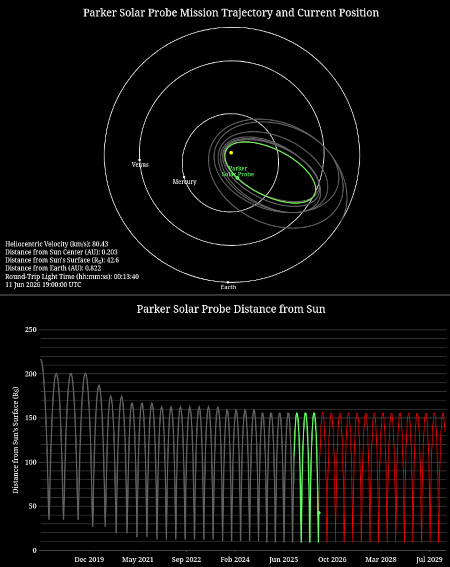
The overall flight plan for Parker
The overall flight plan for Parker. The green indicates
this most recent close approaches.

The Parker Solar Probe this past week successfully completed its 28th close fly-by of the Sun, zipping past its surface at a distance of only 3.8 million miles.

During this solar encounter, which started June 3 and ends Saturday, June 13, Parker’s four scientific instrument packages gathered data from inside the Sun’s atmosphere, or corona. Parker will begin returning detailed spacecraft telemetry on June 14, with science data transmission set to run from Wednesday, June 17 to Tuesday, June 30.

…Parker also equaled its record-setting speed of 430,000 mph — a mark that, like Parker’s distance to the Sun, was set during a close approach on Dec. 24, 2024, and matched during five flybys since, most recently on March 11. Parker will continue matching these speed and distance records during future flybys.

Engineers estimate the spacecraft’s heat shield experiences temperatures exceeding 1,700 degrees Fahrenheit with each close pass.

With each pass the spacecraft dives deep into the Sun’s corona and gathers data about it unobtainable from a distance. It is also gathering that data over time, as it first arrived in 2018, when the Sun was at its solar minimum with little sunspot activity. Since then it has ramped up to maximum and is presently thought to be on its way back down to minimum (though this still remains uncertain). Parker’s ability to gather data cross this timeline is invaluable for gaining a better understanding of the Sun’s behavior.

7 comments

Science operations about to resume on Europe’s two-satellite Proba-3 space telescope

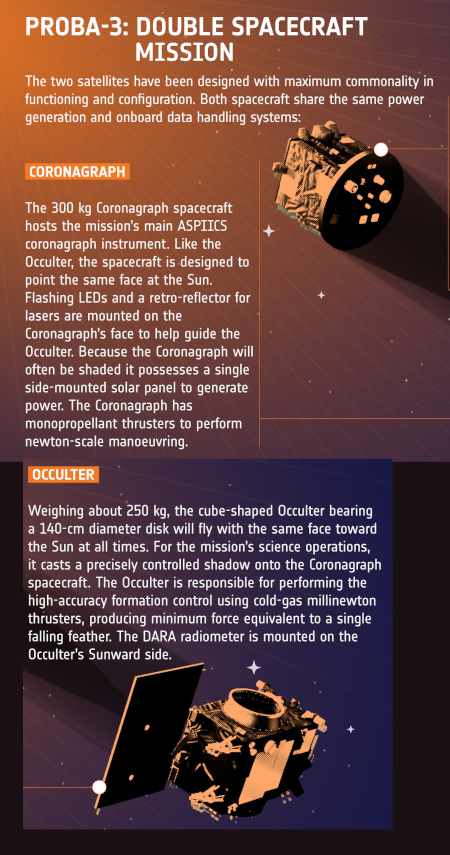
The Proba-3 mission
The Proba-3 mission. Click for original.

After months of trouble-shooting after losing contact with the coronagraph probe of Europe’s two-satellite Proba-3 solar space telesscope in February 2026, engineers have successfully resumed precise formation flying of the two spacecraft, and are about to resume full science observations of the Sun’s corona.

The mission is explained in the graph to the right. In February all contact with the coronagraph, which holds the mission’s science instruments, was lost. After a month of struggle, engineers regained contact, but it required another few months of trouble-shooting to pin down the cause of the problem and fix it. The press release provides almost no information about that cause, other than this one quote that hints it was software-based.

“One by one, we have checked the status of each of the spacecraft’s subsystems. We have also been able to successfully perform the operations that proved critical in February,” says Damien. “Back then, it triggered the unfortunate chain reaction that led to loss of connection with the spacecraft, but after patching the root cause in the software, we were confident that this activity will cause no further issues.”

With both spacecraft once again operating in tandem, the occulter can block the Sun’s light so the coronagraph can observe the Sun’s corona, its atmosphere. Essentially, Proba-3 creates an on-going artificial eclipse so as to make the corona visible for study.

4 comments

Sunspot update: May sunspot activity jumps

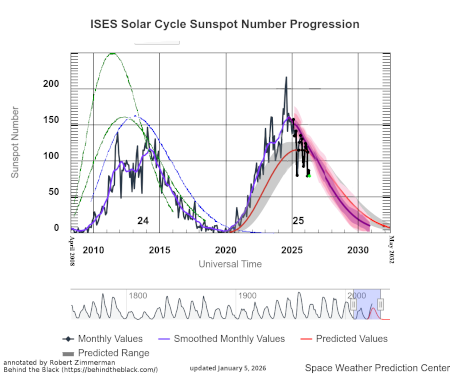
It is the beginning of the month, so it is time for my monthly sunspot update. According to NOAA’s June update of its monthly graph of the sunspot activity on the Earth-facing hemisphere, the amount of sunspots in May surprised us once again by increasing upward, though the totals continue to be below prediction.

That graph is below, annotated with extra information by me to illustrate the larger scientific context.
» Read more

1 comment

New long term analysis of solar activity suggests the Sun is undergoing some form of internal structural change

Sunspot activity for the past two cycles
NOAA’s chart of sunspot activity.
Click for the most recent update.

The uncertainty of science: Scientists doing a new analysis of more than forty years of solar data have concluded that some form of “subsurface structural changes associated with successive 11-year [sunspot] cycles” are taking place, with those changes “ever more progressively confined just beneath the solar surface.”

Using almost 40 years of helioseismic data from six telescopes around the world in the Birmingham Solar Oscillations Network (BiSON), the researchers uncovered a gradual change in structure just beneath the surface that has spanned multiple cycles, with the current solar cycle 25 showing particularly strong signatures of these changes.

Lead author Professor Bill Chaplin, from the University of Birmingham, said: “The Sun has its own ‘active biorhythm’ creating rising and falling magnetic activity that shapes space weather. However, traditional surface measures don’t capture the full story – that the Sun may be entering a different mode of behaviour unfolding over decades.

“We have uncovered evidence of systematic changes in the solar activity cycle. Crucially, magnetic activity is becoming more tightly confined near the surface with each cycle.”

The confinement appears to be within the first 600 miles below the surface, which for the Sun is barely skin deep.

In reading the paper [pdf], it is very clear they have detected these changes, but are as yet unable to apply them to any larger fundamental processes. They are observing the Sun change, but don’t know why. It could be simply random fluctuations of behavior, or it could be part of the Sun’s normal behavior related to its magnetic field and the nuclear fusion that makes it burn.

In either case, this lack of deeper understanding means it is impossible as yet to predict what will happen next, or how those future changes will impact us here on Earth.

1 comment

Scientists: First data from Europe’s Proba-3 satellites suggest the Sun’s slow solar wind is faster and more chaotic than expected

Figure 4 showing variable speeds of slow solar wind
Click for original image.

The uncertainty of science: According to the first published paper [pdf] from Europe’s two Proba-3 satellites, scientists have found the slow solar wind that comes from the Sun is sometimes far faster than expected, and is also far more chaotic. From the second link above:

Just like wind on Earth, solar wind can be fast or slow, smooth or gusty. Fast solar wind usually flows in a smooth current from magnetic structures called coronal holes. In contrast, slow solar wind is variable and gusty, making understanding how it works more difficult.

Scientists think that slow solar wind is generated by the Sun’s magnetic field lines changing how they are connected, merging and separating again. This process pushes out blobs of plasma (electrically charged gas) in so-called ‘streamers’: large, bright rays in the corona.

…Previously, scientists found that close to the Sun’s surface, slow solar wind should have speeds around 100 km/s. Instead, Andrei’s team tracked some blobs of plasma moving at 250–500 km/s.

The graph to the right, Figure 4 in the paper, shows Proba-3’s tracking of a variety of these blobs. Not only did some move faster than expected (the arrows above the gray line marking earlier data), their speeds changed with time, with some actually speeding up.

The reason the Sun’s fast wind is relatively stable is that it emanates from magnetic structures dubbed coronal holes because the magnetic field lines there are is somewhat calm and stable. The slow wind meanwhile comes out through much more active and unstable regions of the magnetic field, with its field lines jumping about as well as connecting and unconnecting from the field’s structure in a chaotic manner.

This research suggests that the slow wind is chaotic and thus unpredictable, almost like the weather on Earth.

2 comments

Engineers regain contact with Proba-3’s Coronagraph probe

The Proba-3 mission
The Proba-3 mission. Click for original.

A month after all contact was lost with the Coronagraph probe of Europe’s two-spacecraft Proba-3 solar observatory, engineers have regained contact with it this week, and have been able to place it in safe mode in preparation for re-establishing science operations.

After more than a month of silence, ESA’s ground station in Villafranca, Spain, received telemetry from the Coronagraph spacecraft. Telemetry is a package of data sent by a spacecraft including information on its temperature, voltages, and health of onboard systems.

The Coronagraph is now in safe mode and stable, and the mission team and operators are running health checks on the spacecraft to understand if any parts of it have been damaged.

The spacecraft’s solar panel is facing the Sun, powering the essential electronics on board, and charging the battery with the remaining power.

Before it can resume observations engineers need to get the spacecraft back up to operating temperature after a month without power.

As shown in the graphic to the right, the Coronograph satellite is the heart of this mission. It records the data, available because the Occulter blocks the Sun from view so that the corona, the Sun’s atmosphere, can be seen. It is almost a miracle that it has survived that month, and can soon resume observations.

1 comment

Solar scientists: We finally think we know the location of the Sun’s dynamo

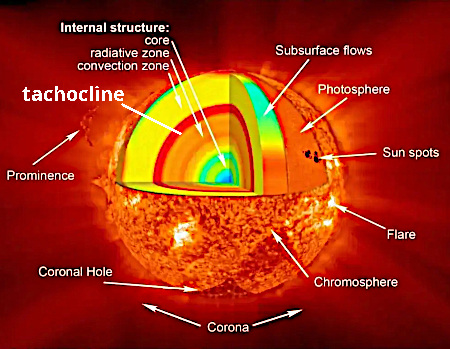
The Sun's interior
NASA graphic used in the press release and
annotated to post here.

The uncertainty of science: Using three decades of data gathered during the last three solar cycles, scientists now think they have finally determined the location of the Sun’s dynamo in its interior, at a transition point about 125,000 miles below the surface called the tachocline. From the abstract of their paper [pdf]:

The exact location of the solar dynamo remains uncertain–whether it operates primarily in the near-surface shear layer, throughout the entire convection zone, or near the tachocline – a region of sharp transition in the solar rotation, located at the base of the convection zone, approximately 200,000 km [125,000 miles] beneath the surface. Various studies have supported each of these possibilities.

…Our analysis reveals that the gradient of rotation displays ‘butterfly’–like behavior near the tachocline, which is similar to the magnetic butterfly diagram at the surface. This result supports the idea that the solar dynamo has a deep-seated origin, likely operating either near the tachocline or throughout the convection zone, thereby disfavoring the recent scenario of a shallow, near-surface dynamo. This finding may also have important implications for understanding how stellar dynamos operate in general. [emphasis mine]

Even though scientists have known for more than a century that the Sun’s eleven-year cycle of flipping the polarity of its magnetic field is the fundamental cause of the sunspot cycle, they actually know very little about the dynamo that causes that magnetic field, as this study implies. They not only don’t have any understanding of the fundamental processes that creates that dynamo or causes it to flip polarity every eleven years, they still aren’t entirely sure where it is located within the Sun.

Thus, the highlighted sentence above is one large understatement. Of course knowing the dynamos location will have “important implications for understanding stellar dynamics.” This study is a first good stab at the problem, but it also shows us how little we actually know.

Remember this when anyone tells you “the science is settled” about climate change. The Sun is the number one influence on the Earth’s climate, and its solar cycle appears to be an important factor in that influence. Until we have a better understanding of the Sun, its magnetic field, and the dynamo that creates it, no climate prediction will be worth anything. Such predictions will be all guesswork, and likely put forth for political reasons.

6 comments

ESA loses contact with the coronagraph satellite of its duel-satellite Proba-3 mission

The Proba-3 mission
The Proba-3 mission. Click for original.

The European Space Agency (ESA) today announced that engineers have lost contact with the Coronagraph satellite of its duel-satellite Proba-3 mission, and are working now to recover contact.

During the weekend of 14–15 February 2026, an anomaly onboard Proba-3’s Coronagraph spacecraft triggered a chain reaction that led to the progressive loss of attitude (spacecraft orientation) and prevented the entry into safe mode.

Because the spacecraft’s solar panel was no longer facing the Sun, the onboard battery started to discharge quickly. This caused the spacecraft to enter survival mode, when minimum electronics are active and data transmission to the ground is interrupted.

The exact root cause of the anomaly is under investigation, and mission teams and operators have joined forces to attempt to re-establish contact with the spacecraft to recover the situation.

The Coronograph satellite is the heart of this mission. It records the data, available because the Occulter blocks the Sun from view so that the corona, the Sun’s atmosphere, can be seen. Based on this report, it does not look good that the spacecraft can be recovered.

At the same time, the mission has apparently achieved all of its initial goals, and was now on an extended mission.

3 comments

Sunspot update: Sunspot activity tumbles in February, including the 1st blank days since ’22

The uncertainty of science! It is the start of the month, and thus time for another sunspot update, using NOAA’s monthly graph of the sunspot activity on the Earth-facing hemisphere, updated by NOAA to include the activity in February but annotated with extra information by me to illustrate the larger scientific context.

Last month I lambasted NOAA’s solar science panel for its consistently failed predictions, and made a tentative prediction of my own, suggesting the ramp down to solar minimum might not be occurring as they had predicted in April 2025.

This month I can lambast myself, because the Sun in February saw a significant drop in sunspots, including three consecutive days in which the Sun was blank of spots, for the first time since 2022. This drop supports the NOAA panel prediction and makes my prediction look foolish, but it also suggests the ramp down is continuing to go faster than predicted.
» Read more

2 comments

Sunspot update: Maybe solar maximum isn’t over?

The uncertainty of science! It is time for another sunspot update. It is also time to note that once again the Sun appears to be confounding the predictions of NOAA’s solar science panel. Below is NOAA’s monthly graph of the sunspot activity on the Earth-facing hemisphere, updated by NOAA to include the activity in January but annotated with extra information by me to illustrate the larger scientific context.

Since April 2025 that science panel has been predicting that the solar maximum has passed and the Sun was beginning the ramp down to solar minimum, now expected to occur around 2031-32. And in the ten months since, sunspot activity has appeared to more or less track that prediction, as indicated by the purple/magenta curve line on the graph below.

It now appears that this prediction might very well have been premature.
» Read more

2 comments

Sunspot update: Ramp down to minimum continues?

Another year, another month, another sunspot update! Time to post my monthly update of the never-ending sunspot cycle on the Sun, using NOAA’s own monthly update of its graph of sunspot activity and annotating it with extra information to illustrate the larger scientific context.

The green dot on the graph below indicates the level of sunspot activity on the Sun’s Earth-facing hemisphere during the month of December. Unlike November, when activity plunged, in December the sunspot count recovered, producing more sunspots, though the number still reflected the ramp down to solar minimum that NOAA’s panel of solar scientists had predicted in April 2025 (as indicated by the purple/magenta line).
» Read more

2 comments

Sunspot update: Sunspot activity again crashes far below predictions

It is the start of another month, so it is time again to post my monthly update of the never-ending sunspot cycle on the Sun, using NOAA’s own monthly update of its graph of sunspot activity and annotating it with extra information to illustrate the larger scientific context.

The green dot on the graph below indicates the level of sunspot activity on the Sun’s Earth-facing hemisphere during the month of November. And once again, the Sun surprised us, producing far less sunspots than expected, based on the April 2025 prediction by NOAA’s panel of solar scientists (as indicated by the purple/magenta line).
» Read more

3 comments

Sunspot update: Solar activity continues to decline as predicted

Another month has passed, and so it is time for my monthly update on the never-ending sunspot cycle on the Sun. using NOAA’s own monthly update of its graph of sunspot activity and annotating it with extra information to illustrate the larger scientific context.

The green dot on the graph below indicates the level of sunspot activity on the Sun’s Earth-facing hemisphere during the month of October. Not only did the number of sunspots decline from the count in the previous month, as predicted in April 2025 by NOAA’s panel of solar scientists (as indicated by the purple/magenta line), it dropped below their prediction.
» Read more

5 comments

Sunspot update: For one month the Sun does what the scientists predicted!

It is the start of the month, which means it is time for my monthly sunspot update, using NOAA’s own monthly update of its graph of sunspot activity and annotating it with extra information to illustrate the larger scientific context.

This graph is below, with the green dot showing the sunspot number for activity on the Sun’s Earth-facing hemisphere in September. As you can see, the count closely matched the April 2025 prediction by NOAA’s panel of solar scientists, which posited that the Sun was finally beginning its ramp down from solar maximum (as indicated by the purple/magenta line).
» Read more

2 comments

Sunspot update: In August sunspot activity continued to rise

Time for this month’s sunspot update. To do this each month I begin by taking NOAA’s own monthly update of its graph of sunspot activity and annotating it with extra information to illustrate the larger scientific context.

This annotated graph showing the August activity is below, and for the third month in a row sunspot activity increased (as indicated by the green dot), so that the August number of sunspots now closely matched the April 2025 prediction by NOAA’s panel of solar scientists that the Sun was finally beginning its ramp down from solar maximum.
» Read more

2 comments

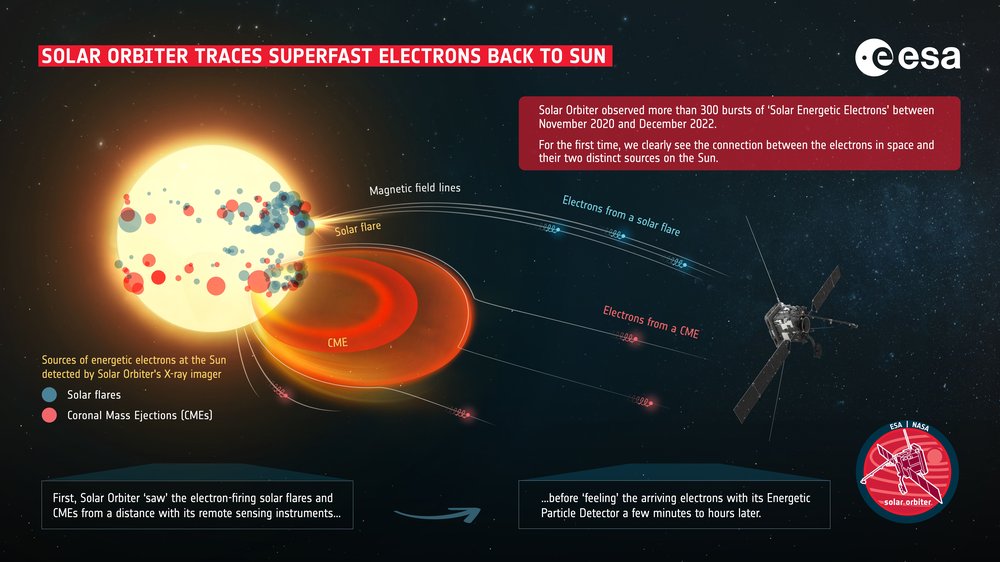
Scientists pinpoint the origin of the energetic electrons thrown out by the Sun

Infographic about Solar Orbiter data
Click for original image.

Using Europe’s Solar Orbiter probe, scientists have now successfully identified the two sources of the energetic electrons accelerated at high speed by the Sun, and in doing so also determined why those particles sometimes arrive later than expected.

The Sun is the most energetic particle accelerator in the Solar System. It whips up electrons to nearly the speed of light and flings them out into space, flooding the Solar System with so-called ‘Solar Energetic Electrons’ (SEEs). Researchers have now used Solar Orbiter to pinpoint the source of these energetic electrons and trace what we see out in space back to what’s actually happening on the Sun. They find two kinds of SEE with clearly distinct stories: one connected to intense solar flares (explosions from smaller patches of the Sun’s surface), and one to larger eruptions of hot gas from the Sun’s atmosphere (known as ‘coronal mass ejections’, or CMEs).

“We see a clear split between ‘impulsive’ particle events, where these energetic electrons speed off the Sun’s surface in bursts via solar flares, and ‘gradual’ ones associated with more extended CMEs, which release a swell of particles over longer periods of time and over broader angular ranges,” says lead author Alexander Warmuth of the Leibniz Institute for Astrophysics Potsdam (AIP), Germany.

The researchers observed 300 events between November 2020 and December 2022 at many different distances from the Sun, allowing them to clock their travel times. The graphic above illustrates what they found.

5 comments

Sunspot update: The Sun appears ready to once again confound the experts

It is the start of the month and time once again for my monthly sunspot update, using the update that NOAA posts each month to its own graph of sunspot activity but annotated by me with extra information to illustrate the larger scientific context.

This month’s update graph is below, and it shows once again that it is a big mistake to put any faith into any prediction anyone makes about the Sun’s eleven-year sunspot cycle, tracked by scientists since the 1700s. Beginning in April 2025 the NOAA solar science panel has been predicting that the solar maximum had hit its peak and that we should expect the Sun to begin its ramp down to solar minimum, expected around 2031.

NOT!
» Read more

1 comment

Scientists: The Sun’s bright corona acts to impede coronal mass ejections

Using data gathered by the Solar and Heliospheric Observatory (SOHO) since its launch in 1995, scientists have determined that when the Sun’s corona (its atmosphere) is bright, it acts to slow and even block the ejection of coronal mass ejections (CMEs), which if they impact the Earth’s magnetic field can have a harmful effect on our modern technology.

Using data from NRL’s Large Angle and Spectrometric Coronagraph Experiment (LASCO) on board the joint European Space Agency (ESA)-NASA Solar and Heliospheric Observatory (SOHO), the NRL team [National Research Laboratory] compiled nearly three decades of observations of the solar corona. They studied the extensive dataset to investigate trends in the brightness of the Sun’s corona and compare them to CME velocities over the same period. Their study found a strong correlation between the two datasets, with bright regions of the solar corona appearing to relate to substantially slower CME velocities and, in some cases, perhaps entirely precluding CMEs.

This data will help solar weather observers better predict the arrival of CMEs, should they erupt from the Sun aimed at Earth. It will also allow them to gauge the risk of CMEs even occurring.

8 comments

Parker completes its 24th close fly-by of the Sun

The Parker Solar Probe has successfully completed its 24th close fly-by of the Sun, the last of its initial primary mission, matching the distance and speed record set during two previous fly-bys.

Parker Solar Probe checked in with mission operators at the Johns Hopkins Applied Physics Laboratory (APL) in Maryland — where it was also designed and built — on Sunday, June 22, reporting that all systems are healthy and operating normally. The spacecraft was out of contact with Earth and operating autonomously during the close approach.

During this flyby, the spacecraft also equaled its record-setting speed of 430,000 miles per hour (687,000 km per hour) — a mark that, like the distance, was set and subsequently matched during close approaches on Dec. 24, 2024, and March 22, 2025.

The data obtained during this fly-by will be beamed back to Earth in the coming months, as Parker moves to the outer part of its orbit, farther from the Sun.

Though this completes the planned orbits of the mission’s primary mission, the proposed Trump budget continues to fund the spacecraft’s operation for the next five years, allowing it to monitor changes in the Sun as it ramps down from solar maximum to solar minimum.

1 comment

Europe’s Solar Orbiter takes first images of the Sun’s south pole

The south pole of the Sun
Click for original image.

Because its orbit has now dropped 17 degrees below the ecliptic plane of the solar system, the European Space Agency’s (ESA) Solar Orbiter probe has been able to snap the first images of the Sun’s south pole, as shown by the two pictures to the right.

The [two images show] the Sun’s south pole as recorded on 16–17 March 2025, when Solar Orbiter was viewing the Sun from an angle of 15° below the solar equator. This was the mission’s first high-angle observation campaign, a few days before reaching its current maximum viewing angle of 17°.

The instruments each observe the Sun in a different way. PHI images the Sun in visible light (left) and maps the Sun’s surface magnetic field (right).

The magnetic field data on the right has revealed that at present the field at the pole is “a mess,” because the Sun is presently at solar maximum.

While a normal magnet has a clear north and south pole, the PHI instrument’s magnetic field measurements show that both north and south polarity magnetic fields are present at the Sun’s south pole. This happens only for a short time during each solar cycle, at solar maximum, when the Sun’s magnetic field flips and is at its most active. After the field flip, a single polarity should slowly build up and take over at the Sun’s poles. In 5–6 years from now, the Sun will reach its next solar minimum, during which its magnetic field is at its most orderly and the Sun displays its lowest levels of activity.

Solar Orbiter is now well positioned to observe the expected changes in the Sun’s magnetic field as sunspot activity ramps down to solar minimum.

0 comments
1 2 3 19