
Solar storms are simply no longer a threat
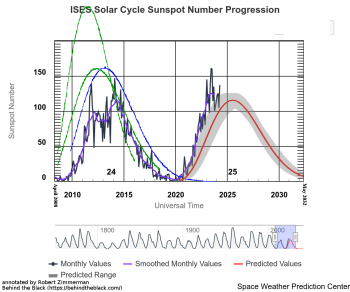
The sunspot cycle as of May 2024
The sunspot cycle as of May 2024. Click
for full details.

Today’s Chicken Little Report: When NOAA predicted on May 9, 2024 that a powerful solar flare had erupted from the Sun and was aiming a major solar storm directly at the Earth, the scientists at the federal government’s Space Weather Prediction Center could not help underlining the disaster potential, and were ably aided by the mainstream press. This CNN report was typical:

“Geomagnetic storms can impact infrastructure in near-Earth orbit and on Earth’s surface, potentially disrupting communications, the electric power grid, navigation, radio and satellite operations,” according to the Space Weather Prediction Center. “(The center) has notified the operators of these systems so they can take protective action.”

The center has notified operators in these areas to take action to mitigate the potential for any impacts, which include the possibility of increased and more frequent voltage control problems. Other aspects operators will monitor include a chance of anomalies or impacts to satellite operations and frequent or longer periods of GPS degradation.

And as always, the news report has to end with this warning of doom:
» Read more
12 comments

The aurora as seen looking down from space


The aurora over the U.S. on May 11, 2024
Click for original image.

NOAA on May 13, 2024 released a set of eight images taken by its fleet of JPSS weather satellites, showing the strong Aurora Borealis or Northern Lights that were activated over the May 11th weekend due to several very strong solar flares on the Sun and sent a geomagnetic storm at the Earth.

One of those images, reduced to post here, is to the right. You can see the eastern coast of the United States, outlined by city lights, with a band of aurora cutting across the northern half and reaching south below the Great Lakes. The other seven images are available at the link above.

The geomagnetic storm was the strongest produced by the Sun in more than two decades, since 2003. That storm occurred during solar maximum, as did the May 11th this past weekend. However, the Sun experienced another solar maximum in-between, in 2014, which produced few such storms, and none as strong.

I want to add that despite the screams of panic prior to the arrival of this storm, its arrival produced only minor disturbances in the world’s electrical grid, and in fact was proof positive that the many decades of work that electrical companies have devoted to protecting the grid from such storms has paid off. It is very unlikely any major storm from the Sun can harm that grid in the future, unless of course we get lazy and stop maintaining it.

4 comments

Sunspot update: A minor uptick in sunspot activity in April

It is that time of the month again. Yesterday NOAA posted its monthly update of its graph tracking the number of sunspots on the Sun’s Earth-facing hemisphere. As I have done now for every month since I began this website in 2010, I have posted this updated graph below, with several additional details to provide some larger context.

In April the number of sunspots on the Sun went up somewhat, the count rising to the highest level since the count hit its peak of activity last summer. The sunspot number in April, 136.5, was however still significantly less than the 2023 peak of 160. Thus it appears the Sun is likely still the middle saddle of a doubled-peaked relatively weak solar maximum, with the Sun doing what I predicted in February 2024:
» Read more

1 comment

Sunspot update: The Sun continues what appears will be a weak maximum

As I have done each month since 2011, I am now posting an annotated version of NOAA’s monthly graph, tracking the solar sunspot activity on the Earth-facing hemisphere of the Sun. The NOAA updated graph was posted at the start of March, covering activity through the end of February, so this report is a little later than normal.

That graph is below. In February sunspot activity remained essentially steady, only slightly higher than the activity from the month before. Those numbers also hovered at about the same level seen since August 2023.
» Read more

1 comment

Sunspot update: The Sun in January acted like solar maximum is here

In my monthly sunspot update at the start of January, I asked in the headline “Are we now in the next solar maximum?”

The Sun’s sunspot activity in January since then has apparently answered that question. NOAA this week posted its monthly update of its graph showing solar sunspot activity on the Sun’s Earth-facing hemisphere, and as I do every month since 2011, I have posted that graph below, with annotations to provide a larger context.
» Read more

11 comments

Sunspot update: Are we now in the next solar maximum?

Time for my monthly update on the Sun’s sunspot activity has it proceeds through its eleven-year sunspot cycle. NOAA has released its update of its monthly graph showing the number of sunspots on the Sun’s Earth-facing hemisphere, and I have posted it below, annotated with further details to provide a larger context.

In December sunspot activity increased slightly for the second month in a row, but only by a little bit. The number of sunspots for the month was still significantly below the highs seen in the summer, and continue to suggest that the Sun has already entered solar maximum (two years early), and like the previous two solar maximums in 2001 and 2013, will be double peaked.
» Read more

11 comments

Sunspot update: Activity rises in September but not significantly

Another month has passed, and it is once again time to post my annotated graph of NOAA’s monthly update of its graph that tracks the number of sunspots on the Sun’s Earth-facing hemisphere. The new graph is posted below, with several additional details to provide some larger context.

Last month we saw a drastic drop in August of sunspot activity, suggesting that the next maximum might possibly have been reached, though many months earlier than predicted. This month’s graph below, which shows an increase in activity in September but still well below the highs seen in June and July, strengthens that conclusion.
» Read more

3 comments

Parker completes 17th close fly-by of the Sun, setting new records

The Parker Solar Probe on September 27, 2023 completed its seventeenth close fly-by of the Sun, setting new speed and distance records.

Set up by a gravity-assist flyby of Venus on Aug. 21, the close approach (known as perihelion) occurred at 7:28 p.m. EDT, with Parker Solar Probe moving 394,736 miles per hour (635,266 kilometers per hour) around the Sun – another record. The milestone also marked the midway point in the mission’s 17th solar encounter, which began Sept. 22 and continues through Oct. 3.

It zipped past the Sun at a distance of only 4.51 million miles, also a record.

Whether it survived this fly-by will not be confirmed until October 1, when it is able to safely send its first data back after moving far enough away from the Sun to reopen communications.

3 comments

India’s Aditya-L1 solar telescope initiates some science observations

According to India’s space agency ISRO, its Aditya-L1 solar telescope has begun science observations with one instrument, even as it continues its journey to its final position at L1, one million miles from the Earth.

The activation of STEPS occurred on September 10, 2023, at a distance exceeding 50,000 km from Earth. This distance equates to more than eight times the Earth’s radius, placing it significantly beyond the Earth’s radiation belt region. Following the successful completion of essential health checks for the instrument, the data collection process continued until the spacecraft had travelled beyond the 50,000 km mark from Earth.

All units of STEPS are currently operating within normal parameters. A graphical representation illustrates the measurements, showcasing fluctuations in the energetic particle environment within Earth’s magnetosphere, which were collected by one of the instrument’s units.

It is expected Aditya-L1 will reach L1 in January, where it will begin round-the-clock observations of the Sun, in parallel with NASA’s Soho telescope, which has been at L1 since the 1990s.

0 comments

The sunspot count in August demonstrates fully the utter uncertainty of science

In doing these sunspot updates every month since I started Behind the Black thirteen years ago, one of the repeated common themes has been noting how little we really know about the basic fundamental processes within the Sun. We know the process involves nuclear fusion combined with fission, and that process also creates a powerful magnetic field that every eleven years flips in its polarity. We also know that this eleven year cycle corresponds to an eleven year cycle of rising and then falling sunspot activity.

The devil however is in the details, and we know very little about those details. How those larger processes link to the specific changing features on the Sun remains little understood, if at all. The sudden and entirely unexpected steep drop in sunspot activity in August, as noted in the release yesterday of NOAA’s monthly update of its graph that tracks the number of sunspots on the Sun’s Earth-facing hemisphere, demonstrates this level of ignorance quite starkly.
» Read more

17 comments

India successfully launches its first solar observation satellite

India’s space agency ISRO tonight (September 2, 2023 in India) successfully used its PSLV rocket with six strap-on boosters to place in orbit its first solar observation satellite, Aditya-L1, lifting off from its coastal Sriharikota spaceport.

The spacecraft will eventually maneuver itself to the L1 point about one million miles closer to the Sun, where it will make continuous observations of the star’s visible hemisphere, using seven different instruments. Its observations will supplement those of the SOHO solar observatory (also located at the L1 point), which was launched in 1995 and is long overdue for replacement, or at least some redundancy.

For India, this was the seventh launch in 2023, which ties its previous annual launch high achieved in both 2016 and 2018. The country however has three more launches tentatively scheduled for this year, though none has as yet a specific launch date.

The leaders in the 2023 launch race:

60 SpaceX
38 China
12 Russia
7 Rocket Lab
7 India

In the national rankings, American private enterprise still leads China in successful launches 69 to 38. It also leads the entire world combined, 69 to 62, while SpaceX by itself now trails the rest of the world (excluding American companies) 60 to 62. SpaceX however has launches scheduled for September 2nd and 3rd, so these numbers are likely to change.

2 comments

Sunspot update: In July the Sun continued its high sunspot activity

Today NOAA released its monthly update of its graph that tracks the number of sunspots on the Sun’s Earth-facing hemisphere. As I have done every month for the entire thirteen years I have been doing this website, I have posted that updated graph below, adding to it some extra details to provide some context.

Though the sunspot count in July was slightly less than the very high numbers in June (the highest seen in more than two decades), the decline was almost inconsequential. Except for June’s activity, the activity in July was still the highest sunspot count in a month since September 2002, when the Sun was just beginning its ramp down after its solar maximum that reached its peak in late 2001. From that time until the last two months, the Sun had been in a very prolonged quiet period, with two solar minimums that were overly long and a single solar maximum that was very weak with a extended double peak lasting almost four years.
» Read more

7 comments

Scientists think they have finally discovered what makes the Sun’s corona so hot

Using data from Europe’s Solar Orbiter spacecraft, scientists now think they have finally pinpointed the process that causes the Sun’s corona — its atmosphere — to be many times hotter than its surface.

For decades, scientists have been struggling to explain why temperatures in the sun’s outer atmosphere, the corona, reach mind-boggling temperatures of over 1.8 million degrees Fahrenheit (one million degrees Celsius). The sun’s surface has only about 10,000 degrees F (6,000 degrees C), and with the corona farther away from the source of the heat inside the star, the outer atmosphere should, in fact, be cooler.

New observations made by the Europe-led Solar Orbiter spacecraft have now provided hints to what might be behind this mysterious heating. Using images taken by the spacecraft’s Extreme Ultraviolet Imager (EUI), a camera that detects the high-energy extreme ultraviolet light emitted by the sun, scientists have discovered small-scale fast-moving magnetic waves that whirl on the sun’s surface. These fast-oscillating waves produce so much energy, according to latest calculations, that they could explain the coronal heating.

You can read the paper here [pdf]. The results have not yet been confirmed, but if so it will solve one of the space age’s oldest scientific mysteries.

5 comments

Sunspot update: June saw the most sunspots in more than two decades

Time for our monthly sunspot update, based on NOAA’s monthly graph that tracks the number of sunspots on the Sun’s Earth-facing hemisphere. I have posted that graph below, but have added some extra details to provide some context.

June saw the highest sunspot count in a month since September 2002, when the Sun was just beginning its ramp down after its solar maximum that reached its peak in late 2001. From that time until now, the Sun has been in a very prolonged quiet period, with two solar minimums that were overly long and a single solar maximum that was very weak with a extended double peak lasting almost four years.
» Read more

3 comments

Scientists claim to identify cause of Sun’s fast solar wind

The uncertainty of science: Using data from the Parker Solar Probe, scientists now believe they have identified the cause of Sun’s fast solar wind that streams from the magnetic regions on the Sun that are dubbed coronal holes.

In a paper published June 7, 2023 in the journal Nature, a team of researchers used data from NASA’s Parker Solar Probe to explain how the solar wind is capable of surpassing speeds of 1 million miles per hour. They discovered that the energy released from the magnetic field near the sun’s surface is powerful enough to drive the fast solar wind, which is made up of ionized particles—called plasma—that flow outward from the sun.

The results depend a great deal on computer modeling, based on our presently limited understanding of magnetic field processes in environments like stars. It will need to be confirmed by more data from Parker as well as later probes.

1 comment

Sunspot update: May activity once again far above prediction

With the start of the month it is time once again for our monthly sunspot update, based on the new data that NOAA today added to its own monthly graph that tracks the number of sunspots on the Sun’s Earth-facing hemisphere. I have posted that graph below, but have added some extra details to provide some context.

In May the number of sunspots zipped upward again, ending up at the second highest monthly count during this ramp up to solar maximum, and the second highest count since the last solar maximum in 2014.
» Read more

4 comments

Sunspot update: April activity drops steeply

NOAA this week once again published an update of its monthly graph that tracks the number of sunspots on the Sun’s Earth-facing hemisphere. As I do every month, I have posted this graph below, with some additional details included to provide some context.

In April the number of sunspots dropped again, for the second time in the past three months. The high activity previously had suggested that the solar maximum was going to be much higher than predicted, or possibly would come sooner than expected. The drop however now suggests that the fast rise in sunspot activity that we have seen since the beginning of the ramp up to solar maximum in 2020 might finally be abating.
» Read more

7 comments

Scientists predict solar maximum to arrive one year early

The scientists whose prediction of a more active upcoming solar maximum that has so far turned out more accurate than the consensus prediction have now updated their prediction, lowering it somewhat but also predicting the maximum will occur one year early, in 2024 instead of 2025.

The team’s finalized forecast for the current cycle expects it to peak in late 2024, one year earlier than NASA and NOAA had predicted. The cycle, the team thinks, will reach about 185 monthly sunspots during its maximum and thus be somewhat milder than what the team originally forecasted. This peak intensity will place this cycle at about the average compared to the historical record.

In other words, now that we are about halfway to maximum, they have concluded that while NOAA’s prediction was too low, their prediction was too high. They have now adjusted their expectations to be closer to what they now think will happen.

A short solar cycle however has historically corresponded to much higher sunspot activity. If this new prediction is correct (a short cycle with a mild maximum), it will mean that the Sun is still behaving in ways that the solar science community does not understand, or can predict.

4 comments

Sunspot update: Activity remained high in March

It is time for my monthly sunspot update. NOAA this week updated its graph that tracks the number of sunspots on the Sun’s Earth-facing hemisphere. This graph is posted below, with some additional details included to provide some context.

Last month the number of sunspots dipped slightly after a gigantic leap of activity in January. This month showed a small rise in activity, but not enough to bring levels back to the January’s levels. Nonetheless, activity remains the highest seen since 2014. when the last solar maximum was approaching its end, and continues to exceed significantly the 2020 prediction by NOAA’s panel of solar scientists.
» Read more

3 comments

Sunspot update: After going through the roof last month, sunspots drop into the attic this month

With the start of another month NOAA this week updated its graph that tracks the number of sunspots on the Sun’s Earth-facing hemisphere. As I do every month, I have posted that updated graph below, adding some additional details to provide some context.

Last month the number of sunspots rocketed upward to the highest seen since 2014, and only the second time since November 2002 that the Sun was that active. In February those high numbers dropped, though the sunspot activity during the month remained well above the 2020 prediction by NOAA’s panel of solar scientists.

» Read more

7 comments
1 2 3 4 5 19