Sunspot update: The Sun confounds the predictions again!

It is time for my monthly update of the Sun’s ongoing sunspot activity, using the update that NOAA posts each month to its own graph of sunspot activity but annotated by me with extra information to illustrate the larger scientific context.

The activity in May was shocking in that it completely contradicted all expectations by everyone in the solar science community, with the Sun’s sunspot count changing in a way that was somewhat unprecedented. The graph below makes this very clear:

» Read more

6 comments

New ground-based images of the Sun’s surface

The Sun's surface, as seen by Inouye Solar Telescope
Click for original image.

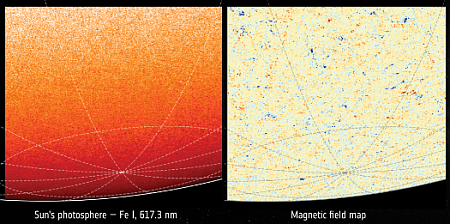
Cool image time! The picture to the right, cropped, reduced, and sharpened to post here, was taken using the Inouye Solar Telescope in Hawaii. It shows the granule surface of the Sun at very high resolution, resolving objects as small as 12 miles across.

The team used the Inouye’s Visible Broadband Imager (VBI) instrument operating in the G-band, a specific range of visible light especially useful for studying the Sun because it highlights areas with strong magnetic activity, making features like sunspots and fine-scale structures like the ones in the study easier to see. The setup allows researchers to observe the solar photosphere at an impressive spatial resolution better than 0.03 arcseconds (i.e., about 20 kilometers on the Sun). This is the sharpest ever achieved in solar astronomy.

The scientists then used computer simulations to confirm that the smallest features, curtains of plasma raising along the walls of the granules, are linked to fluctuations in the Sun’s magnetic field.

As interesting and cutting edge this research is, the language of the press release seems more aimed at touting this telescope then describing new science. Practically every sentence uses words like “unmatched,” “unparalleled,” “unique,” and “unprecedented” (multiple times), and then ended with this quote:

“This is just one of many firsts for the Inouye, demonstrating how it continues to push the of solar research,” says NSO [National Solar Observatory] Associate Director for the NSF [National Science Foundation’s] Inouye Solar Telescope, Dr. David Boboltz. “It also underscores Inouye’s vital role in understanding the small-scale physics that drive space weather events that impact our increasingly technological society here on Earth.”

I have noticed this phenomenon recently in many government press releases. It appears that the releases issued in the past month have become less about real research and are more designed to lobby the public against any possible budget cuts proposed by the Trump administration.

5 comments

The Sun’s surface, in high resolution

The Sun's surface in high resolution
Click for movie (though not of this image)

Cool image time! The picture to the right, reduced and sharpened to post here, was one of a number of pictures released today by the science team operating the new adaptive optics at the 60 inch Goode Solar Telescope (GST) at the Big Bear Solar Observatory (BBSO) in California. It shows the fluffy surface of the Sun, made of many needle-like threads called spicules, with larger bits of plasma (in the center) flung upward and back along the Sun’s magnetic field lines.

If you click on the image, you can watch a 42-second movie produced by many images of a different plasma blob as it changes and evolves. Other short movies produced show bits of this material falling back quickly along those field lines as well as that fluffy surface of needles waving almost like tall prairie grass. The width of the image covers approximately 25,000 miles, which means you could fit about three Earth’s in this space.

To create these images from a ground-based telescope required new technology:

The GST system Cona uses a mirror that continuously reshapes itself 2,200 times per second to counteract the image degradation caused by turbulent air. “Adaptive optics is like a pumped-up autofocus and optical image stabilization in your smartphone camera, but correcting for the errors in the atmosphere rather than the user’s shaky hands,” says BBSO Optical Engineer and Chief Observer, Nicolas Gorceix.

Using this refined imagery, solar scientists will be better able to track and observe the Sun’s small scale behavior (actually quite large on human scales).

3 comments

Sunspot update: Activity rises slightly in April

It is the start of the month, so it is of course time for my monthly report on sunspot activity, based on the update that NOAA posts each month to its own graph of sunspots activity. As I have done since the start of Behind the Black in 2010, I take that graph each month and annotate it with extra information to illustrate the larger scientific context.

Sunspot activity in April did nothing to tell us anything about the Sun’s future activity. It rose slightly, but not by enough to suggest that the prediction put forth last month by NOAA scientists that the ramp down to solar minimum has begun is wrong.
» Read more

4 comments

Sunspot update: NOAA scientists try to hide how wrong they have gotten things

My monthly sunspot update today will have less to do with the Sun’s sunspot activity itself — which continues to show a very very slow decline from a peak in August 2024 — and more to do with more games-playing by NOAA solar scientists to fool the public into believing they know more than they do.

Below is my annotated version of NOAA’s monthly graph showing the amount of sunspot activity on the Earth-facing hemisphere of the Sun. This graph is significantly different from the graph that NOAA’s scientists have issued for the past few years, with all the changes designed to make it seem as if these scientists’ predictions are on the money, when they have been entirely wrong now for two solar cycles in a row.
» Read more

10 comments

Parker completes 23rd close fly-by of Sun, matching record set by its previous fly-by

The Parker Solar Probe on March 22, 2025 successfully completed its 23rd close fly-by of Sun, matching the distant and speed records set by its previous fly-by in December 2024.

NASA’s Parker Solar Probe completed its 23rd close approach to the Sun on March 22, equaling its own distance record by coming within about 3.8 million miles (6.1 million kilometers) of the solar surface. The close approach (known as perihelion) occurred at 22:42 UTC — or 6:42 p.m. EDT — with Parker Solar Probe moving 430,000 miles per hour (692,000 kilometers per hour) around the Sun, again matching its own record.

Actual science data won’t be downloaded from the spacecraft for several weeks, but it has sent back a signal that it is in good shape and operating as expected.

1 comment

Sunspot update: Sunspot activity remains high but stable

The uncertainty of science Time for my monthly update on our Sun’s sunspot cycle, based on NOAA’s monthly graph of the sunspot activity on the Earth-facing hemisphere of the Sun, but annotated by me with additional information.

The graph below shows that the number of sunspots in February continued the trend during this solar maximum of being significantly higher than the consensus prediction by a panel of NOAA solar scientists, as indicated by the red curve. At the same time, the count in February was well below the high point during the summer of 2024. Instead, though it went up slightly in February it remains at about the same level we have seen since September.
» Read more

1 comment

Sunspot update: Sunspot activity continued its decline in January

Another month has passed, meaning it is time for another update on the Sun’s sunspot cycle, based on NOAA’s monthly graph tracking that activity but annotated by me with additional information.

In January the decline in sunspot activity on the hemisphere facing Earth since August 2024 continued, with the number of sunspots dropping to a level not seen since May 2023, when the Sun’s was ramping up from solar minimum to solar maximum.
» Read more

5 comments

Parker confirms it gathered science data during its record-breaking solar fly-by on December 24th

Parker flight plan
The flight plan for Parker. Click for original.

Engineers have now confirmed that during its record-breaking close fly-by of the Sun on December 24, 2024 all of its science instruments functioned as planned and were able to collect data as to that previously unexplored near-solar environment.

Breaking its previous record by flying just 3.8 million miles above the surface of the Sun, Parker Solar Probe hurtled through the solar atmosphere at 430,000 miles per hour — faster than any human-made object has ever moved. A beacon tone, received in the mission operations center at the Johns Hopkins Applied Physics Laboratory (APL) in Laurel, Maryland, late in the evening of Thursday, Dec. 26, confirmed the spacecraft had made it through the encounter safely.

The telemetry (or housekeeping data) that APL began receiving on Jan. 1 provided more detail on the spacecraft’s operating status and condition. It showed, for example, that Parker had executed the commands that had been programmed into its flight computers before the flyby, and that its science instruments were operational during the flyby itself.

A full download of this data will occur later this month, after the spacecraft further retreats from the Sun and gets in a better position to transmit it.

This ain’t the end, however. Parker has two more similar close-up fly-ups coming in March and June. Neither will break December’s records, but both will be almost as close to the Sun. After this the probe’s primary mission will be complete. At the moment there is no word if it will get extended should the probe survive intact after those fly-bys.

3 comments

Sunspot update: Is this sunspot maximum over, or will it become another doubled peaked maximum?

Well, after almost fifteen years it had to happen at last. In preparing to do my monthly sunspot update today, which I had done every month since I started Behind the Black in 2010, I discovered that I had completely forgotten to do the update in December. Sorry about that.

No matter, the changes from month-to-month are not often significant, and fortunately that turned out to be the case in November and December of 2024. Since my last update at the beginning of November 2024, sunspot activity on the Earth-facing hemisphere of the Sun has been relatively stable, based on NOAA’s monthly graph tracking that activity. In November the activity dropped slightly, only to recover a small amount in December.
» Read more

2 comments

Parker probe phones home, signalling it has successfully survived its record-breaking closest approach to the Sun

Parker flight plan
The flight plan for Parker. Click for original.

NASA today reported that it has received a signal from the Parker Solar Probe, indicating all of its systems are in good health following its record-breaking closest approach to the Sun on December 24, 2024.

The mission operations team at the Johns Hopkins Applied Physics Laboratory (APL) in Laurel, Maryland received the signal just before midnight EST, on the night of Dec. 26. The team was out of contact with the spacecraft during closest approach, which occurred on Dec. 24, with Parker Solar Probe zipping just 3.8 million miles from the solar surface while moving about 430,000 miles per hour.

Not only was this the closest any human-built object has gotten to the Sun, it was the fastest any human-built object has ever traveled.

This close fly-by was Parker’s 22nd of the Sun since launch. In its nominal mission it plans to do two more close approaches as shown in the graphic to the right, both of which will be comparable to the record just set.

2 comments

Parker to make its last fly-by of Venus

The Parker Solar Probe is scheduled to complete its last fly-by of Venus on November 6, 2024, passing only 233 miles above the planet’s surface.

The flyby will adjust Parker’s trajectory into its final orbital configuration, bringing the spacecraft to within an unprecedented 3.86 million miles of the solar surface on Dec. 24, 2024. It will be the closest any human made object has been to the Sun.

That close solar approach will occur on December 24, 2024. Whether the spacecraft can survive is the main question, and we won’t find out until three days later, when it sends a signal to confirm its survival. If successful, it will then attempt to repeat that close fly-by at least two more times.

As for the Venus fly-by, the spacecraft will use one instrument to attempt to peer into Venus’s clouds.

0 comments

Sunspot update: in October solar activity increased after September’s crash

Time for this month’s sunspot update. As I have done every month since I started this website in 2010, I am posting NOAA’s most recent update of its monthly graph tracking the number of sunspots on the Sun’s Earth-facing hemisphere, adding some additional details to provide context.

In October, following a crash in activity in September, the Sun showed a slight increase the number of sunspots. The increase did not match the drop from the month before, but it brought the activity back up to the level seen during the summer.
» Read more

1 comment

Sunspot update: Sunspot activity crashes in September

As it is the start of the month, it is time another monthly sunspot update, in which I provide some context and analysis to NOAA’s most recent update of its monthly graph tracking the number of sunspots on the Sun’s Earth-facing hemisphere.

After several months in which the number of sunspots rose considerably each month, in September the sunspot count crashed, dropping precipitously to levels closer to the various predictions of solar scientists, but still far above what they had all expected at this time of the solar maximum.

» Read more

4 comments

Observations of solar flares do not match the standard model used to explain their origin

The uncertainty of science: When scientists carefully compared new and much more precise observations of the Sun’s solar flares with the standard model they have used for decades to explain their origin, they found unexpected differences, suggesting the model is wrong or imcomplete.

In sum, none of the processes simulated in accordance with the model proved capable of explaining the observational data. The conclusion drawn by the researchers was obvious to some extent: the standard model of solar flares needs to be reformulated, as required by the scientific method.

The scientists found that the two sources of each flare brightened at slightly different times. The model said these sources should brighten almost simulatanously, and no version of the model could explain the contradiction.

All this means is that the researchers simply don’t have enough data or understanding of the Sun to formulate a model that can fully explain the process. This study simply demonstrates this, but also provides a guide for soliving the problem.

12 comments

Sunspot update: In July the Sun produced the most sunspots in almost a quarter century

Every month since this website began fourteen years ago, when NOAA posts its update of its monthly graph tracking the number of sunspots on the Sun’s Earth-facing hemisphere, I post my own analysis, adding some details to provide the larger context.

Of all those updates — numbering about 168 — this month’s is possibly the most significant. Since around 2008, the Sun began a long period where it was unusually quiet, with the solar maximum that occurred in 2014 possibly the weakest in two hundred years. Before that weak maximum begun, half the solar science community predicted it would be a very powerful maximum, while half predicted a weak maximum. Both got it wrong, though the weak prediction was closer though still too high.

When it came time to predict the next solar maximum, expected around 2025, that same solar science community was once again in disagreement. Most approved a NOAA science panel prediction in April 2020 calling for another weak minimum, similar to the one in 2014. A few dissented, however, and instead predicted in June 2020 that the maximum would be one of the strongest ever. In April 2023 however those dissenters chickened out, and revised their prediction downward, still forecasting a peak higher than the NOAA prediction but no longer anywhere as intense.

Based on what happened on the Sun in July, they should have had more faith in their earlier prediction.
» Read more

9 comments

Do Kepler’s sunspot drawings tell us the length of the solar cycle in the 17th century?

Kepler's first sunspot drawing
Click for original image.

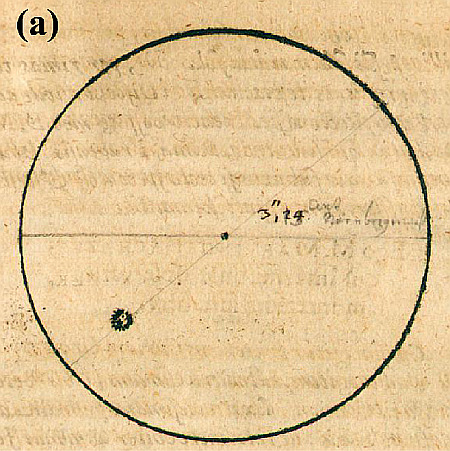
The uncertainty of science: Scientists have done a new analysis of Johannes Kepler’s three drawings of sunspots on the Sun in 1607, and have concluded that the solar cycle at that time — just before the start of the Maunder grand minimum of no sunspots for decades — was about the same length, 11 years, that has been measured since the 1700s onward.

You can read the peer-reviewed paper here. The drawing to the right is figure 1 in that paper, and shows Kepler’s first drawing of the Sun’s surface showing sunspots. From the paper’s conclusion:

In combination with sunspot drawings in the 1610s–1620s, it is reasonable to suppose that the duration of the Solar Cycle −13 was between 11 and 14 yr. This does not support Miyahara et al.’s claim of anomalously long/short durations for Solar Cycle −13 (16 yr) and Solar Cycle −14 (5 yr) but supports Usoskin et al.’s reconstruction of regular durations of Solar Cycle −13 (11 yr) and Solar Cycle −14 (14 yr).

In other words, the solar cycle prior to the sixty-plus yearlong Maunder Minimum, when few to none sunpots occurred, was about eleven years long, like now, and not five years or sixteen years long, as some scientists have theorized. Knowing the length and nature of the cycle before the Maunder grand minimum would help scientists predict when the next minimum might occur. It would also help them better document the Sun’s long term behavior.

There is however great uncertainty in this result, since there really is so little data about sunspots prior to the Maunder Minimum. Before Galileo’s first use of the telescope in astronomy in 1609, such observations like Kepler’s were rare and very difficult. The conclusions here are intriguing, but hardly convincing.

In fact, it is really impossible to get a defiinitive answer from this data. We really won’t know how the Sun behaves just prior to a grand minimum until it happens again and scientists can use modern technology to observe it.

0 comments

Sunspot update: The Sun keeps its boom going

Time for my monthly analysis of NOAA’s monthly tracking of the number of sunspots on the Sun’s Earth-facing hemisphere. As always, I have posted NOAA’s updated graph below, adding some details to provide the larger context.

In June the Sun continued the high activity from May, with the sunspot count significantly higher than predicted, 164.2 compared to the prediction of 104.9.
» Read more

5 comments

Curiosity sees evidence of solar storm hitting Mars

Charged particles from solar storm
Click to see original three-frame movie.

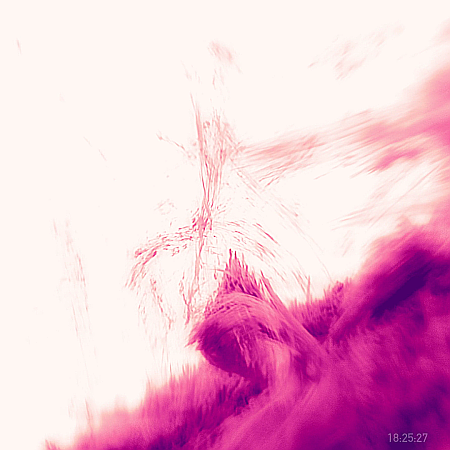
Cool image time! The picture to the right is a screen capture from a three-frame movie created from photos taken by one of the navigation cameras on the Mars rover Curiosity. The white streak and other smaller streaks were created by charged particles hitting the camera’s CCD detector on May 20, 2024, from a solar storm caused by the strong solar flares presently being pumped out by the Sun.

The mission regularly captures videos to try and catch dust devils, or dust-bearing whirlwinds. While none were spotted in this particular sequence of images, engineers did see streaks and specks – visual artifacts created when charged particles from the Sun hit the camera’s image detector. The particles do not damage the detector.

The images in this sequence appear grainy because navigation-camera images are processed to highlight changes in the landscape from frame to frame. When there isn’t much change — in this case, the rover was parked — more noise appears in the image.

Curiosity’s Radiation Assessment Detector (RAD) measured a sharp increase in radiation at this time – the biggest radiation surge the mission has seen since landing in 2012.

The view of this picture is to the south, looking towards the top of Mount Sharp, though that peak, more than 25 miles away, is not visible because the mountain’s lower flanks are in the way. A second movie showing similar charged particle streaks was taken looking south, with the rim of Gale Crater barely visible 20-30 miles away.

0 comments

Sunspot update: In May the Sun went boom!

As I have done at the start of every month since I begun this webpage back in 2010, I am posting NOAA’smonthly update of its graph tracking the number of sunspots on the Sun’s Earth-facing hemisphere, adding to it several additional details to provide some larger context.

While April had showed only a small uptick in sunspot activity, in May the sunspot activity on the Sun went boom, setting a new high for sunspots during this solar maximum as well as the highest sunspot count since September 2002. The sunspot count of 171.7 smashed the previous high of 160 this cycle, set in June 2023. This new high underlined was by the large solar flare on May 9th that sent the most powerful geomagnetic storm to hit the Earth’s magnetic field in many decades, producing spectacular auroras in many low latitudes.
» Read more

4 comments
1 2 3 4 19