Chai Kichi & Spaul – Aheng Haheng
An evening pause: How about some silliness, dressed up in some very nice music.
Hat tip Diane Zimmerman.
An evening pause: How about some silliness, dressed up in some very nice music.
Hat tip Diane Zimmerman.
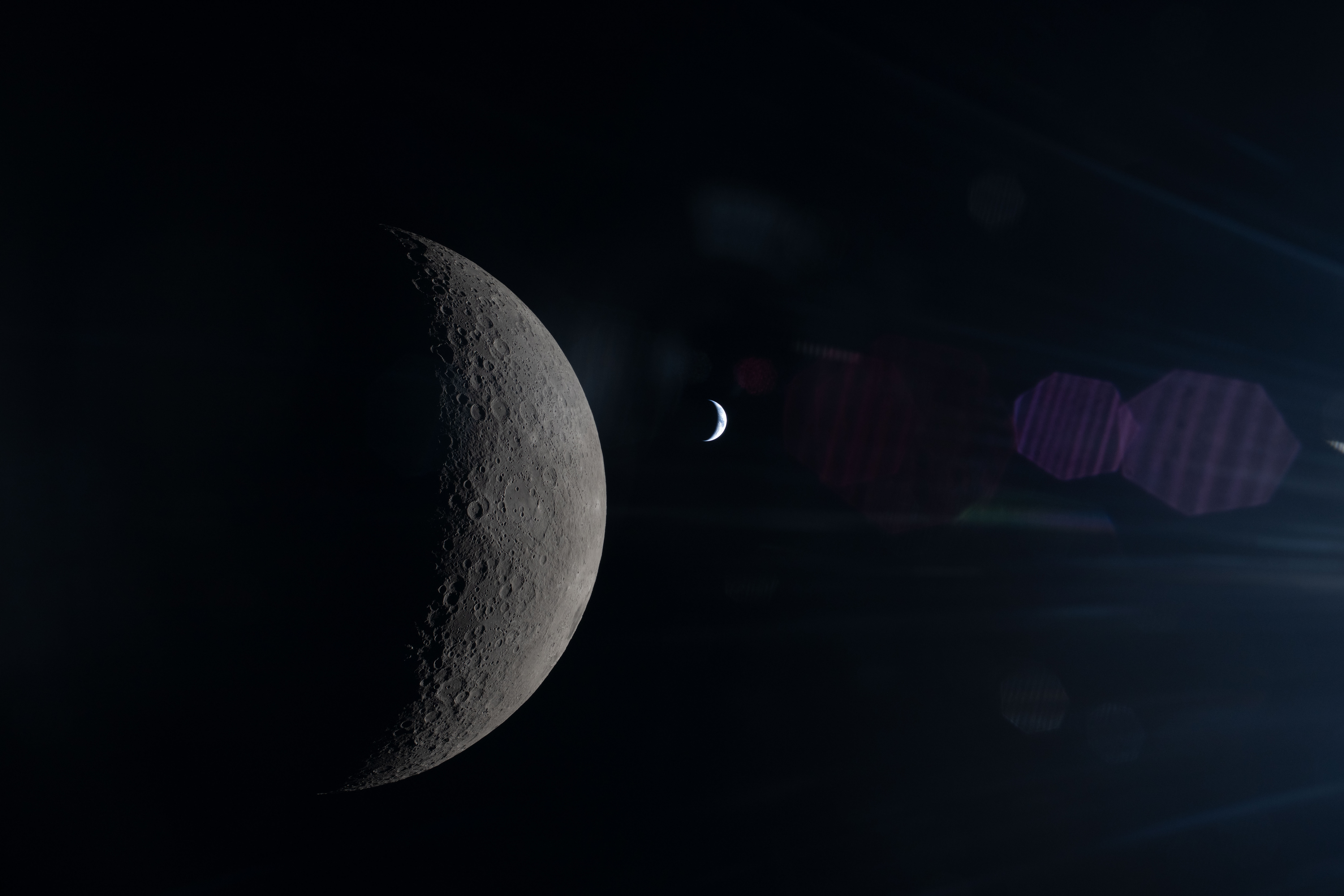
After reviewing the operation of Orion capsule during its first day in orbit, the NASA Artemis-2 management team approved sending the spacecraft to the Moon.
The burn occurred at 7:49 Eastern. The live stream of that burn is embedded below.
At this moment NASA and the crew are committed. No matter what happens, they cannot return to Earth any earlier than about nine days from now. And when they return, they will have to do a direct dive into the atmosphere, heading to splashdown. The Orion heat shield at that point must work.
» Read more
Courtesy of BtB’s stringer Jay. This post is also an open thread. I welcome my readers to post any comments or additional links relating to any space issues, even if unrelated to the links below.
Cool image time! The picture to the right, cropped, reduced slightly, and sharpened to post here, was taken by Voyager-2 on August 26, 1989 shortly after it had completed its close fly-by of Neptune, looking back at the planet from a distance of about 175,000 miles.
The two main rings are clearly visible and appear complete over the region imaged. … Also visible in this image is the inner faint ring at about 25,000 miles from the center of Neptune, and the faint band which extends smoothly from the 33,000 miles ring to roughly halfway between the two bright rings. Both of these newly discovered rings are broad and much fainter than the two narrow rings.
These long exposure images were taken while the rings were back-lighted by the sun at a phase angle of 135 degrees. This viewing geometry enhances the visibility of dust and allows fainter, dusty parts of the ring to be seen. The bright glare in the center is due to over-exposure of the crescent of Neptune. The two gaps in the upper part of the outer ring in the image on the left are due to blemish removal in the computer processing. Numerous bright stars are evident in the background. Both bright rings have material throughout their entire orbit, and are therefore continuous.
While Voyager-2 took other pictures of these rings (here, here, here, here, and here), I think this picture shows the rings best, if not terrible well. Images using the Hubble and Webb space telescopes as well as others have not been better.
The rings were first confirmed to exist in the mid-1980s, shortly before Voyager-2’s fly-by. We now think there are five rings total, all made of dark material, likely a mix of carbon-based molecules, much of it the equivalent of dust and soot.
I have just finished two books that very nicely recount America’s first foreign war in the first decade of the 1800s, following its independence from Great Britain. The war was President Thomas Jefferson’s effort to stop the piracy of American ships by the three Islamic nations on the north coast of Africa — Algeria, Tunis, and Tripoli (now in Libya) — then called the Barbary coast.
These Arab nations had for decades made it policy to hold all Mediterranean shipping hostage, demanding tribute from everyone or else they would attack ships, steal their goods, and either enslave their crew and passengers or hold them for ransom. The European nations paid, endlessly, rather than fight. The U.S. initially paid, but by 1800 and the election of Jefferson as president, it was tired of paying — especially because the payments were never enough to stop the raiding, nor were they enough to free those already captured and enslaved. When the ruler of Tripoli declared war against the U.S., Jefferson was glad to oblige.
The war that followed was the first in which American troops fought on foreign soil and planted the American flag in victory. It was also the first in which joint operations by American naval and land forces led to that victory. And finally, it was the first battle for the U.S. Marines, thus establishing firmly that branch of the military.
The two books to the right tell this story most effectively, but in very different ways.
First there is The Pirate Coast: Thomas Jefferson, the first Marines, and the secret mission of 1805 by Richard Zacks. Published in 2005, it is a very rich and well-researched work, while being remarkably readable because it tells the story from the point of view of the individuals involved. There is much triumph and tragedy in this story, and Zacks captures both.
Then we have Thomas Jefferson and the Tripoli Pirates, written by Brian Kilmeade and Don Yaeger and published ten years later in 2015. Unlike Zacks’ book, it does not delve as deeply into the lives of the many players, Instead, it is a fast-reading short but very thorough overview of this war.
Both books are worth reading, though The Pirate Coast is the better history. I strongly recommend you read both, however, beginning with the Kilmeade/Yaeger book.
» Read more
The new Rubin Observatory, a ground-based telescope in Chile, has discovered over 11,000 new asteroids in its first preliminary observations, with most in the main asteroid belt but a large number in the Kuiper Belt beyond Neptune and 33 previously unknown near-Earth asteroids.
The graphic to the right, annotated by me to post here, shows all of Rubin’s asteroid detections in light blue.
The submission to MPC [Minor Planet Center] comprises approximately one million observations, taken over the span of a month and a half, of over 11,000 new asteroids and more than 80,000 already known asteroids, including some that had previously been observed but were later “lost” because their orbits were too uncertain to predict their future locations. You can interact with all of Rubin’s asteroid discoveries in the Rubin Orbitviewer, which uses real data to provide an intuitive way to explore the structure of our cosmic backyard in three dimensions and in real time. Also, visit the Rubin Asteroid Discoveries Dashboard to learn about the new objects Rubin has uncovered.
…Among the newly identified objects are 33 previously unknown near-Earth objects (NEOs), which are small asteroids and comets whose closest approach to the Sun is less than 1.3 times the distance between Earth and the Sun. None of the newly discovered NEOs pose a threat to Earth, and the largest is about 500 meters wide.
Astronomers predict that Rubin will eventually find 90,000 new near-Earth objects, with some expected to pose a risk of hitting the Earth. It does this by repeatedly surveying the southern sky with its large mirror, then identifying new objects with its sophisticated software.
Using six years of archival data from the Cassini Saturn orbiter, scientists now think Saturn’s magnetic field is lopsided, pulled sideways due to the planet’s very fast rotation as well as the material that surrounds the ringed planet.
The graphic to the right, Figure 4 from the research paper [pdf], compares the Earth’s symmetric magnetic field (top) with that of Saturn’s (bottom). From the press release:
The team found that the cusp was dragged to the right as viewed from the Sun, and was located most often between 1:00 and 3:00 (as it might appear on a clockface), compared to 12:00 as it would be on Earth.
The researchers said this was likely because of Saturn’s extremely fast rotation (a Saturn day is 10.7 hours) and the heavy “soup” of plasma (ionised gas) it pulls around it, a product of gases emitted by Saturn’s moons, especially Enceladus. Together, these are thought to drag the magnetic field lines to the right. But more simulations are needed to confirm this interpretation.
When the solar wind hits the Earth’s magnetic field lines at the cusp, that wind is funneled down along those lines to the poles, where it produces the aurora. This new analysis at Saturn will help scientists better understand the behavior of Saturn’s aurora, which is made even more complex by the planet’s many moons.
SpaceX yesterday filed a letter of complaint against Amazon with the Federal Communications Commission (FCC), stating that on Amazon’s last launch on February 12, 2026 it violated its license, placing its 32 satellites in a higher orbit than the 400-kilometer orbit the FCC approved, forcing 30 Starlink satellites to maneuver to avoid collision.
Worse, Amazon did not inform anyone of this change. From SpaceX’s letter:
Despite its repeated representations and related license conditions, Amazon launched eight times into orbits with insertion altitudes above 450 km without submitting any amended orbital debris mitigation plan or seeking Commission approval for such a change. Most recently, even with input from SpaceX, Amazon’s February 12, 2026, launch on Ariane 6 inserted its satellites at an altitude sufficiently high that it led to unmitigable collision risks with dozens of operational spacecraft.
To be clear, Amazon did not update its orbital debris mitigation plan. But more importantly, Amazon did not provide sufficiently accurate ephemerides to facilitate postdeployment deconfliction for that launch, which significantly increased the risks to all satellite operations near the 480 km insertion altitude as well as to inhabited spacecraft. Amazon’s lack of deconfliction forced Starlink satellites alone to perform 30 collision avoidance maneuvers within hours immediately following the Ariane launch to avoid the newly deployed satellites. Even in the presence of these maneuvers, the risk from this insertion is estimated to considerably exceed the Commission’s semi-annual reporting threshold of 1 × 10⁻⁵ for unmitigated conjunctions.
Amazon is already at risk of violating its FCC license in other ways. The license requires it to get half its 3,232 satellite constellation in orbit by July. It will not meet that requirement, and has already submitted a request for a waiver.
The violation that SpaceX cites in its letter is in many ways much more egregious. The whole point of the FCC’s licensing process is to coordinate the use of spectrum and orbital operations. The commission will not take kindly such a blatant disdain by Amazon of the FCC’s legal responsibilities. The FCC’s chairman, Brendan Carr, has already blasted Amazon in public for its slow satellite deployment, even as it repeatedly files what appear to be frivolous papers trying to block SpaceX.
Hat tip to reader Richard M.
SpaceX yesterday filed the first confidential paperwork the the Securities and Exchange Commission (SEC) for its initial public offering (IPO) of public stock, now targeting a June-July time frame.
The filing was reported by Bloomberg, the Wall Street Journal and Reuters, citing unnamed sources familiar with the matter. SpaceX did not immediately respond to a request for comment. The SEC said it had no comment on the matter. The filing will lead to a sale of shares by June or July, according to the published reports. Confidential filings are used by companies to share information with the SEC and investors before they have to disclose to the broader public.
How much SpaceX plans to raise through a sale of some of its shares are not yet available due to the confidential nature. But CEO and principal shareholder Elon Musk is expected to control a majority of voting shares once the details are revealed. And it could make Musk, already the world’s richest person, that much richer.
SpaceX was valued at $800 billion and xAI $230 billion at their most recent funding round in January according to PitchBook, a research firm that tracks the valuation of private companies. That puts the combined companies’ worth at more than $1 trillion.
SpaceX also now includes X (formerly Twitter) that Musk bought for $44 billion, so the combined company is actually even larger. We still do not know any details, such as the number of shares to be sold as well as the initial sale price. One rumor has indicated that SpaceX wants to reserve 30% for sale to individuals, a number much higher than usual. Other rumors say that Musk is designing the sale to make sure he remains the majority stock-holder and thus in control of all three companies.
Stock experts have predicted this stock sale could garner SpaceX as much as $75 billion in cash, which would give it the resources to not only build its proposed million-satellite data center constellation in orbit but also develop the Starship/Superheavy infrastructure to build its own data center on the Moon. And along the way SpaceX would have the funds to do its own space program to settle Mars.
If SpaceX does raise that much, it will truly become America’s space program, doing far more that NASA and much faster — financed voluntarily by the American people.
An evening pause: For a background review, essential for understanding the legal tangles, see these earlier evening pauses from 2012, 2014, and 2023.
Hat tip Wayne DeVette.

SLS less than a minute after launch
NASA’s SLS rocket today successfully launched the Orion capsule, carrying three Americans and Canadian on a planned ten-day mission swinging around the Moon and back to Earth.
During the countdown there were two minor issues, the second of which causes a slight ten-minute delay in the launch. Both were resolved very quickly, though one wonders if NASA can ever do a launch with this rocket without such issues during countdown.
The crew will remain in Earth orbit until tomorrow, checking out the capsule and its systems. Once they have confirmed these are working as expected, they will then fire their engines to head to the Moon.
The live stream can be viewed here.
As this was the first U.S. government launch this year (and the first since 2022), the leader board for the 2026 launch race remains unchanged:
40 SpaceX
16 China
5 Rocket Lab
4 Russia
SpaceX continues to lead the entire world combined in total launches, as it did in both ’24 and ’25.
Courtesy of BtB’s stringer Jay. This post is also an open thread. I welcome my readers to post any comments or additional links relating to any space issues, even if unrelated to the links below.

Corrupt from top to bottom
The Fifth Circuit Court today dismissed the lawsuit by the families of the 346 victims of two Boeing 737-Max crashes, caused by Boeing’s admitted malfeasance and corruption, preventing those families from blocking a sweetheart deal between Boeing and the Justice Department that largely lets Boeing off the hook.
The court’s decision was vile in its own way, as noted by one of their lawyers:
In today’s ruling, the Circuit said that the families’ victims rights challenges to these agreements came too late to allow any remedy. But earlier, in 2023, the Circuit had said that the families’ challenges were “premature.” The fact that the families now will seemingly never receive any remedy is a cruel judicial bait-and-switch, revealing how much work remains to be done to create truly enforcable crime victims’ rights in the criminal justice system. [emphasis mine]
In other words, this court’s rulings over time essentially made it impossible for these victims to ever claim their rights under the Crime Victims’ Rights Act (CVRA).
The background: In 2018 and 2019 two of Boeing’s new 737-Max planes crashed, due to Boeing’s own design. The investigation into the crashes revealed that Boeing knew about these design flaws, lied about it to federal authorities, while doing nothing to fix the identified problems (behavior to which it has admitted). In 2021 Boeing pleaded guilty to malfeasance and corruption charges, and was given three years to clean up its act or face criminal prosecution.
When after three years Justice found Boeing had instead lied again while doing little to fix things, Justice first proceeded with prosecution, only to suddenly back off and make a plea deal that would have Boeing pay and/or invest up to $1.1 billion, about half of which would go to victims’ families.
To understand the opposition by the families to this deal, you need to read what the Justice Department determined about Boeing’s behavior.
A Justice Department investigation uncovered the fact that Boeing had lied to the FAA about the safety of the aircraft—lies that led directly and proximately to the crashes killing 346 passengers and crew. On January 7, 2021, the Justice Department filed a criminal information with a one-count conspiracy charge against Boeing, alleging that “From at least in or around November 2016 through at least in or around December 2018, in the Northern District of Texas and elsewhere, the Defendant, The Boeing Company, knowingly and willfully, and with the intent to defraud, conspired and agreed together with others to defraud the United States by impairing, obstructing, defeating, and interfering with, by dishonest means, the lawful function of a United States government agency.”
The families didn’t simply want money, they wanted justice. They wanted Boeing and its management to be prosecuted for their part in allowing 346 people to die unnecessarily.
At this moment, it appears they won’t get it, because of a similar malfeasance at the Fifth Circuit, which now seems as corrupt and as dishonest as Boeing.

The Artemis-2 flight path. Click for full animation.
The countdown for the launch of the 10-day Artemis-2 manned mission around the Moon continues, with the launch scheduled for 6:24 pm (Eastern) today.
For updates from NASA, go here. So far all is proceeding as planned. A step-by-step outline of the countdown itself can be found here.
A day-by-day detailed description of the planned mission can be found here. For the first day the crew will remain in Earth orbit in order to test the operation of their Orion capsule. To reiterate, the capsule’s life support system has not been flown in space previously, so this first day is critical. If there are any issues, the astronauts are still close to Earth and can return relatively quickly.
If no problems are detected during that first day, on day two the crew will fire the spacecraft’s engines and head to the Moon. At that point everything must function as planned for nine days as they travel out to the Moon, swing around it without going into orbit, and head back to Earth.
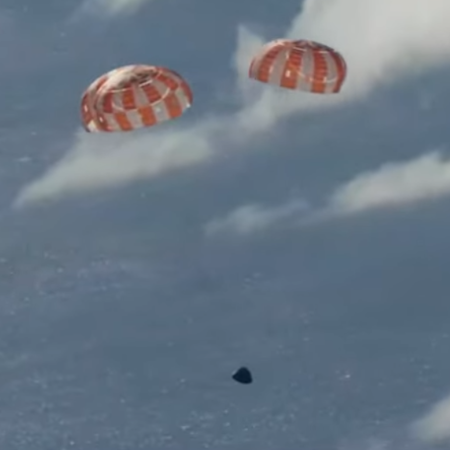
The return to Earth remains the most dangerous moment for this flight. During the 2022 unmanned test flight around the Moon, the heat shield design on Orion did not work as planned, with chunks breaking off in a manner that was unexpected and very concerning. NASA spent two years contemplating the issue, and decided to live with the same heat shield design for this mission, since replacing the shield would have delayed the launch at minimum two years. It has adjusted the return flight path in a way it thinks will mitigate the problem. As its engineers are only guessing at what caused the issue and could be wrong — having done no real life tests — we will not know if they are right until Orion splashes down.
We must pray that they are right.
I have embedded NASA’s live stream below.
» Read more