
Blue Origin’s next New Glenn rocket explodes during static fire test on the launchpad
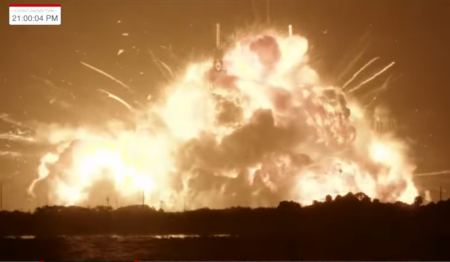
During a static fire test of the first stage tonight in preparation for the next launch scheduled for June 4), Blue Origin’s New Glenn rocket exploded just as the test began, destroying the first stage and much of the only launchpad the company has to launch this rocket.
The link above is cued to just before the explosion, shown in a screen capture to the right. BtB’s stringer Jay just sent me a link to a different video view, from farther away but is in some ways as spectacular. According to Blue Origin’s statement, all workers are accounted for, so fortunately there were no fatalities.
The rocket was to launch 48 Amazon Leo satellites. As those satellites were not on the rocket during this test, they are safe and can be launched elsewhere.
The failure will likely prevent any further New Glenn launches by Blue Origin for at least three to six months. Not only does the company have to determine and fix the cause of the failure, it will need to rebuild the launchpad. At best I expect the company will at best manage one test launch before the end of the year.
As for Amazon, this puts it in a big bind. It has only 302 satellites in orbit, but is required to have launched 1,616 by July, according to its FCC license. It has requested a waiver but the FCC has not yet responded. At the moment of the four companies it has hired to launch the satellites, two are now grounded:
- ULA’s Vulcan rocket: 39 launches [GROUNDED]
- Blue Origin’s New Glenn rocket: 24 launches (reduced from 27) [GROUNDED]
- Arianespace’s Ariane-6 rocket: 18 launches (2 completed)
- SpaceX’s Falcon-9: 13 launches (3 completed)
- ULA’s Atlas-5 rocket: 8 launches (6 completed)
There is no timeline for when Vulcan and New Glenn will fly again. Arianespace hopes to do four to six more launches in ’26, but only one is an Amazon Leo launch, in June. ULA has six additional Atlas-5 rockets in stock, purchased by Boeing to launch its Starliner capsule to ISS. It is very possible a deal could be arranged with Boeing to switch some of those flights to Leo, since at present there are no plans to launch Starliner in the near future.
All in all, Amazon’s only remaining option is SpaceX. Of the ten unflown launches in the SpaceX contract, none are as yet scheduled. It is now likely Amazon will negotiate a deal with SpaceX to accelerate that schedule. While SpaceX’s own launch manifest is quite crowded (launching its own Starlink constellation), making such a deal difficult, the company has also demonstrated its willingness to help competitors. It launched OneWeb satellites when that company’s deal with the Russians fell through. And it quickly launched those first three Leo missions, faster than anyone else.
This also will impact NASA’s just announced unmanned lunar lander program. One mission planned for this year, Blue Origin’s Blue Moon Mark-1 unmanned lander, was scheduled to launch on a New Glenn. In addition, a second New Glenn was set to launch NASA’s Viper rover next year. Neither will happen as scheduled.

On Christmas Eve 1968 three Americans became the first humans to visit another world. What they did to celebrate was unexpected and profound, and will be remembered throughout all human history. Genesis: the Story of Apollo 8, Robert Zimmerman's classic history of humanity's first journey to another world, tells that story, and it is now available as both an ebook and an audiobook, both with a foreword by Valerie Anders and a new introduction by Robert Zimmerman.
The print edition can be purchased at Amazon or from any other book seller. If you want an autographed copy the price is $60 for the hardback and $45 for the paperback, plus $8 shipping for each. Go here for purchasing details. The ebook is available everywhere for $5.99 (before discount) at amazon, or direct from my ebook publisher, ebookit. If you buy it from ebookit you don't support the big tech companies and the author gets a bigger cut much sooner.
The audiobook is also available at all these vendors, and is also free with a 30-day trial membership to Audible.
"Not simply about one mission, [Genesis] is also the history of America's quest for the moon... Zimmerman has done a masterful job of tying disparate events together into a solid account of one of America's greatest human triumphs."--San Antonio Express-News
During a static fire test of the first stage tonight in preparation for the next launch scheduled for June 4), Blue Origin’s New Glenn rocket exploded just as the test began, destroying the first stage and much of the only launchpad the company has to launch this rocket.
The link above is cued to just before the explosion, shown in a screen capture to the right. BtB’s stringer Jay just sent me a link to a different video view, from farther away but is in some ways as spectacular. According to Blue Origin’s statement, all workers are accounted for, so fortunately there were no fatalities.
The rocket was to launch 48 Amazon Leo satellites. As those satellites were not on the rocket during this test, they are safe and can be launched elsewhere.
The failure will likely prevent any further New Glenn launches by Blue Origin for at least three to six months. Not only does the company have to determine and fix the cause of the failure, it will need to rebuild the launchpad. At best I expect the company will at best manage one test launch before the end of the year.
As for Amazon, this puts it in a big bind. It has only 302 satellites in orbit, but is required to have launched 1,616 by July, according to its FCC license. It has requested a waiver but the FCC has not yet responded. At the moment of the four companies it has hired to launch the satellites, two are now grounded:
- ULA’s Vulcan rocket: 39 launches [GROUNDED]
- Blue Origin’s New Glenn rocket: 24 launches (reduced from 27) [GROUNDED]
- Arianespace’s Ariane-6 rocket: 18 launches (2 completed)
- SpaceX’s Falcon-9: 13 launches (3 completed)
- ULA’s Atlas-5 rocket: 8 launches (6 completed)
There is no timeline for when Vulcan and New Glenn will fly again. Arianespace hopes to do four to six more launches in ’26, but only one is an Amazon Leo launch, in June. ULA has six additional Atlas-5 rockets in stock, purchased by Boeing to launch its Starliner capsule to ISS. It is very possible a deal could be arranged with Boeing to switch some of those flights to Leo, since at present there are no plans to launch Starliner in the near future.
All in all, Amazon’s only remaining option is SpaceX. Of the ten unflown launches in the SpaceX contract, none are as yet scheduled. It is now likely Amazon will negotiate a deal with SpaceX to accelerate that schedule. While SpaceX’s own launch manifest is quite crowded (launching its own Starlink constellation), making such a deal difficult, the company has also demonstrated its willingness to help competitors. It launched OneWeb satellites when that company’s deal with the Russians fell through. And it quickly launched those first three Leo missions, faster than anyone else.
This also will impact NASA’s just announced unmanned lunar lander program. One mission planned for this year, Blue Origin’s Blue Moon Mark-1 unmanned lander, was scheduled to launch on a New Glenn. In addition, a second New Glenn was set to launch NASA’s Viper rover next year. Neither will happen as scheduled.
On Christmas Eve 1968 three Americans became the first humans to visit another world. What they did to celebrate was unexpected and profound, and will be remembered throughout all human history. Genesis: the Story of Apollo 8, Robert Zimmerman's classic history of humanity's first journey to another world, tells that story, and it is now available as both an ebook and an audiobook, both with a foreword by Valerie Anders and a new introduction by Robert Zimmerman.
The print edition can be purchased at Amazon or from any other book seller. If you want an autographed copy the price is $60 for the hardback and $45 for the paperback, plus $8 shipping for each. Go here for purchasing details. The ebook is available everywhere for $5.99 (before discount) at amazon, or direct from my ebook publisher, ebookit. If you buy it from ebookit you don't support the big tech companies and the author gets a bigger cut much sooner.
The audiobook is also available at all these vendors, and is also free with a 30-day trial membership to Audible.
"Not simply about one mission, [Genesis] is also the history of America's quest for the moon... Zimmerman has done a masterful job of tying disparate events together into a solid account of one of America's greatest human triumphs."--San Antonio Express-News
Man, what a mess. I had big hopes for Blue, and unless they’re uncommonly fast, it’ll be many months before we see another launch from them. Tomorrow is going to be an extremely rough day for the entire workforce.
3 to 6 months is highly optimistic. It took SpaceX over a year to rebuild LC 40 after the Amos explosion, and that wasn’t remotely on this scale.
Blue is in the process of bringing another pad online. They will surely end up concentrating their efforts on one or the other, so not only are they going to face a period with no pads at all, but the point at which they have a second online is surely also going to be pushed back.
There was already more demand for New Glenn than it reasonably had any hope of meeting, and this just makes it worse. Highly unfortunate.
David Eastman: As you must know by now, I am an optimist. I appreciate your dose of reality.
Wow!! That’s an impressive fireball!
As for return to flight? They’re not flying again this year. Maybe next year.
The hydrolox powered space shuttle had 1 launch failure out of 135.
Grok says: LH2 + LOX mixtures are less prone to violent condensed-phase detonations when they mix accidentally.
In comparison:
But LOX and liquid methane are highly miscible — they mix together very readily. If a tank or line breach occurs, the mixture can form a detonable “condensed phase” explosive with higher overpressures and blast yields than hydrolox or kerolox failures.
This is where Blue gets to show what it’s made of. But, let’s face it, Fate has tackled Blue in its own end zone. This will be neither quick nor easy to come back from. I hope Blue can recoup and regroup fast enough to launch another New Glenn this year, but I think the odds of that happening are no better than one in three. Among other knock-on effects of this mishap is some unknown degree of damage to Blue’s potential for participating in Artemis 3.
About the only good that might come from this “observation” is that we have now had a ground-level explosion of a large methalox booster with a known quantity of propellant aboard. This should provide some data useful for establishing realistic, as opposed to theoretical, safety zone radii for methalox rockets generally. Noting the distances to which bits of wreckage of given masses were thrown will be particularly useful.
This could be big trouble for the ULA Vulcan too if the root cause traces back to the BE4. From watching the video it appears that something let loose at the base of the rocket first (a single optical halo of a very intense pressure wave appears centered there and looks much more substantial than flame trench type pressure waves), flames shot up the side of the rocket, and then the entire tankage let go starting at the top of the booster (perhaps because at that point the hydrostatic shock blew the top open?).
I wonder if Blue was re-using even a single previously flown BE4 on this mission to get some initial data on that challenge?
In any event this was sad to see. I too had high hopes for Blue to get in the game as competition is what drives improvement., but this will be a substantial setback. The only silver lining is that SpaceX doesn’t seem to need much competition to motivate innovation and improvement. Elon has bred that into the entire company culture and consistently sets lofty but practical goals to keep moving forward even in the face of setbacks.
Bezos has discovered that selling books is a lot easier than launching rockets.
The damage to Blue Origin infrastructure could be even worse than we thought. NSF regular Woods170 says his contacts report extensive damage to the integration facility, including the other remaining New Glenn core:
“Just got word back from a Blue source. Internal cameras showed substantial damage happening to the interior of the integration facility, when the shockwave hit the building. And that includes damage to the other New Glenn booster that was in there.”
https://forum.nasaspaceflight.com/index.php?topic=63382.160#new
Aerial shots from at least one news helicopter does seem to show serious damage to the integration building.
Blue Origin have a lot of work ahead of them.
“This could be big trouble for the ULA Vulcan too if the root cause traces back to the BE4.”
Yeah, I had that thought, too. Both ULA and the FAA will need to be reassured by the investigation that the engines were not the cause of the explosion, before they try even a booster-less Vulcan launch.
Richard M,
Yes, a lot of work. Three shifts 24/7/365 for months at the very least.
From Dick Eagleson ” Noting the distances to which bits of wreckage of given masses were thrown will be particularly useful.”
I was amazed at the one piece of whatever it was flying off to the right in the second view. It was large enough to see from the camera vantagepoint so I suspect it was fairly large.
Second Item: Musk comment is I think appropriate: “Sorry to see this, I hope you recover quickly, Most unfortunate. Rockets are hard.”
And “Ad astra per aspera” through hardships to the stars
“Long Stick Goes Boom” – Krokus
In sports, no competitor enjoys circumstantial failure affecting a rival. It could happen to you. But, business is not sports. Market share is where it’s at. Engineering is not sports. It’s a controllable variable. Even so, there is more satisfaction in besting a rival according to the Friday Royal Navy toast: “To A Willing Foe and Sea Room!”
And now Jared should admit he was wrong in dismantling SLS infrastructure since neither member of the trillionaire boys club look capable of fielding landers any time soon.
“I was amazed at the one piece of whatever it was flying off to the right in the second view. It was large enough to see from the camera vantagepoint so I suspect it was fairly large.”
Common speculation is that this was probably a COPV. It looks like there was more than one of those visible, kinetically released by the explosion.
But I’m sure that in the coming weeks they’ll have crews covering the ground and the sea off shore for several miles around to identify rocket fragments like that in order to fully inform that coming estimate of safety zones for methane heavy lift rockets that Mr Eagleson was talking about up above.
Speaking of which . . . Given that there are five OTHER methalox medium and heavy lift American launch vehicles in advanced development (Starship, Nova, Terran R, Neutron) or coming into operation (Vulcan), one hopes that the full details of the accident investigation will be shared in the industry if it turns out that this event was caused in any way by a new failure mode involving methane propellant.
Richard M,
The COPV speculation is probably correct. That would also explain their speed and distance as a COPV contains high-pressure gas and is propelled by more than just the explosion.
You are correct that more rocket companies than just Blue may ultimately profit from whatever is learned during investigation of this explosion. Lots of questions. Let’s hope we get at least some preliminary answers fairly soon.
Jeff Wright,
No version of SLS was ever going to have any role in transporting a lander so I entirely fail to see the point of your remark.
“And now Jared should admit he was wrong in dismantling SLS infrastructure since neither member of the trillionaire boys club look capable of fielding landers any time soon.”
I hate to be the one to tell you this, Jeff, but SLS cannot land on the Moon, either.