
Who really was Jay Gould?
To get to the point, right at the start, Jay Gould was not a “Robber Baron”, nor was he the worst “Robber Baron,” as many journalists of his time as well as many historians in the next century liked to slander him, implying he was unethical, cruel, and routinely used under-handed tactics to destroy others while making himself wealthy. In fact, he was no more a robber baron then the entire class of hard-nosed businessmen who in the 1800s became America’s first generation of today’s billionaires, using the free enterprise system to gather wealth to themselves while building vast industries that employed millions and made the lives of everyone better and more prosperous.
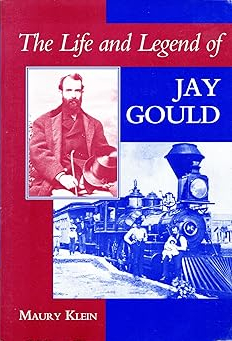
I have just finished reading Maury Klein’s 1997 fine biography of Jay Gould, the Life and Legend of Jay Gould, and was not surprised to learn that Gould was never the evil personification of worst sort of capitalist, as routinely portrayed by our leftist academia for the past century. Instead, I discovered he was no different then all the other leading businessmen of his time, hard-nosed and ruthless when it came to cutting deals, but strongly committed to making the businesses he ran profitable and successful, providing the public a useful product they would be eager to use.
You see, in a free capitalist society, you can’t succeed unless you are willing to be ruthless at times. This doesn’t necessarily mean you routinely use violence, or break the law, or go out of your way to hurt others, but it does mean you defend yourself from attack, and retaliate quickly using legal means when under attack. These rules apply today as they did in Gould’s time. Nothing has changed.
Gould was no different than Cornelius Vanderbilt (whose life I reviewed here). Nor does he differ from John D. Rockefeller, or Elon Musk, or Jeff Bezos, or any one of the thousands and thousands of American businessmen, who from the founding of this country used its free but legal framework to build a nation while enriching themselves.
Gould’s most famous area of success involved his ownership of many railroads, both in the American west as well as the first elevated subways in New York City. He also gained full control over Western Union, and for more than a decade ran a system that provided the entire country and even the world its first instantaneous method of communications. To gain control over these venues involved many battles, some of which required tactics that were harsh, even a bit under-handed, and clever. Sometimes it required payoffs to politicians, or tricky stock deals that once completed left many others sinking in the wake.
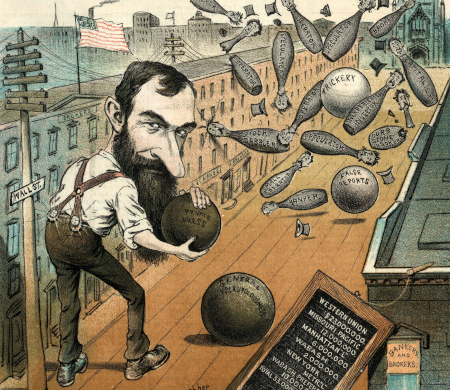
A typical anti-Gould newspaper cartoon from 1882
Gould’s tactics however were never much different than those of others of his ilk. And like those others, his overall good management of his companies he controlled, as well as the good treatment of the people who worked under him, garnered strong loyalty and support across these industries. Gould wanted control, but always when he had it he used it to make his product better and more useful.
When he died, it was the people who knew him who had good things to say about him, and it was the journalists who did not who continued to spread the slanders, because it made good copy and sold newspapers. And sadly, for the decades that followed, historians used those news reports — mostly wrong — as their primary sources of information, and thus the legend of an evil Gould was created.
Klein’s biography is a worthy effort to counter this bad history. More Americans should read it, if only to realize their past history was far more admirable than what they have been taught for the past few generations.
Gould’s tactics — and his success — were things he learned very earlier on in life, when he went out on his own.
He began as a teenager surveyor, and quickly discovered on his first real job that the man who hired him was a thief. In his first big project when he was just twenty, to build a major tanning factory in the wilderness of Pennsylvania, proved to him that to survive in business you had to be hardhearted. The project was a partnership of Gould and an established businessman named Zadock Pratt. Pratt had made a fortune running tanning factories, and was impressed with Gould’s drive and intelligence. Pratt would provide the cash and Gould would build and manage the factory, and they would split the profits.
Once Gould had successfully built the factory and was turning out hides in great numbers, however, Pratt suddenly decided he wanted it all for himself. He made Gould a take-it-or-leave it offer: Either Gould would pay him $60,000 to buy Pratt out, or Pratt would pay Gould $10,000 to buy him out. Pratt assumed Gould would have to take the ten grand because he assumed Gould didn’t have the cash. Pratt would then have gotten himself a very profitable concern with relatively little effort.
Pratt under-estimated Gould, a mistake many would make over the decades. Gould had anticipated this double-cross, and was able to quickly make a deal with others to provide him the cash to buy Pratt out. In the end, Gould got the business and Pratt was left empty-handed. And like many whom Gould outwitted over the years, Pratt then would spread veiled slanders against Gould, implicating dishonesty when there had been none.
Gould took this experience to heart. In all his business dealings over the decades he always prepared for the double-cross, and was always better prepared to overcome it. His focus was on his own success, even if it meant he had to leave others by the wayside.
And in this Gould was no different than everyone else of his time, or ours. In our free competitive American society you need to compete hard to survive and succeed. If you do, and you also focus on providing a good product at the same time, you will become wealthy, and do good at the same time.
The Declaration of Independence, which sets forth America’s
fundamental belief in life, liberty, and the pursuit of happiness
And this is the fundamental lesson: Freedom is a wonderful thing, because it allows each person to follow his or her dreams. It carries with it however terrible risks and responsibility. There is no paradise on Earth. All we can do is set up our society with fair but limited laws — which Americans did initially — and ask everyone to try to follow those laws as they scramble to achieve those dreams, sometimes obsessively and without mercy.
In the 1800s Gould and the businessmen he competed against often skirted the edge of those laws, but also almost always stayed within their spirit. Their goal was to build, for profit, and they succeeded quite amazingly in this goal. Little they did was truly corrupt, and when it was it usually ended up in failure, not success.
The subsequent effort in the 20th century by Americans to tighten our laws to regulate these behaviors has generally been a failure. All it did was make success harder, by restricting freedom.
Better to let freedom reign, even if it means that sometimes bad things will happen. It is impossible to outlaw misbehavior by regulation. Better to let free competition and hard reality beat it. That’s what happened in Gould’s time. That is what should happen now, in America.

On Christmas Eve 1968 three Americans became the first humans to visit another world. What they did to celebrate was unexpected and profound, and will be remembered throughout all human history. Genesis: the Story of Apollo 8, Robert Zimmerman's classic history of humanity's first journey to another world, tells that story, and it is now available as both an ebook and an audiobook, both with a foreword by Valerie Anders and a new introduction by Robert Zimmerman.
The print edition can be purchased at Amazon or from any other book seller. If you want an autographed copy the price is $60 for the hardback and $45 for the paperback, plus $8 shipping for each. Go here for purchasing details. The ebook is available everywhere for $5.99 (before discount) at amazon, or direct from my ebook publisher, ebookit. If you buy it from ebookit you don't support the big tech companies and the author gets a bigger cut much sooner.
The audiobook is also available at all these vendors, and is also free with a 30-day trial membership to Audible.
"Not simply about one mission, [Genesis] is also the history of America's quest for the moon... Zimmerman has done a masterful job of tying disparate events together into a solid account of one of America's greatest human triumphs."--San Antonio Express-News
I have not read this piece. In my 83rd year, I have come to understand that the history of “the American Experiment (in individual responsibility and freedom – together with the “rights” necessary in their exercise), is anathema to the collective moral tenets that have dominated mankind’s philosophy for millennia!
Capitalism and the individual rights that give rise to it, is incompatible with the idea that the life of the individual must be morally and politically subordinate to the lives of the rest of us! The single caveat being the initiation of physical force must be banished from relationships.
I do not know if Gould was evil, I know I have been told he was. Perhaps he was? The idea of “America” is not! It was the greatest moral-political experiment in history!
Dave Walden: You really should read Klein’s book. Gould wasn’t evil, he was mostly a force for good. That his competitive world sometimes required ruthless actions simply meant he was much like all the other successful businessmen around him.
And be aware, my calling his actions sometime ruthless I do not mean he committed violence or outright harm. He simply took actions that worked, even if those actions caused financial loss to others.
Thank you, Robert. I shall read it.
Walden, you should tell that to the Democrat/Socialists since they are the ones who are “…anathema to the collective moral tenets that have dominated mankind’s philosophy for millennia” right up to and including assassination.
Jay Gould = John Gault?
Whereas Gould may have been a typical successful man of his times Rockefeller has been a truly evil s.o.b. John D. Rockefeller and the generations of Rockefellers that have followed him are the instigators in the globalist ant-civilization machine that has plagued us since the early 1900s. The Rockefellers are behind the turning of the medical profession into a pharmaceutical solves all pipeline with petroleum based solutions being part of that, they are one of the main financial supporters along with Carnegie of the Flexner Report which has bastardized medicine making all homeopathic remedies off limits. The Rockefellers are the ones behind the UN, they donated the land where the UN building sits today, they are one of the main proponents of the climate change hoax, et al. They are one of the folks who have a hand in all the tyrannical programs, foreign policy and economical solutions meant to depopulate the planet and control the human species. A recommended read is Rockefeller: Controlling the Game by Jacob Nordangard. Not all businessmen who succeed in our capitalist system are altruistic many are tyrannical power hungry and use their wealth to advocate this. The US culture has equated extreme wealth with intelligence in that we should take advice from wealthy people, which is wrong.
Also in today’s society there are two types of entrepreneurs First, there are naturally successful entrepreneurs who innovate, take risks, and satisfy consumer needs in a competitive marketplace. They create value, and their profits are a reward for serving others. However, there are also artificially successful entrepreneurs who, by contrast, win—not through merit or creativity—but because they receive government favors—subsidies, protective regulations, tax breaks, or public contracts. Their success is politically-engineered, not market-earned. Elon Musk is an example of an artificially successful entrepreneur whose success is due to being the largest private contractor for government and receiving favorable regulations like government invented carbon credits which is how Tesla makes money. The clients for his boring company are all governments city or state.. His AI companies are receiving heavy government favoritism so much so that he hid the financial losses of X by merging it with his AI company creating xAI. Space X is successful due to government contracts also.
Pecan Scandi asked: “Jay Gould = John Gault?”
Probably not. John Gault abandoned the tyranny and asked specific other highly productive people to join him in the abandonment.
Elon Musk may be a closer example, as he is a highly productive person who has abandoned the California tyranny. However, as far as I know he has not asked anyone else to also abandon California. Now that California is also pondering a “billionaire’s tax” on assets, several more of California’s billionaires have begun fleeing, along with millions of others of the population (a trend that is three or four years old).
There are many highly productive people abandoning New York, especially the city, and I have heard at least one popular (productive?) radio talk show host recommend that others also abandon New York. He is even closer to John Gault.
JustPassingThru,
Your indictment of subsequent generations of Rockefellers is broadly accurate, but John D. the original was far more sinned against than sinning. The landmark anti-trust case against Standard Oil was brought by a cabal of Rockefeller’s less successful competitors and an ambitious cadre of progressives in government looking to bag themselves a high-profile scalp. This fight is often described as being about Standard Oil’s “monopolization” of the gasoline business, but it was actually initiated before gasoline was a consideration. It was actually about Standard Oil’s alleged “monopoly” in the kerosene business. Kerosene, as a lighting, heating and cooking fuel was the great petrochemical play of the 19th century. The attack on Standard Oil was couched, by its attackers, as a defense of consumers against monopoly pricing. But there never was any monopoly pricing. During Standard Oil’s entire rise and through its fight with government “trust-busters,” the retail price of kerosene continued to fall due to economies of scale Standard Oil’s competitors by and large couldn’t match.
It is certainly true that by the time Standard Oil was actually broken up in 1911, gasoline had become a big deal and kerosene was fading in the wake of electrification, but there was no “monopoly pricing” of gasoline either.
Standard Oil, in fact, never attained an actual monopoly on either kerosene or gasoline production. It was a national brand and thus had higher average transport costs for its goods than did smaller competitors who operated in local or regional markets.
Subsequent generations of Rockefellers went one of the ways typical of the inheritors of great American fortunes – internalizing entirely groundless guilt for the alleged sins of their fathers, expiated by ostentatious “philanthropy” via foundations that quickly become piggy banks for the Left. That scenario has been repeated many times since the days of the first generation of Rockefeller heirs. A modern equivalent would be the children of the late Sam Walton, founder of Wal-Mart.
Multiple examples of two other pathways taken by heirs of great fortunes have also been seen over the past century or so. One is the “shirtsleeves to shirtsleeves in three generations” path in which a profligate descendant of the builder of the great fortune manages to piss the entire thing away during his own lifetime. A classic example would be Huntington Hartford II, grandson of one of the brothers who founded the once-dominant Great Atlantic and Pacific Tea Company, otherwise known as A&P. It was the Wal-Mart of its day.
A second path that arrives at pretty much the same destination is simple indifference toward, and inattention to, the affairs of the enterprises that underpinned the original fortune. The paradigmatic example of this is the Kennedy family. None of Joe Kennedy’s sons took any interest in any of the family businesses and they all eventually faded. Combined with the fact that every generation of Kennedys has punched well above its weight in the reproduction department and the original fortune was split so many ways that there are now no remaining Kennedys who are really all that wealthy by contemporary standards – too many Kennedys, not enough money.
Your characterization of Elon Musk as some sort of modern Parasite King is just wildly wide of the mark. He started the first of his several successful software businesses from literally nothing while he was still a minor in South Africa. The last of these successes in serial software entrepreneurship was a little something called PayPal. After that came SpaceX, Tesla and the rest.
You are quite incorrect about either of those companies being subsidy queens. Tesla has been the largest beneficiary of several subsidy programs at both the state and federal levels over the years, but none of these were put in place specifically to benefit Tesla and some were in place before the company was founded. Tesla has prospered because it has consistently led in electric vehicle technology and – at least as important, in manufacturing technology. It is still the only company anywhere on Earth that consistently makes good money on sales of purely electric vehicles. The real nexus of government subsidized electric vehicle production is the PRC which has literally dozens of such firms only one of which – BYD – has ever made even a little bit of money on purely electric vehicles and which still relies on sales of hybrids to stay alive.
Tesla, of course, has other lines of business than just electric vehicles including its home solar panel and battery backup business (Powerwall) and its utility-scale battery business (Megapack) as well as its electric vehicle charging network, Supercharger, which is a separate profit center now available to most other makes of electric vehicles. The disappearance of various forms of electric vehicle subsidy will not have a major effect on Tesla’s fortunes going forward. That is especially true as Tesla has, in Full Self Driving, the only scalable autonomous vehicle capability extant. Sales of this technology, under license, to other vehicle makers is going to be a major new source of revenue for Tesla fairly shortly and for which it will incur effectively no additional costs to provide.
Then, of course, there will be Tesla’s Optimus autonomous humanoid robot business – which may well be a bigger deal than all of Tesla’s other lines of business combined within a decade. There are no government subsidy programs for robots.
SpaceX, for its part, did once derive most of its revenue from the US federal government, but for services rendered, not as subsidy. NASA development money for Dragon addressed a critical need NASA had in the wake of the Columbia disaster and the subsequent winding down of the Shuttle program. ISS was already up and needed continuing cargo service. Legacy contractors couldn’t provide either timely or affordable such service but SpaceX could. This was in no way, shape or form a case of “subsidy.”
Nor have been any of the other things SpaceX has done at government behest. SpaceX delivered, by 2020, a renewed US capability to fly crew to and from ISS – something that became especially crucial in the wake of Russia’s attack on Ukraine in early 2022. After having to initially sue to even win the right to bid for US military space business, SpaceX has since become the most prolific and reliable provider of same, something that will be even more true as the Golden Dome program ramps up.
It is also the lowest-cost provider of such. That, in fact, is the key to all of the business Musk’s various companies have with governments at all levels – they can undercut legacy providers because they have invested to create technology that reduces costs, be that for rockets, tunnels or whatever.
Even with all of these government jobs, however, government work has constituted a smaller and smaller percentage of SpaceX’s total revenue over the last several years. The vast majority of that now comes from Starlink. Most of the rest comes from SpaceX’s still-expanding commercial launch business. Government revenue is now 10% or less of SpaceX’s annual total. That trend is likely to continue with deployments of next-gen Starlink (broadband Internet) and Starlink Mobile (direct-to-cell) satellites as well as those for Earth-orbiting AI data centers plus all of the tanker, crew, lander and other traffic that will be needed to address Elon’s lunar industrialization and proliferated AI data center plans.
You can, perhaps, find some contemporary billionaires of the type you describe, but Elon Musk is not one of them.