
Giving Thanks
An evening pause: As the kid says, “Everything.”
An evening pause: As the kid says, “Everything.”
An afternoon pause: We are all too busy right this moment with turkey, friends, family, and socializing. Here Louis Armstrong tells you what it all means, really.
Recorded in 1967.
Washington, D.C.
October 3, 1863
By the President of the United States of America.
A Proclamation.
The year that is drawing towards its close, has been filled with the blessings of fruitful fields and healthful skies. To these bounties, which are so constantly enjoyed that we are prone to forget the source from which they come, others have been added, which are of so extraordinary a nature, that they cannot fail to penetrate and soften even the heart which is habitually insensible to the ever watchful providence of Almighty God.
In the midst of a civil war of unequalled magnitude and severity, which has sometimes seemed to foreign States to invite and to provoke their aggression, peace has been preserved with all nations, order has been maintained, the laws have been respected and obeyed, and harmony has prevailed everywhere except in the theatre of military conflict; while that theatre has been greatly contracted by the advancing armies and navies of the Union. Needful diversions of wealth and of strength from the fields of peaceful industry to the national defence, have not arrested the plough, the shuttle or the ship; the axe has enlarged the borders of our settlements, and the mines, as well of iron and coal as of the precious metals, have yielded even more abundantly than heretofore. Population has steadily increased, notwithstanding the waste that has been made in the camp, the siege and the battle-field; and the country, rejoicing in the consciousness of augmented strength and vigor, is permitted to expect continuance of years with large increase of freedom.
No human counsel hath devised nor hath any mortal hand worked out these great things. They are the gracious gifts of the Most High God, who, while dealing with us in anger for our sins, hath nevertheless remembered mercy.
It has seemed to me fit and proper that they should be solemnly, reverently and gratefully acknowledged as with one heart and one voice by the whole American People. I do therefore invite my fellow citizens in every part of the United States, and also those who are at sea and those who are sojourning in foreign lands, to set apart and observe the last Thursday of November next, as a day of Thanksgiving and Praise to our beneficent Father who dwelleth in the Heavens. And I recommend to them that while offering up the ascriptions justly due to Him for such singular deliverances and blessings, they do also, with humble penitence for our national perverseness and disobedience, commend to His tender care all those who have become widows, orphans, mourners or sufferers in the lamentable civil strife in which we are unavoidably engaged, and fervently implore the interposition of the Almighty Hand to heal the wounds of the nation and to restore it as soon as may be consistent with the Divine purposes to the full enjoyment of peace, harmony, tranquillity and Union.
In testimony whereof, I have hereunto set my hand and caused the Seal of the United States to be affixed.
Done at the City of Washington, this Third day of October, in the year of our Lord one thousand eight hundred and sixty-three, and of the Independence of the United States the Eighty-eighth.
By the President: Abraham Lincoln
Some background here.
Using its Long March 4C rocket China yesterday successfully launched Gaofen-12, a remote sensing satellite designd to study Earth resources.
The leaders in the 2019 launch race:
27 China
18 Russia
11 SpaceX
7 Europe (Arianespace)
China now leads the U.S. 27 to 23 in the national rankings.
The launch schedule remains very busy, with a Rocket Lab launch set for early tomorrow and two launches to ISS (a Dragon and Progress) scheduled next week. In fact, seventeen launches are tentatively listed for launch in December, which would be once every other day. Several are unlikely, but regardless December will be a very busy month in the launch industry.
An evening pause: For Thanksgiving week. If life gets you down, think of this man and buck up.
Hat tip Cotour.
Click for full image.

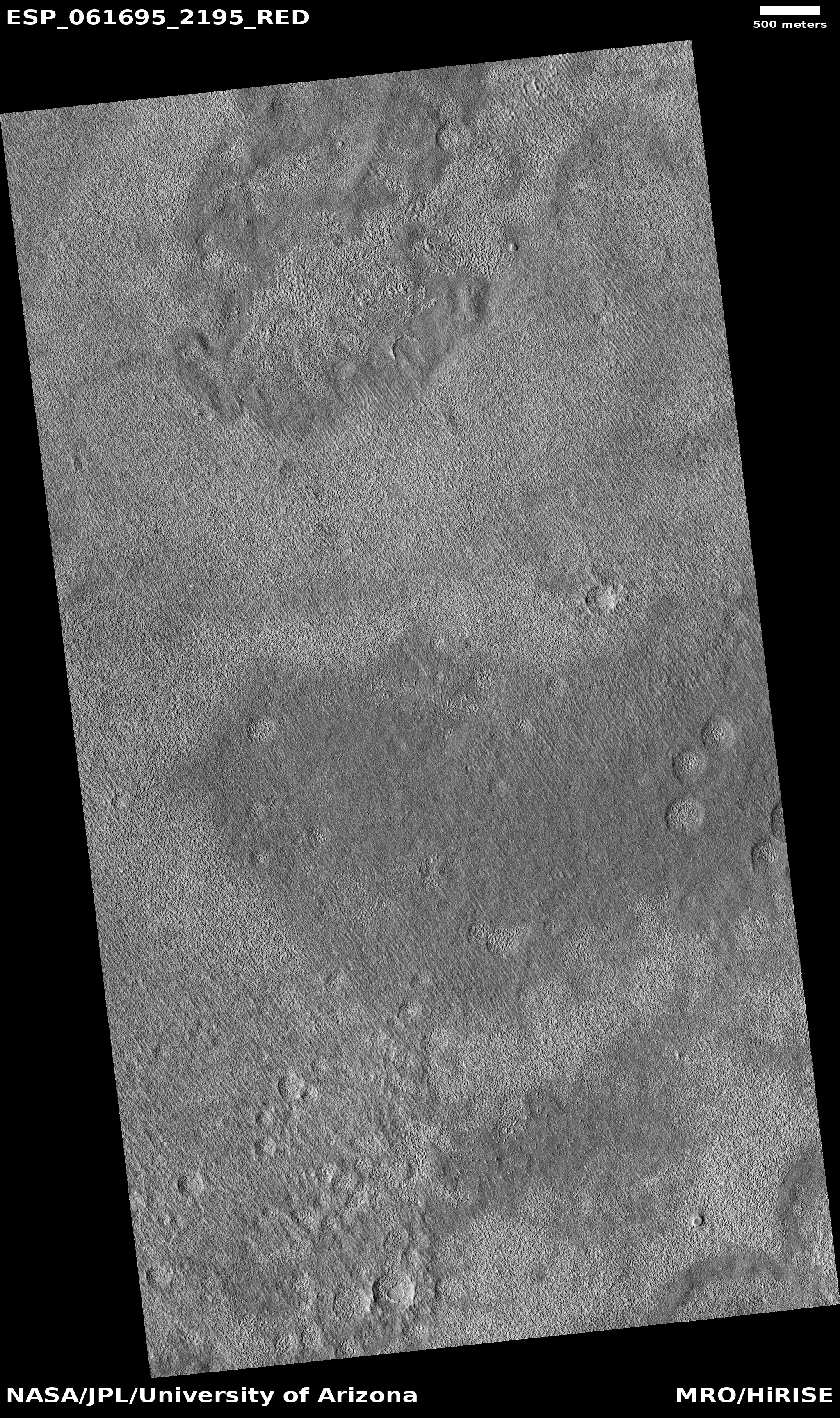
Cool image time! Even though it appears that SpaceX has completed its first round of images of its candidate landing sites surrounding the Erebus Montes mountains in the Arcadia Planitia plains in the Martian northern lowlands, this does not mean that other planetary scientists are not asking for more images of this region, for their own scientific research.
The photograph on the right, cropped and reduced to post here, was released in the early November image download from the high resolution camera of Mars Reconnaissance Orbiter (MRO). Uncaptioned but dubbed “Beginning of Possible Glacial Unit,” it shows what appears at first glance to be a relatively featureless area south of Erebus Montes, out in the flat plains.
A closer look suggests otherwise. For one, the full image shows darker and lighter areas. The close-up to the right, its location indicated by the white box in the wider image above, also shows several intriguing depressions that appear to be revealing a knobby lower layer. In fact, in the full image it appears that the darker areas are areas where material has covered that knobby lower layer. Where it is bright the ground resembles the floors of these depressions, knobby and complex.
I do not know why they label this the “beginning” of a glacial unit. What I do know is that the research of this region has consistently found evidence of a lot of buried ice. To quote Donna Viola of the University of Arizona noted, “I think you could dig anywhere to get your water ice.” The knobby features to me suggest a surface that is showing signs of sublimation, where the exposed ice is slowly eroding. Think of what happens to a block of ice when you spray warm water on it. As it melts it leaves behind just these kinds of strange formations.
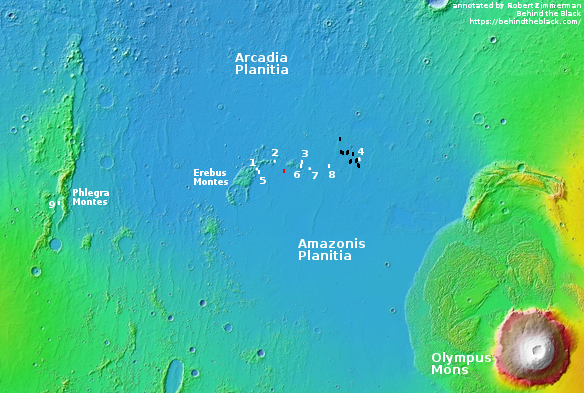
The red box in the map on the right shows the location of this photograph relative to the other images taken for SpaceX. The white boxes are the company’s images taken for Starship. The black boxes are the images it obtained in 2017 when it was thinking of sending a Dragon capsule to Mars.
This map does not show all images taken by MRO’s high resolution camera in this area, but the coverage is very scattered, with many gaps. Over time I suspect these gaps will be filled more quickly than other northern plain regions, because the scientists know that SpaceX has an interest in this area. That interest means there is an increased chance that a mission will fly here in the relatively near future, which in turn is going to generate more scientific interest as well.
Chinese engineers have unfolded and activated the Dutch radio antennas on Queqiao, their lunar relay satellite orbiting the Moon, an action that had been delayed because the lander Chang’e-4 and rover Yutu-2 had both exceeded their nominal mission on the surface.
The Chinese satellite was previously mainly seen as a communications satellite. However, the Chinese moon mission has by now achieved its primary goals. Consequently, the Chinese have redefined the satellite to be a radio observatory. As such, the Netherlands-China Low Frequency Explorer is the first Dutch-Chinese space observatory for radio astronomy.
Marc Klein Wolt, Managing Director of the Radboud Radio Lab and leader of the Dutch team, is happy: “Our contribution to the Chinese Chang’e 4 mission has now increased tremendously. We have the opportunity to perform our observations during the fourteen-day-long night behind the moon, which is much longer than was originally the idea. The moon night is ours, now.”
If Queqiao is now dedicated to being a radio antenna full time during the lunar night, I wonder if this means the Chinese are shutting down Chang’e-4 and Yutu-2. Up to now both spacecraft have only operated during the lunar night, which suggests that was the only time they could relay data. It is possible that data relay could take place at other times, and that the lander and rover can function autonomously, but I have my doubts.
Both Chang’e-4 and Yutu-2 functioned for twelve lunar nights, four times longer than planned, so shifting gears on Queqiao to do radio astronomy is not unreasonable. Unfortunately, the lack of transparency from China leaves us in the dark about the fate of Chang’e-4 and Yutu-2.
The uncertainties of science: New research simulating microgravity on Earth now suggests that zero gravity might weaken the walls of the intestines.
The barrier function of the intestinal epithelium, he added, is critical for maintaining a healthy intestine; when disrupted, it can lead to increased permeability or leakiness. This, in turn, can greatly increase the risk of infections and chronic inflammatory conditions such as inflammatory bowel disease, celiac disease, Type 1 diabetes, and liver disease.
McCole’s team used a rotating wall vessel — a bioreactor that maintains cells in a controlled rotation environment that simulates near weightlessness — to examine the impact of simulated microgravity on cultured intestinal epithelial cells.
Following culture for 18 days in the vessel, the team discovered intestinal epithelial cells showed delayed formation of “tight junctions,” which are junctions that connect individual epithelial cells and are necessary for maintaining impermeability. The rotating wall vessel also produces an altered pattern of tight junction assembly that is retained up to 14 days after the intestinal epithelial cells were removed from the vessel.
This is good research, but it has not proved anything, merely indicated an area of research that needs a follow-up in space. I also wonder if there has been any evidence of this phenomenon from astronauts returning from long missions. As far as I know, intestinal issues have never been mentioned as a problem post flight.
Mob rule: A local Cornwall council meeting yesterday approved a $10 million grant for a new spaceport despite protesters screaming and yelling in the gallery and outside, forcing the meeting to end early.
After deciding not to defer a decision, councillors voted to grant £10.32m of capital funding to the spaceport by 66 to 34, with one abstention.
The gallery then erupted with chants as protesters launched paper airplanes. The chamber was then cleared of councillors and the meeting adjourned as the crowds continued to chant and shouted at councillors as they left saying things like “shame on you”. [emphasis mine]
Police were required to maintain order.
I have highlighted the vote count to note that these protesters clearly did not have that much real support. Their protests however remain a good intimidation tactic, so expect more protests if this project continues, especially because it appears the climate change crowd is beginning to behave as if any new technology is a threat. From the article it appears the protests were dominated by global warming activists from the group Extinction Rebellion. Also, “the groups Red Rebels and deathly-looking Penitents were joined by locals carrying signs and flags.”
I grant that it might not make sense for this local council to spend so much money for a spaceport, especially because they are doing it mostly for Richard Branson’s Virgin Galactic. They are likely to find the money wasted.
The protests however are mindless and an act of bullying, and are not the way to debate this or any subject sanely.
India today successfully used its PSLV rocket to launch its own Cartosat-3 Earth observation satellite plus 12 cubesats for the commercial company Planet.
This was India’s fifth launch in 2019.
The leaders in the 2019 launch race remain unchanged:
26 China
18 Russia
11 SpaceX
7 Europe (Arianespace)
China leads the U.S. 26 to 23 in the national rankings.
A evening pause: The performers are Florian Cristea (violin), Richard Smith, Bina Coquet, Fernando Seifarth (guitar), and Nando Vicencio (bass).
Hat tip Tom Biggar.
Arianespace today used its Ariane 5 rocket to launch two communications satellites, one a military satellite for Egypt and another a commercial satellite for Inmarsat.
The leaders in the 2019 launch race:
26 China
18 Russia
11 SpaceX
7 Europe (Arianespace)
China still leads the U.S. 26 to 23 in the national rankings.

Click for full image.
Astronomers have taken a new image of the interstellar comet 2I/Borisov. The photograph to the right is that image, with the Earth placed alongside to show scale.
According to van Dokkum the comet’s tail, shown in the new image, is nearly 100,000 miles long, which is 14 times the size of Earth. “It’s humbling to realize how small Earth is next to this visitor from another solar system,” van Dokkum said.
Laughlin noted that 2l/Borisov is evaporating as it gets closer to Earth, releasing gas and fine dust in its tail. “Astronomers are taking advantage of Borisov’s visit, using telescopes such as Keck to obtain information about the building blocks of planets in systems other than our own,” Laughlin said.
The solid nucleus of the comet is only about a mile wide. As it began reacting to the Sun’s warming effect, the comet has taken on a “ghostly” appearance, the researchers said.
The comet will reach its closest point to the Earth, 190 million miles, in early December.
Click for full image.
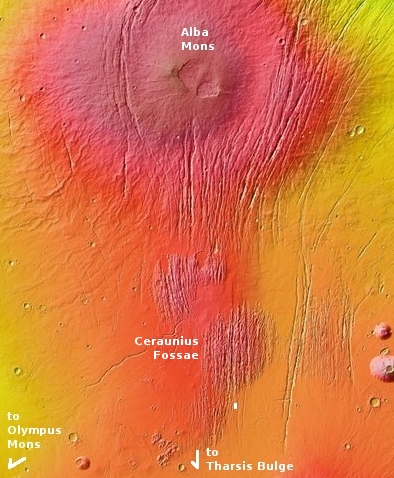
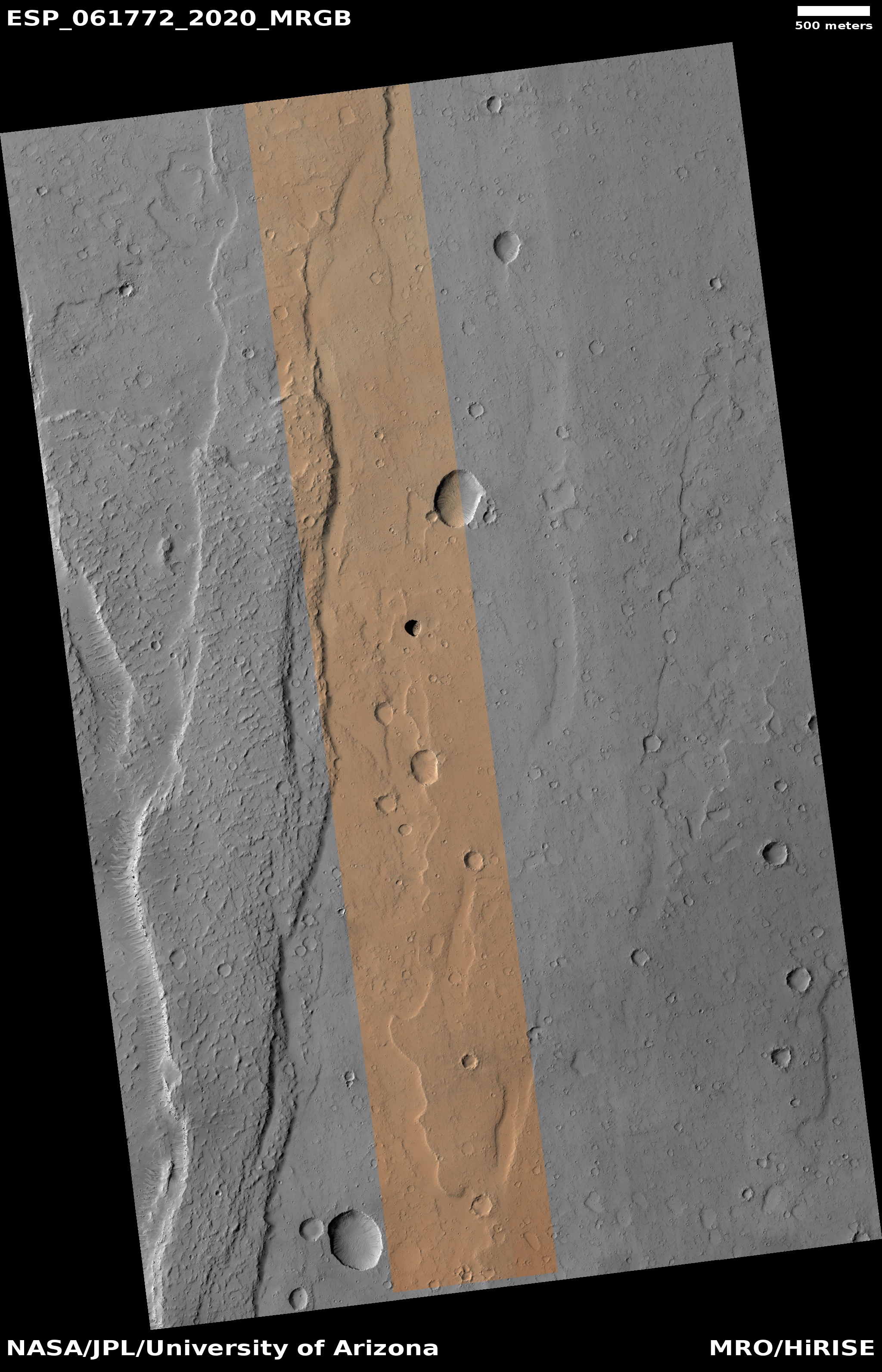
Time for what has almost become a monthly pit report from Mars Reconnaissance Orbiter (MRO). The November image download from the spacecraft’s high resolution camera included two pit-related photographs, both very different. To the right is the first, cropped to focus on the pit and the immediate surrounding terrain. Below that is a wider overview map to provide the context.
This pit’s location is indicated by the white box at the southern end of a region dubbed Ceraunius Fossae, made of hundreds and hundreds of parallel north-south fissures extending more than seven hundred miles south of the giant volcano Alba Mons and caused when the ground was stretched from below, causing it to crack.
This surrounding terrain helps to explain the pit’s origin. First it is located in a north-south depression with a number of other less pronounced depressions. While these do not line up precisely, they still suggest that they are sinkholes where the surface material is draining downward into voids below. Normally the assumption would be the existence of a lava tube, but here the downward grade is very small. Instead, what is likely happening is that the ground is being stretched, causing cracks to form into which surface material slips downward.
The Ceraunius Fossae fractures are extensional features produced when the crust is stretched apart…. Mechanical studies indicate that a regional pattern of radiating graben and rifts is consistent with stresses caused by loading of the lithosphere by the enormous weight of the Tharsis bulge….Several generations of grabens with slightly different orientations are present in Ceraunius Fossae, indicating that stress fields have changed somewhat over time.
In addition to producing normal faults and graben, extensional stresses can produce dilatant fractures or tension cracks that can open up subsurface voids. When surface material slides into the void, a pit crater may form. Pit craters are distinguishable from impact craters in lacking raised rims and surrounding ejecta blankets. On Mars, individual pit craters can coalesce to form crater chains (catenae) or troughs with scalloped edges.
That’s what we see here. The pit is suggestive of a void below, but it is likely not going to be a long coherent underground passage but a serious of random gaps, aligned roughly along the larger crack and producing the various depressions on the surface.
Today’s second pit is of an entire different nature.
» Read more
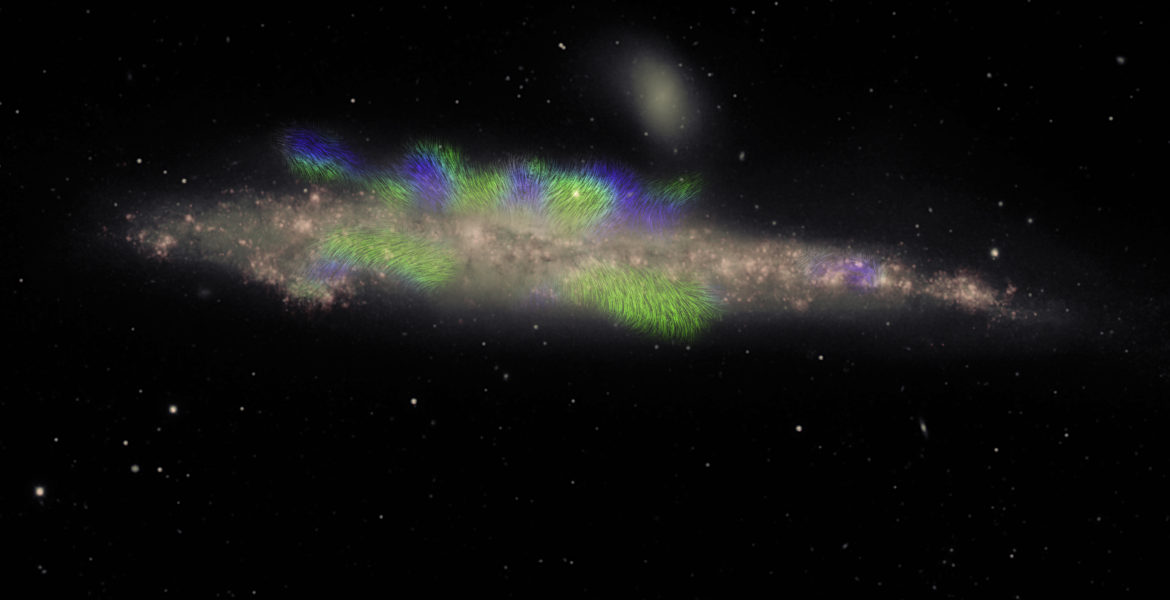
Click for full image.
Astronomers have made the first detection in another galaxy of a magnetic field that extends out into the galaxy’s halo.
The image above, based on data from the Jansky radio telescope, illustrates what they found..
The spiral galaxy is seen edge-on, with its disk of stars shown in pink. The filaments, shown in green and blue, extend beyond the disk into the galaxy’s extended halo. Green indicates filaments with their magnetic field pointing roughly toward us and blue with the field pointing away. This phenomenon, with the field alternating in direction, has never before been seen in the halo of a galaxy.
“This is the first time that we have clearly detected what astronomers call large-scale, coherent, magnetic fields far in the halo of a spiral galaxy, with the field lines aligned in the same direction over distances of a thousand light-years. We even see a regular pattern of this organized field changing direction,” said Marita Krause, of the Max-Planck Institute for Radioastronomy in Bonn, Germany.
The galaxy, dubbed the Whale by the astronomers, is about 35 million light years away, and has a diameter of about 80,000 light years, slightly smaller than the Milky Way.
The uncertainty of science: Astronomers have discovered 19 more dwarf galaxies, now totaling 23, that appear to have significant deficits of dark matter.
Of 324 dwarf galaxies analyzed, 19 appear to be missing similarly large stores of dark matter. Those 19 are all within about 500 million light-years of Earth, and five are in or near other groups of galaxies. In those cases, the researchers note, perhaps their galactic neighbors have somehow siphoned off their dark matter. But the remaining 14 are far from other galaxies. Either these oddballs were born different, or some internal machinations such as exploding stars have upset their balance of dark matter and everyday matter, or baryons.
It may not be a case of missing dark matter, says James Bullock, an astrophysicist at the University of California, Irvine. Instead, maybe these dwarf galaxies have clung to their normal matter — or even stolen some — and so “have too many baryons.” Either way, he says, “this is telling us something about the diversity of galaxy formation…. Exactly what that’s telling us, that’s the trick.”
Since we do not know what dark matter is to begin with, finding galaxies lacking it only makes more difficult to create a theory to explain it. Something causes most galaxies to rotate faster than they should, based on their visible mass. What that is remains an unknown.
Using a Soyuz-2 rocket the Russians today successfully launched a classified military satellite from its spaceport in Plesetsk.
The leaders in the 2019 launch race:
26 China
18 Russia
11 SpaceX
6 Europe (Arianespace)
China continues to lead the U.S. in the national rankings, 26 to 23.
These numbers will change again later today if Arianespace successfully launches two communications satellites. They have been trying to launch now for three days, but minor technical problems and weather have stymied them.
An evening pause: From the 1954 Colgate Comedy Hour Christmas Special with Abbott & Costello.
Hat tip Tom Biggar.
The Supreme Court today ruled that the defamation suit of global warming activist Michael Mann against the National Review and the Competitive Enterprise Institute can go forward.
On Monday, the Supreme Court denied a petition by the Competitive Enterprise Institute and National Review magazine to rehear and dismiss the defamation lawsuit brought by well-known climate scientist Michael Mann. The Competitive Enterprise Institute and National Review have been fighting for years to dismiss the case before it goes to trial, but the Supreme Court’s denial means the case will move forward in D.C. district court.
The Supreme Court rejected the petition without comment. But Justice Samuel Alito, a conservative, dissented, arguing that the case addresses critical freedom of speech and freedom of the press issues.
The court has basically ruled that Mann should be allowed his day in court. Since the case stems from criticism of Mann’s shoddy climate science work, I suspect he will find himself having problems once that day arrives, as he did in Canada.
The bad part of this is that it allows Mann to achieve part of his strategy, which is to chill any criticisms of his shoddy work, out of fear he will sue and thus cost the critic a lot of money mounting a defense. No one should be allowed to use the law as a weapon to prevent criticism, especially if that criticism successfully proves the nature of that person’s very shoddy and incompetent climate research, including faking data and hiding pertinent real data.
UPDATE: I have crossed out the words above because they misconstrued my intended meaning. Mann’s effort to use the law to try to squelch opposing points of view is wrong, but in a free society we must allow him this bad behavior. If the law functions properly, his misbehavior (and shoddy science work) will become very evident with time.
By the way, did I mention that Mann’s scientific work is generally very shoddy, and not very trustworthy?
In the past week several ugly events have illustrated forcefully how mob rule now dictates who can or cannot speak freely in America. Worse, these events show that we are no longer a civilized social order run by reason. Instead, we have become a culture where whoever can throw the loudest tantrum dictates policy.
First we have the horrible events last week at the State University of New York-Binghamton.
To understand how disgusting and despicable the first story above is, it is necessary for you to watch the video below. Pay special attention to the taller girl in the fur-lined parka who at about four minutes keeps looking at the camera-person (whom I think is also a girl) and aggressively and repeatedly asking, “Why are you shaking so? Why are you shaking so?” The reason is obvious. The girl filming is one the conservative students, and she is justifiably frightened. The taller girl, hostile and irrationally angry because a conservative dared to advocate opinions she doesn’t like, is clearly being physically threatening. As are all of her leftist compatriots.
The response of the college administration to this atrocious behavior was even more vile, essentially endorsing the actions of the mob:
» Read more