
April 22, 2019 Zimmerman/Thomson podcast
The podcast of my hour long interview with Steve Thomson on WCCO-830-AM in Minnesota on April 22, 2019, is now available here.
Hat tip reader Wayne DeVette
The podcast of my hour long interview with Steve Thomson on WCCO-830-AM in Minnesota on April 22, 2019, is now available here.
Hat tip reader Wayne DeVette
Embedded below the fold in two parts.
» Read more
An evening pause: A nice rendition of a song by Kate Wolf about crossing the divide between life and death, who herself died far too young.
Hat tip Danae.
NASA’s safety panel held a long scheduled meeting to review NASA’s on-going manned projects, and had the following to say:
The first story describes very little new information about the explosion on April 20th that destroyed the Dragon crew capsule during engine tests, other than it occurred in connection with the firing of the Dragon’s eight SuperDraco engines. I am being vague because they were.
The second story describes the panel’s strong objection to any effort by NASA to trim the test program for SLS in order to meet the Trump administration’s 2024 deadline for returning to the Moon. It also confirms officially for the first time that NASA will not be able to fly the first unmanned mission of SLS in 2020. That flight is now expected in 2021, a decade after NASA began development of SLS, and seventeen years after George Bush Jr first proposed NASA build this heavy-lift rocket.
That’s practically one person’s entire career at NASA. Seems pretty shameful to me.
While I actually agree with the panel’s advice in both of these stories, both stories however do reflect the overall culture of this safety panel: Go slow, take no risks, be patient. This culture is in fact so cautious that it has served to practically make impossible any American exploration of space, on our own rockets.
Based on what I expect now during the investigation of the Dragon explosion, I would not be surprised if the panel successfully delays the first manned Dragon launch another year or two or three.
An unnamed official at India’s space agency ISRO has revealed that they have decided to further delay its lunar lander/rover Chandrayaan-2 until July following the landing failure of SpaceIL’s Beresheet on the Moon.
“We saw Israel’s example and we don’t want to take any risk. Despite Israel being such a technologically advanced country, the mission failed. We want the mission to be a success,” he said.
The launch of India’s Moon mission was scheduled in April but it was postponed after Israel’s Beresheet spacecraft crashed during moon landing early this month. The ambitious mission was a first for a private effort.
“Landing on the Moon is a very complex mission and all the exigencies have to be factored in,” the official added.
No reason was given for the delay, other than a desire to be cautious. While caution is often a wise thing in experimental engineering, too much caution can be a fatal flaw. Chandrayaan-2 was originally scheduled for launch in the first quarter of 2018. It has now been delayed repeatedly since then, with the only hint of a reason being an unconfirmed story suggesting it was damaged during ground tests.
If this damage is the reason, then ISRO should tell us. Otherwise, the agency is beginning to look like it is afraid to fly.
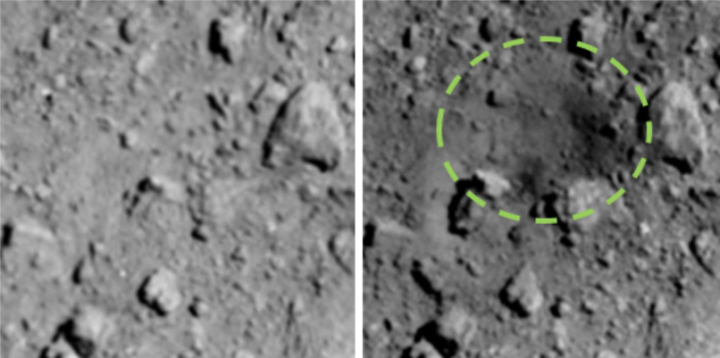
The Hayabusa-2 science team has released before and after images of the spot on Ryugu where the spacecraft’s explosive projectile caused the creation of a small crater.
On the left above is the before, with the new crater indicated by the circle on the right. Note the rocks in both pictures, some now partly covered with debris. They did not give a scale, but this is a very small area, probably less than a few feet across.
They now need to analyze whether they can safely touchdown at this spot and grab a sample.
An evening pause: Watch those fingers dance. The instrument she’s playing is called a harp guitar.
Hat tip Tom Biggar.
The uncertainty of science: New and very firm data from the Hubble Space Telescope on the universe’s expansion rate conflicts with just-as-firm data obtained by Europe’s Planck astronomical probe.
According to Planck, the present universe should be expanding at a rate of 67 kilometers per second per megaparsec. According to Hubble, the actual expansion rate is 74 kilometers per second per megaparsec.
And according to the scientists involved, both data sets are reliable and trustworthy, leaving them baffled at the difference.
“This is not just two experiments disagreeing,” explained [lead researcher and Nobel laureate Adam Riess of the Space Telescope Science Institute (STScI) and Johns Hopkins University, in Baltimore, Maryland.] “We are measuring something fundamentally different. One is a measurement of how fast the universe is expanding today, as we see it. The other is a prediction based on the physics of the early universe and on measurements of how fast it ought to be expanding. If these values don’t agree, there becomes a very strong likelihood that we’re missing something in the cosmological model that connects the two eras.”
Ya think? Any cosmologist who claims we really understand what is going on, based on our present fragile and very limited knowledge, is either fooling him or herself or is trying to fool us.
I should note that there seems to be an effort, based on the press release above as well as this second one, to downplay the amount of uncertainties that exist in this cosmological work. Both releases fail to note that when scientists announced their first expansion rate estimate from Hubble’s first data back in 1995, those scientists claimed with absolute certainty that the expansion rate was 80 kilometers per second per megaparsec. At the time some scientists, led by the late Allan Sandage of the Carnegie Observatory, disputed this high number, claiming the number could be as low as 50. Some even said it could be as low as 30 kilometers. Sandage especially found himself poo-pooed by the cosmological community for disputing that the 80 number pushed by Hubble’s scientists in 1995.
In the end, the Hubble scientists in 1995 were closer to today’s Hubble number than Sandage, but his estimate was not wrong by that much more, and he was right when he said the number had to be lower. Either way, Hubble’s modern estimate of 74 for the present expansion rate is very well constrained, and is a far more trustworthy number than previous estimates.
However, do we know with any reliability what the expansion rate was billions of years ago? No. Cosmologists think it was faster, based on supernovae data, which is where the theory of dark energy comes from. It is also where Planck’s predictions come from.
That early expansion rate, however, is based on such tentative data, containing so many assumptions and such large margins of error, that no serious scientist should take it too seriously. It suggests things, but it certainly doesn’t confirm them.
This is why their faith in the numbers derived from Planck puzzles me. It is based on a “prediction,” as Riess admits in the quote above, which means it is based on a theoretical model. It is also based on that very tentative early supernovae data, which makes it very suspect to me.
The Hubble data is real data, obtained by looking at nearby stars in a very precise matter. Its margin of error is very small. It contains only a few assumptions, mostly involving our understanding of the Cepheid variable stars that Hubble observed. While skepticism is always called for, trusting this new Hubble data more is perfectly reasonable.
In the end, to really solve this conflict will require better data from the early universe. Unfortunately, that is not something that will be easy to get.
The Justice Department has reached a settlement with the company that had faked test results which caused faulty components to be installed on Orbital ATK’s Taurus rocket, eventually causing two consecutive launch failures.
SPI agreed to plead guilty to one count of mail fraud while SEI entered into a deferred prosecution agreement. SPI will pay $34.1 million in combined restitution to NASA, the Missile Defense Agency (MDA) and commercial customers, and forfeit $1.8 million in “ill-gotten gains.” The company will also pay an additional $6 million to NASA and $5 million to MDA as part of a separate civil settlement.
The companies acknowledged that SPI altered test results for nearly two decades, starting in the mid-1990s, such that aluminum extrusions that had failed mechanical properties testing instead appeared to have passed. Dennis Balius, a testing lab supervisor at SPI who led the effort to falsify test results for a number of years, pled guilty on separate charges in 2017 and was sentenced to three years in prison.
Those aluminum components were sold to a number of companies, including those who had contracts with NASA and MDA. The Justice Department statement noted that the components were used in frangible joints in launch vehicles and missiles. Such joints are used in vehicle separation systems.
“NASA maintains that SPI’s manufacturing processes lacked sufficient controls and produced extrusions unable to pass mechanical properties testing,” the Justice Department stated. “NASA further maintains that it identified SPI’s out-of-specification extrusions as the cause of two failed rocket launches, which resulted in the loss of important scientific missions.” SPI disputed those claims, although NASA has barred the company from contracting.
The worst part of this story is that it likely ended up destroying Orbital ATK, an innocent party to this fraud. Though the company lives on now as a division within Northrop Grumman, it never quite recovered from the two Taurus launch failures in 2009 and 2011. Customers went elsewhere, and the company’s launch business dried up. The only customer Orbital ATK was able to muster afterward was NASA, and the number of launches this provided was not enough, causing company’s eventual absorption by Northrop Grumman.
In a planned fly-over of Ryugu yesterday Hayabusa-2 took its first direct images of the location where it had fired an explosive projectile and thus confirmed the creation of a man-made crater by that projectile.
“The asteroid’s terrain has clearly been altered,” said Yuichi Tsuda, an associate professor at the Japan Aerospace Exploration Agency.
Hayabusa2, which began its descent toward the asteroid Wednesday afternoon, captured images of its surface to determine the existence of the crater after it successfully shot a metal projectile at Ryugu on April 5 in an experiment deemed the first of its kind.
According to the JAXA, the probe photographed the area hit by the projectile from a distance of 1.7 km. The agency compared images of the asteroid’s surface before and after the shooting of the projectile to determine the presence of a man-made crater.
They have not yet released any of these images. They will use them however for planning a touchdown and sample grab within this crater in next few months.
The first segment is embedded below the fold. The second segment is not yet available.
» Read more
An evening pause: Why do even alien lawyers get portrayed this way?
Hat tip Jim Mallamace.

Click for full image.
Cool image time! In perusing the April image release from the high resolution camera of Mars Reconnaissance Orbiter (MRO), I came across the image above, cropped and reduced to post here, of the discovery of another landslide within Hydraotes Chaos, one of the largest regions of chaos terrain on Mars. The image above was taken on February 9, 2019, and has since been followed up with a second image to create a stereo pair.
This is not the first landslide found in Hydraotes Chaos. I highlighted a similar slide on March 11. Both today’s landslide as well as the previous one likely represent examples of gravitational collapses as shown in this science paper about Martian ground water. Some scientists have proposed that Hydraotes Chaos was once an inland sea, and as the water drained away the loss of its buoyancy is thought to cause this kind of landslide at the base of cliffs and crater rims.
The past presence of water also helps explain the soft muddy look of this landslide. When this collapse occurred the material was likely saturated with water. Today it is most likely quite dry and hardened, but when it flowed it flowed like wet mud. Its size, almost a mile long and a quarter mile across, speaks to Mars’s low gravity, which would allow for large singular collapses like this.
Hydraotes Chaos itself is probably one of the more spectacular places on Mars. It sits at the outlet to Marineris Valles, shown in the image below. This gigantic canyon, which would easily cover the entire U.S. if placed on Earth, was the largest drainage from the large volcanic Tharsis Bulge to the west, where Mars’s largest volcanoes are located.
» Read more
Hayabusa-2 has begun its fly-in of Ryugu to make its first close observation of the man-made crater it created on the asteroid’s surface on April 4.
The link takes you to the images downloaded in real time from the spacecraft’s navigation camera. New images appear approximately every thirty minutes. The approach has only just begun, so Ryugu remains somewhat small in the images. This will change as the day proceeds.
The new colonial movement: China today announced that the launch of the first module for its space station will take place in the first half of 2020 on the maiden flight of its Long March 5B rocket.
China also announced today that they will launch Chang’e-5, their lunar sample return mission, by the end of this year, followed in 2020 by a Mars probe. Both launches will require use of the Long March 5.
The 5B appears to be a redesigned version of the 5, which has launched twice but failed on its second launch in 2017. Since then all launches of the Long March 5 ceased, with hints in the press that the failure occurred because the rocket’s first stage engines had badly underperformed and required a complete redesign. This redesign caused significant delays in the launch of Chang’e-5, China’s space station, and its Mars probe.
Today’s announcements suggest that that engine redesign is probably complete, and that they are now ready to resume Long March 5 launches, including the upgraded and revised 5B.
Capitalism in space: Though Boeing intends to bring its manned Starliner capsule down on land, it has begun water recovery tests of the capsule, working in conjunction with Air Force recovery teams, to prepare for the possibility that it might sometimes have to splashdown in the ocean.
While the article reviews the tests, it also contains this interesting piece of information:
While today’s test was the first in-water practice run for Starliner at sea rescue, it represents a much larger DoD commitment to space crew rescue operations – universal procedures that would be followed for Starliner, Dragon, and Orion.
During ascent for Starliner, Dragon, and Orion, the 304th Rescue Squadron will have two teams stationed along the east coast of the United States, one at Patrick Air Force Base (just South of the Cape) and the other in Charleston, South Carolina.
The Patrick team, Rescue 1, will be responsible for on-pad aborts that place a capsule in the water or for aborts in the first couple minutes of flight that place the capsule within a 200 nautical mile zone from the Cape.
After that distance is exceeded, the Charleston crew (Rescue 2) would be responsible for rescue of a launch-aborting crew vehicle anywhere else across the Atlantic.
The third team, stationed in Hawai’i, (also part of Rescue 2) would be responsible for any after-launch immediate landing need or off-nominal Station return contingency that places a Starliner or Dragon in the Pacific.
It appears that the responsibility for water recovery of American manned spacecraft has been taken over by the Air Force. Up until now SpaceX has performed its own water recovery for its unmanned cargo Dragon capsules.
Capitalism in space: The startup rocket company Relativity today announced the signing of a second launch contract for its as-yet untested Terran 1 rocket.
Relativity, the world’s first autonomous rocket factory and launch services leader for satellite constellations, today announced a partnership with mu Space, the innovative Thai satellite and space technology company, to launch a satellite to Low Earth Orbit (LEO) on Relativity’s Terran 1 rocket, the world’s first and only 3D printed rocket.
The first contract was with the well-established satellite company Telesat. The rocket, Terran 1, is scheduled for its first orbital test flight at the end of 2020.
So, where does Relativity stand among the leaders in the new smallsat commercial rocket industry? Let’s do a quick review.
Rocket Lab is of course far in the lead. It has launched four times, and its Electron rocket is now operational.
Second in this race is probably Virgin Orbit. The company has won several launch contracts, and says it will begin launch tests momentarily of its LauncherOne air-launched rocket.
Next comes Vector Launch, though some might argue it is ahead of Virgin Orbit. This company has obtained a large amount of investment capital, has completed two test suborbital launches, has a number of launch contracts, and hopes to do its first orbital launch later this year.
After these three companies there is a pack of rocket companies, all with investment capital, tentative launch contracts, and rockets that are only in the development stages. These include Exos Aerospace, Relativity, and Firefly, with Exos probably in the lead as it has already test flown its reusable SARGE suborbital rocket.
This list does not include the pseudo-private Chinese rocket companies, OneSpace, ISpace, LinkSpace, Landspace, and ExSpace, all of whom are independently developing smallsat rockets using Chinese investment capital but working under the supervision of the Chinese government. Several of these companies have attempted orbital launches. As yet none have succeeded.
Nor have I included India, which has announced it is going to build its own smallsat rocket to supplement its larger PSLV rocket in order to maintain its market share in this new smallsat industry. I also have left out a number of European companies, all of whom are far behind but nonetheless exist and are beginning development.
Other then the already-operating Rocket Lab, all of these companies are predicting their first rocket launches within the next three years. Some will succeed. Some will not. Nonetheless, the launch pace as we move into the 2020s is likely to get quite interesting.
An evening pause: Performed live on television 1985.
Hat tip Diane Zimmerman.
The InSight science team has announced that they think they have detected their first Mars quake, though it was too small to provide much information about the Martian interior.
The Martian surface is extremely quiet, allowing SEIS, InSight’s specially designed seismometer, to pick up faint rumbles. In contrast, Earth’s surface is quivering constantly from seismic noise created by oceans and weather. An event of this size in Southern California would be lost among dozens of tiny crackles that occur every day.
“The Martian Sol 128 event is exciting because its size and longer duration fit the profile of moonquakes detected on the lunar surface during the Apollo missions,” said Lori Glaze, Planetary Science Division director at NASA Headquarters.
…Three other seismic signals occurred on March 14 (Sol 105), April 10 (Sol 132) and April 11 (Sol 133). Detected by SEIS’ more sensitive Very Broad Band sensors, these signals were even smaller than the Sol 128 event and more ambiguous in origin. The team will continue to study these events to try to determine their cause.
The data so far suggests is that Mars is far quieter than Earth geologically, but any conclusions at this point would be premature.
If you happen to be one of the many Democrat voters who limits his or her reading to such media sources as the New York Times or Wired, you might believe without doubt that Pete Buttigieg (pronounced BOOT-i-edge), the mayor of South Bend, Indiana, is not only most qualified Democratic politician running for President, he is also John Kennedy reborn, able to lead the nation into a bipartisan paradise of smart liberal polices beneficial to all!
First there is this June 18, 2018 article in the New York Times:
Far from being just the out-gay mayor of a scrappy rebounding Rust Belt city, Mr. Buttigieg is a singular politician: a Democrat in a Republican stronghold; a high school valedictorian who graduated Phi Beta Kappa from Harvard and who also attended Oxford as a Rhodes scholar; a political comer who, after winning election at 29, quickly set about reversing an economic decline in this northern Indiana city, where the last Studebaker rolled off a South Bend assembly line in 1963; a Navy veteran who, in 2014, took an unusual leave-of-absence from his civic day job to serve a tour of duty in Afghanistan.
He is also one of a handful of Democrats that, in a New Yorker article, were cited by President Barack Obama as the future of the Democratic Party, an anointing whose potential ramped up this spring when, with an eye on the 2020 race, Mr. Buttigieg’s own political action committee began supporting legislative races in Georgia, Arizona, Michigan, Colorado and Ohio.
This more recent April 11, 2019 article in Wired is equally ebullient.
Buttigieg brought data, flow charts, and McKinsey-esque analysis to city government—as well as a bit of philosophical humanism. Since he became mayor seven years ago, unemployment in the city has fallen, from 13 percent in 2010 to 3.2 percent last fall—below the national rate—and South Bend has seen its first significant population increase in half a century. (Unemployment has since ticked back up, to 4.3 percent.)
The country itself was in recovery from the Great Recession during those years, but Buttigieg undertook specific changes that pushed South Bend up the hill.
Pete Buttigieg however is none of the things these puff pieces say he is. Both articles are the worst and most despicable form of journalism. They tell you nothing really about this Democratic Party candidate, but attempt — for partisan political reasons — to make that Democrat appear to be the second coming of Jesus.
Let’s take a real look at Pete Buttigieg, based on what he claims he wishes to do should he win the Democratic presidential candidacy and then win election. We will find that he is not unlike Andrew Yang, another Democratic Party fascist who thinks he knows best for everyone, and thus should be given the power to rule our lives, down to the most trivial matters. And woe to us should we have the temerity to disagree with his totalitarian demands.
» Read more