
Johnny Cash & Willie Nelson – I Still Miss Someone
An evening pause: Hat tip Jim Mallamace, who said, “A song about longing and being incomplete.”
And seeing Willie Nelson without a beard in itself makes this worth watching.
An evening pause: Hat tip Jim Mallamace, who said, “A song about longing and being incomplete.”
And seeing Willie Nelson without a beard in itself makes this worth watching.
Yesterday’s magnificent successful launch of SpaceX’s Falcon Heavy rocket elicited numerous news stories from the general press, most of which were reasonably accurate if very superficial in their coverage. As a space guy who focuses on this stuff, I find that much of the reporting in the mainstream press reads as if the author has just discovered the subject, and is scrambling to come up to speed quickly.
This CNN article is typical. The journalist gets most of her facts right, but her lack of context because she hasn’t been following the subject closely causes her to not understand the reasons why the Falcon Heavy will fly less than the Falcon 9.
Falcon Heavy is not expected to fly nearly as often as its smaller counterpart, which has completed more than 20 missions since last February. Falcon Heavy only has five missions on its manifest so far.
The basic facts in this quote are entirely true, but it somehow implies that the Falcon Heavy is simply not that much in demand, which isn’t true. The reason Falcon Heavy has approximately one quarter of the missions of the Falcon 9 is because it is still new and it hasn’t yet garnered the customers. Also, as a slightly more expensive rocket than the Falcon 9 ($90 million per launch vs $60 million) fewer customers are going to buy it.
Still, the Falcon Heavy has more than five missions upcoming, with contracts for at least seven launches, by my count, and having this many contracts this quickly is remarkable, considering the rocket’s newness. It is more than the Russians are getting for their Proton rocket, around since the 1960s. And it is almost as many contracts as both Arianespace and ULA are each getting on a yearly basis.
Falcon Heavy is clearly becoming a big financial success, and will in the next few years I think routinely fly three to four times per year. There is a lot of demand for it, which will only grow with time.
This flaw in getting the background right by the CNN reporter is not really a big deal, but it does illustrate why it is better for ordinary citizens to get their news not from generalists in the mainstream press but from specialists in each field (such as myself), who understand the details more closely and can get the context right.
However, every once in awhile the mainstream press publishes a story that is so egregious and badly written that I think it necessary to give it a public pan, if only to make others aware of that this kind of bad journalism is not unusual. I also admit that it can be quite entertaining to highlight this pitifully bad journalism.
Yesterday one of Houston’s local television stations, KPRC-TV, published its own quick report on the Falcon Heavy launch. And boy, was that report a facepalm.
» Read more
The Hayabusa-2’s science team has scheduled their first observations of the artificial crater the spacecraft made on the surface of the asteroid Ryugu for April 25.
The probe will observe the crater, which was generated during an impact experiment on April 5, from a height of 1.7 kilometers. JAXA will collate the data with photographs of the surface taken near the impact point to measure the size and location of the crater. It will also examine the dispersion of rocks and judge whether Hayabusa2 can land to take samples.
This is only their first assessment. Once they feel comfortable about getting closer, they will then plan the spacecraft’s second touchdown and sample collection, this time hopefully from within that crater.
Despite the failure of its Beresheet lunar lander to land softly on the Moon yesterday, the private company SpaceIL has been awarded a one million dollar prize by the X-Prize for its success in getting into lunar orbit and coming as close as it did to successfully landing.
“As a testament to the team’s passion and persistence, we are presenting this one million dollar Moonshot Award to the SpaceIL team at our annual Visioneering Summit in October 2019, with the hope that they will use these funds as seed money towards their education outreach or Beresheet 2.0, a second attempt to fulfill the mission,” said XPRIZE CEO Anousheh Ansari.
The article also outlines some details about the failure. The main engine cut off during descent, and though they were able to get it restarted, the spacecraft was now too close to the surface and traveling too fast to slow it down. They are now assessing their data to figure out why the engine cut off as it did.
Capitalism in space: Virgin Orbit has signed an agreement with the European launch services provider Exolaunch to provide launches for it appears as many as 20 smallsats.
Exolaunch, a spinoff of the Technical University of Berlin formerly called ECM-Space, has arranged launches, managed missions and integrated small satellite rideshare clusters for customers in Europe and North America. Exolaunch customers include startups, universities, scientific institutions and space agencies. In 2019, Exolaunch is under contract to send more than 60 small satellites into orbit. Forty of those satellites are scheduled to fly together on a Russian Soyuz rocket this spring or summer.
It appears that this agreement covers those 20 additional satellites, but the announcement is vague, probably because Virgin Orbit has still not completed its first launch. Until it does so, many of its launch contracts will be somewhat tentative, with its customers keeping the option to withdraw.
Capitalism in space: One week after dropping its protest for losing the bidding competition for the Lucy asteroid mission, SpaceX has been awarded by NASA the launch contract for its Double Asteroid Redirection Test (DART) mission, set for launch in June 2021.
The $61 million launch price is significantly lower than past NASA contracts for Falcon 9 launches. NASA awarded SpaceX a contract for the Sentinel-6A satellite in October 2017 for a November 2020 launch on a Falcon 9 from Vandenberg at a total cost of $97 million. The Surface Water and Ocean Topography (SWOT) satellite will launch on a Falcon 9 in April 2021 under a contract awarded in November 2016 at a value of $112 million.
This low cost technology test mission, costing a total of $9 million, was initially going to be launch as a secondary payload. That NASA is now going to pay SpaceX for a full launch is most intriguing. It seems to me that there might be a bit of quid pro quo here. NASA wanted that protest dropped, and offered this launch to convince SpaceX to do that, as long as the launch cost was kept low. $60 million is really SpaceX’s standard price for Falcon 9 launch, using new boosters, but for NASA that is the least they’ve paid. How much more this is than what NASA would have paid to launch DART as a secondary payload is the real question.
An evening pause: In honor the various space related engineering daring-do today, let’s watch a modern fighter jet show off at an air show.
Hat tip Danae.
I have embedded the live stream of Falcon Heavy launch below the fold. It does not go live until just before launch, which is now scheduled for 6;35 pm (Eastern).
The live stream is now live. I will post updates below, so refresh your screen to see them.
This is not a routine SpaceX launch, where we have become nonchalant about the company’s ability to vertically land a first stage. They admit getting the core stage back will be challenging. They also admit that this is essentially a countdown of three rockets, so they are going to be very conservative. If anything pops up during countdown, they will scrub and try another day.
They have launched.
The side boosters have successfully separated.
The center core stage has successfully separated.
Re-entry burns for the two side boosters has been completed.
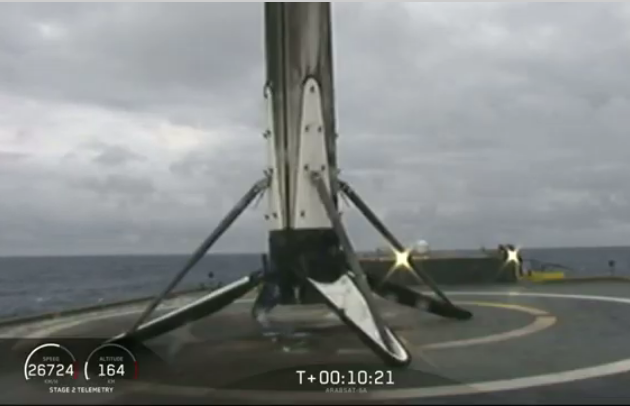
Re-entry burn on the core stage has been completed.
Both side boosters have landed.
The payload is in orbit.
The core stage has landed successfully on the drone ship.
Though the satellite has not yet been deployed, the rest of this mission is almost certainly going to go as planned, as it is essentially identical to a normal Falcon 9 launch. Update: payload successfully deployed!
Getting all three stages back is a notable achievement. They intend to recycle the two side cores and use them on the very next Falcon Heavy launch in June. The core stage will likely be reused as well but when has not yet been announced.
The leaders in the 2019 launch race:
4 SpaceX
4 China
4 Europe
3 Russia
The U.S. leads the pack 7 to 4 in the national rankings.
In the heavy lift launch race, SpaceX is by far in the lead in successful launches:
2 SpaceX
1 China
0 SLS (NASA)
I should add that I am being generous to include China’s Long March 5 in this heavy lift list. It really doesn’t qualify, but it remains the only other near competitor.
» Read more
Summary: Curiosity successfully drills into the clay unit. Yutu-2 continues its exploration on the far side of the Moon.
For the updates in 2018 go here. For a full list of updates before February 8, 2018, go here.
For the overall context of Curiosity’s travels, see my March 2016 post, Pinpointing Curiosity’s location in Gale Crater.
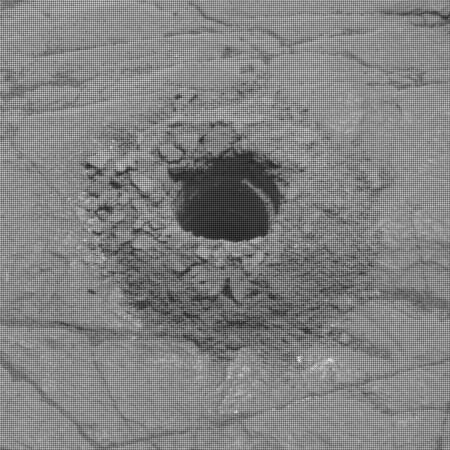
The news this week from Curiosity is that the rover has successfully drilled into the ground in the clay unit valley the rover is presently exploring betweent Vera Rubin Ridge and Mount Sharp’s higher slopes.
The image to the right shows is a close-up of that drill hole.
The rover’s drill chewed easily through the rock, unlike some of the tougher targets it faced nearby on Vera Rubin Ridge. It was so soft, in fact, that the drill didn’t need to use its percussive technique, which is helpful for snagging samples from harder rock. This was the mission’s first sample obtained using only rotation of the drill bit.
Since my last rover update on February 20, 2019, they have been traveling for several weeks to get to a spot where they can do this drilling. The clay unit seems very soft, and almost mudlike, which made finding a good surface to drill somewhat challenging. Most of the terrain seemed too soft to drill into. It almost would be better to have a scoop, as the Viking landers had. Curiosity doesn’t really have this however. It needs to use its drill, which really is a more efficient way to get down deeper into the ground anyway.
The map below shows their recent travels.
» Read more
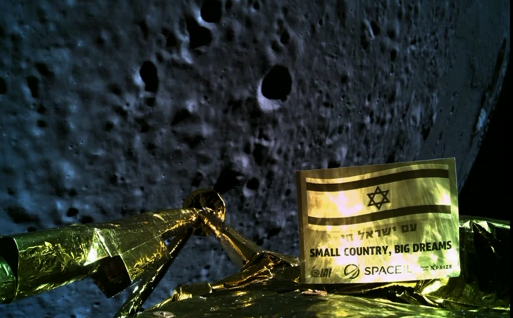
An engine problem during landing has caused Beresheet to crash onto the lunar surface.
The image on the right was the last image beamed back by the spacecraft during the landing sequence. It looks down at the lunar surface from several thousand meters.
As Netanyahu immediately noted, “If at first you don’t succeed, you try again.”
This failure definitely slows down the effort to transition from government-controlled space exploration to a free effort by the independent citizenry of all nations. It does not stop it however. There are other private lunar missions already scheduled, and of course, there is the effort by SpaceX to build its own heavy-lift rocket to make interplanetary space travel affordable for all.
The next decade will see this effort blossom. Beresheet’s failure is an example of those first baby steps, when the ability to stand is uncertain, and sometimes results in a fall. But babies turn into adults. The future is bright indeed.
They have begun the live stream of Beresheet’s landing on the moon, with the arrival of Benjamin Netanyahu in the viewer’s gallery. It is in Hebrew, and will likely mostly involve watching people sitting at computer consoles, and then standing and cheering when the spacecraft lands.
However, I have embedded it below the fold for your viewing pleasure.
UPDATE: They are including English commentary.
» Read more
Capitalism in space: DARPA has chosen Vector Launch, Virgin Orbit, and a third unnamed company to compete for up to $10 million in prizes in its quick launch competition.
The Defense Advanced Research Projects Agency (DARPA) is giving $400,000 to each of three companies chosen to compete in the “DARPA Launch Challenge” to demonstrate rapid and responsive launch of small payloads. Tucson-based Vector Launch, Virgin Orbit, and a “stealth” startup will now have the opportunity to compete for prizes up to $10 million for successfully proving they can successfully launch twice in a row within a short timeframe from being provided mission parameters, DARPA told reporters here April 10.
First, I wonder why Rocket Lab was not picked. I suspect this is because it is already launching operational missions, and so does not need this developmental boost. Also, its rocket might not meet DARPA’s criteria. The launch systems of both Vector and Virgin Orbit are designed to allow them to quickly transport their rocket to any number of launch sites and go. Rocket Lab’s Electron appears to need a more established launchpad.
Second, I wonder what that third unnamed startup is. There are more than two dozen in development right now, but I can only think of one, Exos Aerospace, that has actually done any successful test flights, albeit suborbital. Whether its reusable SARGE suborbital rocket, being used to incrementally develop an orbital version, fits DARPA’s needs is not clear.
It could also very well be that DARPA has not actually chosen a third company, but has informed several that they can get that third slot, if they can achieve certain goals in a certain time frame. It could be that both DARPA and these companies would rather keep this private competition private. For the companies, they’d rather not advertise their failure to win it. For DARPA, the goal is to help, not hurt, the companies.
The new colonial movement: Despite two launch failures already this year as well as U.S. opposition, Iranian officials earlier this week said that they still have plans to launch three more times in 2019.
I have no idea how seriously we should take this claim. Iranian officials have made a number of claims in recent years that proved nothing by bombast. This might be that, or not.
Embedded below the fold in two parts.
» Read more
An evening pause: A song that looks back at September, from the cold fading days of December.
From The Fantasticks.
The new colonial movement: The privately-built Israeli lunar probe Beresheet has completed its last orbital maneuver before attempting a landing on the Moon tomorrow.
The elliptical orbit now has a low point of 9 to 10 miles above the lunar surface.
Capitalism in space: SpaceX has pushed its Falcon Heavy launch back to tomorrow, April 11, at 6:35 pm pm (eastern) tonight.
No reason yet on why. The live stream is embedded below the fold, and will be available here when the launch happens.
» Read more

Cool image time! The Lunar Reconnaissance Orbiter (LRO) science team today released a beautiful oblique image looking of the central peaks of Compton Crater, a far side crater with a floor that is fractured and is one of about 200 hundred such craters.
Today’s Featured Image highlights an floor-fractured crater (FFC) that could tell us much about the lunar crust. An asteroid or comet impact is thought to have excavated 146.6-kilometer-wide Compton crater about 3.85 billion years ago. Igneous intrusion or viscous relaxation — or perhaps both processes — subsequently produced branching fractures and small basalt plains within Compton crater. The latter are darker than their surroundings.
Unlike Copernicus Crater, the surface appears smooth. Go to the link and zoom in to see what I mean. All the fractures appear very large and filled in. Of course, that could be because of the image’s resolution, and that other images might show more details and pits.
I find the central peaks more intriguing, however. It appears that, following their formation they were hit by several bolides, one of which carved a gigantic deep hole into those peaks.
The European Space Agency today released the results of more than a year of observations from its Trace Gas Orbiter (TGO), among which were two significant findings.
First, the orbiter detected no methane in Mars’s atmosphere, contradicting recent results from both Curiosity and Mars Express.
The new results from TGO provide the most detailed global analysis yet, finding an upper limit of 0.05 ppbv, that is, 10–100 times less methane than all previous reported detections. The most precise detection limit of 0.012 ppbv was achieved at 3 km altitude. As an upper limit, 0.05 ppbv still corresponds to up to 500 tons of methane emitted over a 300 year predicted lifetime of the molecule when considering atmospheric destruction processes alone, but dispersed over the entire atmosphere, this is extremely low.
…“The TGO’s high-precision measurements seem to be at odds with previous detections; to reconcile the various datasets and match the fast transition from previously reported plumes to the apparently very low background levels, we need to find a method that efficiently destroys methane close to the surface of the planet.”
It appears they think the Curiosity and Mars Express detections were very localized and occurred close to the surface, where TGO could not detect it.
The second significant finding is indicated by the map below, showing a global map of subsurface water distribution on Mars. I have also posted below this map a global elevation map from Mars Reconnaissance Orbiter (MRO), as the similarities and differences are important.
» Read more
These two stories gleaned from yesterday’s House testimony by Attorney General William Barr at first glance might seem unrelated:
Of course these stories are related. The spying occurred in conjunction with the FBI’s effort to pin the fake Russian collusion accusation on Trump.
If a legitimate investigation occurs here, then a number of people will be facing jail time, for perjury, for abuse of power, for actually conspiring to overturn a legal election. Moreover, it appears the investigation might not be limited to actions by the FBI. According to Barr’s testimony today at a Senate hearing, multiple intelligence agencies are implicated.
While it is important that the top law enforcement in the United States publicly acknowledged that the Obama administration and its intelligence agencies surveilled its domestic political opponents during the heat of a presidential election, it is what [Barr] said next that was most startling: that the CIA and other federal agencies in addition to the FBI may have been involved. “I’m not talking about the FBI necessarily, but intelligence agencies more broadly,” he said.
This whole Russian-collusion scam was corrupt from the get-go. Its only benefit is that it has revealed the depth of corruption in the executive branch of the federal government, which tried to set itself up as an American Praetorian Guard, with the right to anoint its favored political leaders as president, rather than the voters.
More importantly, this investigation is going to find out how much the Democratic Party, and its leader at the time, Barack Obama, were involved in this scam. We know already that the Washington bureaucracy is highly partisan and Democratic. What we don’t know is if that unhealthy partisanship was weaponized by Obama to generate this scam.
Barr might very well find out.