
November 29, 2018 Zimmerman/Batchelor podcast
Embedded below the fold in two parts.
» Read more
Embedded below the fold in two parts.
» Read more
Theft by government: The civil forfeiture scam that the city of Philadelphia has been running for years to steal the property of innocent people in order to personally benefit the prosecutors running the program has been shut down by a legal court settlement.
Was it theft? You decide:
Philadelphia routinely threw property owners out of their homes without notice. It forced owners to navigate the notorious “Courtroom 478,” where so-called “hearings” were run entirely by prosecutors, without any judges or court-appointed lawyers to defend property owners. Again and again, prosecutors demanded that property owners appear in court, sometimes ten times or more. Missing even a single “hearing” meant that prosecutors could permanently take an owner’s property, sell it and use the proceeds for any law-enforcement purpose they wished. More than 35 percent of proceeds went to salaries, including the salaries of the very officials seizing and forfeiting property, thus creating a perverse incentive to abuse this system. Today’s landmark settlement brings all of that to an end.
The settlement doesn’t end civil forfeiture, which is itself constitutional illegal, but forces the program to function in a more reasonable manner. Revenues will now go a drug treatment program, judges will run the hearings, and the hearings will be fast and straightforward. In addition, the settlement provides for compensation for those harmed by the past policy.
The Space Show has begun its annual fund-raising campaign.
As someone who has appeared on David Livingston’s show more times than anyone else, I hope my readers will consider supporting the Space Show with some generous donations. David was one of the few people, along with I, advocating commercial space back when the idea was considered insane. In many ways it was his effort with the Space Show that helped drive the revolution toward private space that is now remaking the entire aerospace industry and thus making the exploration and colonization of the solar system finally possible.
An evening pause: Hat tip Mike Nelson.
Working for the Democratic Party: Despite being protected under whistleblower laws, and despite his demonstrated cooperation with congressional committees, the FBI raided the home of Clinton whistleblower on November 19, spending six hours rummaging through his house.
FBI agents raided the home of a recognized Department of Justice whistleblower who privately delivered documents pertaining to the Clinton Foundation and Uranium One to a government watchdog, according to the whistleblower’s attorney.
The Justice Department’s inspector general was informed that the documents show that federal officials failed to investigate potential criminal activity regarding former Secretary of State Hillary Clinton, the Clinton Foundation and Rosatom, the Russian company that purchased Uranium One, a document reviewed by The Daily Caller News Foundation alleges.
The delivered documents also show that then-FBI Director Robert Mueller failed to investigate allegations of criminal misconduct pertaining to Rosatom and to other Russian government entities attached to Uranium One, the document reviewed by TheDCNF alleges. Mueller is now the special counsel investigating whether the Trump campaign colluded with Russia during the 2016 election.
“The bureau raided my client to seize what he legally gave Congress about the Clinton Foundation and Uranium One,” the whistleblower’s lawyer, Michael Socarras, told TheDCNF, noting that he considered the FBI’s raid to be an “outrageous disregard” of whistleblower protections.
Sixteen agents arrived at the home of Dennis Nathan Cain, a former FBI contractor, on the morning of Nov. 19 and raided his Union Bridge, Maryland, home, Socarras told TheDCNF.
There is significantly more at the link. It appears most obviously that the FBI here was used to harass and intimidate this man, simply because he has taken action that threatens Hillary Clinton and the Democratic Party.
I wonder once again if our legally elected president, mandated by the Constitution to run this agency, is really in charge, or if we have an agency run by its employees for political purposes, completely out of control. To me it sure looks like the latter. If Trump was the fighter he portrays himself to be, there would be wholesale firings over this raid, today.
Using ground-based telescopes as well as the space telescope Kepler astronomers have obtained their best and earliest view of a Type Ia supernova.
The supernova, named SN 2018oh, was brighter than expected over the first few days. The increased brightness is an indication that it slammed into a nearby companion star. This adds to the growing body of evidence that some, but not all, of these thermonuclear supernovae have a large companion star that triggers the explosion.
Las Cumbres Observatory (LCO), based in Goleta, California, is a global network of 21 robotic telescopes that obtained some of the best data characterizing the supernova in support of the NASA mission. Wenxiong Li, the lead author of one of three papers published today on the finding, was based at LCO when much of the research was underway. Five other LCO astronomers, who are affiliated with the University of California Santa Barbara (UCSB), also contributed to two of the papers.
Understanding the origins of Type Ia supernovae is critical because they are used as standard candles to map out distances in cosmology. They were used to discover Dark Energy, the mysterious force causing the universe to accelerate in its expansion. Astronomers have long known that a supernova is the explosion of a dense white dwarf star (A white dwarf has the mass of the sun, but only the radius of the Earth; one teaspoon of a white dwarf would weigh roughly 23000 pounds) What triggers the explosion is less well understood. One theory holds that the explosions are the merger of two white dwarf stars. Another is that the second star is not a white dwarf at all, but a normal-sized or even giant star that loses only some of its matter to the white dwarf to initiate the explosion. In this theory, the explosion then smashes into the surviving second star, causing the supernova to be exceedingly bright in its early hours.
Finding that Type Ia supernovae can be brighter than previously believed throws a wrench into the results that discovered dark energy, since those results made assumptions about the brightness and thus the distance of those supernovae. If the brightness of these supernovae are not as reliable as expected, they are also less of a standard candle for estimating distance.
At a Sotheby auction of space memorabilia yesterday three Moon rocks brought back by a Soviet-era robot ship sold for $855K.
This was the second time these rocks have sold at auction, with their sale price more than doubling with yesterday’s sale. Though their value has apparently gone up a lot, I think the seller here made a very wise decision. Right now, practically all the rocks are controlled by NASA and are not for sale, thus creating a shortage and forcing the value of the available rocks to rise. Their value will drop however once private companies start hauling them back to Earth.
A number of other interesting space items sold during auction, including several unused spacesuits and several paintings by Chesley Bonestell, Alan Bean, and Norman Rockwell.
Russia today used one of its three remaining Rokot rockets to launch three military communications satellites.
They no longer make Rokot because it uses Ukrainian equipment.
The leaders in the 2018 launch race:
33 China
18 SpaceX
12 Russia
9 Europe (Arianespace)
8 ULA
China remains ahead of the U.S. 33 to 30 in the national rankings.
Evil: After Trump’s 2016 election victory, Google management seriously considered rigging search results so that conservative news outlets would not show up.
They never did it, but instead created a short-lived fact check feature that was clearly aimed at discrediting conservative sites.
“We’re working on providing users with context around stories so that they can know the bigger picture,” chimed in David Besbris, vice president of engineering at Google. “We can play a role in providing the full story and educate them about all sides. This doesn’t have to be filtering and can be useful to everyone,” he wrote. Other employees similarly advocated providing contextual information about media sources in search results, and the company later did so with a short-lived fact check at the end of 2017.
Not only did the fact-check feature target conservative outlets almost exclusively, it was also blatantly wrong. Google’s fact check repeatedly attributed false claims to those outlets, even though they demonstrably never made those claims.
Google pulled the faulty fact-check program in January, crediting TheDCNF’s investigation for the decision.
Forgive me if I remain suspicious about how they rig search results these days. There are too many indications that the culture at this company is tyrannically liberal and willing to destroy anyone who dissents from that political position.
NASA today announced that it has committed $2.6 billion over the next ten years to buy delivery services to the Moon for its unmanned scientific missions, provided from nine different private companies.
The companies selected — Astrobotic Technology, Deep Space Systems, Draper, Firefly Aerospace, Intuitive Machines, Lockheed Martin Space, Masten Space Systems, Moon Express, Orbit Beyond — cover a range of companies from the well established to new companies not yet proven. This announcement essentially permits them all to bid on providing NASA delivery services to the moon for small unmanned probes. The press release states that:
These companies will be able to bid on delivering science and technology payloads for NASA, including payload integration and operations, launching from Earth and landing on the surface of the Moon. NASA expects to be one of many customers that will use these commercial landing services.
More information here. UPDATE: Doug Messier has published the press releases from most of the above companies, describing their individual projects, and I have added links to each.
The program appears modeled after NASA commercial cargo and crew programs, whereby the companies will own and control the orbiters, landers, and rovers they build, allowing them to market them to others for profit. It also appears designed to keep costs low, as did commercial cargo program. NASA is merely the customer.
This is good news. It suggests that the American space industry is continuing to transition away from big government programs, controlling everything, to a robust private industry that is in charge with the government merely one out of many customers.
An evening pause: I especially find the mixture of human labor and machinery here fascinating.
And what better to watch as we enter the holiday season then the making of wine barrels?
Hat tip Phill Oltmann.
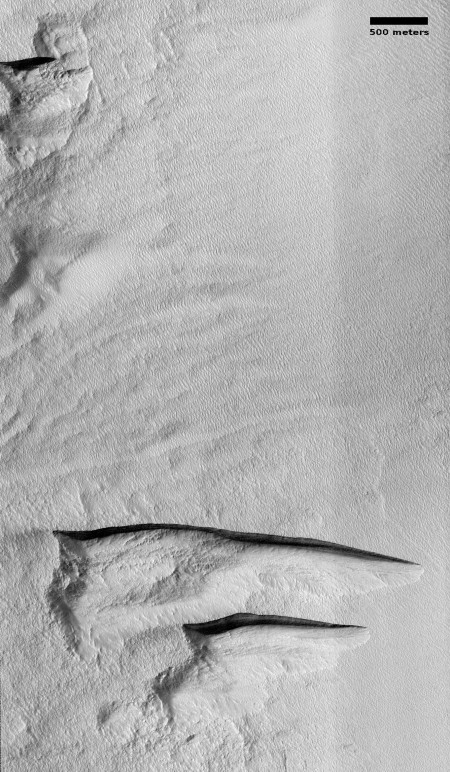
In my review of the November image download from the high resolution camera on Mars Reconnaissance Orbiter (MRO), I am, as a cave explorer and cartographer, naturally attracted to any image with “pit” in the title. The image to the right, cropped, rotated and reduced to post here, was released with the title “Pit in Mid-Latitude Mantle”. That immediately caught my eye, and in looking at it I was at first unimpressed. The three apparent collapses are interesting in that they all have south-facing sharp cliffs, but other than that I wasn’t sure why they were of interest.
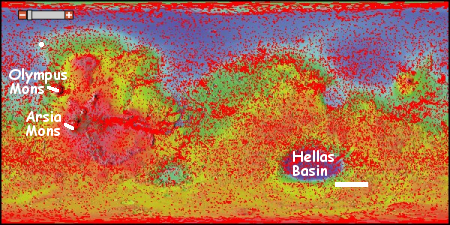
Then I took at look at this image’s location. It is somewhat far south on Mars, at latitude -60 degrees, sitting south of Hellas Basin, the deepest basin on Mars. This location is in the same general area where scientists announced in January the discovery of eight cliffs with visible exposed ice layers. The white horizontal bar below Hellas Basin on the map below and to the right shows the region where seven of those ice cliffs were located. To quote the January press release:
These eight scarps, with slopes as steep as 55 degrees, reveal new information about the internal layered structure of previously detected underground ice sheets in Mars’ middle latitudes.
The ice was likely deposited as snow long ago. The deposits are exposed in cross section as relatively pure water ice, capped by a layer one to two yards (or meters) thick of ice-cemented rock and dust. They hold clues about Mars’ climate history. They also may make frozen water more accessible than previously thought to future robotic or human exploration missions.
Researchers who located and studied the scarp sites with the High Resolution Imaging Science Experiment (HiRISE) camera on MRO reported the findings today in the journal Science. The sites are in both northern and southern hemispheres of Mars, at latitudes from about 55 to 58 degrees, equivalent on Earth to Scotland or the tip of South America. “There is shallow ground ice under roughly a third of the Martian surface, which records the recent history of Mars,” said the study’s lead author, Colin Dundas of the U.S. Geological Survey’s Astrogeology Science Center in Flagstaff, Arizona. “What we’ve seen here are cross-sections through the ice that give us a 3-D view with more detail than ever before.”
In an email correspondence today with Dr. Dundas, he confirmed that the image to the right was of ice cliffs not included in the January paper. The image was a follow-up of an earlier MRO image and was taken to confirm the ice cliff’s existence.
What I noticed in reviewing the January paper was that these three new ice scarps were actually outside the white bar on the map above, located at -60.7 degrees latitude, 83.5 degrees longitude.
» Read more
The Big Green government: Manufacturers of electric cars design the cars so that they routinely transmit information about the car’s status and position to the Chinese government.
More than 200 manufacturers, including Tesla, Volkswagen, BMW, Daimler, Ford, General Motors, Nissan, Mitsubishi and U.S.-listed electric vehicle start-up NIO, transmit position information and dozens of other data points to government-backed [Chinese] monitoring centers, The Associated Press has found. Generally, it happens without car owners’ knowledge.
The automakers say they are merely complying with local laws, which apply only to alternative energy vehicles. Chinese officials say the data is used for analytics to improve public safety, facilitate industrial development and infrastructure planning, and to prevent fraud in subsidy programs.
Outside of China the information is also gathered, but by private companies. Car owners can opt out, but that seems to me to be the unethical way to arrange this. Owners should instead be asked if they want to opt in.
In fact, the gathering of this data, privately or by governments, without the permission of the car owner, is entirely unethical and immoral. That these companies and their managers see nothing wrong with this is another illustration of the abandonment of morality in modern culture. It is also another reason why I want my hi-tech equipment to be as dumb as possible. Above all, I do not want it linked electronically beyond itself.
Capitalism in space: Blue Origin’s release of a payload user guide has provided space geeks a wealth of new information about the design of its New Glenn orbital rocket.
Numerous other items of interest are mentioned on the Guide, with launch vehicle specific elements such as a large common bulkhead being employed on the second stage and common tooling on the second stage and that is also aluminum orthogrid material in its construction. The rocket will use autogenous pressurization for both stages.
The large 7 meter fairing has the ability to launch very large payloads such as space telescopes, but also dual payloads – not unlike Ariane 5 regularly conducts.
The Guide refines some performance numbers, with 1060 kN (240,000 lb) total thrust cited for the second stage, which is slightly down from the 125,000 lb per BE-3U – the second stage engine-performance previously stated by Blue Origin’s online resources.
The article at the link also provides some updates on the status of the construction of the rocket’s launchpad, landing barge, and manufacturing facility.
The new colonial movement: South Korea yesterday successfully completed a suborbital test flight of its first home-built rocket engine.
The 75-ton-thrust engine was fired up and launched the first-stage rocket at the Naro Space Center in Goheung, South Jeolla Province, at 4 p.m., as part of the country’s long-term project to launch the Korea Space Launch Vehicle-2 (KSLV-2), dubbed Nuri, in 2021.
The Ministry of Science and ICT said it achieved an engine burn-time of 151 seconds, which exceeded its goal. It earlier said the test launch would be considered a success if the engine maintained a burn-time of about 140 seconds. The test rocket also reached a maximum altitude of 209 kilometers, 319 seconds after liftoff, and safely landed in international waters southeast of Jeju Island.
The planned orbital launch in 2021 makes this one of many new rockets, from both countries as well as private companies, set to become operational in the early 2020s. It looks like that decade will be especially exciting for space.
Link here. It appears they landed within a small crater filled with sand.
InSight landed in what’s called a hollow, a crater that has been filled in with soil and leveled flat. In images taken from the elbow of the lander’s stowed robotic arm, the edge of the crater is visible. Once the team determines the diameter of the crater—it could be meters, maybe tens of meters—researchers can infer its depth and the amount of sand blown into it. Either way, this bodes well for the heat probe instrument, called HP3, which should penetrate the material with ease. “This is about as good news for HP3 as you could possibly hope,” he says.
Landing in the hollow was fortunate for another reason. InSight didn’t quite hit the bull’s-eye of its target landing zone, and ended up in terrain that, overall, is rockier than desired. But the hollow is mostly devoid of rocks. One, about 20 centimeters across, sits close to the lander’s feet, whereas three smaller ones lie farther away—but none poses a threat to placing the instruments. The hollow is flat and lacks sand dunes, and small pebbles indicate a surface dense enough to support the weight of the instruments. “We won’t have any trouble whatsoever,” Golombek says.
They still need to pin down exactly where the lander is, on the surface. They know, within a few kilometers, but it will take more work to narrow that down to a precise location.
Embedded below the fold in two parts.
» Read more
The new colonial movement: India’s PSLV rocket successfully placed 31 satellites into orbit, including an Indian Landsat-type satellite plus 30 commercial smallsats.
This ties India with Japan at six launches for the year. With one more launch scheduled for this year, they should end up ahead of Japan.
The leaders in the 2018 launch race remain unchanged.
33 China
18 SpaceX
11 Russia
9 Europe (Arianespace)
8 ULA
At 95 total successful launches so far this year, 2018 now matches the total from 1993, the last time the global aerospace industry accomplished that many. That year, China and Japan had one launch each, Europe seven, with the rest by Russia and the U.S. Now the wealth is much more widely spread, and has a strong potential to grow significantly in the next few years.
An evening pause: I think this video, taken at the equator in Ecuador, nicely proves the Coriolis Effect. In fact, it is remarkable how short a distance you need to travel on Earth to flip the effect.

Cool image time! In the November image release from the high resolution camera on Mars Reconnaissance Orbiter (MRO) I found the image on the right (cropped to post here), dubbed “Possible Rock Falls on Steep Slopes in Cerberus Fossae.” You can see the full image by clicking on the photo on the right.
The cropped section focuses on the steep cliffs of this deep canyon, formed when lava flowed down from the giant volcano Elysium Mons almost like water, following the faults created by the bulging volcanoes to carve a long series of parallel canyons more seven hundred miles in length. Not only can individual boulders be seen piled up on the base of the canyon, you can see on the lower right a large section of cliff that has broken off and partly fallen, propped now precariously on the cliff’s steep slope. I would not want to be hiking below it at the base of this canyon.

This photograph itself made me more interested in looking at other MRO images of Cerberus Fossae. The context map on the right shows that MRO has taken numerous images along the length of these faults, indicated by the red boxes. The location of the above image is shown by the white cross, at the western end where the canyons tend to be steep, deep, and pronounced. In taking a look at the many images of Cerberus Fossae, I found a variety of canyons, plus pit chains, lava tube skylights, and one especially intriguing image, posted below, that shows what appears to be an extended collapse along the length of what was once an underground lava tube.
» Read more