What bad news is NASA hiding about the heat shield it will use on the next Orion/SLS manned mission around the Moon?

Orion's damage heat shield
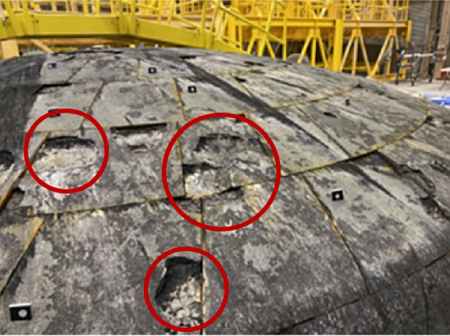
Damage to Orion heat shield caused during re-entry in 2022,
including “cavities resulting from the loss of large chunks”

Even as our uneducated media goes bonkers over another Musk kerfuffle, this time with interim NASA administration Sean Duffy, it is ignoring what now appears to be a strong effort by NASA to cover up some serious issues with the Orion capsule’s heat shield, issues that might be far more serious than outlined in a May 2024 inspector general (IG) report.

That IG report [pdf] found the following:

Specifically, portions of the char layer wore away differently than NASA engineers predicted, cracking and breaking off the spacecraft in fragments that created a trail of debris rather than melting away as designed (see Figure 3 [shown to the right]). The unexpected behavior of the Avcoat creates a risk that the heat shield may not sufficiently protect the capsule’s systems and crew from the extreme heat of reentry on future missions. Moreover, while there was no evidence of impact with the Crew Module, the quantity and size of the debris could have caused enough structural damage to cause one of Orion’s parachutes to fail. Should the same issue occur on future Artemis missions, it could lead to the loss of the vehicle or crew.

In our judgment, the unexpected behavior of the heat shield poses a significant risk to the safety of
future crewed missions.
[emphasis mine]

NASA spent the next few months reviewing the situation, and decided in December 2024 that it did not have the time or funding to redesign and replace the heat shield before the next flight. Instead, it chose to fly the next manned Orion mission — dubbed Artemis-2 and scheduled for the spring of 2026 carrying four astronauts around the Moon — using this same heat shield design but change the flight path during reentry to reduce stress on the shield.

NASA also admitted then that this heat shield design is defective, and that it will replace it beginning with the next mission, Artemis-3, the one that the agency hopes will land people back on the Moon.

The decision to fly humans in a capsule with such a known untrustworthy heat shield design is bad enough. Any rational person would not do this (as the inspector general above concluded). Yet NASA is going ahead, because it has determined that meeting its schedule, getting Americans back to the lunar surface ahead of China and during Trump’s present term of office, is more important than rational engineering and testing.

What now makes this decision even more worrisome is that it appears NASA is covering up the findings of its own engineers, completed in August 2024 but not made public until now.
» Read more

The shaky ground near the Moon’s south pole

Map of lunar south pole showing areas of instability
Click for original map.

According to a paper just published that reviewed and reanalyzed the seismic data gathered by the seismometers placed on the Moon by the various Apollo landings, scientists have determined that the south pole region where NASA wants its first manned Artemis lunar landing to take place happens also to be one of the Moon’s most active moonquake regions. From the paper’s conclusion:

We suggest that the lobate thrust fault scarps in the south polar region in and around the areas of the proposed Artemis III landing regions, particularly the de Gerlache Rim sites and Nobile Rim 1 regions, are potential sources for future seismic activity that could produce strong regional seismic shaking. If slip events on these young faults occur in the south polar region and elsewhere on the Moon, regolith landslides and potential boulder falls can be expected at distances of tens of kilometers from the source faults. Small amounts of water ice in the lunar regolith are expected to significantly increase the cohesion, stabilizing steep slopes against shallow landslides from seismic shaking. Based on our analysis of an N9-level event in the south polar region, we conclude that such an event poses a potential hazard to future robotic and human exploration in the region.

The map to the right is figure 10 from the paper, showing the south pole centered on Shackleton Crater. The colored dots mark areas of potential instability should a quake occur, with the blue boxes indicating all the NASA’s candidate landing sites for the manned Artemis 3 mission. Note the concentration of dots on the interior rim of Shackleton.

The planned landing site of Intuitive Machines Nova-C lander, scheduled for launch in mere weeks, is beyond the top of this map, to the north.

NASA worried FAA launch permit delays to Starship/Superheavy will delay first lunar landing

During a public meeting on June 7, 2023, a NASA official expressed concerns that the FAA’s slow launch permit process for SpaceX’s test program for developing Starship/Superheavy will end up seriously delaying the first Artemis manned lunar landing, presently targeting a December 2025 launch date.

The official, Jim Free, was very careful how he worded his comments, but the FAA issue loomed large in his mind.

Free said NASA met with the Federal Aviation Administration recently to discuss the importance of the Starship rocket to the space agency’s moon exploration plans. The FAA is overseeing SpaceX’s investigation into the problems encountered on the April 20 test launch, when the flight termination system took longer to destroy the rocket than expected. The destruct system is designed to terminate the flight before an errant rocket threatens populated areas.

The FAA is not expected to grant SpaceX another Starship launch license until the investigation is complete, and federal regulators are satisfied with changes to the rocket to address any public safety concerns. “They just have to get flying,” Free said of SpaceX. “When you step back and you look at (it), that’s a lot of launches to get those missions done, so our FAA partners are critical to that.”

For the FAA to treat SpaceX’s test program like ordinary launches, requiring a detailed investigation by it after every test flight, will likely delay the development of Starship/Superheavy by years.

Following the early suborbital tests of Starship, the FAA did not “oversee” the investigations. The FAA merely observed closely SpaceX’s investigation, and let it move forward when SpaceX was satisfied. Now the FAA wants to determine for itself when each launch will occur, even though there is no one at the FAA truly qualified to do that. The result will be endless delays and paperwork, and many fewer flights spaced many more months apart, none of which will do anything to aid the development.

NASA is obviously trying to get the FAA to see this, but we must remember that the change in policy at the FAA almost certainly came from the Biden administration, which doesn’t care as much for getting to the Moon as it does wielding its power to hurt Elon Musk, whom it now sees as a political opponent. Expect NASA’s pleas to fall on deaf ears.

Potential Artemis-3 landing site on the Moon

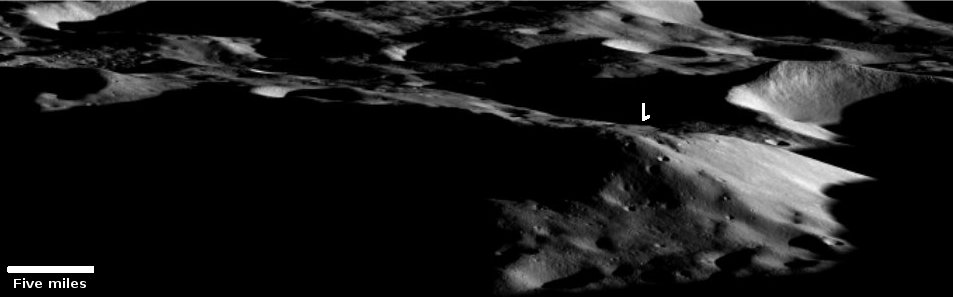
The landing zone for the Artemis-3 mission to the Moon

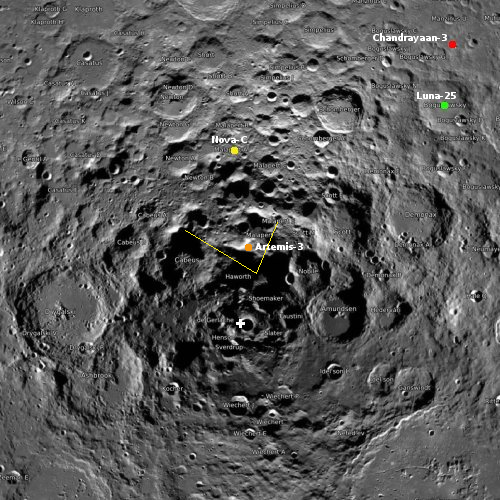
Overview map

The panorama above was released today by the Lunar Reconnaissance Orbiter (LRO) science team, and shows one of the candidate landing sites (arrow) where Starship could land as part of the Artemis-3 mission to the Moon.

The map of the south pole to the right, created from LRO images and annotated by me, gives the context. The yellow lines indicate the approximate area covered by the panorama. The terrain here is rugged, to put it mildly. As the science team notes,

Imagine the view from the summit; it rises more than 5000 meters (16,400 feet) above its base. Off in the distance, you could see a 3500 meter (11,480 feet) tall cliff. One could argue that the sheer grandeur of this region makes it a prime candidate. But then again, a landing here might be too exciting?

That 11,480-foot-high cliff is the crater wall to the right of the arrow. Make sure you go to the link to view the original image. This will be a spectacular place to visit. Whether the astronauts however will be able to find out anything about ice in the shadowed crater floor thousands of feet below them remains questionable.

Artemis-3 is presently scheduled for 2025 but no one should be surprised if it is delayed.

August 22, 2022 Quick space links

From BtB’s stringer Jay: