Want to see an asteroid eclipse a star?

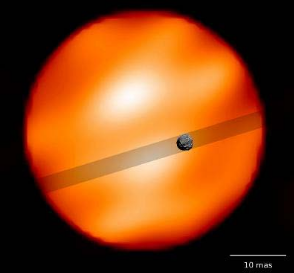
transit of Betelgeuse

On January 2, 2012, an asteroid is going to transit across the face of Betelgeuse. And if you live in Europe, own a very sensitive telescope, look close and don’t blink, you might be able to see it!

This is all according to a preprint paper published today on the Los Alamos astro-ph preprint website, written by scientist Costantino Sigismondi of the Galileo Ferraris Institute and International Center for Relativistic Astrophysics in Rome. You can download the paper here [pdf].

The transit itself will only last 3.6 seconds, and will only be visible along a narrow swath crossing southern India and moving across the Middle East, through parts of Italy, France, and the southwestern most tips of England and Ireland. A map of this path is below the fold.
» Read more

Colorful Vesta

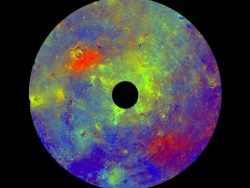
False color of Vesta

Tonight’s press conference at the American Geophysical Union conference focused on the latest results from Dawn, orbiting the giant asteroid Vesta. Or to put it as scientist Vishnu Reddy put it, “Vesta is the most colorful asteroid in the solar system.”

At least, in geological terms. To our human eye the asteroid wouldn’t be so spectacular. However, the false color images released by the scientists show the global geological diversity of Vesta. From the press release:
» Read more

Astronomers prepare for an asteroid fly-by on November 8, using the Earth as the spacecraft

Astronomers prepare for an asteroid fly-by on November 8, using the Earth as the spacecraft.

Large enough to cause regional devastation if it were to hit the Earth, 2005 YU55 is the closest pass by an asteroid this big since 1976, and there won’t be another until 2028. The near miss provides an unparallelled opportunity for radar, optical and infrared observations of a mysterious charcoal-black world similar to the type of asteroid that astronauts may one day set foot on.
Radar bonanza “It’s a bit like a spacecraft fly-by with the Earth being the spacecraft,” says astronomer Don Yeomans at NASA’s Jet Propulsion Laboratory (JPL) in Pasadena, California. “It’s going to be an extraordinary target for radar.”

Rough Terrain

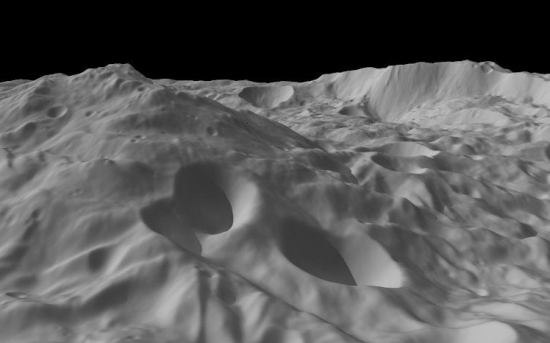
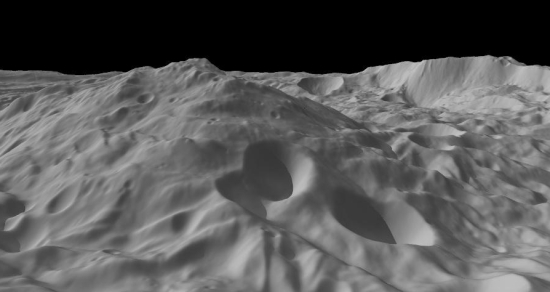
The Dawn scientists have released another spectacular image of the south polar mountain on Vesta whose relative size is three times that of Mount Everest. More information about the image can be found here. From the caption:

The peak of Vesta’s south pole mountain, seen in the center of the image, rises about 13 miles (22 kilometers) above the average height of the surrounding terrain. Another impressive structure is a large scarp, a cliff with a steep slope, on the right side of this image. The scarp bounds part of the south polar depression, and the Dawn team’s scientists believe features around its base are probably the result of landslides.

Mountain on Vesta

It appears the light gravity on Vesta allows for the formation of extreme topology.

NASA has identified ninety percent of the largest near-Earth asteroids

Data from the infrared telescope WISE has now identified ninety percent of the largest near-Earth asteroids.

NASA researchers also downgraded their estimate of the number of medium-sized asteroids, saying there are 44 percent fewer than previously believed. The downside is that scientists have yet to find many of these mid-sized asteroids, which could destroy a metropolitan city.

Video from Dawn

NASA has released an update summarizing what scientists have found since Dawn went into orbit around Vesta in July. The video below, compiled from images Dawn has taken, gives a nice visual overview. The most interesting big feature, understated by the video, is the series of grooves that appear to encircle the asteroid’s equator. To my eye it almost looks like Vesta was once two asteroids that got merged into one, with these grooves indicating the weld point.

The direct link to the video can be found here.

Embedded video from

NASA Jet Propulsion Laboratory California Institute of Technology

Astronomers take one last close look at 1999 RQ36 before sending mission there

Astronomers plan one last close look at 1,900-foot-wide asteroid before sending a space probe there to collect samples.

Discovered in 1999, the OSIRIS-REx target asteroid, designated 1999 RQ36, nears Earth once every six years. During the 2011 closest approach in early September, it will be 10.9 million miles (17.5 million kilometers) away. In 1999, closest approach was 1.4 million miles (2.3 million kilometers).

Strangely, the article above never mentions the fact that 1999 RQ36 has 1 in a 1000 chance of hitting the Earth in 2182, which to my mind is the primary reason for studying it.

Capturing an asteroid into Earth orbit

orbital path after asteroid capture

Want to mine an asteroid? Rather than travel to it with all their mining equipment, three Chinese scientists have proposed a better way. In a paper published today on the Los Alamos astro-ph preprint website, they have calculated the energy required to shift the orbits of the six thousand near-Earth asteroids and place them in Earth orbit for later mining. Of these, they found 46 asteroids that had the potential for such an operation, and two likely candidates for a space mission. One 30-foot-wide asteroid, 2008EA9, will actually be in the right place for this technique in 2049. As they write,

It can be seen that the velocity increment of the 2008EA9 is relatively small (-1.00km/s) and it will very close approach [approximately 645,000 miles] to the Earth in [February] 2049. Moreover the size of the NEO 2008EA9 is very small so that the capturing of it is relatively easy.

The real problem, of course, is adding that small “velocity increment” to the asteroid.
» Read more

1 25 26 27 28 29 31