TESS completes 1st survey of southern sky

The TESS science team today released its first full panorama of the southern sky, revealing everything the space telescope has imaged since launch in one image.

The glow of the Milky Way — our galaxy seen edgewise — arcs across a sea of stars in a new mosaic of the southern sky produced from a year of observations by NASA’s Transiting Exoplanet Survey Satellite (TESS). Constructed from 208 TESS images taken during the mission’s first year of science operations, completed on July 18, the southern panorama reveals both the beauty of the cosmic landscape and the reach of TESS’s cameras. “Analysis of TESS data focuses on individual stars and planets one at a time, but I wanted to step back and highlight everything at once, really emphasizing the spectacular view TESS gives us of the entire sky,” said Ethan Kruse, a NASA Postdoctoral Program Fellow who assembled the mosaic at NASA’s Goddard Space Flight Center in Greenbelt, Maryland.

Within this scene, TESS has discovered 29 exoplanets, or worlds beyond our solar system, and more than 1,000 candidate planets astronomers are now investigating.

A reduced version of this image wouldn’t show anyone its beauty or significance. I have embedded below the fold the short video at the link which shows it quite nicely. The video also summarized the mission quite well.
» Read more

1 comment

Webb telescope faces more schedule risks, engineering issues

Even as NASA touts the final assembly of the James Webb Space Telescope, its program director noted in a presentation that the telescope is still facing several engineering issues that could cause further launch delays.

They presently are targeting a March 2021 launch on an Ariane 5 rocket (ten years behind schedule). Their schedule cushion (the extra time built into their schedule in case they have problems) however has shrunk from nine months to only two. Worse, there remain several lingering unsolved engineering problems.

One such problem is with an electronics unit called a command telemetry processor that malfunctioned during environmental testing. Robinson said engineers had problems duplicating the problem to determine the root cause and plan to replace the unit, along with a traveling wave tube amplifier used in the spacecraft’s communications system that also failed during testing.

NASA has also been working with launch provider Arianespace about concerns that residual pressure within the payload fairing at the time of fairing separation could “over-stress” the sunshield membranes. Tests on recent Ariane 5 launches confirmed that there was a higher residual pressure than the sunshield was designed for. Vents in the fairing are being redesigned to address this, Robinson said, and will be tested on Ariane 5 launches in early 2020.

However, those smaller problems, along with bigger issues like fastener problems with the sunshield found during environmental testing last year, have eroded the margin built into the revised schedule for the mission.

Unmentioned in the article is the fact that Arianespace is planning to retire the Ariane 5 when its Ariane 6 starts launching next year. Right now they have agreed to maintain their Ariane 5 launch facilities through March 2021 to allow Webb’s launch, but further delays could cause significant problems, including fixing the fairing issue mentioned above. At a certain point Arianespace will no longer be willing to hold onto Ariane 5 for just this one launch.

Also unmentioned in the article is the status of Webb’s budget, which has grown from a proposed $500 million cost to almost $10 billion. I suspect that if they can meet their March 2021 launch date that total will not grow much. Any further delays however will once again cause it to balloon.

(I originally listed the proposed cost of Webb above as $1 billion, but that number is wrong. See the comments below).

6 comments

Smallest spherical planet so far found

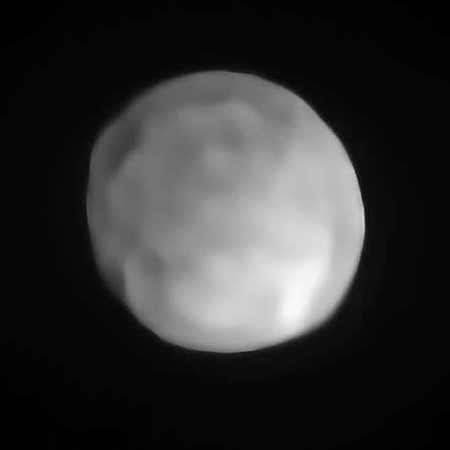
Hygiea

A new image of the asteroid Hygiea has revealed that this main belt object is actually spherical, making it the smallest spherical asteroid so far discovered and suggesting that it could be defined as a planet.

The image, taken by the Very Large Telescope (VLT) in Chile, is to the right. The asteroid was first discovered in 1849 and is the fourth largest in the asteroid belt, after Ceres, Pallas, and Vesta, with a diameter of 267 miles.

The image once again challenges the definition of what makes a planet. It also makes difficult the vague term “dwarf planet.” At what point does a dwarf become a full planet? This has never been clarified, which is why I tend to avoid using the term dwarf planet.

In my many interviews of planetary scientists, they generally dismiss the IAU’s poor definition of a planet and define a planet as anything that has settled into a spherical shape. In the case of Hygiea, that seems to apply.

5 comments

New estimate for Hubble constant differs from previous and also conflicting results

The uncertainty of science: Using microlensing effects scientists have measured a new estimate for the Hubble constant, the rate in which the universe is expanding, and have come up with a number that is different from previous results.

Using adaptive optics technology on the W.M. Keck telescopes in Hawaii, they arrived at an estimate of 76.8 kilometers per second per megaparsec. As a parsec is a bit over 30 trillion kilometers and a megaparsec is a million parsecs, that is an excruciatingly precise measurement. In 2017, the H0LICOW team published an estimate of 71.9, using the same method and data from the Hubble Space Telescope.

The new SHARP/H0LICOW estimates are comparable to that by a team led by Adam Reiss of Johns Hopkins University, 74.03, using measurements of a set of variable stars called the Cepheids. But it’s quite a lot different from estimates of the Hubble constant from an entirely different technique based on the cosmic microwave background. That method, based on the afterglow of the Big Bang, gives a Hubble constant of 67.4, assuming the standard cosmological model of the universe is correct.

An estimate by Wendy Freedman and colleagues at the University of Chicago comes close to bridging the gap, with a Hubble constant of 69.8 based on the luminosity of distant red giant stars and supernovae.

So five different teams have come up with five different numbers, ranging from 67.4 to 76.8 kilometers per second per megaparsec. Based on the present understanding of cosmology, however, the range should have been far less. By now the physicists had expected these different results to be close to the same. The differences suggest that either their theories are wrong, or their methods of measurement are incorrect.

The most likely explanation is that we presently have too little knowledge about the early universe to form any solid theories. These measurements are based on a very tiny amount of data that also require a lot of assumptions.

5 comments

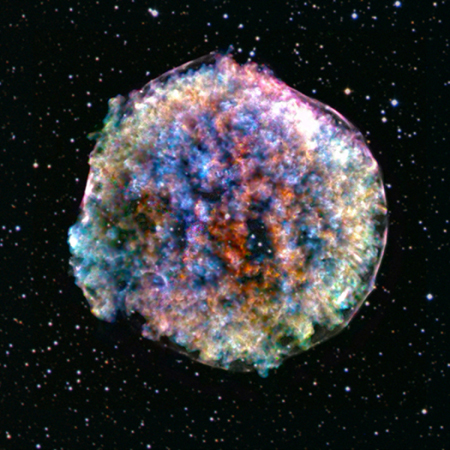
The 1572 Tycho supernova, as seen by Chandra

Remnant of Tycho's supernova

Cool image time! The Chandra science team has released a beautiful X-ray image of the remnant from the 1572 supernova first discovered by astronomer Tycho Brahe.

As with many supernova remnants, the Tycho supernova remnant, as it’s known today (or “Tycho,” for short), glows brightly in X-ray light because shock waves — similar to sonic booms from supersonic aircraft — generated by the stellar explosion heat the stellar debris up to millions of degrees. In its two decades of operation, NASA’s Chandra X-ray Observatory has captured unparalleled X-ray images of many supernova remnants.

Chandra reveals an intriguing pattern of bright clumps and fainter areas in Tycho. What caused this thicket of knots in the aftermath of this explosion? Did the explosion itself cause this clumpiness?

The image to the right, reduced to post here, is a composite of both X-ray (the remnant) and optical light (the background stars).

4 comments

Hubble snaps photo of Comet Borisov

Comet Borisov by Hubble
Click for full image.

Cool image time! Using the Hubble Space Telescope astronomers have snapped the best image so far of interstellar Comet Borisov. The image to the right, reduced and cropped to post here, is that photograph.

Comet 2I/Borisov is only the second such interstellar object known to have passed through our Solar System. In 2017, the first identified interstellar visitor, an object dubbed ‘Oumuamua, swung within 38 million kilometres of the Sun before racing out of the Solar System. “Whereas ‘Oumuamua looked like a bare rock, Borisov is really active, more like a normal comet. It’s a puzzle why these two are so different,” explained David Jewitt of UCLA, leader of the Hubble team who observed the comet.

The comet was 260 million miles away when Hubble took this picture.

1 comment

Astronomers identify likely origin star for interstellar Comet Borisov

Astronomers have backtracked the path of interstellar Comet Borisov to identify its likely origin.

When you rewind Comet Borisov’s path through space, you’ll find that 1 million years ago, the object passed just 5.7 light-years from the center of Kruger 60, moving just 2.13 miles per second (3.43 kilometers per second), the researchers wrote.

That’s fast in human terms —— about the top speed of an X-43A Scramjet, one of the fastest aircraft ever built. But an X-43A Scramjet can’t overcome the sun’s gravity to escape our solar system. And the researchers found that if the comet were really moving that slowly at a distance of no more than 6 light-years from Kruger 60, it probably wasn’t just passing by. That’s probably the star system it came from, they said. At some point in the distant past, Comet Borisov likely orbited those stars the way comets in our system orbit ours.

The remains some uncertainty about these calculations because astronomers are still gathering data on the comet’s path.

0 comments

World’s largest camera lens arrives safely for assembly into LSST

Link here. The lens will be part of the camera used in the Large Synoptic Survey Telescope (LSST), planned for first light in Chile in 2021, and the video at the link showed the moment they removed the shipping container to inspect the lens to make sure it wasn’t damaged during transport.

The lens will next be installed inside the 3.2 gigapixel camera that will be used by LSST, which will do the following:

The LSST will live on a mountain in Chile, where it will use a 3.2-gigapixel camera and some massive optics to capture a 15-second exposure of the night sky every 20 seconds. At this rate, the LSST will be able to image the entire visible southern sky every few nights.

.

I have embedded the video below the fold. This five foot diameter lens is quite astonishing, though the technology that produced it is merely a variation of the same engineering that now routinely produces telescope mirrors 26 feet across.

Hat tip Mike Nelson.
» Read more

4 comments

Astronomers find 20 more moons orbiting Saturn

Astronomers have discovered an additional twenty moons orbiting Saturn, bringing the total known to 82, three more than the 79 moons known to circle Jupiter.

Each of the newly discovered moons is about five kilometers, or three miles, in diameter. Seventeen of them orbit the planet backwards, or in a retrograde direction, meaning their movement is opposite of the planet’s rotation around its axis. The other three moons orbit in the prograde—the same direction as Saturn rotates.

Two of the prograde moons are closer to the planet and take about two years to travel once around Saturn. The more-distant retrograde moons and one of the prograde moons each take more than three years to complete an orbit.

The astronomers have also created a contest allowing the public to help name these new moons.

I will make one prediction: They are going to find many more.

In fact, Saturn’s rings and its numerous moons raise the question of what defines a moon. At present, a moon is defined as any object orbiting a planet, regardless of size. With Saturn’s rings however we have millions of objects orbiting that planet, many very tiny. It seems we have never put a size limit on the definition of a moon, and really need to.

5 comments

Astronomers photograph baby binary system

Baby binary stars dance in joint accretion disk
Click for full image.

Using the Atacama Large Millimetre/submillimetre Array (ALMA), astronomers have obtained the first high resolution image of a baby binary system, its two young stars dancing within a joint accretion disk.

Most stars in the universe come in the form of pairs – binaries – or even multiple star systems. Now, the formation of such a binary star system has been observed for the first time with high-resolution ALMA (Atacama Large Millimetre/submillimetre Array) images. An international team of astronomers led by the Max Planck Institute for Extraterrestrial Physics targeted the system [BHB2007] 11, the youngest member of a small cluster of young stellar objects in the Barnard 59 core in the Pipe nebula molecular cloud. While previous observations showed an accretion envelope surrounding a circum-binary disk, the new observations now also reveal its inner structure.

“We see two compact sources, that we interpret as circum-stellar disks around the two young stars,” explains Felipe Alves from MPE, who led the study. “The size of each of these disks is similar to the asteroid belt in our Solar System and their separation is 28 times the distance between the Sun and the Earth.” Both proto-stars are surrounded by a circum-binary disk with a total mass of about 80 Jupiter masses, which contains a complex network of dust structures distributed in spiral shapes. The shape of the filaments suggests streamers of in-falling material, which is confirmed by the observation of molecular emission lines.

Why most stars form as binary systems is as yet not understood. This data is a major first step towards figuring this out.

0 comments

Astronomers roughly map out Andromeda’s history

The uncertainty of science: Astronomers have now roughly mapped out the history of the Andromeda galaxy, identifying two major events whereby it had absorbed nearby dwarf galaxies.

“It’s been known for 10 to 15 years that Andromeda has a vigorous history of accumulating and destroying its neighbours,” Mackey says. In fact, he says, “It seems to have a much more intense history of that than the Milky Way.”

…[New data] “tells us there were two main events that formed the halo of Andromeda,” Mackey says. “One occurred very long ago. The other must have happened relatively recently.”

Not that Andromeda couldn’t also have eaten innumerable smaller galaxies. ”We can’t trace them with galactic clusters, because they didn’t have any to begin with,” Mackey says.

Most of the news reports about this new research have been very overwrought (Andromeda is “violent” and is going to “eat us!”) and very unaware that the assimilation of nearby small galaxies by Andromeda is not really news. Astronomers have known for years that big galaxies like Andromeda and the Milky Way absorb the dwarf galaxies around them. All this story does is postulate a more detailed though very rough timeline.

1 comment

China to open FAST radio telescope to world

China has decided to allow astronomers worldwide to apply for time on its new FAST radio telescope, the largest such telescope in the world.

Since testing began in 2016, only Chinese scientists have been able to lead projects studying the telescope’s preliminary data. But now, observation time will be accessible to researchers from around the world, says Zhiqiang Shen, director of the Shanghai Astronomical Observatory and co-chair of the Chinese Academy of Sciences’ FAST supervisory committee.

Obviously U.S. astronomers are going to want to use this telescope. I wonder if there will be security issues. I suspect that if they only request time and then make observations, there will be no problems. However, if they need to do anything that will require the use of U.S. technology, in China, then they may find themselves violating the U.S. law that forbids any technology transfer to China.

1 comment

First data suggests Comet Borisov resembles solar comets

The first spectrum obtained from Comet Borisov suggests that it is quite similar to comets in our solar system.

The gas detected was cyanogen, made of a carbon atom and a nitrogen atom bonded together. It is a toxic gas if inhaled, but it is relatively common in comets.

The team concluded that the most remarkable thing about the comet is that it appears ordinary in terms of the gas and dust it is emitting. It looks like it was born 4.6 billion years ago with the other comets in our Solar system, yet has come from an – as yet – unidentified star system.

It is still very early, so drawing any firm conclusions at this point is risky.

10 comments

Planet X a small black hole?

In one of the wilder theories attempting to explain the orbits of the outer objects found beyond Neptune, two physicists have proposed that the reason Planet X has not been located is because it might be a small black hole.

Previous studies have suggested Planet Nine, which some astronomers refer to as “Planet X,” has a mass between five and 15 times that of Earth and lies between 45 billion and 150 billion kilometers from the sun. At such a distance, an object would receive very little light from the sun, making it hard to see with telescopes.

To detect objects of that mass, whether planets or black holes, astronomers can look for weird blobs of light formed when light “bends” around the object’s gravitational field on its journey through the galaxy (simulated image above). Those anomalies would come and go as objects move in front of a distant star and continue in their orbit.

But if the object is a planet-mass black hole, the physicists say, it would likely be surrounded by a halo of dark matter that could stretch up to 1 billion kilometers on every side. And interactions between dark matter particles in that halo—especially collisions between dark matter and dark antimatter—could release a flash of gamma rays that would betray the object’s presence, the researchers propose in a forthcoming paper posted on the preprint server arXiv.

Anything is possible, but some things are certainly less likely than others. If these scientists turn out to be right, however, they will have achieved one of the biggest coups in the history of science.

And yes, the undiscovered planet out there should be referred to as “Planet X”, not “Planet Nine.” Not only is Pluto a planet, so are a lot of other objects in the solar system that up to recently were not considered so.

2 comments

A big planet circling a small star

The uncertainty of science: In contradiction of every existing stellar and planetary formation model, astronomers have found a half-sized Jupiter exoplanet orbiting a tiny red dwarf star.

The red dwarf GJ 3512 is located 30 light-years from us. Although the star is only about a tenth of the mass of the Sun, it possesses a giant planet – an unexpected observation. “Around such stars there should only be planets the size of the Earth or somewhat more massive Super-Earths,” says Christoph Mordasini, professor at the University of Bern and member of the National Centre of Competence in Research (NCCR) PlanetS: “GJ 3512b, however, is a giant planet with a mass about half as big as the one of Jupiter, and thus at least one order of magnitude more massive than the planets predicted by theoretical models for such small stars.”

It appears the universe does not care what this and other scientists think “should” happen. The universe will do what the universe wants to do.

This discovery only underlines how little we understand of the formation of stars and their solar system. Be prepared for many more like surprises in the coming decades and centuries.

0 comments

Astronomer: Look for monolith on co-orbiting asteriods

According to one astronomer in a paper published this week, the most likely place to find alien artifacts would be on the co-orbital asteroids, objects whose orbit is very similar to the Earth and thus always nearby but mostly unseen.

In this context, a co-orbital is an asteroid that goes around the Sun on the same, or similar, orbital path to Earth. Co-orbital objects approach Earth very closely every year at distance is much shorter than anything except the moon.

Consequently, co-orbitals could be a great place to watch Earth from. Not only would any alien probes on co-orbital objects be concealed, but they would also be anchored and able to access solar energy. They could possibly sustain themselves for many thousands of years.

According to this paper, if aliens have visited the solar system in the past they would place their long-term alien probes on such an asteroid, or even give it a comparable co-orbit. And if we look and don’t find anything, that would strongly imply that we are alone in the universe.

Fun stuff, but need I say that not finding alien artifacts at these locations proves nothing.

Hat tip Jeff Bliss.

2 comments

Scientists propose mission to interstellar comet Borisov

In a paper published on the Cornell arXIiv site for preprint science papers, scientists have posted a paper proposing sending an unmanned probe to the newly discovered interstellar Comet Borisov, arriving in 2045.

You can download the paper here. [pdf]

Their analysis found that we just missed the ideal and most efficient launch date using the Falcon Heavy. If it had launched in July 2018 a two-ton spacecraft could have reached Comet Borisov by next month.

The best alternative option is a launch in January 2030, flying past Jupiter, then the Sun, and arriving in 2045. Because of the mission’s close approach to the Sun to gain speed, the mission would require the type of shielding developed for the Parker Solar Probe. If the Space Launch System was used for launch, a six-ton spacecraft could be sent. With other available rockets the largest possible payload would be 3 kilograms (about 6 pounds), making the probe a cubesat. As they note,

Despite this very low mass, a CubeSat-scale spacecraft could be sent to the interstellar object. Existing interplanetary CubeSats (Mars Cube One) show that there is no principle obstacle against using such a small spacecraft to deep space.

In fact, having a decade and a half before launch guarantees that a cubesat will be able to do this job, because by 2030 the technology for using smallsats for this kind of planetary mission should be fully developed.

6 comments

The never-ending snowstorm circling Saturn

New data suggests that the water being spewed out of Enceladus’s tiger stripes is depositing so much snow and ice on Saturn’s three inner moons, Mimas, Enceladus and Tethys, that these moons, as well as Enceladus, are about twice as bright in radar than previously thought.

Dr Le Gall and a team of researchers from France and the US have analysed 60 radar observations of Saturn’s inner moons, drawing from the full database of observations taken by the Cassini mission between 2004 and 2017. They found that previous reporting on these observations had underestimated the radar brightness by a factor of two.

Unprotected by any atmospheres, Saturn’s inner moons are bombarded by grains of various origins which alter their surface composition and texture. Cassini radar observations can help assess these effects by giving insights into the purity of the satellites’ water ice.

The extreme radar brightness is most likely related to the geysers that pump water from Enceladus’s internal ocean into the region in which the three moons orbit. Ultra-clean water ice particles fall back onto Enceladus itself and precipitate as snow on the other moons’ surfaces.

Dr Le Gall, of LATMOS-UVSQ, Paris, explained: “The super-bright radar signals that we observe require a snow cover that is at least a few tens of centimetres thick. However, the composition alone cannot explain the extremely bright levels recorded. Radar waves can penetrate transparent ice down to few meters and therefore have more opportunities to bounce off buried structures. The sub-surfaces of Saturn’s inner moons must contain highly efficient retro-reflectors that preferentially backscatter radar waves towards their source.”

While the new results suggest that the surfaces of these moons are much brighter that expected, I find the circumstances they describe far more fascinating: a never-ending snow storm in the orbits around Saturn and landing continually on these moons.

My, isn’t the universe wonderful?

1 comment
1 43 44 45 46 47 113